Massachusetts Visitors Buy a One-Year Sticker
If you’re bringing an ATV or UTV into Massachusetts, a registration sticker from your home state may not be enough. Visitors generally need a Massachusetts non-resident OHV registration, which is issued for a one-year term. This guide explains what that sticker does, what it doesn’t do, how to prepare an application, and what to check before you tow.
What the One-Year Massachusetts Sticker Means
Massachusetts does not treat an out-of-state OHV sticker as a substitute for its own registration. A visitor who wants to ride where Massachusetts registration is required should plan to get a Massachusetts sticker, even if the machine is properly registered at home. The state’s approach is covered in Massachusetts Has No Reciprocity for Visitors and Out-of-State OHV Stickers Are Not Valid in Massachusetts.
The one-year term is the key difference many visitors notice. Massachusetts resident registrations and non-resident registrations have different terms, so don’t assume a sticker issued to a visitor will follow the same renewal cycle as a local rider’s. Check the registration record and the current instructions from the Massachusetts Environmental Police for the effective and expiration dates.
A Massachusetts sticker is an OHV registration credential. It does not turn a quad or side-by-side into a street-legal vehicle, and it does not give you permission to ride on any land you choose. Registration is one requirement among several: you still need a place where your machine and type of riding are allowed, and you need to follow applicable safety and equipment rules.
| What the sticker does | What it does not do |
|---|---|
| Registers an eligible OHV with Massachusetts for the term shown on the registration | Replace your home-state registration or make it valid in Massachusetts |
| Helps satisfy the state registration requirement for riding where registration is required | Serve as a general trail pass or guarantee access to a forest, trail, park, or private property |
| Connects the machine to its registration information and required decals | Make the machine legal for public roads |
| Provides a registration card that should be carried with the machine | Replace any required safety certificate, landowner permission, or site-specific permit |
Before traveling, sort out three separate questions:
- Is the machine registered for Massachusetts? A home-state sticker alone may not meet the Massachusetts requirement.
- Is the riding location open to this type of machine? Access depends on the land manager, local rules, trail conditions, and sometimes the vehicle’s size or type.
- Does the rider meet the applicable rules? Age, supervision, helmet, equipment, and safety-certificate requirements can matter, especially for younger riders.
It’s easy to confuse registration with access because people often call both things “permits.” The one-year sticker is registration, not a promise that every trail is open to you. For the registration process itself, Where a Visiting Rider Applies for a Massachusetts Sticker is a useful companion guide.
How to Prepare a Visitor Registration Application
The most useful preparation is to gather the machine’s identifying information and ownership documents before you start. Missing or inconsistent paperwork can slow an application, particularly when a visitor is trying to register a machine bought recently, purchased privately, or brought from another state.
Collect the machine details
Have the vehicle identification number (VIN) or other identifying serial information available. Record it directly from the machine, then compare it with the paperwork. A single character copied incorrectly can create a mismatch that needs to be corrected. If you have trouble locating the number, use Where to Find the VIN on an ATV or Side-by-Side before starting the application.
Also have the machine’s make, model, and other requested details ready. If you’re registering more than one machine, treat each one as its own application and verify that every VIN and document belongs to the correct vehicle.
Gather proof of ownership
The paperwork you need depends in part on how you acquired the machine. A manufacturer’s certificate of origin may be relevant for a new machine. A bill of sale and earlier ownership documents may be needed for a used one. A title or registration from another jurisdiction may help establish the machine’s history, but don’t assume it replaces every Massachusetts document.
For a private purchase, make sure the bill of sale identifies the machine clearly and shows the buyer and seller information. If you’re planning a purchase, What a Bill of Sale Must Show to Register and Massachusetts Registration Without a Bill of Sale explain common paperwork issues. For a new machine, see Why a New Quad Needs a Certificate of Origin.
If the information on the bill of sale, machine, and prior documents does not match, pause and ask the registration office what it will accept. Avoid trying to resolve a discrepancy by guessing at a number or altering a document. That can create a larger problem than a delayed application.
Check tax paperwork for your situation
Sales-tax documentation may be part of the registration process, depending on where and how you bought the machine and whether tax was paid or an exemption applies. A visitor who purchased the vehicle in another state should not assume that the seller’s receipt settles every Massachusetts requirement.
Check the current instructions for the form or proof applicable to your purchase. The guides Massachusetts Requires Form ST-6 Proof and Massachusetts Sales Tax Forms at Registration explain why tax paperwork can be relevant. If the machine was a qualifying gift, Massachusetts Exemption Form ST-6E may help you understand what to ask about. Eligibility depends on the facts and the current rules, so don’t claim an exemption simply because no money changed hands in the way you expected.
Use the current application route and confirm fees
Massachusetts provides an online registration route, but the application process and payment options can change. Start from the official Massachusetts Environmental Police registration information rather than a search result or an old saved link. Massachusetts Online Registration System covers the online process, while Registering an ATV With the Environmental Police explains the agency’s role.
For named companies or products, current prices and service terms should always be checked with the provider. The same practical rule applies here: confirm the current registration charge and accepted payment methods through the official source before submitting. Don’t budget from an old forum post or assume that a resident fee applies to a visitor. Why Residency Changes the Term explains why residency affects the registration category.
Keep copies or clear photos of the application confirmation and supporting documents. If you use Amazon or another retailer to buy a small waterproof document pouch for the tow vehicle, keep it separate from the machine’s carried registration card; a pouch is useful for organizing copies, but it does not replace the required card.
Applying, Receiving, and Displaying the Sticker
Once you have the paperwork, enter the details carefully and review the application before sending it. Pay particular attention to the owner’s name, mailing address, VIN, and purchase information. If the visitor’s mailing address differs from the machine’s usual storage address, provide the information the form requests rather than substituting one address for another without guidance.
After you submit, watch for the registration materials and any follow-up request. Processing time can vary, and an application confirmation is not necessarily the same thing as having the required registration card and decals in hand. If you’re traveling on a fixed schedule, leave room for processing and shipping rather than planning to arrive at a trailhead and sort it out there. See Massachusetts Registration Processing Time for more on timing.
When the materials arrive, check them before the trip:
- Match the owner and machine information to your records.
- Confirm the registration term and expiration date shown.
- Make sure the card and decals are present and readable.
- Review the placement instructions for the machine type.
- Ask the registration office about any error before applying a decal or heading out.
Massachusetts requires the registration card to be carried with the machine. Keep it available while riding, not locked in a truck or trailer parked somewhere else. The Registration Card You Must Carry in Massachusetts and Why Your Registration Card Must Ride With the Machine cover this practical requirement.
Decal placement matters, too. Don’t choose a convenient panel without checking the current instructions: placement rules can differ in how they apply to a quad and a side-by-side. Use Massachusetts Decal Placement Rules for the general requirements and Massachusetts Decal Placement on a Side-by-Side if you’re registering a UTV. A clear photo of the applied decals can be handy for your records, but it doesn’t replace the physical decals.
If you store your documents in a small pouch purchased through Amazon, make sure the registration card remains easy to reach and protected from water and mud. Don’t put the only card in a sealed container that requires tools to open, or leave it in a vehicle that won’t be accompanying the machine.
If a decal is lost or damaged before the trip, ask about the replacement process rather than trying to reproduce it yourself. Massachusetts Decal Replacement If Lost explains what to do when a sticker goes missing. If the card is lost, follow the separate instructions for getting a replacement; a decal and a registration card are different items.
A Sticker Is Not a Trail Pass
A Massachusetts registration does not open every trail, forest, or private riding area. It confirms registration status; access is controlled separately. A land manager may restrict OHVs entirely, allow only certain machine types, close a route for weather or maintenance, or require a separate permit. Private riding parks may set their own admission, waiver, equipment, and rider-age rules.
Before you travel, identify the exact place where you intend to ride and check its current rules. Don’t rely only on an old map, a social-media post, or a route shared by another rider. A route may cross several land parcels, and permission on one section does not automatically mean permission on the next.
State forest access is especially important to verify. Massachusetts has a limited set of locations where OHV riding may be allowed, and designated routes can have seasonal closures or restrictions. Massachusetts Trail Planning and Closures and Massachusetts ATV Trails: Three Berkshire Forests can help you understand the difference between a registered machine and an open riding area. Confirm current conditions with the relevant forest office before towing a long distance.
Private land requires the owner’s permission. A machine registration does not grant a right to cross someone else’s land, use an unmarked woods road, or pass through a closed gate. Ask permission in advance and make sure it covers the specific route and date. For broader riding rules, see Massachusetts Landowner Permission in Writing.
Parking is another separate consideration. A sticker does not necessarily cover a day-use charge, camping reservation, or parking requirement. Check whether the forest or park charges for parking, whether a reservation is required, and whether visitor rates or rules differ. Why the Sticker Does Not Cover Your Parking explains the distinction.
If you’re using a private park, contact the operator directly before setting out. Ask whether it accepts the machine type and Massachusetts registration, what documents riders need to carry, and whether it has any age, helmet, sound, or equipment rules. A Massachusetts registration should not be treated as an admission ticket or as proof that you meet every site-specific requirement.
Other Rules Visitors Should Check Before Riding
Visitors need to follow Massachusetts riding rules while in the state, even if their home state handles youth riders, equipment, or road crossings differently. The machine’s registration status does not override rider requirements.
Rider age and supervision
If a young person will ride, check Massachusetts age and supervision requirements before planning the trip. Rules can depend on the rider’s age, machine size, location, and whether the activity is a sanctioned event. A parent’s permission or a home-state certificate may not answer every question.
Start with Massachusetts ATV Age Requirements and Massachusetts Safety Certificates Under 18. If you’re bringing a child, look up the specific age category rather than relying on a general summary. The rules for a 12-year-old, a 14-year-old, and a 17-year-old may not be the same. Ask the relevant official contact whether a certificate earned elsewhere is accepted for the intended activity; don’t assume equivalence.
Road crossings and public ways
Registration does not allow an ATV or UTV to travel along public roads as if it were a registered road vehicle. Rules for crossings are different from rules for riding on the road, and crossings may have specific stop, visibility, and supervision requirements. Check Massachusetts Rules for Crossing a Road and Massachusetts Bans Riding on Public Ways before choosing a route.
A GPS route can lead you onto a road or trail that is not open to OHVs. If you’re unsure whether a connector is authorized, don’t treat the fact that another rider used it as proof that it is legal. Confirm the route with the land manager or use a verified map.
Equipment and safe transport
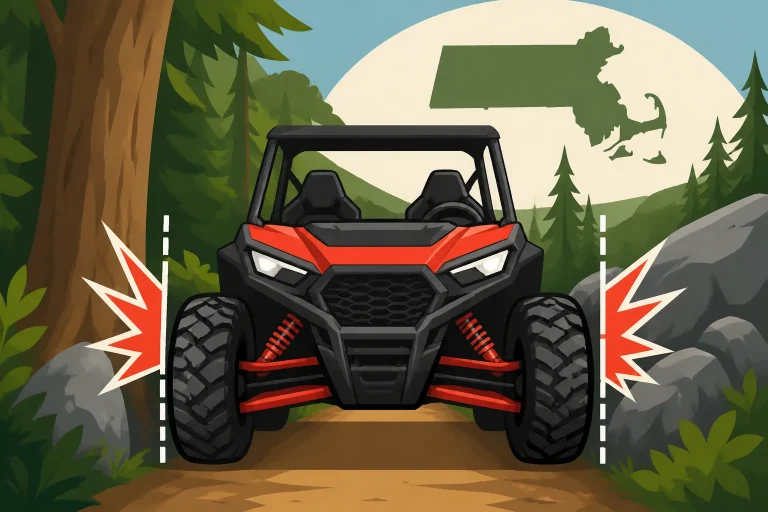
Check the machine before leaving home, not at the trail entrance. Confirm that required safety equipment works and that your machine is appropriate for the intended route. Size can matter: a side-by-side that is wider than the trail’s permitted limit may not be allowed even if it is properly registered. Read Massachusetts Equipment Requirements and Massachusetts Trails That Allow Side-by-Sides when choosing where to ride.
Carry a basic trip kit with water, a first-aid supply, a charged phone, and a paper backup for directions where service may be limited. If you use Amazon to source a compact first-aid kit or weatherproof map sleeve, check that the items suit the length and conditions of your trip; buying gear doesn’t replace knowing the route or having a plan if the group gets separated.
When hauling, secure the machine properly and check the trailer, tie-downs, lights, and load before driving. Keep registration paperwork protected during transport, then make sure the card accompanies the machine while riding.
A Visitor’s Pre-Trip Checklist
Use this short checklist a few days before departure, then repeat the parts that depend on current conditions shortly before you leave.
- Confirm the registration category. Make sure you applied as a non-resident and understand the one-year term shown on the registration.
- Check the application status. Confirm that the registration materials have arrived and that the owner, VIN, and machine details are correct.
- Put the card with the machine. Keep it available while riding, not just in the tow vehicle.
- Apply and inspect the decals. Follow current placement instructions for an ATV or UTV and check that the decals are visible and secure.
- Choose a confirmed riding location. Verify that the site is open to your machine type and that the route you plan to ride is authorized.
- Check separate access costs or permits. Ask about parking, camping, reservations, and any park-specific requirements.
- Review rider rules. Confirm age, supervision, safety-certificate, helmet, and equipment requirements for everyone in the group.
- Recheck conditions. Closures and access instructions can change; verify them with the land manager close to the trip.
- Keep contact information handy. If there’s a registration or access question, use the official agency or forest contact rather than relying on a third-party comment.
- Have a backup plan. If a trail is closed or the machine is not allowed, know another legal place to ride before you arrive.
For a visitor, the simplest approach is to treat the Massachusetts sticker as a necessary registration step, not the whole trip plan. Get the correct one-year registration, carry the card, display the decals as instructed, and independently confirm where you can ride. Those checks take less time at home than trying to resolve missing paperwork or a closed trailhead after the trailer is already there.
Disclaimer
This article is for general informational purposes only and does not constitute professional advice. Laws, prices and regulations vary by location and change over time. Consult a qualified professional for guidance on your specific situation.