Side-by-Sides Too Wide for a Berkshire Trail
A side-by-side can be registered for off-highway use and still be too wide for a particular Berkshire trail. That mismatch can waste a long drive or tempt riders to squeeze past barriers and damage the trail. The key is to check the machine’s full width against the specific route’s rules, then confirm that the route is open to that type of vehicle.
Why a side-by-side may not fit a Berkshire trail
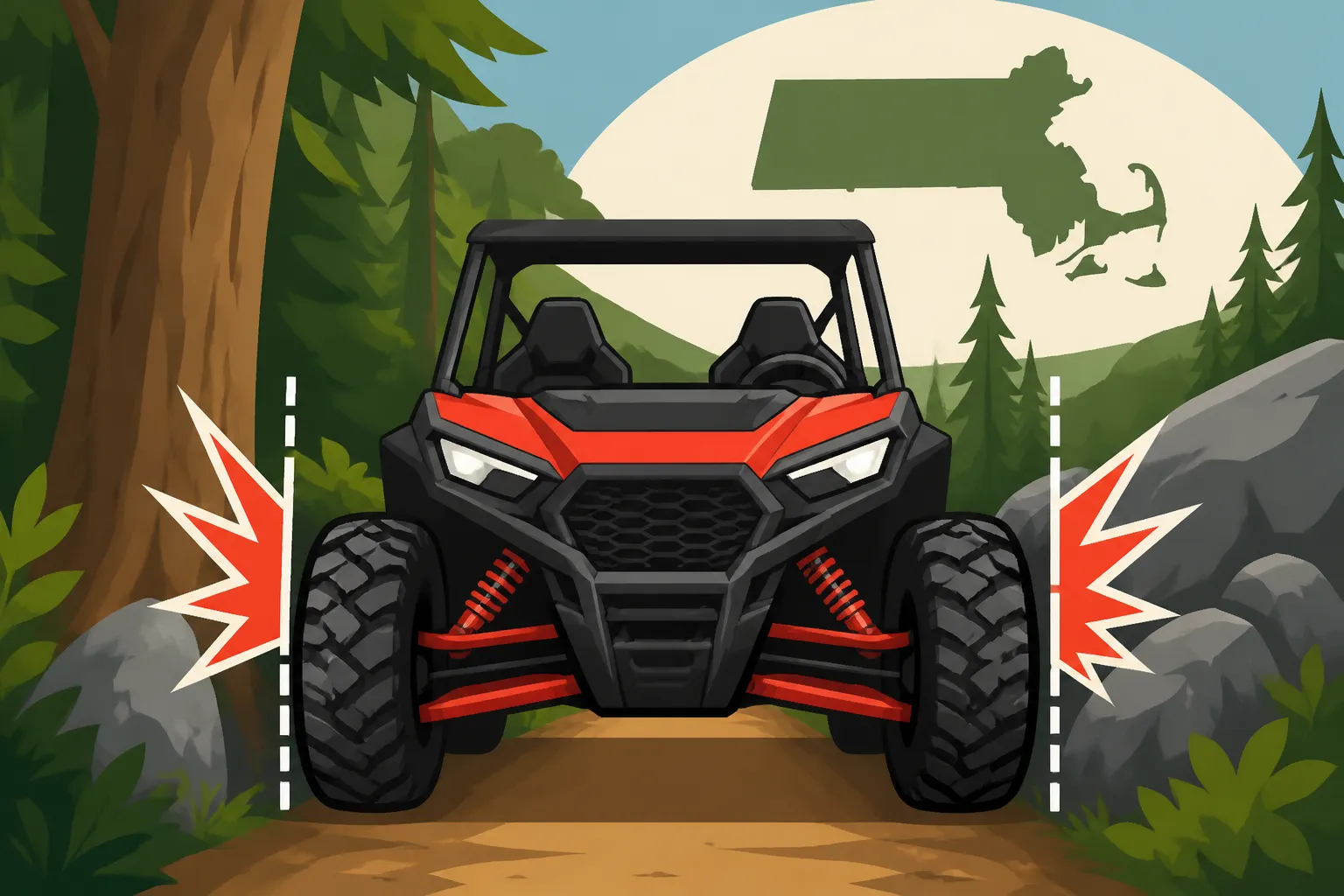
Side-by-sides are built wider than many quads, and narrow trails can have tight turns, trees, rocks, drainage features, and barriers that leave little room to maneuver. A machine that fits through a gate may still be too wide for the trail beyond it. The route’s suitability depends on more than whether the vehicle can physically enter at the trailhead.
Berkshire riding areas are not one continuous network with a single access rule. A forest may have designated OHV trails, other routes intended for different kinds of vehicles, and areas where motorized riding is not allowed. A trail marked for off-highway use is not automatically open to every kind of OHV. Check whether side-by-sides are permitted on the specific route, not just whether the forest allows some OHV riding.
Width can also be more complicated than the measurement in a vehicle brochure. A listed width may describe the machine as equipped from the factory. Wider tires, wheel spacers, aftermarket suspension parts, fender extensions, mirrors, or other add-ons can change the maximum width. Accessories may also affect clearance even if they do not make the machine wider.
Measure the widest point from one outer edge to the other, including the tires and installed accessories. A basic tape measure, available at hardware stores or Amazon, can help, but take care to measure the vehicle level and at its widest point. If an accessory is removable, decide whether you will ride with it installed and measure accordingly. Do not rely on a visual estimate or the width of the bed.
Then compare that measurement with the trail’s stated limit, if one is published. If you cannot find a clear width limit, do not treat the absence of a number as permission. Ask the forest office or the responsible land manager whether your specific machine is allowed. Include its make, model, measured width, and any relevant accessories when you ask.
A route can be too narrow even when the vehicle’s published dimensions seem close to the limit. Trail conditions change; a storm can bring down trees, wash out an edge, or make a tight section harder to pass. A trail that was passable on a previous visit may not be suitable now. Check current conditions as well as the general rules.
For a broader overview of where different vehicle types are allowed, see Massachusetts Trails That Allow Side-by-Sides. For conditions that may affect a planned trip, Massachusetts Trail Conditions Before You Tow can help you prepare before loading the trailer.
Check the machine and the route before you leave
Use a simple check before committing to a Berkshire ride. The goal is to confirm both that the side-by-side fits the machine limits and that the particular route is open to it.
- Find the machine’s listed width. Check the owner’s manual or the manufacturer’s specifications for your exact model and configuration. Different trims or wheel packages can have different dimensions.
- Measure the machine as you plan to ride it. Measure the widest point, including tires and accessories. Record the result so you can give the forest office a precise figure.
- Identify the exact forest and route. “Riding in the Berkshires” is not specific enough. Confirm the forest, trail system, and intended trailhead.
- Look for vehicle-type and width restrictions. Check the official information for that riding area, posted signs, and any restrictions for the specific trail. A general OHV listing may not settle whether a side-by-side is allowed.
- Check for temporary closures or damage. A route’s usual rules do not mean it is open on the day you arrive. Look for current notices and ask the responsible office if information is unclear.
- Get a direct answer if uncertainty remains. Ask whether the exact side-by-side, at its measured width, may use the route. Make a note of the answer and any conditions given.
- Choose another plan if you cannot confirm access. Do not count on finding a wider trail after arrival. Confirm an appropriate alternative before towing.
A map can help you identify a route, but it may not show every barrier, narrow section, or temporary closure. The map should be one part of the check, not the only source. Massachusetts Trail Planning and Closures covers why route status and access information can change. If you are making a long trip, use Checking Rules Before a Long Drive to the Berkshires as a reminder to verify the details before setting out.
It is also worth checking what the trail is designed for. Some routes are narrow by design and may be suitable for motorcycles or quads but not a wider side-by-side. Do not assume that a route described as an OHV trail accommodates every off-highway vehicle. If official information names allowed vehicle types, follow that information. If it does not, ask rather than interpreting silence as approval.
Registration, permits, and physical access are different
A common source of confusion is treating registration as permission to ride anywhere. Registration establishes that the machine has the required registration for use where applicable; it does not guarantee that a particular trail is open to it. A registered side-by-side can still be excluded because of width, vehicle type, closure, landowner restrictions, or other trail rules.
Likewise, a parking payment, day-use charge, permit, or access instruction does not necessarily authorize every vehicle on every route. These requirements address different things. Registration is not a substitute for trail permission, and a parking receipt is not proof that a machine meets a trail’s width or vehicle restrictions.
Massachusetts registration and trail access are separate questions. Check the current registration requirements for your circumstances, then confirm the riding area’s access rules independently. Massachusetts Registration and Trail Access explains that distinction. If you are bringing a machine from another state, do not assume that an out-of-state registration or sticker automatically provides access; check Massachusetts Rules for an Out-of-State Machine before riding.
Carry any required registration documents and follow the posted requirements, but do not use registration status as a reason to enter a route that may be too narrow. For side-by-side-specific rules, see Massachusetts Rules for a Side-by-Side. Rules for a machine and restrictions on an individual trail work together: satisfying one does not cancel the other.
The same principle applies to safety and equipment requirements. A machine may be properly equipped and its operator may meet the applicable requirements, but a narrow route can still be off limits to that vehicle. Confirm each part separately: legal registration, operator requirements, vehicle eligibility, trail access, and current trail status.
What to do if your side-by-side is too wide
If the route is too narrow or the land manager cannot confirm that your side-by-side is allowed, do not try to make it work on the trail. Driving around a barrier, riding along the edge, or leaving the established route can damage vegetation and soil, create a new track, or put you in conflict with posted restrictions. It can also leave you in a spot where turning around or recovering the machine is difficult.
Instead, consider these options:
- Choose a trail or riding area that explicitly allows your vehicle. Confirm the vehicle type and width before the trip. Do not rely on another rider’s general description of the area.
- Use an appropriate private riding facility. Contact the operator first to confirm vehicle dimensions, permitted machine types, and any facility-specific rules.
- Take a narrower machine if you have access to one. A quad or motorcycle may fit routes that are not suitable for a side-by-side, but that does not mean every narrow route is automatically open to it.
- Plan a different outing for the side-by-side. If no suitable route is available or confirmed, postpone the trail ride rather than forcing access.
- Ask about conditions before unloading. If a route is unexpectedly closed or the trailhead signs differ from what you checked, stop and contact the responsible office.
A trail ride is not worth risking a machine, damaging public land, or creating a problem for other users. Width affects maneuvering as well as entry: a wide vehicle may have difficulty turning around, passing another user, or negotiating a constriction. If the route is marginal, the practical answer is to choose another location.
Before departure, make a short trip folder with the machine’s measured width, the route information, any current closure notices, and the registration documents you need to carry. Recheck the forest’s current notices close to the travel date, especially after severe weather or during a season when access conditions can change. For seasonal timing, consult Massachusetts DCR Riding Season and confirm that the particular riding area is open.
The safest rule is straightforward: a side-by-side needs both legal registration and confirmed access to the specific trail. Measure the complete machine, check the route’s restrictions, and get a clear answer before you tow. If the width or access rule is uncertain, choose a route that is clearly suitable rather than testing the limit on the trail.
Disclaimer
This article is for general informational purposes only and does not constitute professional advice. Laws, prices and regulations vary by location and change over time. Consult a qualified professional for guidance on your specific situation.