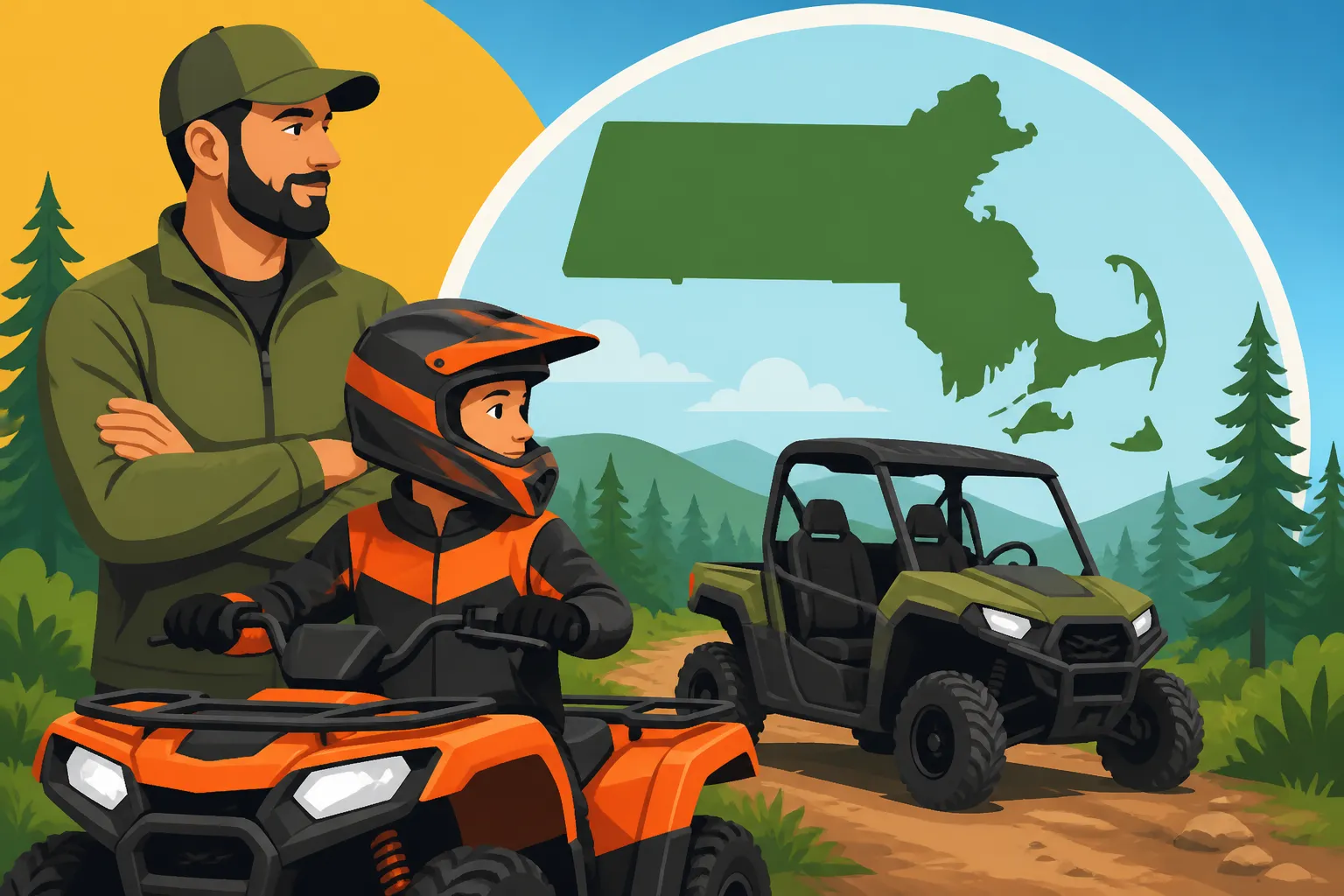
Supervision Defined on Public Land
If a young rider is allowed on a Massachusetts OHV trail, having an adult somewhere in the group may not be enough. The key question is whether the rider is in the age group that requires supervision and whether the adult can keep direct contact. Here’s what that means in practice, and what to check before riding on public land.
What direct supervision means on a public trail
For a rider who must be supervised, plan on the adult maintaining continuous visual contact and being able to communicate with the rider. The adult should be able to see what the young rider is doing and respond promptly—not simply be somewhere on the same trail system.
A phone, radio, or GPS tracker can help a group stay in touch, but it should not be treated as a substitute for direct supervision. A device can lose signal, and a rider may need immediate help after a fall or an unexpected turn. If a hill, bend, dust cloud, thick trees, or distance blocks the adult’s view, the adult may no longer be supervising directly in a practical sense.
There is an important difference between riding together and supervising. An adult following behind at a distance may not be able to see the young rider, while an adult riding just ahead may not notice that the rider has stopped or left the trail. Keep the group close enough for the adult to maintain sight and communicate without relying on repeated calls or messages.
This does not mean an adult has to ride beside the child at every moment. On a narrow trail, that may be unsafe or impossible. It does mean choosing a pace, spacing, and route that keep the adult meaningfully present. If the trail separates the riders or the adult cannot see what is happening, stop and regroup.
Public land adds another layer: supervision does not create permission to ride. The trail or area must be open to the machine, and the rider still has to meet the applicable age, equipment, registration, and safety requirements. Massachusetts riding areas have different rules and closures, so confirm access before towing out. Massachusetts Trail Planning and Closures
| Situation | What direct supervision should look like | Safer response |
|---|---|---|
| Open, straight trail | Adult can see the young rider and communicate promptly | Keep a manageable gap and ride at a pace that preserves contact |
| Blind corner or steep rise | The rider may disappear from view | Stop before the obstruction or have the adult move only where sight is restored |
| Dust or thick woods | Visibility may be reduced even on familiar ground | Slow down, increase spacing only if sight remains clear, and regroup when needed |
| Split trail or junction | Riders could choose different routes | Stop together, identify the route, and keep the adult with the young rider |
| Mechanical problem or fall | The rider may need immediate help | Stay close enough to respond; do not assume a phone call is an adequate plan |
The table is a practical way to think about supervision, not a replacement for the legal age rules. For the legal meaning and limits of adult supervision, consult the current Massachusetts requirements before riding.
Who needs supervision and who can provide it
Supervision requirements depend on the rider’s age and the kind of riding involved. Massachusetts has strict youth rules, and exceptions for organized events should not be mistaken for permission to ride a public trail. In general, a child under 14 cannot simply ride a recreational vehicle on public land because a parent is present. Narrow event-related exceptions have their own conditions. Massachusetts Bans Riders Under 14
Age restrictions also affect which machine a young person may operate. For riders in the 14-to-16 age range, Massachusetts has an engine-size limit and supervision requirements. Do not assume that an adult’s presence makes a larger machine lawful for the rider. The age bracket, engine size, setting, and type of activity all matter. Massachusetts Age and Engine Size Ladder
The supervising adult must meet the applicable requirements. For the age groups that require an adult, do not assume that any older teenager or another child in the group qualifies. The relevant standard identifies an adult, and the law can also make supervisors responsible for a young rider’s violations. Who Counts as a Supervising Adult at 18 Massachusetts Supervisors Held Liable
A parent or guardian may be the most practical person to supervise, but the important point is not the relationship. It is whether the person qualifies under the rules, stays in direct contact, and takes responsibility for the young rider’s conduct. A parent who is parked at the trailhead or riding elsewhere in the forest is not providing the same supervision as an adult riding with the child.
Before planning a ride, check each rider’s situation separately. A family may include children in different age brackets, and one machine or route may be suitable for one rider but not another. Review the specific rules for the age involved rather than applying one broad rule to every child in the group. Massachusetts ATV Age Requirements
Also check whether a safety certificate is required. Some young riders must complete safety training and carry the required certificate when riding on public land. An adult’s supervision does not replace a certificate requirement, just as a certificate does not replace required adult supervision. Massachusetts Safety Certificates Under 18
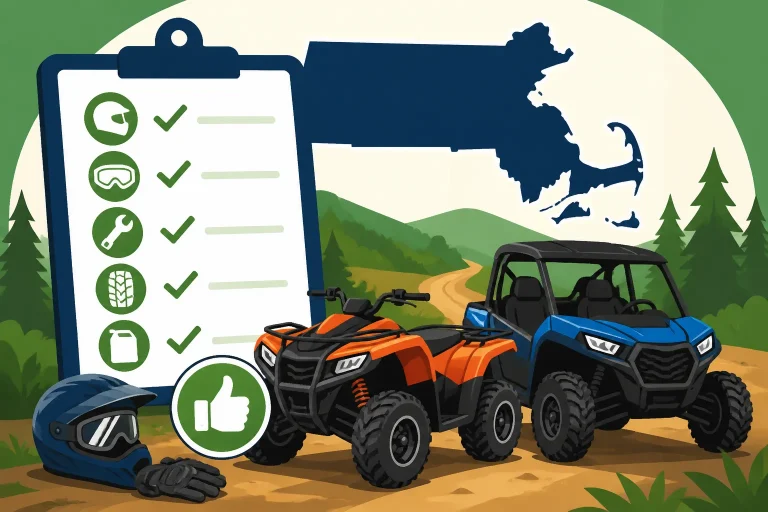
A simple pre-ride check can prevent confusion:
- Confirm the rider’s age and identify the exact rules that apply to that age.
- Check whether the machine’s engine size and type are allowed for that rider.
- Confirm that the rider has any required safety certificate and knows how to carry or show it.
- Identify the adult who will supervise and make sure that person understands the responsibility.
- Choose a route and riding pace that let the adult keep the young rider in view and communicate.
- Verify the trail is open to that machine and that the group meets registration and other access requirements.
Registration is separate from supervision. A properly registered ATV or UTV does not automatically qualify a young rider to operate it, and a parent’s registration does not establish that an adult is supervising. Massachusetts also requires its own registration for many recreational vehicles used in the state; an out-of-state sticker should not be assumed to satisfy that requirement. Massachusetts Requires Its Own Registration Out-of-State OHV Stickers Are Not Valid in Massachusetts
How to keep supervision effective on the trail
The most reliable approach is to set clear expectations before the engine starts. Tell the young rider who the supervising adult is, which machine the adult will be on, and what to do if the group gets separated. Agree that no one passes the adult, takes a different route, or continues past a stop point without checking in.
Keep the route appropriate for the least experienced rider, not just the most capable adult. A steep climb, narrow ledge, blind corner, or fast group pace can make it difficult to maintain visual contact. A route that is easy for an experienced rider may still be unsuitable for a child who is learning to control a machine.
Ride at a speed that preserves the adult’s ability to react. If the adult is too far behind to see what is happening, the group is moving too quickly or is spaced too far apart for direct supervision. If the adult is ahead, stop at junctions and other decision points so the young rider can follow the correct route without guessing.
Use a clear regrouping routine. Stop at trail intersections, before difficult sections, and whenever visibility drops. Make eye contact or otherwise confirm that the young rider understands the next instruction before setting off. This is especially useful when engines, helmets, and trail noise make ordinary conversation difficult.
Do not use an electronic device as the main safety plan. A radio may help with communication, but it cannot show whether the rider is upright, on the correct trail, or approaching a hazard. A device is a backup for a group that remains together, not a reason to let a young rider travel out of sight.
The adult also needs to be ready to stop riding and help. If the young rider is tired, frightened, having trouble controlling the machine, or struggling with the terrain, continuing just to complete a loop is a poor trade-off. Turn around, take a break, or choose an easier route. Supervision is active judgment, not only keeping a rider within view.
For a group ride, designate one adult to supervise each young rider or small group, and agree on the arrangement before the ride. Do not assume another adult is watching a child unless that person has explicitly accepted the responsibility. Group leaders should avoid spreading young riders among machines without a clear adult assigned to each one.
Public land rules still apply during the ride. The adult and child must stay on authorized routes, follow closures, and respect restrictions on where machines may operate. A supervising adult cannot authorize a child to ride on a closed trail, cross a prohibited area, or enter land without permission. Where Massachusetts Law Says You May Not Ride Massachusetts Trail Access Without a Pass
Common misunderstandings and what to check before leaving
A few assumptions cause particular trouble:
- “The adult is in the same forest, so that counts.” Being in the same area is not the same as maintaining direct contact. If the adult cannot see and communicate with the rider, supervision may not be effective.
- “A parent can make an exception.” A parent’s permission does not override statutory age or machine limits.
- “The safety certificate covers supervision.” Training and supervision are separate requirements. Satisfying one does not automatically satisfy the other.
- “The rider can go ahead because the trail is familiar.” Familiarity does not prevent a fall, mechanical issue, wrong turn, or sudden change in visibility.
- “A radio makes it okay to separate.” Communication equipment may help, but it should not replace the required direct supervision.
- “Registration means the young rider can use the machine.” Registration concerns the machine and its lawful use; the rider must still qualify to operate it.
Rules and trail access can vary by location, and requirements may change. Before setting out, confirm the current youth rules with an official Massachusetts source and check the rules for the specific public riding area. If the planned route makes continuous visual contact impractical, choose another route or leave the young rider out of that ride.
When in doubt, use a conservative standard: keep the adult close, maintain sight and communication, and stop whenever either one is lost. That approach is safer for the child and makes it easier for the supervising adult to meet the responsibility that comes with the ride.
Disclaimer
This article is for general informational purposes only and does not constitute professional advice. Laws, prices and regulations vary by location and change over time. Consult a qualified professional for guidance on your specific situation.