Where Massachusetts Law Says You May Not Ride
It's incredibly frustrating, isn't it? You've got your ATV or side-by-side ready to hit the trails, maybe you just invested in some rugged upgrades from a place like SuperATV, and all you want to do is enjoy the great outdoors. But before you even load up the trailer, you're hit with a wave of questions about where you can actually ride in Massachusetts. The rules can feel like a minefield, and nobody wants to inadvertently break the law, face fines, or worse, cause damage or injury. This guide is here to clear up the confusion, detailing exactly where Massachusetts law says you absolutely cannot ride your off-highway vehicle (OHV), helping you stay on the right side of the rules and out of trouble.
Public Roads and Highways: The Absolute No-Go Zone
One of the most common misconceptions among new and even some seasoned riders is the idea that you can just "zip down the road a bit" to get to a trail, or that certain dirt roads are fair game. In Massachusetts, the law is exceptionally clear on this point: generally speaking, ATVs and UTVs are absolutely prohibited from operating on public ways, which include paved roads, gravel roads, and even the shoulders of highways. This isn't just a suggestion; it's a fundamental aspect of [Massachusetts ATV Laws Under Chapter 90B].
Why Off-Highway Means Off-Highway
The very definition of an "off-highway vehicle" is one designed for operation off of public roads. These machines lack the safety equipment, like turn signals, specific mirrors, or Department of Transportation (DOT) approved tires, that would make them suitable for road use. Beyond that, their handling characteristics at road speeds are vastly different from street-legal vehicles. Trying to maneuver a quad or side-by-side built for rugged trails on asphalt or busy thoroughfares can be incredibly dangerous, not just for the rider but for other motorists. The state sees these machines as inherently unsuitable for road traffic.
It's easy to look at a quiet country road, especially one that turns to dirt, and think, "What's the harm here?" But the law doesn't make a distinction based on traffic volume or road surface. If it's maintained by the town or state and open to public vehicular traffic, it's considered a public way. Even riding along the very edge, or on the shoulder, is typically illegal. This can be a real pain if your favorite trail system has sections divided by a public road, leading to that common frustration of feeling like you're stuck between a rock and a hard place, unable to legally connect segments.
Limited Road Crossing Exceptions
Now, there are very specific, narrow exceptions for crossing a public way, but these are not to be confused with riding on a public way. You cannot ride down the road for any distance, even a short one. Instead, these exceptions are for direct, perpendicular crossings to access another trail or piece of private property. Even these crossings come with strict rules. For example, you must come to a complete stop before entering the public way, yield to all traffic, and cross at a right angle. The Environmental Police are very clear about [Massachusetts Crossings Require a Full Stop].
Furthermore, there are age restrictions that come into play for these crossings. Riders under a certain age are typically prohibited from crossing public ways without direct adult supervision, and sometimes not at all, depending on their age bracket. It's a nuanced area, and getting it wrong can lead to a significant fine and potential impoundment of your machine. Always, always treat public roads as off-limits unless you are performing a specific, legal crossing according to all the rules.
Private Land: Permission is Paramount
Massachusetts prides itself on protecting private property rights, and this extends directly to where you can operate your ATV or UTV. Riding on someone else's land without explicit, written permission is not just rude, it's illegal. This is one of the biggest challenges riders face, as vast stretches of land might appear open and unmanaged, but they almost always belong to someone.
The "No Trespassing" Myth and Reality
Many riders mistakenly believe that if land isn't clearly posted with "No Trespassing" signs, it's fair game. This is a dangerous misconception in Massachusetts. The law does not require private landowners to post their property to keep people off. If you are on private land without the owner's permission, you are trespassing, whether there's a sign or not. This applies to everything from a small woodlot behind someone's house to vast tracts of commercial timberland.
The consequences of trespassing can range from a warning to a hefty fine, and repeat offenses can lead to more serious legal action. Landowners are often protective of their property, and damage caused by OHVs, even unintentional, can be a major source of conflict. Imagine the frustration of a farmer finding ruts through their hayfield or a homeowner discovering their backyard peace disturbed by engine noise. Securing [Massachusetts Landowner Permission in Writing] isn't just a good idea; it's a legal necessity. Keep a copy of that permission with you whenever you ride on private property, because an Environmental Police officer will almost certainly ask for it if they encounter you there.
How to Legally Ride on Private Property
The best way to ensure you're riding legally on private land is to seek out specific permission from the landowner. This means direct communication, ideally in writing, outlining where and when you're allowed to ride. Some landowners might be open to it, especially if you offer to help with trail maintenance or other tasks. Others might have specific conditions, like restricting access during hunting season or prohibiting riding within a certain distance of their home. Knowing [Massachusetts Requires Written Permission] upfront can save a lot of headaches later.
There are also private riding parks and clubs that operate on private land, providing authorized riding opportunities. These are excellent resources for riders who want to avoid the legal complexities of finding their own private land access. Such parks often have their own rules regarding safety gear, age limits, and vehicle types, but they provide a legal and often well-maintained place to ride without the constant worry of trespassing.
Protected Areas: Beaches, Dunes, and Conservation Lands
Massachusetts boasts beautiful coastlines, unique wetlands, and valuable conservation areas, all of which are subject to strict environmental protections. Operating ATVs and UTVs in these sensitive ecosystems is almost universally prohibited, and for good reason. The environmental impact can be severe and long-lasting.
Why Coastal Areas Are Off-Limits
Our state's beaches and dunes are particularly vulnerable to damage from off-road vehicles. The fragile ecosystems of sand dunes, in particular, are vital for coastal protection and home to many species of plants and animals. The tires of an ATV can quickly erode sand dunes, destroy vegetation that stabilizes the sand, and disturb nesting wildlife. This is why [Massachusetts Bans Beach and Dune Damage] and generally prohibits OHV use in these areas.
Even areas that might seem like open sand flats or hard-packed beach at low tide are usually protected. It's not just about direct damage; it's also about noise pollution disturbing residents and wildlife, and the safety risks of mixing fast-moving vehicles with beachgoers. Always assume that beaches, tidal flats, and dune systems are entirely off-limits for your ATV or UTV, unless you are part of a sanctioned, permitted event that has secured rare and specific approval, which is exceedingly uncommon for recreational riding.
Conservation Lands and Wetlands
Beyond the coast, Massachusetts has a vast network of conservation lands, managed by state agencies, local towns, and private land trusts. While these lands offer incredible opportunities for hiking, birdwatching, and enjoying nature, very few of them permit ATV or UTV use. The primary purpose of most conservation lands is ecological preservation, and motorized vehicles are seen as detrimental to this goal. Wetlands, bogs, and sensitive forested areas are especially susceptible to damage from OHVs, leading to soil compaction, erosion, and disruption of delicate habitats.
If you're unsure about a specific conservation area, always check with the managing authority – be it the local conservation commission, a land trust, or the state's Department of Conservation and Recreation (DCR). The rule of thumb should always be: if it's not explicitly marked as an OHV trail, assume it's prohibited. Ignoring this can lead to fines, environmental damage that is costly to repair, and further restrictions for all riders. Protecting these areas is crucial for preserving the natural beauty of Massachusetts for everyone.
Certain State Lands: When DCR Says No
While the Department of Conservation and Recreation (DCR) manages the state forests where legal OHV riding is permitted, it's vital to understand that not all DCR lands are open to ATVs and UTVs. In fact, the vast majority are not. It can be confusing because the same agency manages both open and closed areas, so a DCR sign doesn't automatically mean "ride here."
State Forests Without OHV Access
Massachusetts has numerous state forests and parks, but only a select few are designated for off-highway vehicle use. Riders often find themselves looking at a DCR map, seeing a large green area, and assuming it's an open invitation for their quad or side-by-side. This is incorrect. Many state forests are managed primarily for hiking, equestrian use, mountain biking, or passive recreation, and motorized vehicles would conflict with these uses and management goals. For example, [Savoy Mountain Bans Massachusetts ATVs], despite being a beautiful state forest.
The DCR actively maintains a list of authorized trails and areas. If a state forest is not on that list, or if specific trails within a designated OHV forest are marked as closed to motorized vehicles, then riding there is illegal. Ignorance of these designations is not an excuse. It's the rider's responsibility to check the DCR website or contact the specific forest management office before trailering their machine to an unfamiliar location. This saves you from a wasted trip, potential fines, and the frustration of being turned away.
Shared-Use Trails and Restrictions
Even within the state forests that do allow OHVs, specific trails or sections might be restricted or designated for other users only. For instance, some trails might be open to motorcycles but not ATVs or side-by-sides, or vice-versa. There are also many multi-use trails where OHVs share the path with hikers, horseback riders, and cyclists. In these scenarios, courtesy and adherence to specific rules are paramount. Speed limits are usually strictly enforced, and yielding to non-motorized users is always expected.
For instance, the eastern part of Massachusetts has more limited OHV opportunities, with many trails designated for motorcycles only, like [Freetown-Fall River's Motorcycle Trails in Massachusetts]. This distinction is critical; don't assume that if one type of OHV is allowed, all are. Understanding these nuances helps preserve the limited access we do have and prevents further restrictions from being imposed due to irresponsible riding. Always look for signage and consult official DCR maps before venturing out, and remember that even in authorized areas, not every single path is open to every type of machine.
Age and Size Restrictions: Who Can't Ride Where
Massachusetts has some of the most stringent laws in the country regarding youth OHV operation. These aren't just suggestions; they are serious legal mandates designed to protect young riders and those around them. Where a young person can ride, and what kind of machine they can operate, is heavily regulated and can limit access to even otherwise authorized areas.
The Under-14 Ban and Exceptions
Perhaps the most impactful law for youth riders is [Sean's Law: The 2010 Ban Named for a Boy], which generally prohibits anyone under the age of 14 from operating an OHV anywhere in Massachusetts, including private land. This is a tough pill to swallow for many families, but it was enacted to prevent tragic accidents involving young, inexperienced riders. This means that a child under 14 cannot ride a quad or dirt bike in your backyard, on your own private land, or at any state trail system.
There are very narrow exceptions, primarily for participation in sanctioned, organized competitive events that are approved by the appropriate authorities, and even then, specific rules apply. For example, [Massachusetts Riders Under 10 and Sanctioned Events] details these rare circumstances. Otherwise, the rule is clear: if they're under 14, they cannot ride. Parents are held liable for violations, so it's critical to understand [Massachusetts Parent Liability for a Young Rider] if you have children interested in OHV riding. This isn't about discouraging kids from riding, but ensuring they do so safely and legally when they are old enough.
Engine Size and Supervision Requirements
Even for riders between 14 and 18, there are significant restrictions on the type of machine they can operate and the level of supervision required. For instance, riders aged 14 to 16 are generally limited to machines with an engine size of 90cc or less. This engine cap is a critical detail, as many youth quads exceed this limit. Operating a machine too powerful for their age group, even if they are otherwise allowed to ride, is a violation. The law defines [The 90cc Engine Cap for Riders 14 to 16] quite clearly.
Furthermore, riders under 18 generally need to be under the direct supervision of an adult who is at least 18 years old and meets specific criteria. This isn't just about having an adult nearby; it means continuous visual contact and often verbal communication. The supervising adult is also held responsible for the young rider's actions. This can sometimes mean that even if a trail is open to OHVs, a family with a younger rider might find their options limited by these supervision requirements. It's a comprehensive set of rules designed to scaffold experience and safety, ensuring that young people learn to ride responsibly.
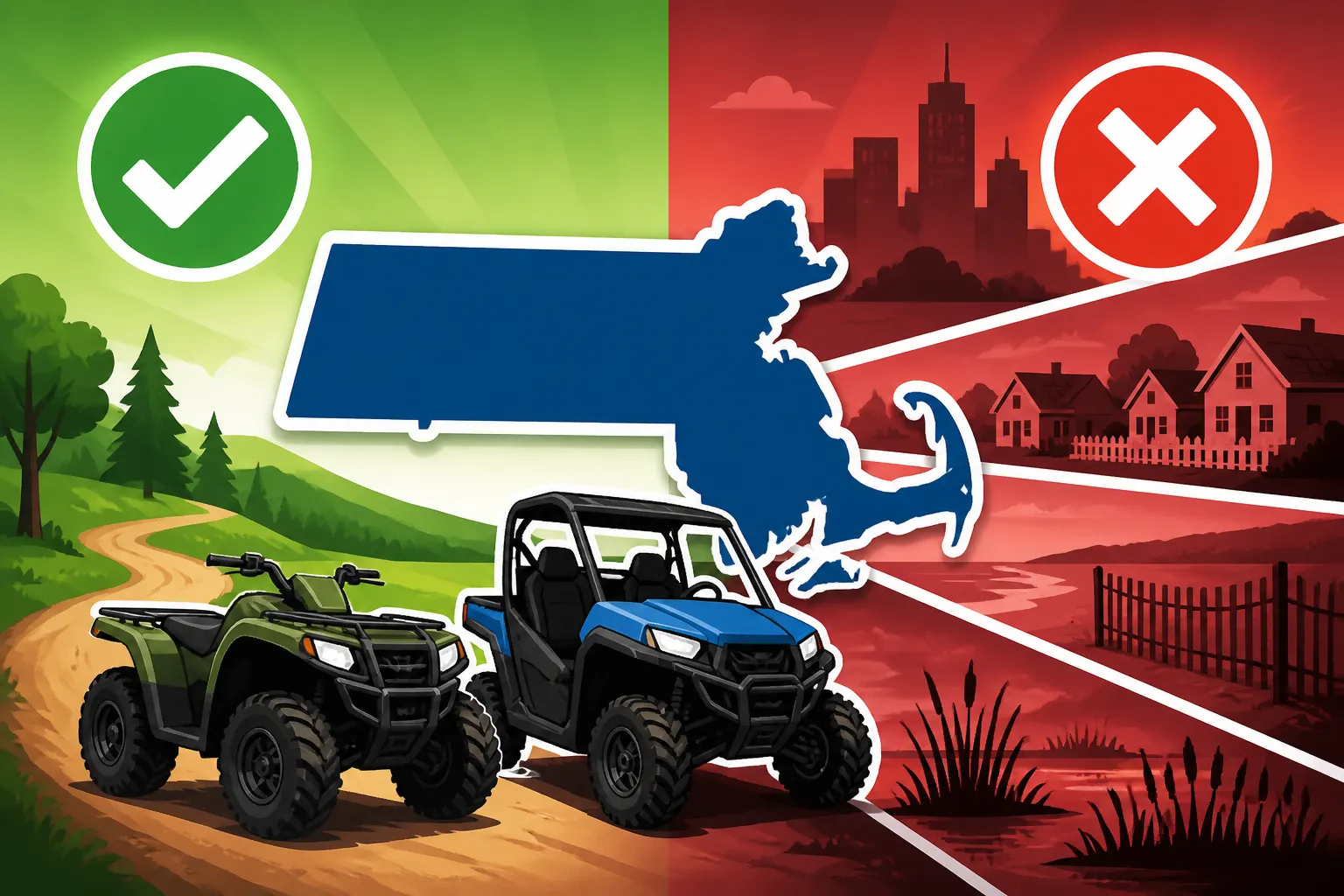
| Prohibited Riding Area Category | Key Restrictions | Potential Consequences |
|---|---|---|
| Public Roads/Highways | Generally illegal, even shoulders. | Fines, impoundment, safety risks. |
| Private Land (without permission) | Trespassing, no "unposted is allowed" rule. | Fines, legal action by landowner. |
| Beaches & Dunes | Highly sensitive ecosystems, environmental damage. | Significant fines, environmental cleanup costs. |
| Wetlands & Conservation Areas | Ecological preservation, habitat disruption. | Fines, damage to natural resources. |
| Undesignated DCR State Forests | Many DCR lands are not for OHVs, specific trail rules. | Fines, closure of access for all riders. |
| Under 14 Riders (anywhere) | Broad ban for safety, with very limited exceptions. | Parent liability, fines, machine impoundment. |
| Under 16 (over 90cc) | Engine size limits for youth riders 14-16. | Fines, safety risks, machine impoundment. |
Other Specific Prohibitions and Considerations
Beyond the broad categories, there are a few other specific scenarios and rules that dictate where you absolutely cannot ride in Massachusetts. These often relate to noise, proximity to dwellings, and other nuisance factors that can lead to complaints and further restrictions for the OHV community.
Noise, Proximity to Dwellings, and Curfews
Even in areas where riding is generally permitted, there are rules designed to minimize disturbance to others. This includes regulations on noise levels and operating within a certain distance of occupied dwellings. [Massachusetts's 150-Foot Dwelling Rule] states that you generally cannot operate an OHV within 150 feet of an occupied dwelling without the express written consent of the owner. This is a significant restriction that can affect riding on private land, or even on trails that pass close to residential areas.
Furthermore, state forests often have specific quiet hours or curfews for OHV operation, especially near campgrounds or residential abutters. Ignoring these rules can lead to complaints from the public, which then puts pressure on DCR to impose stricter rules or even close trails. It’s a common frustration for riders who want to enjoy their sport, but being mindful of how noise travels and impacts others is key to responsible riding and maintaining access.
Environmentally Sensitive Areas and Wildlife
Beyond the specific prohibitions on beaches and wetlands, riders should always be acutely aware of environmentally sensitive areas and wildlife habitats. Even on designated trails, going off-trail, known as "bushwhacking," is almost universally prohibited. This is because going off the established path can cause erosion, damage vegetation, and disturb wildlife. Many state forests are home to protected species, and their habitats can be easily disrupted by unauthorized off-trail riding.
It's also crucial to remember that certain times of the year, like spring nesting seasons or during severe drought, can bring temporary closures or heightened restrictions. For example, during very dry periods, fire risks increase, and OHV use might be curtailed to prevent wildfires. Always check for current [Massachusetts Trail Planning and Closures] before heading out, especially during sensitive seasons. Responsible riding includes protecting the environment and respecting wildlife, ensuring that future generations can also enjoy these areas.
The Importance of a Spark Arrester and Muffler
While not directly a "where not to ride" rule, lacking proper equipment can render any trail off-limits. All ATVs and UTVs operating in Massachusetts, especially on public lands, are required to have a functioning spark arrester and a muffler that meets specific sound emission standards. Without these, even if you are on an otherwise legal trail, your machine is not compliant, and you could be ticketed or even turned away. [Massachusetts Muffler Requirements] are in place to control noise pollution and prevent wildfires, particularly when riding through dry vegetation.
Some riders might be tempted to modify their exhaust systems for more power or a louder sound. However, doing so can put you in violation of these laws, and the Environmental Police regularly conduct equipment checks at trailheads. A stock exhaust with a well-maintained spark arrester is typically your safest bet for legal operation. Investing in quality parts, perhaps from a reputable aftermarket provider like SuperATV, that are designed to meet these regulations can help ensure your machine is always trail-ready and compliant. Don't let a simple equipment oversight prevent you from legally enjoying the few trails we have.
Disclaimer
This article is for general informational purposes only and does not constitute professional advice. Laws, prices and regulations vary by location and change over time. Consult a qualified professional for guidance on your specific situation.