Massachusetts Certificate Rules at 16 and 17
A 16th or 17th birthday changes some Massachusetts riding rules, but it does not make a young ATV or UTV rider exempt from safety-certificate requirements. The key is to know what the certificate proves, when the rider must carry it, and which separate rules still control supervision, registration, and where the machine may go.
What the Certificate Rule Means at 16 and 17
In Massachusetts, riders under 18 must meet the applicable off-highway vehicle safety-certificate requirements. A 16- or 17-year-old should not assume that age alone is enough to ride legally on land open to OHV use. The certificate is evidence that the rider completed the required safety training; it is not a registration card, a license plate, or permission to use a particular trail.
The certificate requirement applies to both ATVs and UTVs. A side-by-side may feel more like a small vehicle than a quad, but its size, seat belts, or steering wheel do not turn it into a road-legal car or remove the youth training requirement. The underlying rules apply to off-highway recreational vehicles, so check the classification of an unusual or modified machine rather than relying on what the seller calls it.
For riders in this age group, the practical answer is straightforward:
- Complete the safety training required for the Massachusetts certificate.
- Keep the certificate with the rider when required, especially on public land.
- Check the age, supervision, and crossing rules separately; a certificate does not cancel them.
- Confirm that the machine itself is registered and that the land is open to that type of riding.
The training requirement is part of a wider set of youth rules. Riders under 16 face additional age and supervision limits, including restrictions that may apply to engine size. At 16 and 17, those rules change, but other conditions still matter. For a broader breakdown by age, see Massachusetts ATV Age Requirements and Massachusetts Rules for Young Riders on Public Land.
A certificate also does not create permission to ride wherever a machine can physically travel. Massachusetts land-access rules, trail closures, and owner permission remain separate issues. A rider can have the correct certificate and registration and still be riding somewhere prohibited. The basics of legal riding locations are covered in Where Massachusetts Law Says You May Not Ride.
Because rules, course arrangements, and trail requirements can change, check the current instructions from the state’s OHV safety program or the agency responsible for the riding area before heading out. For a young rider, doing that check in advance is easier than trying to sort out a missing document or an access restriction at the trailhead.
How the Safety Certificate Is Earned and Used
A certificate is earned by completing the required safety and responsibility training, not simply by owning a machine, taking a test on a phone, or having an older relative explain the controls. Massachusetts training has more than one component. Course arrangements can differ, so follow the current program instructions closely and make sure each required part is complete before expecting a certificate.
The training is intended to cover more than basic throttle and steering. Riders need to understand how to operate responsibly, recognize hazards, and follow rules that apply to trails and public land. A young person who has ridden for years on private property may still need to complete the formal course. Familiarity with a family machine is useful, but it is not a substitute for the required credential.
Treat registration and training as separate requirements
The safety certificate belongs to the rider; registration belongs to the machine. A 16-year-old may have a valid certificate while riding an unregistered ATV, which does not make that machine legal to use where registration is required. Likewise, a correctly registered UTV does not satisfy the rider’s training requirement.
Before a ride, check both sides of the paperwork:
| Item | What it relates to | What to check |
|---|---|---|
| Safety certificate | The individual rider | The rider completed the required training and can show proof when required |
| OHV registration | The individual machine | The registration is current and matches the machine |
| Registration card | The registered machine | The required card is available to carry with the machine |
| Land permission or access | The location | The owner or land manager allows that machine and rider to use the route |
| Additional area rules | The location and activity | The trail is open, and local conditions or permits are satisfied |
For registration steps and supporting paperwork, see How to Register an ATV in Massachusetts. If you need to understand what document must be carried on a ride, The Registration Card You Must Carry in Massachusetts covers that separate obligation.
Carry proof rather than relying on memory
If the rider is required to carry the certificate, plan for it to be available during the ride. Do not assume that an adult’s phone, a course confirmation email, or a photo of a card will be accepted as a replacement for the required proof. Check the current official instructions about acceptable formats and what to do if the certificate is lost or not yet issued.
Keep the certificate somewhere it can be accessed without distracting the rider or risking damage. A secure pocket or other protected storage works better than leaving it in a vehicle back at the parking area. The goal is simple: if an officer or land manager asks for proof, the rider should not have to end the ride or search through someone else’s belongings.
The certificate should also be kept distinct from the registration card. The registration card identifies the registered machine; the safety certificate relates to the rider. A family with multiple young riders should make sure each rider has their own required proof, rather than assuming one person’s documents cover everyone in the group.
If the rider completed training but has not received or cannot locate the certificate, contact the appropriate program office or course provider before riding. Do not assume that a course receipt or a parent’s statement is equivalent to the completed credential. For practical questions about finding or carrying proof, Looking Up a Massachusetts Safety Certificate and Massachusetts Certificates Carried on Public Land are useful next steps.
What Changes at 16 and What Does Not
A 16th birthday matters, but it is not a blanket permission slip. Massachusetts has age-based rules for youth riders, and some restrictions differ for younger children and teens. At 16 and 17, riders still need to follow the rules that apply to their age, the machine, the location, and the specific activity.
One common mistake is treating the safety certificate as if it replaces supervision. The certificate documents training; it does not automatically answer whether a rider may operate alone in a particular situation. Supervision requirements are a separate legal question, and the details can depend on age and where the riding takes place. Check Massachusetts Supervision Rules on Public Land and Who Counts as a Supervising Adult at 18 if the ride involves a young operator and an adult escort.
Another mistake is assuming that a driver’s license makes an ATV or UTV road legal. A license may matter for particular crossing or supervision rules, but it does not convert an OHV into a street-legal vehicle. Massachusetts generally does not provide a standard path for turning an ATV into a vehicle with ordinary road-use privileges. For the limits on road use, see Can You Ride an ATV on the Road in Massachusetts?.
Do not carry over rules for younger riders without checking
Rules that apply to a 14- or 15-year-old may not apply in the same way to a 16- or 17-year-old. In particular, youth rules can set age-based limits on who may operate, what engine size is allowed, or whether adult supervision is required. Those limits are not interchangeable, and information written for a younger child can lead to the wrong conclusion for a teenager.
At the same time, moving into an older age bracket does not remove the certificate requirement for riders under 18. Nor does it remove helmet, equipment, registration, or land-access rules. A teenager should verify the rule for the exact activity rather than relying on a general statement such as “I’m old enough now.”
If a ride involves an organized race, practice session, or sanctioned event, event rules may add another layer. A youth rider should not assume that an event’s entry approval changes the ordinary rules for riding outside that event. Check the organizer’s requirements and the applicable state rules before signing up.
Road crossings are a separate issue
A trail ride may involve crossing a public way even when the route itself is off-road. That crossing is not an invitation to ride along the road, and the rules for stopping, yielding, and who may cross are separate from certificate requirements. A rider should know the crossing procedure before reaching an intersection, not learn it while approaching traffic.
Parents and group leaders should plan routes so the young rider does not need to travel on a public way. Where a permitted crossing is involved, review the age-specific conditions and make sure the rider understands that a full stop and careful crossing are essential. See Massachusetts Rules for Crossing a Road and Massachusetts Crossings Require a Full Stop for more detail.
The same separation applies to equipment. A certificate does not make an ATV’s brakes, lighting, or muffler compliant. Riders and adults should check the machine before departure and understand the equipment rules that apply to the type of riding planned. Massachusetts Equipment Requirements explains the machine-side requirements.
Where a 16- or 17-Year-Old May Ride
The certificate answers a question about the rider’s training. It does not decide whether a trail, forest, private property, or event is open to that rider. Massachusetts access can be limited by land ownership, area-specific rules, vehicle type, trail condition, and seasonal closures.
On private property, the landowner’s permission matters. Permission to use one parcel does not automatically extend to neighboring land, a connecting woods road, or a trail across a different owner’s property. Young riders should have clear permission for the actual route and follow any conditions set by the owner. The rules about written permission and riding near homes are covered in [Massachusetts Landowner Permission Forms] and Why 150 Feet From a Dwelling Matters.
On public land, do not assume that every road or trail shown on a map is open to ATVs or UTVs. Some areas restrict OHV use, and a trail may be closed even if it appears suitable or has been used before. Check the land manager’s current information and obey signs at the entrance and along the route. Massachusetts Trail Planning and Closures can help with planning around access changes.
A sticker or registration is not a general trail pass. Massachusetts does not treat registration as permission to ride on every public trail, and a state sticker does not replace site-specific access requirements. This is especially important for out-of-state families: having a valid registration from home does not necessarily satisfy Massachusetts requirements. See Massachusetts Requires Its Own Registration and Out-of-State OHV Stickers Are Not Valid in Massachusetts.
For a visiting teen, check the rider’s certificate, the machine’s registration, and the location’s access rules as three distinct items. A young rider’s home-state training document may not automatically meet every Massachusetts requirement. Confirm what the Massachusetts program or the specific riding area accepts before making a long trip.
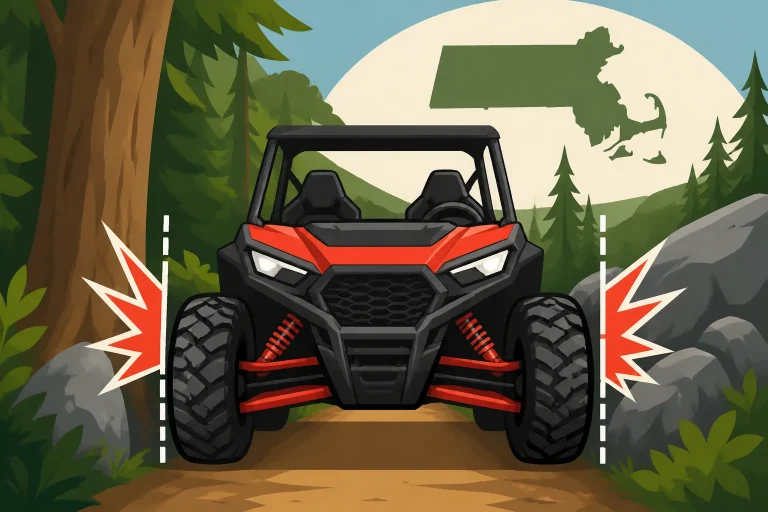
The same caution applies to UTVs. A trail open to narrow ATVs may not accommodate a wider side-by-side. Check vehicle dimensions and the land manager’s rules before unloading. A vehicle can be registered and operated by a properly trained teen yet still be prohibited because it is too wide or is not an allowed type for that trail.
A Pre-Ride Check for Families
A short check before each ride prevents most avoidable problems. It also gives a 16- or 17-year-old a chance to take responsibility for their own documents and decisions while an adult helps confirm the details.
- Confirm the rider’s certificate. Make sure the required training is complete and that the rider has the proof they are expected to carry.
- Check the rider’s age-specific rules. Do not assume that a rule for a younger child or adult applies unchanged to a 16- or 17-year-old.
- Verify the machine’s registration. Confirm that the paperwork matches the ATV or UTV being ridden and that the registration is current.
- Check the route and land access. Confirm the exact area is open to that vehicle type and that any required permission or site-specific instruction is in place.
- Review crossings and supervision. Identify any public-way crossings and make sure the rider understands what is required.
- Inspect the machine and gear. Check brakes, lights, muffler, helmet, and other required equipment before leaving the staging area.
- Pack documents where they can be reached. Keep rider and machine documents accessible without confusing one for the other.
For families with several machines or riders, make a separate document check for each person and vehicle. It is easy to put one registration card in a parent’s pack and assume the group is covered. That can leave the actual operator without the proof they need.
It is also helpful to discuss the plan before starting the engine. Agree on who leads, where the group will stop, what to do if someone becomes separated, and how the rider should respond to a closure sign or an officer’s direction. Safety training is most useful when its lessons are applied to the specific trail and conditions.
If any part of the requirement is unclear, ask the appropriate state program or land manager before riding. A course provider can clarify training completion and certificate delivery; a registration office can address machine paperwork; and the land manager can confirm access. These are different questions, so contacting the right office usually saves time.
Frequently Asked Questions
Does a 16- or 17-year-old need a Massachusetts OHV safety certificate?
Riders under 18 must meet the applicable Massachusetts safety-certificate requirements. A 16th birthday does not by itself remove the training requirement. Confirm the current course and proof instructions before riding.
Does the certificate allow a teen to ride without an adult?
Not by itself. The certificate proves training; supervision rules are separate and can depend on the rider’s age and where the riding takes place. Check the rules for the specific ride rather than treating the certificate as an exemption.
Does a safety certificate register the ATV or UTV?
No. The certificate relates to the rider. The machine has its own registration requirements, and the rider must also have access to any required registration card.
Can a teen use a home-state certificate in Massachusetts?
Do not assume it will be accepted. A visiting rider should confirm with the Massachusetts OHV safety program or the relevant land manager what certificate and registration documents are required.
Does the certificate allow riding on public roads?
No. Training proof does not make an ATV or UTV street legal. Public-way crossings and road use have separate rules.
Disclaimer
This article is for general informational purposes only and does not constitute professional advice. Laws, prices and regulations vary by location and change over time. Consult a qualified professional for guidance on your specific situation.