Massachusetts Crossings Require a Full Stop
Riding your ATV or UTV in Massachusetts offers incredible access to some beautiful natural landscapes, but navigating the rules around public roads can feel like a minefield. Many riders get frustrated and confused about where they can and can't go, and critically, how to legally cross a road without risking a hefty fine or, worse, an accident. This comprehensive guide will walk you through everything you need to know about legally and safely crossing public ways on your off-highway vehicle (OHV) in the Bay State, ensuring you stay compliant and confident on your adventures.
The Fundamental Rule: Massachusetts Crossings Require a Full Stop
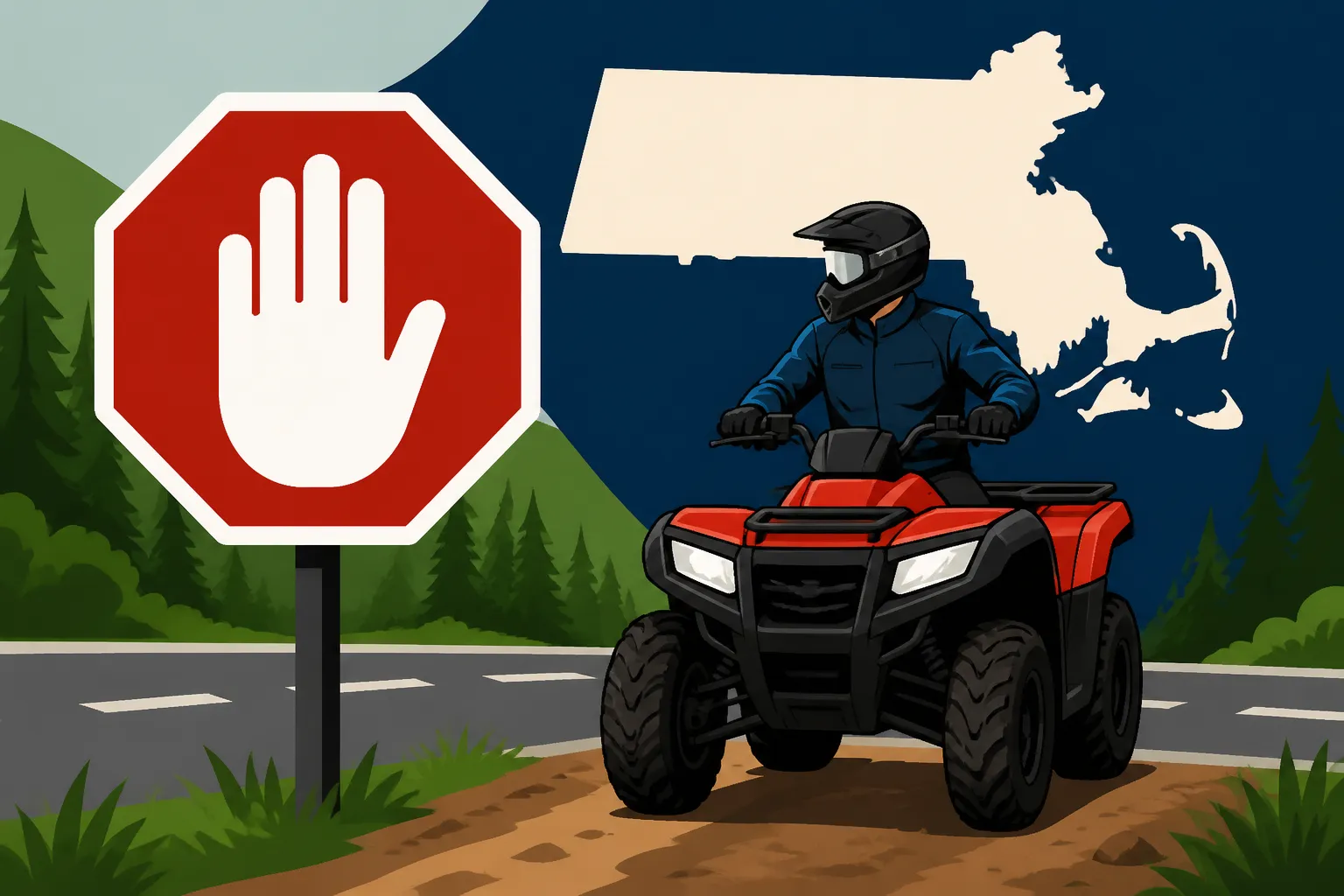
The most critical rule for any ATV or UTV rider in Massachusetts approaching a public way is often overlooked or misunderstood, leading to citations and dangerous situations. It’s not enough to just slow down or do a “rolling stop.” The law is very clear, and it’s there for everyone’s safety: [Massachusetts Crossings Require a Full Stop].
Understanding "Public Way" in Massachusetts
Before we even talk about stopping, it's vital to grasp what Massachusetts considers a "public way." Many riders assume this only refers to paved, major roads, but that's a dangerous misconception. In Massachusetts, a "public way" is broadly defined and includes a lot more than just asphalt highways. It encompasses any street, road, highway, or other public thoroughfare that is open to the public for travel. This definition is crucial because it includes paved roads, gravel roads, dirt roads maintained by a town or state, and even some unimproved roads that the public has a right to use. [Which Dirt Roads Count as a Public Way] is a common question, and the answer often surprises people. Even if it looks like a forgotten dirt path, if it's legally designated as a public way, the rules apply.
Imagine you’re out exploring near October Mountain State Forest, enjoying the network of trails. You come across a dirt road that seems quiet and seldom used. You might be tempted to just zip across without a second thought. However, if that dirt road is officially a public way, you are legally obligated to treat it with the same respect and caution as you would a busy highway, meaning a complete, unequivocal stop is required. Misinterpreting this can put you and others at risk.
The Mandatory Full Stop Explained
So, what exactly does a "full stop" entail when you're on an ATV or UTV? It means coming to a complete and total halt, with your wheels no longer rotating, before you enter the intersection or cross the public way. This isn't a suggestion; it's a legal mandate. You must stop at a point where you have a clear view of approaching traffic on the public way, without impeding it. This might mean stopping at the edge of the trail where it meets the road, or a few feet back if vegetation or terrain obstructs your view.
Once you’ve stopped, you must yield the right-of-way to any traffic on the public way. This involves actively looking in both directions for vehicles, bicycles, or even pedestrians. Only when the way is clear, and it's safe to proceed, should you begin your crossing. This moment of pause is not just for legal compliance, but for your own safety and the safety of others. It gives you a chance to assess speed, distance, and potential hazards that might not be obvious during a rolling approach. It's a fundamental step that allows you to confidently cross, knowing you've done your due diligence.
Why This Rule Exists: Safety and Legal Precedent
The rule requiring a full stop before crossing a public way isn't just about making things inconvenient for OHV riders; it's steeped in critical safety concerns and established legal precedent. Off-highway vehicles, by their nature, are designed for rugged terrain, not for interacting with highway traffic. They typically have lower top speeds, different braking characteristics, and are less visible than cars or trucks. When an ATV or UTV suddenly enters a public way, the potential for a severe collision skyrockets. Motorists often aren't expecting an OHV to appear, especially on less-traveled dirt roads.
Historically, accidents involving OHVs and motor vehicles on public roads have been a significant concern, leading to legislative efforts like [Massachusetts ATV Laws Under Chapter 90B] which governs how these machines interact with public infrastructure. This law, and specifically the full stop requirement, aims to minimize those risks. It places the onus on the OHV operator to ensure the crossing is absolutely clear and safe. From a legal standpoint, failing to adhere to this rule can result in significant penalties, including fines and potential impoundment of your machine, not to mention liability if an accident occurs. It underscores the importance of the full stop as a critical safeguard against preventable tragedies, making sure every rider prioritizes caution over convenience.
Age, Licensing, and Supervision Requirements for Crossings
Massachusetts has some of the strictest OHV laws in the country, especially concerning young riders. These rules extend directly to how and when an OHV operator can cross a public way, adding layers of responsibility that all riders, and especially parents, need to understand thoroughly. It's not just about stopping; it's about who can even attempt the crossing in the first place.
Riders Under 16 and Road Crossings
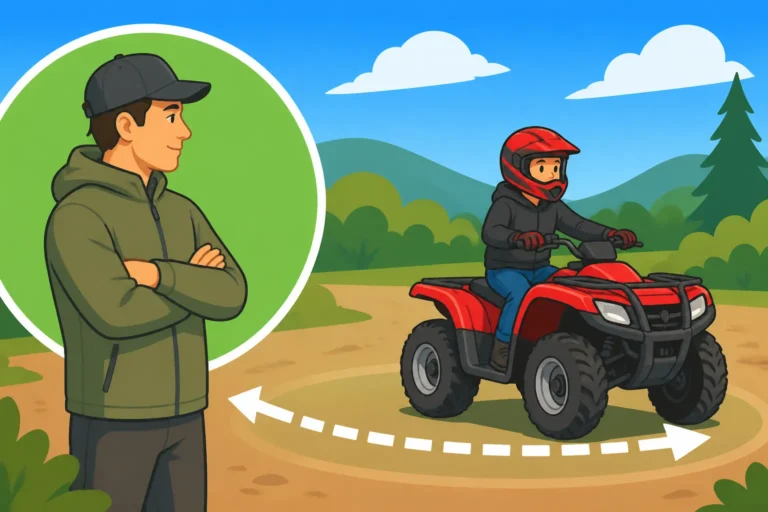
For riders under the age of 16, the rules around public way crossings are exceptionally stringent. Massachusetts law dictates that riders under 16 are generally prohibited from operating an ATV or UTV on public lands or ways unless they are participating in a sanctioned event or under strict supervision in specific scenarios. More broadly, [Massachusetts Riders Under 14 Are Banned] from operating ATVs even on private land, with very limited exceptions for sanctioned events. When it comes to crossing a public way, a rider under 16 must be under the direct supervision of an adult who is at least 18 years old. This adult must also possess a valid motor vehicle operator's license and be in a position to constantly monitor and instruct the younger rider.
Think of a scenario where a family is riding trails near Pittsfield State Forest. A 14-year-old rider, even one who is very experienced, cannot legally cross a public road on their own. Their supervising adult must be present, actively guiding them through the crossing, and ensuring all safety protocols are followed. This isn't a passive supervision; it requires active engagement and communication to navigate what can be a high-risk maneuver. The responsibility for the crossing ultimately rests with the supervising adult, making their presence and attentiveness non-negotiable for young riders.
The Role of a Driver's License for Older Riders
Once a rider turns 16 and a half, the rules surrounding road crossings shift slightly, especially if they hold a valid motor vehicle operator's license. [Road Crossings Change at 16 and a Half] is an important distinction. While all riders must still execute a full stop and yield to traffic, an OHV operator aged 16 and a half or older, who possesses a valid driver's license, is no longer required to be under direct adult supervision for crossing public ways. This means that if you're 17 with a driver's license, you can make that crossing independently, provided you follow all other rules.
However, holding a driver's license doesn't grant you carte blanche to ride on the public way. It only applies to the act of crossing. The core principle of OHV use in Massachusetts—that these machines are not for road use—still applies rigorously. The license signifies that the operator has demonstrated a basic understanding of traffic laws and safe vehicle operation, which is deemed sufficient for the brief, controlled act of crossing. Even so, caution and defensive riding are paramount, as the inherent challenges of visibility and maneuverability of an OHV on a public way remain.
What "Supervising Adult" Means During a Crossing
The term "supervising adult" is not to be taken lightly, especially when it concerns a younger rider attempting to cross a public way. In Massachusetts, a supervising adult must be at least 18 years old and possess a valid motor vehicle operator's license. Furthermore, they are legally responsible for the actions of the minor rider they are supervising. During a road crossing, this means the adult must maintain continuous visual contact and be able to provide verbal communication to the minor rider. They need to be close enough to intervene if necessary, and actively instruct the younger rider on when and how to cross safely. [Massachusetts Supervising Adult Defined] highlights the gravity of this role.
For example, if a parent is supervising their 15-year-old child on a youth quad from a slightly more powerful machine, they shouldn't just be generally in the vicinity. They should approach the public way with the child, confirm the full stop, look both ways with the child, and give clear, audible instructions to proceed. If something goes wrong, the supervising adult is liable. This level of active participation ensures that the safety and legal obligations for road crossings are met, offering a protective layer for younger riders and the public.
| Rider Age Group | Driver's License Required | Adult Supervision for Crossings | Carry Safety Certificate |
|---|---|---|---|
| Under 14 | No | Always (Sanctioned Events Only) | Yes |
| 14 to 16 | No | Always | Yes |
| 16 to 16.5 | No | Always | Yes |
| 16.5 and Up | Yes (for independent crossing) | No (if licensed) | Yes (if under 18) |
The "How-To" of Safe and Legal Road Crossings
Knowing the rules is one thing; putting them into practice safely and effectively is another. A legal road crossing isn't just about meeting the minimum requirements; it's about executing a maneuver that minimizes risk for everyone involved. It requires foresight, awareness, and decisive action.
Approaching the Public Way Safely
Your approach to a public way is just as important as the crossing itself. As you near an intersection with a public road, reduce your speed significantly. This isn't just to prepare for the full stop, but also to give yourself ample time to assess the environment. Look for signs of traffic – not just vehicles, but also bicycles, pedestrians, or even wildlife. Be mindful of dust you might kick up if it's a dry day, as this can obscure your visibility or signal your presence to approaching vehicles.
Position your machine strategically as you come to a stop. Aim for a spot where you have the clearest possible view of traffic in both directions without encroaching on the public way. Sometimes, dense vegetation or a blind corner on the trail can make this challenging. In such cases, you might need to stop slightly further back, then creep forward slowly to a point where your visibility is maximized before making your final, complete stop. This careful, deliberate approach sets the stage for a safe crossing and ensures you’re not caught off guard by an unexpected vehicle.
Scanning for Traffic and Yielding the Right-of-Way
Once you’ve come to a full and complete stop, the next critical step is an exhaustive scan for traffic. This means turning your head and actively looking left, then right, then left again, similar to what you would do in a car. Don't rely solely on your peripheral vision or a quick glance. OHVs are smaller and less visible than cars, so you need to be absolutely certain the path is clear. Listen for approaching vehicles, as sound can sometimes precede sight, especially around bends or over hills.
Remember, you must yield the right-of-way to any traffic on the public way. This isn't negotiable. If a car is approaching, even if it seems far away, it has the right-of-way. Wait until the road is completely clear, or until the approaching vehicle has passed and there is ample time and space for you to cross safely. Never assume a driver sees you or will slow down for you. Being overly cautious here can literally save your life. Taking an extra moment to be certain is always the right decision.
Crossing Directly and Without Delay
Once you've stopped, scanned, yielded, and confirmed the way is clear, you should cross the public way as directly and efficiently as possible. This means moving straight across the road to the opposite trail or shoulder, without making any unnecessary turns or lingering on the roadway. The goal is to minimize your time on the public way. Accelerate smoothly but deliberately to ensure you clear the lane quickly.
Resist the temptation to drive parallel to the road for even a short distance, or to make any detours. The law allows for crossing, not for riding on the public way. Plan your crossing point to align directly with the trail on the other side. This direct approach reduces confusion for other motorists and minimizes the chances of you being in an unexpected position on the road. Brands like SuperATV offer heavy-duty control arms and suspension components that can contribute to predictable handling, which is especially helpful when you need precise control during a quick crossing maneuver. Just like a professional driver, make your intentions clear and execute the crossing with confidence and precision.
Common Misconceptions and Costly Mistakes
Despite the clear language of Massachusetts OHV laws, several misconceptions persist among riders, often leading to costly mistakes. Understanding these common pitfalls can help you avoid fines, accidents, and legal troubles. It’s about knowing the spirit of the law, not just the letter.
Riding On the Road vs. Crossing It
One of the most dangerous and frequently misunderstood distinctions is the difference between crossing a public way and riding on it. Massachusetts law is unequivocally clear: ATVs and UTVs are strictly prohibited from being operated on any public way, except for the specific act of crossing at a right angle after a full stop. This means you cannot ride down the shoulder, use the road to connect two close trails, or drive on it for any distance whatsoever, even if you think it’s just "a short hop." [Can You Ride an ATV on the Road in Massachusetts?] is a question with a very firm "no" as the answer, save for the crossing exception.
Many riders, perhaps coming from states with more lenient laws, assume that a quiet country road or a dirt lane "doesn't count." They might see a local riding their quad to the mailbox and think it's permissible. However, an Environmental Police officer will likely see it as a violation. The penalty for riding on a public way can be severe, often resulting in significant fines and the potential impoundment of your machine. This fundamental rule is in place to protect both OHV riders, who are vulnerable on roads, and other motorists who aren't expecting these vehicles in traffic lanes.
The Myth of "Just a Few Feet"
Following closely from the "riding on the road" misconception is the idea that it's okay to travel "just a few feet" down a public way to reach another trail access point or to avoid an obstacle. This is a myth that can lead directly to a citation. There is no legal grace period or distance exemption for operating an OHV on a public way. Even if you only travel for ten feet on the asphalt or gravel shoulder, you are technically in violation of the law.
The law is black and white on this point: operate only to cross, and do so directly. Trying to skirt this rule by riding a short distance on the public way not only puts you at risk of a penalty but also exposes you to the dangers of road traffic. It's an unnecessary gamble that offers little benefit compared to the potential consequences. If a trail connection requires traveling on a public way for any distance, however short, that connection is not legally permissible for an OHV. Always plan your routes to avoid any riding on public roads, no matter how brief.
Penalties for Improper Crossings
The consequences for improper road crossings in Massachusetts can be steep, ranging from monetary fines to more serious legal repercussions. An Environmental Police officer, who is authorized to enforce OHV laws, can issue a citation for failing to make a full stop, failing to yield, or for riding on a public way. Fines can quickly add up, and repeat offenses can lead to even harsher penalties. [Massachusetts Penalties for Illegal Riding] are not to be taken lightly.
Beyond the immediate financial hit, there's the risk of having your machine impounded. If your ATV or UTV is seized, you'll incur additional towing and storage fees, on top of the original fine, just to get it back. In the event of an accident during an illegal crossing, your liability could be substantial, potentially leading to civil lawsuits that far exceed the cost of any fine. Furthermore, if a young rider is involved, the supervising adult could face direct legal consequences. These penalties serve as a strong deterrent, emphasizing the state's commitment to safety and adherence to OHV regulations.
Equipment and Visibility for Road Crossings
While not specifically mandated for crossings alone, certain equipment and visibility measures significantly enhance your safety when interacting with public roads. Massachusetts has general equipment requirements for OHVs that become even more critical when you're momentarily sharing space with other vehicles. Thinking ahead about your machine's setup can make all the difference.
Essential Lighting and Reflectors
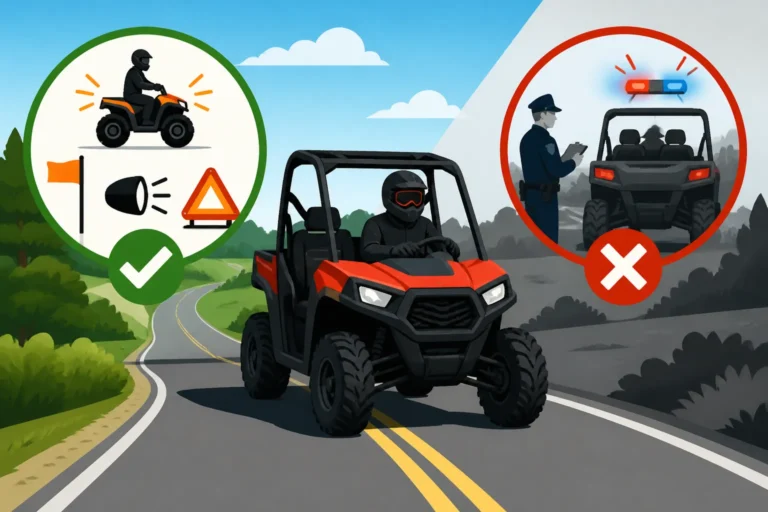
For any riding that might occur near dawn, dusk, or in low-light conditions, proper lighting on your ATV or UTV is essential, especially when preparing to cross a public way. Massachusetts law generally requires a white headlight visible from at least 200 feet and a red taillight or reflector visible from at least 100 feet after sunset or in conditions of reduced visibility. [Massachusetts Lighting After Sunset] is a rule all riders should know. For road crossings, this visibility becomes paramount.
Consider augmenting your machine's standard lighting. Adding auxiliary LED light bars or cube lights can dramatically increase your frontward visibility to oncoming traffic, making you much easier to spot. Reflective tape or decals on the sides of your OHV, perhaps from a company like SuperATV that specializes in aftermarket accessories, can also significantly improve your machine's profile, particularly for traffic approaching from the side during your crossing. The more visible you are, the better chance other drivers have to react appropriately, reducing the risk of a collision. Don't leave your visibility to chance; every bit of light and reflection helps.
Helmet Requirements for All Riders
Regardless of age or experience, Massachusetts law mandates that every ATV and UTV operator and passenger must wear a helmet. This isn't just a suggestion; it's a non-negotiable safety requirement. [Massachusetts Helmet Law for Every Rider] is strictly enforced, and for good reason. A helmet is your primary protection in the event of an impact, and an improper road crossing is precisely the kind of scenario where an accident with severe head trauma could occur.
When preparing for a road crossing, ensure your helmet is properly fitted and secured. A helmet that is too loose or not strapped correctly offers diminished protection. While the helmet law applies to all riding, its importance is amplified during the brief, high-risk maneuver of crossing a public way, where you are interacting with faster-moving traffic. There’s no compromise on head protection in Massachusetts; it’s a vital piece of gear that every rider must wear.
Ensuring Your Machine is Trail-Ready
Beyond lighting and helmets, having a generally well-maintained and trail-ready machine is crucial for safe road crossings. This means ensuring your brakes are fully functional and responsive, your tires are in good condition and properly inflated for control, and your steering is tight and predictable. A machine with worn brakes, a loose steering column, or bald tires will be harder to control during the critical moments of a crossing, increasing your risk.
Regular maintenance, like checking brake fluid, inspecting tire tread, and tightening suspension components, contributes to overall safety. If your machine is equipped with aftermarket accessories like enhanced suspension or wider control arms from manufacturers such as SuperATV, ensure they are correctly installed and maintained. These components can improve stability and handling, which are assets when you need to quickly and precisely traverse a public way. A reliable machine that responds predictably is a safe machine, and that confidence is invaluable when you're momentarily sharing the road with other vehicles.
Planning Your Route: Minimizing Road Crossings
The safest road crossing is often the one you don't have to make. Strategic route planning can significantly reduce your exposure to public ways, enhancing your riding experience and safety in Massachusetts. This involves a bit of homework before you even load your machine onto the trailer.
Utilizing Trail Maps and Designated Crossings
Before heading out to a state forest like Beartown or October Mountain, always consult the official trail maps. These maps are invaluable resources, often highlighting designated OHV trails and, crucially, clearly marking where trails intersect with public roads. By studying these maps, you can identify routes that minimize the number of road crossings or avoid them altogether. Look for continuous trail systems that allow for longer rides without interruption.
Some areas might have specific, officially sanctioned crossing points that are better signed or offer improved visibility. Prioritize using these designated crossings over improvising your own. While the general rules for a full stop and yielding apply everywhere, official crossing points are often placed where visibility is better or traffic flow is lower. Always carry a physical map or have a reliable GPS unit with updated trail information, as cell service can be spotty in some of the more remote parts of the Berkshires. Knowing your route in advance allows you to anticipate crossings and mentally prepare for them, rather than encountering them unexpectedly.
When to Seek Alternatives to a Crossing
Sometimes, a direct trail connection across a public way might seem like the easiest path, but it might also be the riskiest. If a particular crossing point has extremely poor visibility, heavy traffic, or is located on a fast-moving road, it's often wiser to seek an alternative. This might mean extending your ride slightly, finding a different trail segment, or even trailering your machine a short distance to access another part of the trail system.
For example, if you're trying to connect two sections of trail that are separated by a major state highway with constant, high-speed traffic, even with a full stop, that crossing is inherently dangerous. In such a scenario, consider if there’s a safer, less trafficked alternative nearby, or if it makes more sense to pack up and drive to the next trailhead. Your safety and legal compliance should always outweigh the convenience of a direct, but dangerous, crossing. Thinking creatively about your route can prevent you from making a risky decision.
The Importance of Written Permission for Private Land Connections
Massachusetts ATV riders often rely on a mix of public trails and private land access. If your planned route involves crossing private property to bypass a public road section, you absolutely must have [Written Permission From a Bay State Owner]. This isn't just a courtesy; it's a legal requirement to avoid trespassing charges. Riding on private land without explicit, written permission is illegal and can lead to fines and legal action from landowners.
Even if you have permission to ride on one part of private land, that doesn't automatically grant you permission to cross another landowner's property to avoid a public road. Each individual landowner's consent is required. Before you embark on your ride, confirm all necessary permissions are in place and carry them with you. This not only protects you legally but also helps maintain positive relationships with private landowners, which are crucial for the future of OHV riding in Massachusetts. A well-planned route that respects both public and private land regulations will offer a much more enjoyable and worry-free experience.
Disclaimer
This article is for general informational purposes only and does not constitute professional advice. Laws, prices and regulations vary by location and change over time. Consult a qualified professional for guidance on your specific situation.