Massachusetts Online Course Provider
Finding an online ATV safety course is not the same as finding the course Massachusetts accepts for its off-highway vehicle safety certificate. The key is to start with the state’s current course instructions, confirm the online provider is approved for Massachusetts, and complete any required in-person training or skills assessment too.
How to find the Massachusetts-approved online course provider
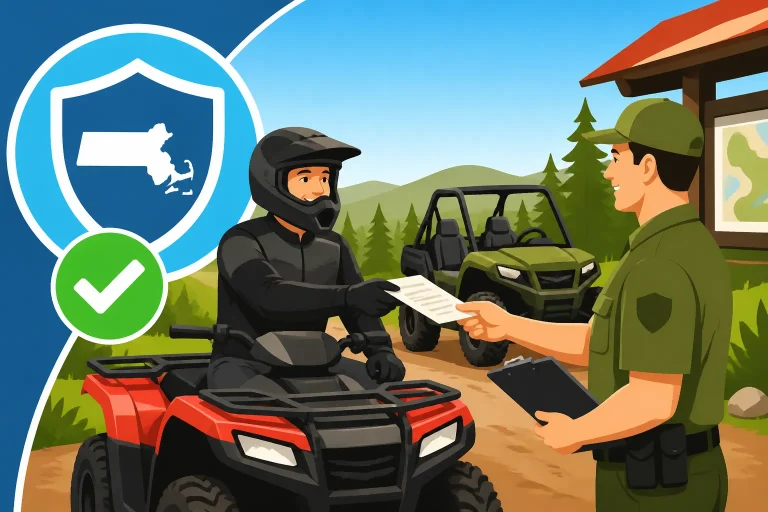
Start with the Massachusetts Environmental Police or the Boat and Recreation Vehicle Safety Bureau, which handles off-highway vehicle safety training. Use the course information on an official state page to identify the current online course and the steps for completing the full program. If a search result takes you to a commercial course site, confirm that the state directs riders there before paying or creating an account.
This matters because an online ATV course may be useful general training without being accepted for a Massachusetts certificate. A course designed for another state, a generic safety quiz, or a manufacturer’s tutorial may cover sensible riding practices but still fail to meet Massachusetts requirements. A certificate from another state or course provider should not be assumed to substitute for the Massachusetts program.
The provider and enrollment process can change. Check the state’s latest instructions before you register, especially if you have saved a link from an older page or received a recommendation in a forum. Verify that the page describes an off-highway vehicle course for Massachusetts, not a boating course, a driver education course, or a course intended only for a different jurisdiction.
Use this checklist before enrolling:
| Check | What to confirm |
|---|---|
| State approval | Massachusetts course instructions identify or direct you to the provider |
| Course subject | The course applies to ATVs or other off-highway vehicles, not a different activity |
| Course role | The online course is described as one part of the Massachusetts safety program, if additional steps are required |
| Rider information | The name and identifying details you enter match the rider who will complete the course |
| Completion record | You know how to save or retrieve proof of finishing the online module |
| Next step | You know whether to schedule an in-person session, skills test, or another required step |
The course itself is only one part of preparing a young rider to operate legally. Age restrictions, supervision rules, machine-size limits, and where riding is permitted still apply. The online module does not override those rules. For the age-related certificate requirements, see Massachusetts Safety Certificates Under 18 and Massachusetts Certificate Rules Under 16.
Why the online module may not be the whole certificate
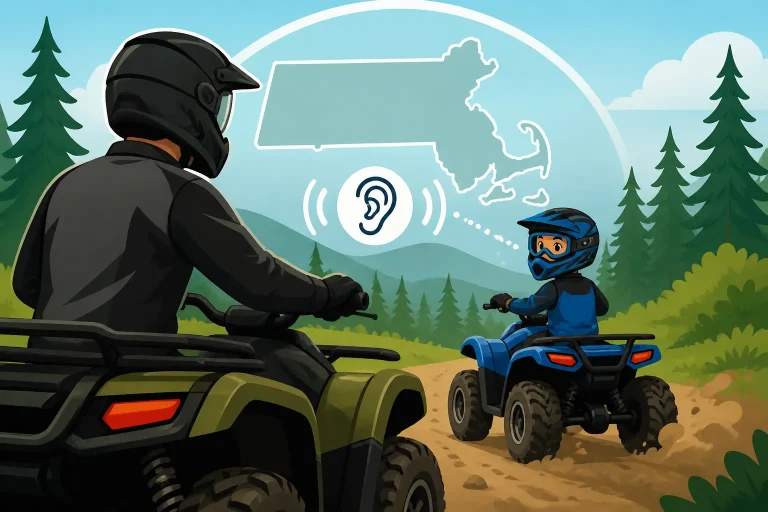
Massachusetts training is described as a two-part process: an online component and an in-person component. The online portion lets a student work through instructional material at their own pace, but completion may not be the final step. Riders should follow the state’s instructions for any classroom session, skills assessment, or other in-person requirement before treating the certificate process as complete. The practical details are covered in Two Parts to the OHV Safety Certificate and Massachusetts In-Person Skills Test.
An online course can introduce important topics, including responsible operation, safety equipment, hazards, and rules of the riding environment. But reading or watching material on a screen is different from demonstrating safe control of a machine. In-person training gives the student a chance to apply what they studied and lets instructors assess practical skills where required. Massachusetts’s in-person training is associated with the Environmental Police; check the current course schedule and instructions rather than assuming any local class will count.
Keep a copy of the online completion confirmation. It can help you show that you finished the first part when you arrange the next step or need to resolve an account issue. It is not necessarily a substitute for the final certificate. If the provider says the result is sent electronically, still save the confirmation and note the student’s login information in a secure place.
Also check the state’s rules for carrying proof. A student who has completed the required program may still need to have the certificate available while riding in situations covered by the law. Review Massachusetts Certificates Carried on Public Land and Riders Under 18 Must Carry the Certificate for the relevant requirements. A screenshot or course-completion email may not be the same as the certificate officials expect a rider to carry.
A useful way to think about the course is:
- Online learning: Complete the Massachusetts-approved online component and save its completion record.
- Additional instruction or assessment: Follow the current state directions for the in-person portion, if required for the rider.
- Certificate confirmation: Make sure the final certificate has been issued and that the rider knows how to carry or present it as required.
- Separate ride preparation: Confirm the machine’s registration, the rider’s eligibility, and the rules for the planned location.
Do not book a ride or assume a rider is ready just because the online dashboard says “complete.” That status may refer only to the online module. If the course website and the state instructions appear to conflict, pause and ask the course contact or the state safety office which step remains.
Enrollment steps and common problems
Before opening the course site, gather the rider’s details and use the information the state’s instructions request. If a parent or guardian is completing enrollment for a minor, make sure the account is for the student who will take the course. A parent account, shared email address, or mistyped name can make it harder to retrieve records or match online completion to an in-person session.
A practical enrollment sequence is:
- Find the official state course instructions. Start with Massachusetts Environmental Police or the Boat and Recreation Vehicle Safety Bureau, then follow its current direction to the online provider.
- Check that the course fits the rider. Confirm that it is the Massachusetts off-highway vehicle course and that the rider can meet any applicable age or enrollment conditions.
- Read the full process before paying or starting. Look for instructions about the online portion, in-person training, required equipment, scheduling, and completion records. Providers may charge for a course, and terms can change, so confirm current details directly with the provider.
- Enter the student’s information carefully. Use consistent spelling and save the login details and any confirmation number.
- Finish the online module without rushing. Complete all required lessons, tests, or acknowledgments, and save the completion record.
- Arrange the next required step. Use the state’s course schedule or contact instructions to find out how to complete any in-person portion or skills assessment.
- Confirm the final certificate. Check that the student has completed the full process, not just the online segment, and learn how the certificate must be carried.
Common problems tend to come from mixing up the course provider with the authority that sets or administers the state program. A provider may host the online learning, while the state establishes the accepted process and schedules or conducts another part. That is why a provider’s general claim that a course is “state approved” should be checked against Massachusetts’ own directions.
Another frequent issue is choosing a course based on a search snippet or an old recommendation. Search results can lead to courses intended for another state, and old bookmarks may no longer reflect the current registration process. Go back to the official state course page if you are unsure. If the provider name, course title, or next step is unclear, ask the state office before beginning.
Parents should plan for the student to take the course in the student’s own name and be involved in any required parent attendance. Massachusetts has specific rules concerning parents and younger students; confirm whether they apply to your child by checking Massachusetts Parent Attendance Rules. Completing the online module together may be useful, but do not treat a parent’s participation as a replacement for the student’s own work or any required in-person attendance.
If the online course is unavailable, the student cannot access an account, or no suitable in-person date appears, contact the provider or state office using the contact details on the official course page. Keep a brief record of the issue, including the student’s name, course account email, and any completion confirmation. Avoid creating duplicate accounts unless the provider recommends it, because duplicate profiles can split progress between records.
Keep training separate from registration and trail access
A safety certificate and a machine’s registration solve different problems. The certificate relates to rider training and eligibility. Registration relates to the vehicle and the state’s requirements for operating it. Completing a safety course does not register an ATV or UTV, provide a trail pass, or grant permission to ride on land.
That distinction is especially important for visiting riders. Massachusetts registration requirements are separate from the rider’s safety training, and an out-of-state sticker should not be assumed to satisfy Massachusetts registration rules. See Massachusetts Requires Its Own Registration and Out-of-State OHV Stickers Are Not Valid in Massachusetts. Visitors should also check the state’s instructions for the applicable non-resident registration before hauling a machine to a riding area.
Likewise, a valid registration sticker does not guarantee access to every trail or forest. Location rules, seasonal closures, landowner permission, and rider requirements still matter. Before a trip, confirm the rules for the specific riding area and make sure each rider has any required documentation. The course certificate is one piece of the preparation, not a substitute for the rest.
For a young rider, the best order is to verify the rules first, complete the approved training process, confirm the final certificate, and then check the machine and riding location. If the rider’s age or situation falls near a rule threshold, do not rely on a general course page to answer a legal question. Check the state’s current requirements for that rider and machine before riding.
Disclaimer
This article is for general informational purposes only and does not constitute professional advice. Laws, prices and regulations vary by location and change over time. Consult a qualified professional for guidance on your specific situation.