Riding Etiquette When You Meet Hikers
Meeting hikers on an ATV or UTV trail can feel awkward, especially when the path is narrow, dusty, or busy and everyone is unsure who should move first. In Massachusetts, the safest and most courteous approach is to slow down early, stop when needed, give people room, and follow posted trail rules. This guide explains how to make those encounters calmer for riders and hikers alike.
Before you share a trail with hikers
Confirm the route is open to your machine
A trail that looks rideable is not automatically open to ATVs or UTVs. In Massachusetts, permitted riding areas and allowed vehicle types can vary by location, and trail access may change with closures, conditions, or posted rules. Check the current information for the specific forest or riding area before unloading. The guide to Massachusetts ATV Trails: Three Berkshire Forests offers helpful context for riders planning a trip in the Berkshires.
Do not assume that a route is open to motorized vehicles just because you see tire tracks or another rider using it. Stay on authorized routes, obey signs and barriers, and turn around if a trail is closed or its status is unclear. A shortcut around a gate or a muddy section can damage the trail and create conflict with hikers, land managers, and nearby communities.
It also helps to plan a route that suits the least experienced person in your group. Review Massachusetts Trail Difficulty Ratings and Massachusetts Trail Planning and Closures before you go. A route that looks simple on a map may have narrow sections, steep slopes, soft ground, or limited places to pull aside. Planning ahead makes it less likely that you will need to squeeze past hikers in an unsafe spot.
Set expectations with your group
Before the ride, agree on a simple rule: if hikers are nearby, everyone slows down and the lead rider manages the encounter. Riders farther back should not surge forward, crowd the hikers, or try to pass before the group has room. On a UTV ride, remind passengers to stay seated and avoid leaning or reaching outside the vehicle while it is moving.
A group can also agree to keep noise low near trailheads, campsites, and places where people may be walking. Avoid revving the engine to announce your arrival or rushing to close a gap between machines. If you are riding with children or newer riders, explain that stopping calmly is part of trail riding—not a sign that someone has made a mistake.
It is worth checking the etiquette expectations for the area as well. Massachusetts Trail Etiquette Locals Expect can help you think through how your riding affects other trail users, while What an Environmental Police Officer Checks at a Trailhead is a useful reminder that following access rules matters as much as operating carefully once you are on the trail.
What to do when hikers appear
Slow down early and make your intentions clear
The best encounter usually starts before you reach the hikers. Ease off the throttle as soon as you see people ahead, keep a generous following distance, and approach slowly enough that you can stop without braking hard. Sudden acceleration, sharp turns, or a loud approach can startle people who may not have heard you coming—especially around a bend or in a wooded section.
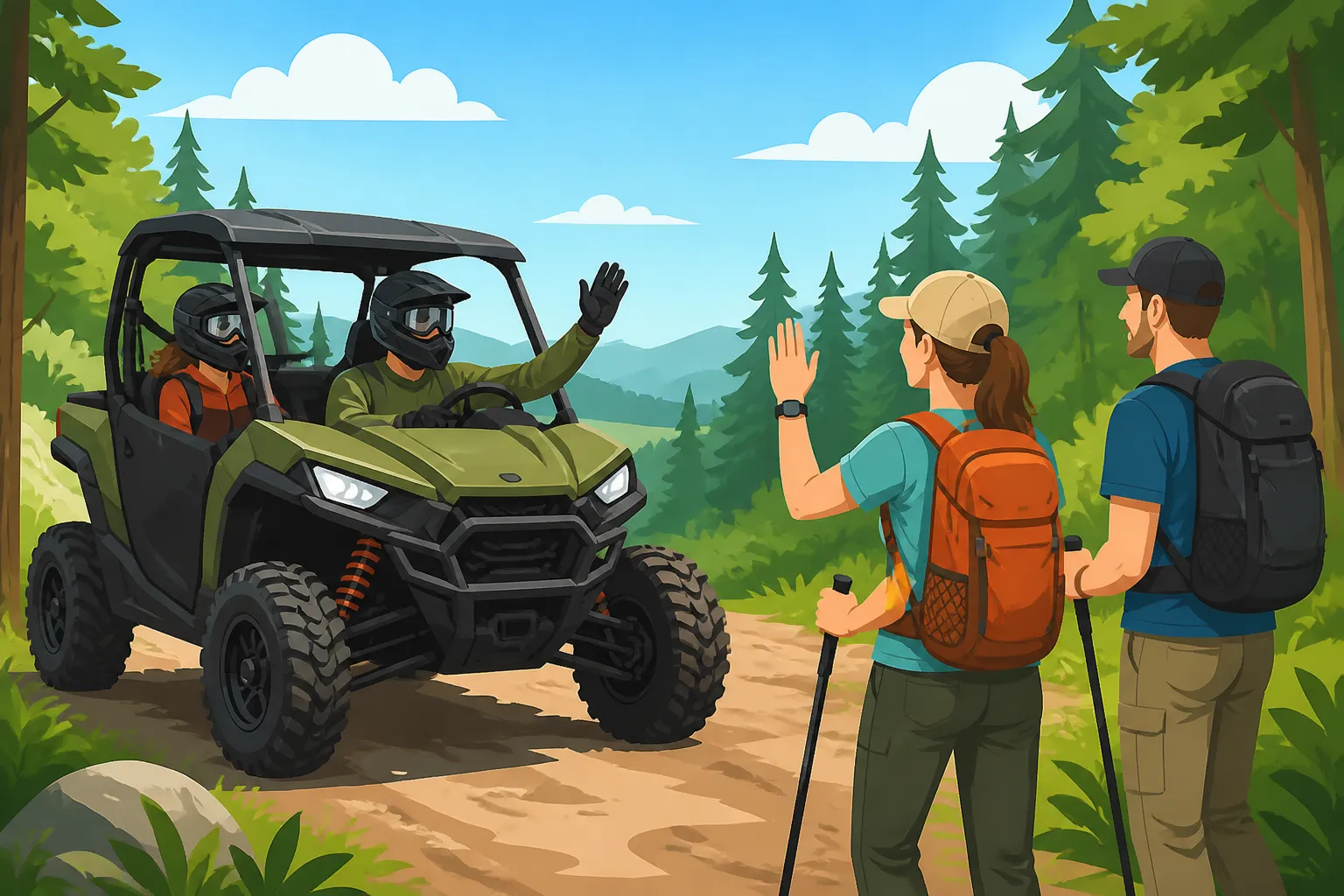
When the trail is narrow, stop in a place where you are stable and visible. Avoid stopping on a steep incline, loose edge, or blind corner if you can safely reach a better spot. Let the hikers see that you are waiting. A calm wave or brief greeting can reassure them that you have noticed them and are not planning to force your way through.
If you are riding in a group, the lead rider should signal the rest to stop and wait. Keep enough distance between machines that nobody is left idling close to the hikers. For a larger group, it may be more comfortable for hikers if the machines pass in a controlled sequence, with each rider moving only when there is plenty of space.
Give hikers space rather than expecting them to move
Do not assume hikers must step off the trail because you are on a motorized vehicle. They may have children, dogs, mobility concerns, or a steep drop beside them. The courteous choice is to wait, assess the trail, and ask whether there is a safe place to pass. If the path is too narrow, let the hikers choose where they feel comfortable moving—or wait until a wider area is available.
When a pass is possible, leave ample room and travel at a very low speed. Avoid brushing vegetation, kicking up loose gravel, or making a sharp maneuver that could put a person beside the trail in danger. Keep the machine under control until you are fully past the hikers and have enough distance to resume your normal pace without startling them.
On a narrow Berkshire trail, the safest option may be to pause and let the hikers reach a wider spot first. The advice in Yielding on a Narrow Berkshire Trail is especially relevant when there is little room to pull off. A few minutes of patience is a much better outcome than squeezing by, damaging the trail edge, or making someone feel trapped.
| Situation | Courteous rider response | Avoid |
|---|---|---|
| Hikers are ahead on a straight, wide section | Slow down, stop if needed, and pass only when there is comfortable room | Keeping speed and assuming they will move |
| Hikers are around a blind bend | Stop before the bend if you can do so safely, then approach cautiously | Accelerating into a blind corner |
| The trail is narrow or steep | Wait for a wider, stable place to pass | Passing beside a drop, ditch, or loose edge |
| Hikers have a dog or young children | Give extra space and wait for them to get settled | Revving, crowding, or passing close behind |
| Your group is spread out | Hold the group back and pass in a controlled sequence | Letting several machines bunch up around people |
Turn the engine off when waiting makes sense
If you are stopped close to hikers, switching off the engine can make the encounter feel less intimidating and reduce noise. This is particularly considerate when people are trying to talk, manage a dog, or help a child move to a safe place. It also gives you a moment to check the trail and decide whether there is enough room to pass.
Use good judgment about where you stop. Keep your machine stable and out of the hikers’ path, and do not block a junction or a narrow section where other trail users may come from either direction. If stopping would leave you in an unsafe position, move slowly to a suitable place first, then wait.
After the hikers pass, do not immediately accelerate hard. Give them time to move away and continue at a restrained pace until you are well clear. A sudden burst of speed can undo an otherwise polite interaction and send dust or debris toward people behind you.
Handle tricky encounters with patience
Dust, noise, dogs, and groups
Dust is more than an annoyance when someone is walking behind your machine. On dry trails, slow down well before reaching hikers and avoid spinning the tires or accelerating sharply as you pass. If dust is already hanging in the air, wait for it to settle rather than riding through it at speed. On loose or rocky ground, a slower pass also helps reduce the chance of throwing stones.
Dogs can make an encounter unpredictable. A dog may be leashed, off leash where permitted, frightened by engine noise, or difficult for its handler to control. Stop well back and give the person time to manage the leash. Do not creep forward while the handler is trying to move the dog, and never assume that a dog will stay to one side of the trail.
A large riding group can feel overwhelming even when every individual rider is careful. If hikers are approaching, keep your machines together in a safe waiting area rather than letting the group stretch around a bend. Let the hikers pass the group at their own pace. When your group does move again, leave a little space between machines instead of riding bumper-to-bumper.
What to do if there is no obvious safe passing point
Sometimes the trail is too tight, the ground is unstable, or one side drops away. In that situation, do not make the hikers choose between being crowded and stepping somewhere unsafe. Tell them you are waiting, keep your machine stationary, and look for a wider place where everyone can pass without rushing.
If the hikers are coming toward you, consider whether you can safely back up to a wider section. A UTV may have limited room to turn around, so do not attempt a quick maneuver on a slope or loose edge. If reversing is the safer option, use a spotter when available and move slowly. If neither side can move safely, communicate calmly and work out who can reach the nearest wider area without pressure.
Do not use a horn or repeated revving to hurry people along. If someone is upset, give them space and keep your response calm. A disagreement on the trail is not worth escalating; move to a safe location, follow posted instructions, and report a serious access or safety concern through the appropriate local channel.
Keep the encounter safe after you pass
Resume riding gradually
Once the hikers are behind you, keep your speed low until you have a clear view and are well away from them. Avoid a sudden throttle burst, especially if the trail bends or other hikers may be nearby. If your group has multiple machines, wait until each rider has passed safely before moving on together.
Be mindful of how the trail surface changes under your tires. Repeatedly riding the edge to get around people can widen the route, crush vegetation, and create ruts that are difficult to repair. When there is no safe way through, waiting is better than creating a new path around the obstacle.
Remember that an encounter may affect whether hikers feel comfortable sharing the area in the future. A slow, friendly pass can leave a better impression than a technically successful but hurried one. This matters on shared routes and in forest areas where users depend on one another to follow access rules.
Respect boundaries and access rules
Trail etiquette does not replace legal access requirements. Stay on routes open to your type of machine, obey signs, and do not ride on public ways unless the route and rules expressly allow it. Massachusetts’ restrictions on public ways are covered in Massachusetts Bans Riding on Public Ways. If you are unsure whether a connector, woods road, or trail is authorized, stop and check rather than guessing.
The same care applies when hikers are walking near a trail entrance or crossing point. Slow down, watch for people who may be hard to see, and avoid treating a trailhead or parking area as a place to accelerate. If a route is closed, do not go around a barrier to reach another section. A closure may be in place to protect people, wildlife, or the trail surface.
If you ride in an area where hikers and motorized users may meet, make considerate behavior part of the ride plan. Sharing a State Forest Trail With Hikers offers additional context for mixed-use encounters, and Riding Quietly Past Forest Campsites is worth reviewing when your route passes places where people are resting or camping. For broader trip planning, Massachusetts Trail Planning and Closures can help you prepare for a safer, less stressful day on the trail.
Disclaimer
This article is for general informational purposes only and does not constitute professional advice. Laws, prices and regulations vary by location and change over time. Consult a qualified professional for guidance on your specific situation.