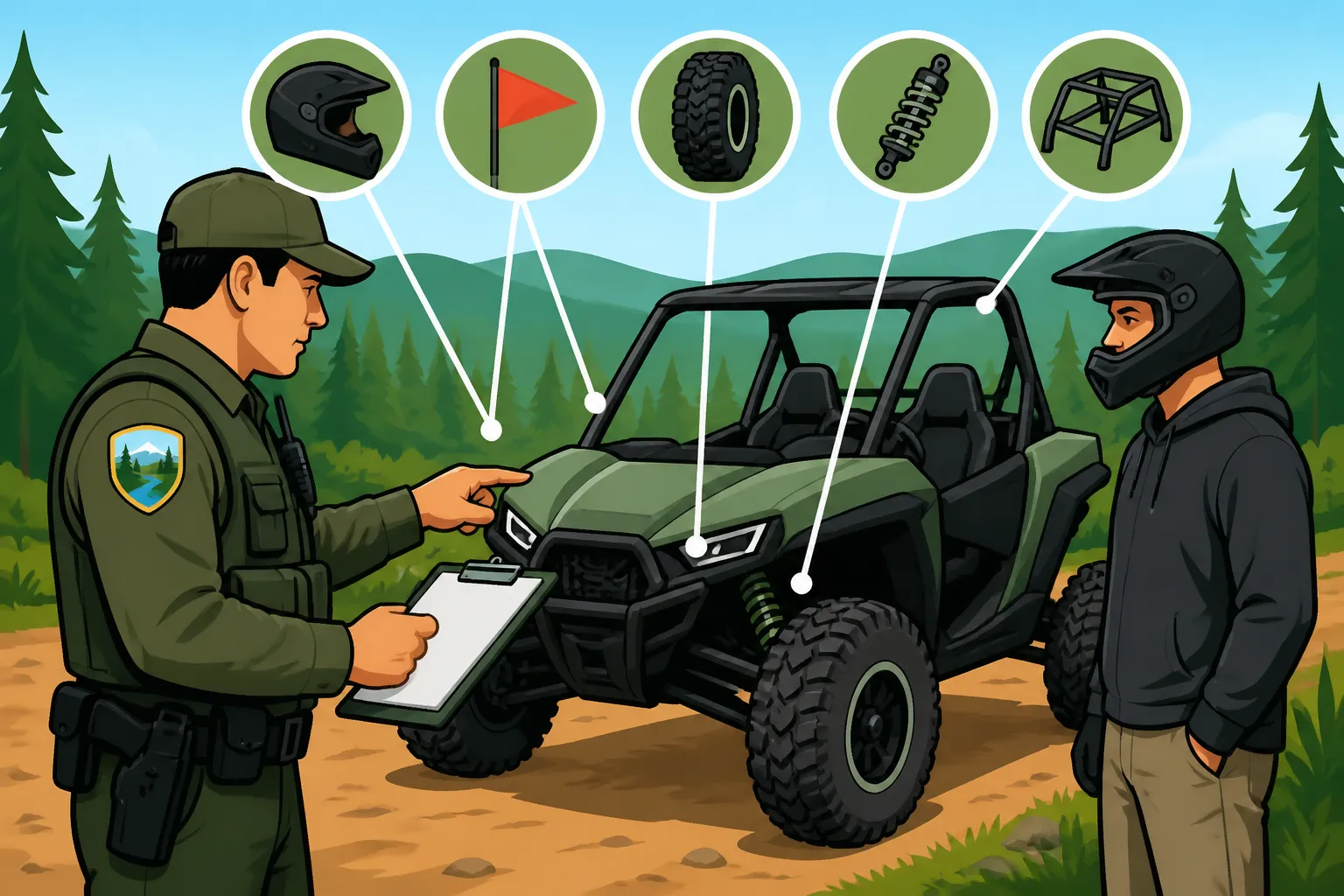
What an Environmental Police Officer Checks at a Trailhead
There's a unique knot of anxiety many of us feel when we pull up to a Massachusetts state forest trailhead, especially when we spot an Environmental Police Officer (EPO) vehicle. It's not about doing anything wrong, but more about the fear of unknowingly missing a detail, a piece of paperwork, or a rule. This guide is here to unravel that knot, giving you a clear, empathetic look at what EPOs are actually checking at the trailhead, so you can ride with confidence, knowing you're fully prepared and compliant with the Bay State's regulations.
The Initial Approach: What Officers Are Looking For at First Glance
When an Environmental Police Officer is at a trailhead, their first impression of your machine and your setup often starts before you even unload. They're trained observers, and there are several quick visual cues they'll take in that signal whether you're a prepared rider or someone who might need a closer look.
Visible Registration and Decals
The most immediate and obvious thing an EPO will look for is your Massachusetts registration. This isn't just about having a registration; it's about having the right registration, displayed correctly, and, crucially, current. They'll quickly scan for the distinctive registration sticker on your ATV or UTV. Is it present? Is it current, or has it expired? For Massachusetts residents, these are typically [Massachusetts Two-Year OHV Registration] stickers, good for two years. Non-residents, however, receive a one-year sticker, and it's vital to know the distinction as expiry dates differ significantly depending on your residency.
They'll also be checking for correct placement. Massachusetts has specific rules about where your decals should be affixed to your machine. Generally, they need to be clearly visible on both sides of the forward half of the vehicle. You can refresh your memory on the specifics by looking up [Massachusetts Decal Placement Rules]. The expiration decal, a smaller sticker indicating the month and year your registration is valid through, has its own spot, typically on the left side of your machine. An expired sticker, one that's peeling off, or a sticker that's placed incorrectly can all trigger an EPO to initiate a conversation, even if everything else is in order. It's such an easy thing to get right, yet often overlooked, leading to unnecessary delays.
General Machine Condition and Compliance
Beyond the sticker, an EPO will quickly assess the overall condition of your machine. This isn't about judging how new or old your ATV or UTV is, but rather its operational integrity and whether it meets basic safety and environmental standards. They'll be looking for glaring issues like broken headlights or taillights – especially if you plan to be out around dusk or dawn, as [Massachusetts Lighting After Sunset] mandates working lights. They'll also listen for excessively loud exhaust systems, which might indicate a modified muffler that doesn't comply with [Massachusetts Muffler Requirements]. A missing spark arrestor, a crucial component for preventing trailside fires, is another red flag EPOs are trained to spot and is legally required under [Does a Massachusetts Trail Machine Need a Spark Arrester?].
Visible modifications will also catch an officer's eye. While many riders enjoy customizing their machines with aftermarket parts, such as lift kits, larger tires, or performance upgrades from companies like SuperATV, it's essential that these modifications don't compromise the vehicle's safety or legal standing. For instance, while a wider stance might improve stability, it could make your machine too wide for certain trails, or it could impact its ability to safely navigate public road crossings if not handled correctly. An EPO isn't necessarily against modifications, but they are looking to ensure that the machine is safe to operate on public lands and complies with [Massachusetts Equipment Requirements]. It's always a good idea to ensure any aftermarket parts you install, even those from reputable manufacturers like SuperATV, don't inadvertently put you out of compliance with state regulations.
Beyond the Visual: Documentation and Rider Readiness
Once an EPO has completed their initial visual scan, their attention will often turn to the paperwork you're required to carry and the readiness of the riders themselves, particularly when it comes to age and safety training. This is where having your ducks in a row can make a world of difference between a quick nod and a prolonged stop.
Proof of Registration and Ownership
While the decal on your machine is the first visual cue, the actual registration card is the concrete proof you're required to carry. [Massachusetts Registration Cards Carried on Board] is a firm rule. This card details your machine's information, your name, and the dates of validity. Think of it like your car's registration; you wouldn't drive without it in your glove box, and the same applies to your ATV or UTV on the trails. If you can't produce the card, it can lead to delays and questions, even if your decal is present. While officers can often verify registration electronically, having the physical card handy demonstrates preparedness and respect for the regulations, making the interaction smoother and faster.
What happens if you don't have it? Not carrying your registration card can be considered a violation, and depending on the officer's discretion and other circumstances, it could result in a citation. Riding an unregistered machine, which is essentially what you're doing if you can't prove it's registered, carries [Massachusetts Penalties for Riding Unregistered]. It's a preventable hassle that can easily be avoided by making sure that card is tucked safely in a waterproof pouch in your pack or machine's storage compartment before every ride. Remember, Massachusetts issues a registration card, not a title, for OHVs, so that card is your primary proof of legal operation.
Rider Age and Safety Certificate Requirements
Massachusetts has some of the strictest laws in the nation regarding youth ATV and UTV riders, largely due to [Sean's Law and Massachusetts Youth Riders]. EPOs are keenly aware of these regulations and will pay close attention to the age of riders, especially those who appear to be minors. They'll be looking to ensure that anyone operating a machine is compliant with [Massachusetts ATV Age Requirements]. This means no riders under 14 on public land, and specific engine size restrictions for riders between 14 and 16 years old.
Furthermore, any rider under 18 years of age operating an OHV on public land must possess a valid Massachusetts Safety Certificate. This isn't just a suggestion; it's a mandatory requirement under [Massachusetts Safety Certificates Under 18]. Officers will often ask younger riders to produce this certificate. For riders under 16, there's an added layer: a parent or guardian must also have attended the safety course with them. [Massachusetts Parents Must Attend Under 16] is a critical detail many families overlook. If a young rider can't produce their certificate, or if they're too young to be riding, the consequences can be serious, ranging from fines to the machine being impounded. These rules are in place for the safety of all riders, especially the youngest and most vulnerable, and EPOs are diligent in enforcing them.
Helmet Law and Proper Gear
The Massachusetts helmet law for OHV riders is universal and non-negotiable. Every single rider, regardless of age, experience, or type of machine, must wear an approved helmet when operating an ATV or UTV on public or private land. This is a point EPOs enforce strictly, and it's covered under [Massachusetts ATV Helmet Law]. They'll be checking to ensure not only that you're wearing a helmet, but that it's a proper helmet – meaning it meets DOT (Department of Transportation) standards and is in good condition, free from major cracks or damage that would compromise its protective capabilities.
While other safety gear like goggles, gloves, sturdy boots, and long pants/sleeves aren't always legally mandated beyond the helmet, an EPO might still take note of your overall preparedness. A rider decked out in appropriate safety gear, including a quality helmet, not only looks more responsible but is also better protected in the event of an incident. It sends a clear message to an officer that you take your safety seriously. Ensuring you and your passengers are wearing the right gear is a fundamental aspect of safe riding and a quick visual check for any EPO at the trailhead.
Trail-Specific Rules and Common Infractions
Beyond the vehicle and rider readiness, Environmental Police Officers are also vigilant about enforcing rules specific to where and how you ride. These regulations are designed to protect the environment, ensure public safety, and maintain harmonious relationships with landowners and other trail users. Understanding these nuances is key to avoiding common pitfalls.
Landowner Permission and Designated Trails
One of the biggest areas of focus for EPOs, especially in a state like Massachusetts with a mix of public and private lands, is ensuring riders are on authorized trails and have proper permission. The Commonwealth has a strict "150-Foot Dwelling Rule," meaning you cannot operate an OHV within 150 feet of a dwelling or building without explicit, written permission from the owner. This rule is often misunderstood, but it's crucial for respecting private property and minimizing noise impacts on residents. [Massachusetts's 150-Foot Dwelling Rule] is enforced rigorously, and simply being "near" a house without permission can lead to a citation.
For riding on private land that isn't your own, [Massachusetts Requires Written Permission]. This isn't just a polite request; it's a legal mandate. An EPO might inquire if you have permission to access certain areas, especially if the trailhead borders private property. On public lands, like state forests, the rule is simpler: stick to designated trails. [Where Massachusetts Law Says You May Not Ride] clearly outlines areas where OHVs are prohibited. Officers regularly patrol these areas and will issue citations for riding off-trail, creating new trails, or entering areas marked as closed or environmentally sensitive. They want to see that you understand and respect the boundaries of legal riding areas, helping to preserve trails for everyone. Many riders appreciate the clear trail access provided by state forests, but that access comes with the responsibility of staying on the marked path.
Crossing Public Ways and Road Use
This is perhaps one of the most frequently misunderstood, and therefore most frequently violated, rules in Massachusetts. The law is crystal clear: ATVs and UTVs are not street legal in Massachusetts, and you cannot ride them on public roads, streets, or highways. Period. [Can You Ride an ATV on the Road in Massachusetts?] The answer is a resounding no, with extremely limited exceptions for crossing. EPOs know that many trail systems require riders to cross a public way to get from one section to another. They will be watching these crossing points very closely.
When crossing a public way, you must come to a complete stop, yield to all vehicular and pedestrian traffic, and proceed only when it's safe and direct, as outlined in [Massachusetts Rules for Crossing a Road]. The crossing must be at approximately a 90-degree angle to the roadway. You are not permitted to travel down the road for any distance, even a short one. This is a major enforcement priority for EPOs, as illegal road use is a significant safety hazard and a primary source of public complaints. Any attempts to circumvent this rule, such as riding along the shoulder or briefly traveling down a road, will almost certainly result in a citation under [Massachusetts Bans Riding on Public Ways].
Environmental Compliance and Respectful Riding
Environmental Police Officers, by their very title, are tasked with protecting Massachusetts' natural resources. This extends to how OHV riders interact with the environment. At a trailhead, an EPO might observe whether your machine is leaking fluids, which can contaminate soil and water. They'll also note if there's any litter around your staging area or if you appear to be preparing for activities that could damage the environment, such as riding through sensitive wetlands or stream beds.
Beyond the immediate trailhead, the expectation is that riders will practice responsible trail etiquette. This means staying on marked trails to prevent erosion, avoiding damage to vegetation, and respecting wildlife. Excessive noise, while often addressed on the trail, can also be observed at the trailhead if your machine is particularly loud upon startup, possibly indicating a non-compliant exhaust system. While specific sound limits aren't always checked with a meter at the trailhead, an officer's trained ear can pick up on an illegally modified system. Even aftermarket parts from brands like SuperATV, designed for performance, must still adhere to environmental regulations. A respectful approach to riding, adhering to designated trails, and leaving no trace are key elements of environmental compliance that EPOs are always keen to see from riders.
Consequences of Non-Compliance and Being Prepared
Encountering an Environmental Police Officer at a trailhead should ideally be a pleasant, even informative, interaction. However, if you're found to be non-compliant with Massachusetts OHV laws, the consequences can range from inconvenient to severe. Understanding these potential outcomes and, more importantly, how to avoid them, is crucial for any responsible rider.
Potential Penalties
The state of Massachusetts takes its OHV regulations seriously, and EPOs are authorized to issue citations for violations. These penalties can vary widely depending on the infraction. For instance, riding an unregistered machine or failing to carry your registration card can lead to fines. Violating the helmet law or the age restrictions, especially for young riders, can also result in significant financial penalties. For instance, [Massachusetts Fines for Riding Under 14] can be substantial, and the parent or guardian can be held directly liable under [Massachusetts Parent Liability for a Young Rider].
In more serious cases, particularly repeat offenses or dangerous riding behaviors, an EPO has the authority to impound your machine. This means your ATV or UTV could be seized, requiring you to go through a legal process and pay fees to retrieve it, as detailed in [Getting a Seized Quad Back From the State]. This is obviously a major disruption and expense that no rider wants to face. The overarching message is that while fines are a deterrent, the potential loss of your riding machine should underscore the importance of strict compliance with [Massachusetts Penalties for Illegal Riding].
Being Prepared for a Positive Interaction
The best way to avoid any negative consequences is, quite simply, to be prepared and knowledgeable. Before you even load your machine onto the trailer, make it a habit to run through a quick checklist:
| Check Item | Requirement/Action | Why it Matters |
|---|---|---|
| Registration Decal | Current, properly affixed on both sides, expiration decal on left. | First visual check for EPOs; indicates legal operation. |
| Registration Card | Carried physically on your person or machine. | Proof of ownership and registration; legally required. |
| Safety Certificate | Required for riders under 18; parents must attend for riders under 16. | Mandatory for young riders on public land; EPOs will ask for it. |
| Helmet | DOT-approved, good condition, worn by all riders/passengers. | Universal Massachusetts law; critical safety gear. |
| Machine Condition | Working lights, compliant muffler, spark arrestor. | Basic safety and environmental compliance; observed immediately. |
| Trail Knowledge | Know designated trails, private land boundaries, and crossing rules. | Prevents trespass, environmental damage, and dangerous road incidents. |
| Written Permission | For private land access or riding within 150 feet of dwellings. | Legal necessity; crucial for respectful land use. |
| Identification | Carry valid ID for yourself. | Standard procedure if questions arise. |
When an EPO approaches you, always be polite, cooperative, and respectful. Have your documents readily accessible; fumbling around for several minutes can be frustrating for both parties. Answer their questions truthfully and without argument. If you're unsure about a rule or a specific trail, asking polite, genuine questions before you ride, perhaps at a ranger station or through an ATV club, is always better than learning the hard way from a citation. Local clubs, like those within the [Massachusetts ATV Clubs Worth Joining] network, are fantastic resources for staying informed about trail conditions and rule changes.
Remember, EPOs are there to ensure everyone's safety and to protect the natural resources we all enjoy. A positive interaction stems from mutual respect and your demonstrated commitment to riding responsibly. By taking the time to understand and adhere to Massachusetts' OHV laws, you contribute to a better, safer riding experience for everyone, ensuring our beautiful trails remain open for generations to come.
Disclaimer
This article is for general informational purposes only and does not constitute professional advice. Laws, prices and regulations vary by location and change over time. Consult a qualified professional for guidance on your specific situation.