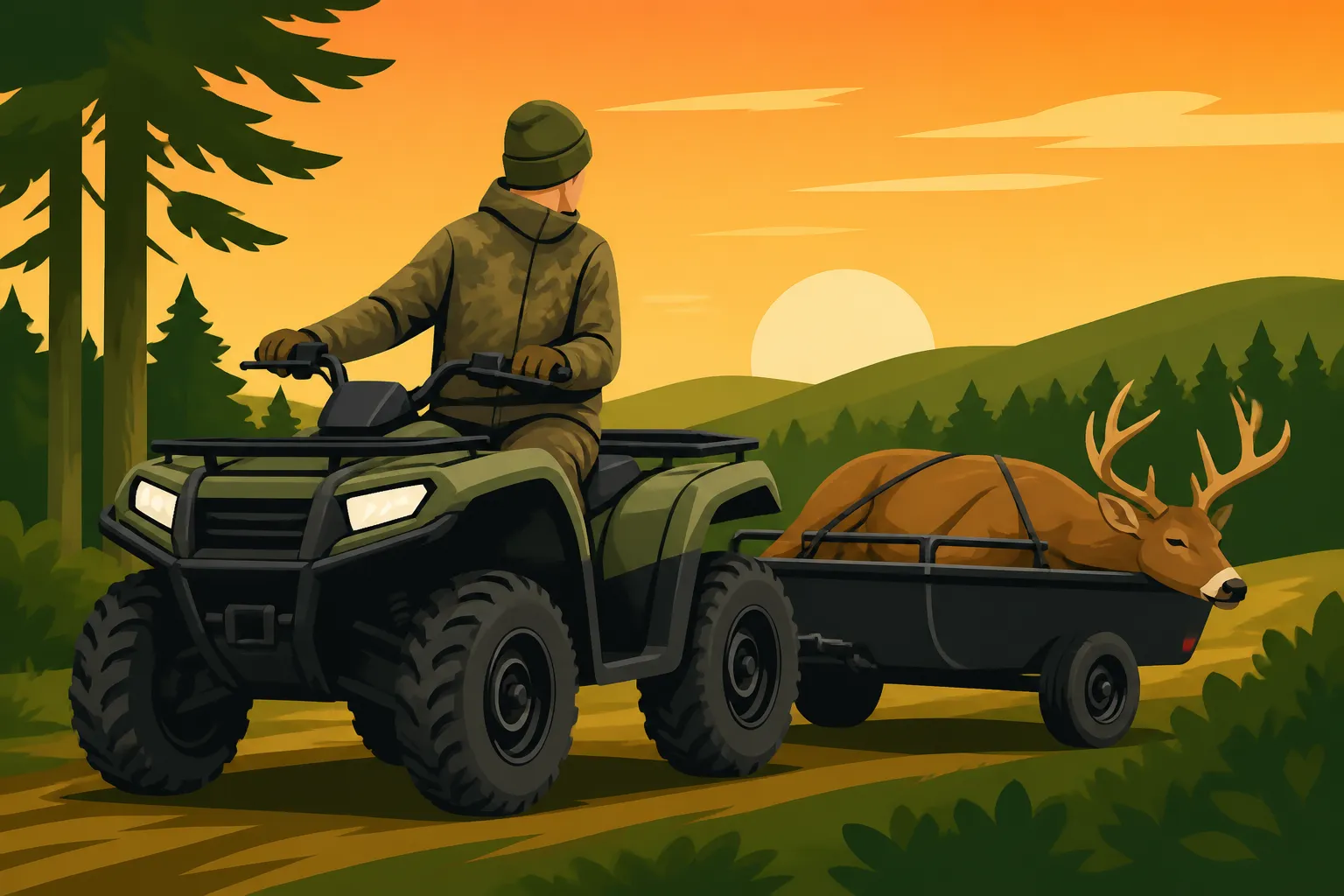
Retrieving a Deer by Quad on Private Ground
Retrieving a deer by quad on private ground in Massachusetts can save a difficult carry, but private property does not make every ride lawful. The key is to separate permission to hunt from permission to drive, then plan a route that respects vehicle rules, property boundaries and the deer’s harvest requirements. A few checks before the ride can prevent a recovery from becoming a trespass, safety or registration problem.
Private land does not mean unrestricted quad use
A landowner’s permission matters, but it is not a blanket exemption from state rules. Permission to hunt on a parcel does not automatically include permission to drive an ATV or UTV across it. If someone else owns the land, ask specifically before using a machine to retrieve a deer. If the route crosses more than one parcel, get permission from each owner.
A quad ride should be for recovering a deer that has already been lawfully taken. Do not use the machine to search for, pursue, harass or drive deer. Keep the activity separate from the hunt itself, and follow the current Massachusetts hunting rules for the season, location, license and permit involved. For a broader look at the distinction between permission to hunt and access to land, see Massachusetts Hunting License and Land Access.
Massachusetts also has rules for off-highway vehicles that can apply even when you are not riding on a public road. Registration, age, equipment and operating restrictions may still matter. Do not assume that a landowner’s consent, or the fact that the ground is private, replaces the requirements for the machine or rider. Start with Massachusetts ATV Laws Under Chapter 90B and Do You Need to Register an ATV in Massachusetts? if you need to check those basics.
The right to ride also depends on what kind of land it is and who controls it. A private parcel may have an easement, a shared driveway, a conservation restriction or another land-use condition that limits vehicle traffic. A trail or woods road may look like a convenient route without being open for quad use. Check who has authority to grant access and where that permission begins and ends.
| Situation | What to confirm before riding |
|---|---|
| You own the land | Whether other rules, easements, local restrictions or hunting rules affect the route |
| A landowner invited you to hunt | Whether that permission also includes using a quad for recovery |
| The route crosses another parcel | Permission from every owner whose land you will enter |
| The route uses a woods road or trail | Whether vehicle use is allowed there, not just foot access |
| The deer is near a public way | Whether the recovery route can stay off the way and avoid unsafe traffic |
| You would need to enter public conservation land | The managing agency’s current vehicle and access rules |
If the deer crosses a property line, do not follow it onto the next parcel by quad without permission. A hunting opportunity or a recovery need does not itself grant access to someone else’s land. Stop at the boundary, contact the owner and agree on what route and vehicle use are allowed. Written permission is especially useful when several people are involved or the property line is not obvious.
The same caution applies if a private parcel borders public land. Permission from the private owner does not authorize a ride across state forest, town conservation land or another public area. Check the rules for that specific property before using it as a shortcut. Massachusetts Wildlife Land Machine Rules explains why access for wildlife-related activities should not be treated as automatic vehicle access.
Get clear permission and plan the recovery route
Before the hunt, discuss recovery plans with the landowner. A quick conversation can clarify whether the quad may be used, who may drive it, where it can travel and what to do if the deer ends up somewhere unexpected. If you are the owner, make the same decisions for guests rather than leaving the route to guesswork after dark or under pressure.
Permission should cover the details that can cause disagreements later:
- The specific ATV or UTV and who will operate it
- The areas where the machine may travel, including any existing woods roads
- Whether the machine can leave the established route to reach the deer
- Which gates may be opened and whether they must be closed afterward
- Whether the machine may be used after sunset or in poor weather
- How to handle a recovery if the deer crosses a boundary
- Whether the owner wants to be contacted before the ride begins
A text or written note can help make the arrangement clear. It does not override state law, but it can reduce misunderstandings about the landowner’s consent. The details in Massachusetts Landowner Permission Forms may help when you want a more formal record of access.
Walk or map out the intended route before relying on it. Look for stone walls, wire, wet ground, steep slopes, soft shoulders, culverts and narrow gates. A route that seems easy on foot may be unsafe for a machine carrying a rider and towing or transporting a deer. Avoid cutting across planted areas, lawns, wetlands or sensitive ground unless the owner has clearly approved it and the use is lawful. The landowner may also have concerns about rutting, erosion, crops or damage to a stone wall.
When possible, agree on a route that stays on an existing track and avoids unnecessary turns. A tight turn on wet or sloped ground can damage the surface or tip a machine. If the route is not suitable for the quad, use another lawful recovery method rather than forcing the machine through.
If a gate is locked, do not treat it as an invitation to go around it. A locked gate may protect private property, livestock, equipment or a public resource. Ask the owner before opening or bypassing it. For more on interpreting access restrictions, see What a Locked Gate on a Woods Road Means.
Before the hunt, also confirm that the planned route does not depend on riding along a public way. Massachusetts does not provide a general street-legal path for an ATV simply because a short road segment would make retrieval easier. Massachusetts Rules for Riding Private Land covers the private-land side of the issue, while Massachusetts Bans Riding on Public Ways explains why a route that spills onto a road needs a separate legal basis.
Operate the machine as a recovery tool, not a shortcut
A recovery ride is often slower and more awkward than ordinary trail riding. The deer may be on a slope, in brush or far from the established route. A quad can help, but it can also create a rollover risk, injure the operator or damage property if the recovery is rushed.
Choose a machine and route that fit the terrain. A side-by-side is wider and may not fit through a narrow opening or between trees; an ATV may be easier to maneuver but can be less stable when loaded or operated on a side slope. Do not assume that a machine that fits through a gate can safely manage the ground beyond it. Check the manufacturer’s operating guidance and use the machine’s intended carrying or towing equipment rather than improvising a load that could shift.
Keep the operator within the applicable age and safety rules. Do not let an unqualified or inexperienced rider take over because the recovery feels urgent. A passenger should ride only if the machine is designed for passengers and the ride is lawful. Helmets and required safety equipment should be used, and the machine should be in sound operating condition. The relevant requirements are not suspended for a short trip across private ground.
Before starting, check basics that matter more on a recovery than a normal ride:
- Tires, brakes, steering and lights
- Fuel and battery condition
- A communication method that works where the machine will travel
- A first-aid kit and suitable clothing for the weather
- The machine’s approved cargo or towing capacity
- A way to secure the deer without blocking controls, lights or the operator’s view
Avoid carrying a load that makes the machine unstable or prevents safe steering and braking. If you cannot secure the deer properly, do not ride with it in that position. Make more than one trip if necessary, or use a different method. Never allow a load to drag in a way that could snag on brush, catch a wheel or shift suddenly.
Use extra care in low light. A route that is familiar in daylight can look different after sunset, and an animal or load can obscure visibility. Do not ride faster than the terrain and conditions allow. Stop if the machine begins to slide, bog down or feel unstable; forcing it onward can turn a manageable recovery into an injury or property-damage incident. If conditions are poor, wait for help or choose a safer method.
The operator should not ride while impaired, and no one should handle a firearm carelessly during the recovery. Keep people clear of the machine’s path, especially when reversing or maneuvering around the deer. Agree on hand signals or another clear way to communicate before the engine is running, since noise can make ordinary conversation difficult.
Keep the ride within the permission given and on land where the vehicle is allowed. If the route must change, stop and get approval before entering a new area. A last-minute shortcut across a neighbor’s land is still a separate access decision. For more on the boundaries of permitted private-land riding, see Massachusetts Rules for Riding Near a House.
Handle the deer and finish the trip carefully
A machine can help with transport, but it does not change the rules for the deer itself. Follow the current Massachusetts deer permit instructions for tagging and reporting. Complete the required steps at the stage specified by those instructions, and do not assume that the deer’s movement by quad substitutes for a tag, check-in or harvest report. When unsure, check with the Massachusetts wildlife agency before transporting the animal.
Plan the recovery so the deer is not left unsecured while you go for a machine or help. If the animal is not clearly dead, do not approach carelessly. Consider personal safety, local hunting rules and the possibility that the animal could move. Keep bystanders away and avoid placing anyone between the deer and an escape route.
A simple recovery sequence can help keep the work controlled:
- Confirm the deer was lawfully taken and identify the land where it lies.
- Contact the landowner if the machine route or access was not already agreed.
- Check the current harvest-tagging and reporting instructions.
- Inspect the route, ground conditions and machine before loading or towing.
- Use a capable operator and secure the deer so the machine remains controllable.
- Stop if the route becomes unsafe or would require unapproved access.
- Complete required harvest reporting and leave gates, land and equipment as agreed.
If the deer is on another person’s property, wait for permission rather than entering with the quad. If permission is refused or the owner cannot be reached, do not assume that urgency gives you a right to cross the boundary. Ask the relevant authorities what lawful options are available.
After recovery, check the route for damage and remove any equipment or debris. Close gates as agreed, report any damage promptly and follow the landowner’s instructions about where to park or clean the machine. Mud, plant material and debris carried back on a quad can also affect other land, so clean the machine appropriately before moving to another property.
The safest approach is to settle the legal and practical questions before the hunt: permission to ride, a route that stays within authorized land, a machine and operator suited to the conditions, and a plan for the deer’s tagging and reporting. That preparation makes quad recovery more predictable without treating private ground as a free-for-all.
Disclaimer
This article is for general informational purposes only and does not constitute professional advice. Laws, prices and regulations vary by location and change over time. Consult a qualified professional for guidance on your specific situation.