Massachusetts Penalties for No Certificate
A missing ATV or UTV safety certificate can turn a ride into an enforcement problem, especially for someone under 18. The tricky part is that certificate rules sit alongside age limits, registration requirements and trail rules, so one document does not settle every question. Here’s what a no-certificate violation may mean, who should carry proof, and what to do if an officer asks for it.
What can happen if you ride without a certificate
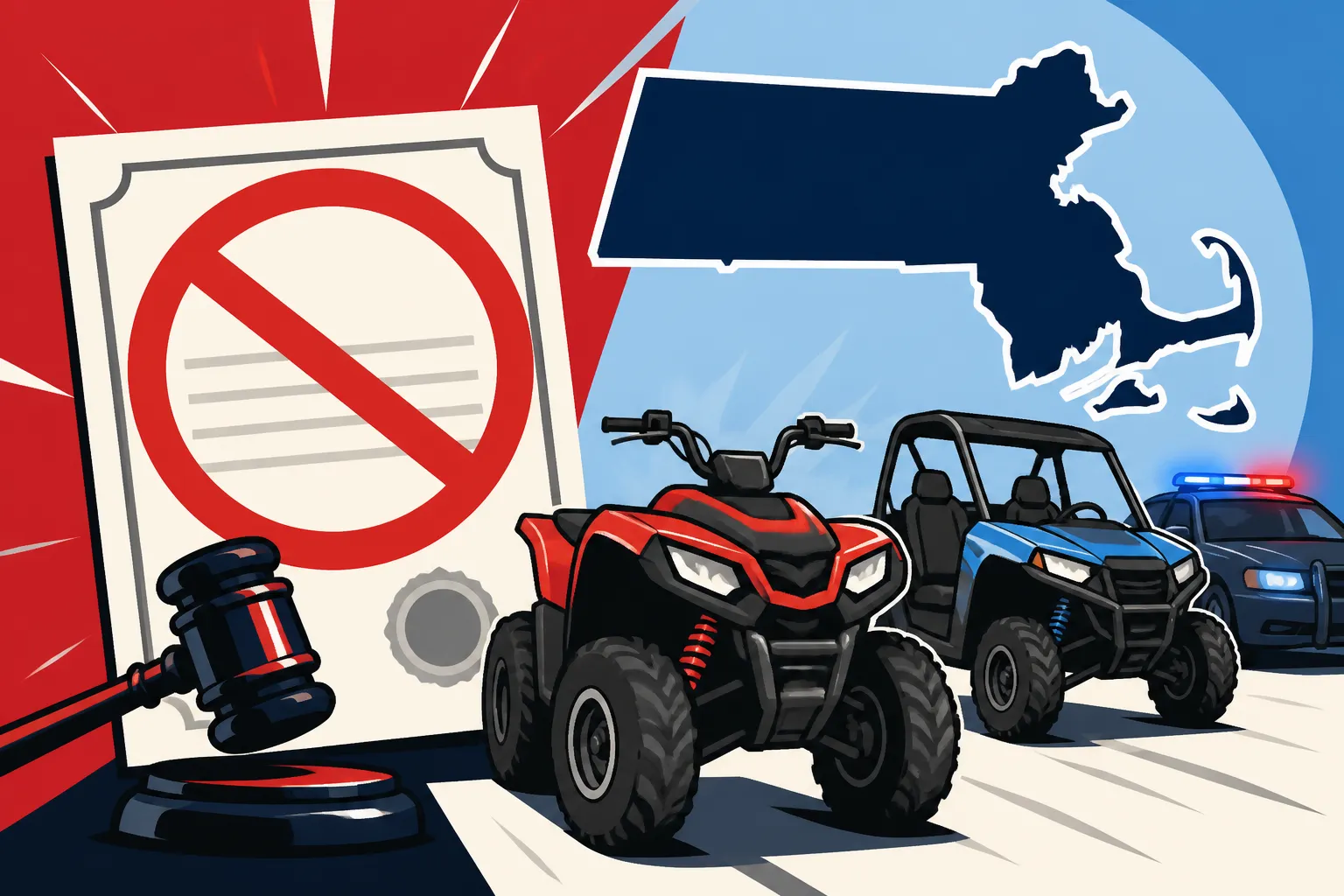
Massachusetts requires young off-highway vehicle riders to meet safety-certificate rules. If a rider who is required to have a certificate cannot produce it when asked, the rider may be cited for a violation. A fine may follow, depending on the charge and circumstances. The amount and consequences can depend on the specific rule involved, so confirm current requirements with the Massachusetts Environmental Police before riding.
A certificate violation is not the same as a registration violation. Registration establishes that the machine is registered under the state’s rules; a safety certificate shows that a rider completed the required safety education. One does not replace the other. Riders also need to follow rules about where they may ride, age limits, supervision, helmets and other equipment. A valid sticker cannot make an otherwise illegal ride legal, and a certificate does not grant access to a closed or unauthorized trail.
| Situation | What it may mean | What to check |
|---|---|---|
| A rider required to carry a certificate cannot show it | The rider may receive a citation for the certificate violation | Whether the rider must carry proof in that situation and what proof is accepted |
| The rider is under the legal minimum age for the activity | A certificate does not remove the age restriction | The age rule and any narrow sanctioned-event exception |
| The machine has no required registration | This is a separate issue from the rider’s certificate | Registration status, decal and card requirements |
| The ride takes place on land where riding is prohibited | A certificate does not authorize access | Land rules, written permission and trail closures |
| An adult is supervising a young rider | Supervision does not automatically waive certificate or age rules | The rider’s age, required certificate and supervision conditions |
Officers may ask a rider to show documents or explain whether the rider meets applicable requirements. Keep required proof accessible, and answer questions calmly. An officer’s request may cover more than the certificate; for example, an officer may also check registration, age-related restrictions or whether the machine is allowed on that trail. For a closer look at possible inspection questions, see What an Environmental Police Officer Can Ask.
A citation does not necessarily mean the same outcome in every case. The officer may be enforcing a certificate rule, a separate operating restriction, or several rules at once. Read the paperwork carefully: the cited section and instructions for responding matter more than a general description of the stop. If you are unsure what a citation alleges, ask the issuing agency or consult a qualified Massachusetts attorney rather than assuming it concerns only the missing certificate.
It also helps to separate a missing document from a missing qualification. A rider may have completed the required course but left the certificate at home; another rider may not have completed it at all. Those are different practical problems, but either can leave the rider unable to promptly demonstrate compliance. Do not assume an officer can look up a certificate during a roadside stop, or that a photo on a phone will necessarily be accepted. Check what proof the state accepts and carry it in the form required.
A missing certificate can also draw attention to other violations. If a young rider is operating an oversized machine, riding without required supervision, or using a trail that does not permit the vehicle, those issues are separate from the certificate. The state’s youth rules are strict, and a certificate does not override them. Read Massachusetts Rules for Young Riders on Public Land and Massachusetts Penalties Under Sean’s Law if the ride involves a young rider or questions about age-related restrictions.
Who needs a certificate and when to carry it
Certificate rules depend on the rider’s age and the kind of riding. Massachusetts has specific requirements for young OHV riders, including rules for riders under 18. The safest approach is to verify the rule for the rider’s exact age and riding situation before heading out, then carry proof whenever the rules require it. See Massachusetts Safety Certificates Under 18 and Riders Under 18 Must Carry the Certificate for details on the age-specific requirement.
Age restrictions are a separate and important part of the picture. A certificate is not permission for a child to ride an ATV or UTV at any age. Massachusetts restricts riding by younger children, with narrow exceptions for certain sanctioned events. A parent or adult should check both the rider’s age rule and the certificate rule rather than treating course completion as a blanket approval.
The machine matters, too. A rule that applies to an ATV may not translate neatly to every type of off-highway vehicle or event. If the rider will use a side-by-side, a youth quad, a dirt bike or a machine at a sanctioned event, confirm the applicable requirements for that specific activity. Do not rely on advice intended for a different vehicle or setting.
Certificate rules are especially easy to confuse with registration and trail access. Massachusetts requires its own registration in relevant circumstances, and an out-of-state sticker is not a substitute for Massachusetts registration where state registration is required. Registration, a safety certificate and permission to ride are separate pieces of the compliance picture. Review Massachusetts Requires Its Own Registration before bringing a machine into the state.
For youth riders, check these points before leaving home:
- Confirm the rider’s age category. Do not assume the rule for one age group applies to another. Requirements and exceptions can differ.
- Check whether the planned riding is allowed. A completed course does not erase minimum-age rules or authorize riding outside an approved event.
- Confirm the course requirement. Use the state’s current safety-course information to determine what must be completed and what documentation is issued.
- Carry the required proof. Keep the certificate where the rider can produce it, not only in a parent’s vehicle or at home.
- Check the machine and trail rules separately. Confirm registration, permitted vehicle type, trail status and any landowner permission needed.
The certificate process may involve more than one course component. Review Two Parts to the OHV Safety Certificate and How to Get a Massachusetts Safety Certificate for an overview of how the process works. Course schedules can change, so check the current state information before making plans. Completing a course shortly before a ride is not a good substitute for confirming that the rider has received acceptable proof.
Parents and supervising adults should not rely only on a verbal assurance that the rider “took the class.” Make sure the certificate has actually been issued, that the rider’s details are correct, and that the rider can access the proof during the ride. If a certificate is lost or delayed, contact the appropriate state office or course provider before riding rather than assuming an enrollment confirmation will count.
How to avoid a certificate problem or respond to a citation
The easiest way to avoid a roadside dispute is to check requirements before the trip and carry the necessary documents. A short pre-ride check is particularly useful when a young rider is involved, when the machine is visiting from another state, or when the group is going to a new trail system.
Before leaving, verify the rider’s age-specific certificate requirement through current Massachusetts guidance. Confirm that the rider has the issued certificate, not simply a course booking or a note from a parent. Keep it somewhere dry and easy to reach. If carrying a paper document, protect it from rain and mud; if you plan to rely on a digital record, first confirm that the state accepts it in that form.
Check the other requirements separately. Confirm that the machine has the registration required for the ride, that its decals and card are in order, and that the planned route allows that type of vehicle. A Massachusetts certificate does not automatically satisfy another state’s rules, and a certificate from another state should not be assumed to meet Massachusetts requirements. For visitors, Massachusetts Safety Certificates Under 18 is a useful place to start, but confirm the rules for the rider and route directly with the state.
If an officer says a certificate is missing, stay calm and ask which requirement the officer believes has been violated. Provide the documents you do have, but do not argue roadside or offer guesses about what the rule says. If the officer issues a citation, keep the paperwork and note the date, location, vehicle and circumstances while they are fresh in your mind. Follow the response instructions and deadline printed on the citation, and do not ignore it because you believe the rider completed a course.
Afterward, find out what the citation actually alleges. Was the rider required to have a certificate? Was the certificate completed but not available? Was there also an age, supervision, registration or trail-access issue? The answers can affect what documentation is useful and what next step makes sense. If the facts are disputed or the consequences could be significant, get legal advice from a qualified professional familiar with Massachusetts law.
If the rider completed the course but does not have the certificate, contact the course provider or responsible state office to ask how to obtain replacement or confirmation documentation. Keep any response and follow the official instructions. Do not alter a document, use another person’s certificate, or assume an unrelated course card is acceptable.
If the rider has not completed the required course, arrange it before the next ride. Until the rider has satisfied the applicable requirement, choose an activity that does not put them in violation of the rules. A parent riding alongside, a private property setting or a machine with a smaller engine does not automatically eliminate certificate or age requirements; check each rule that applies to the planned activity.
Keep a simple document check for every rider in the group:
- Required safety certificate and proof it belongs to that rider
- Registration documents for the machine, where required
- Any permission or access paperwork required for the land
- Contact information for the responsible adult, especially for a young rider
- Current information on the route, closures and vehicle restrictions
This routine is more reliable than trying to sort out a certificate question at a trailhead. Requirements can differ by age and activity, and rules may change. When in doubt, confirm the current requirement with the Massachusetts Environmental Police or another appropriate state office before riding. A few minutes spent checking paperwork can prevent a preventable citation and help keep a young rider within the rules.
Disclaimer
This article is for general informational purposes only and does not constitute professional advice. Laws, prices and regulations vary by location and change over time. Consult a qualified professional for guidance on your specific situation.