Meeting Horses on an October Mountain Fire Road
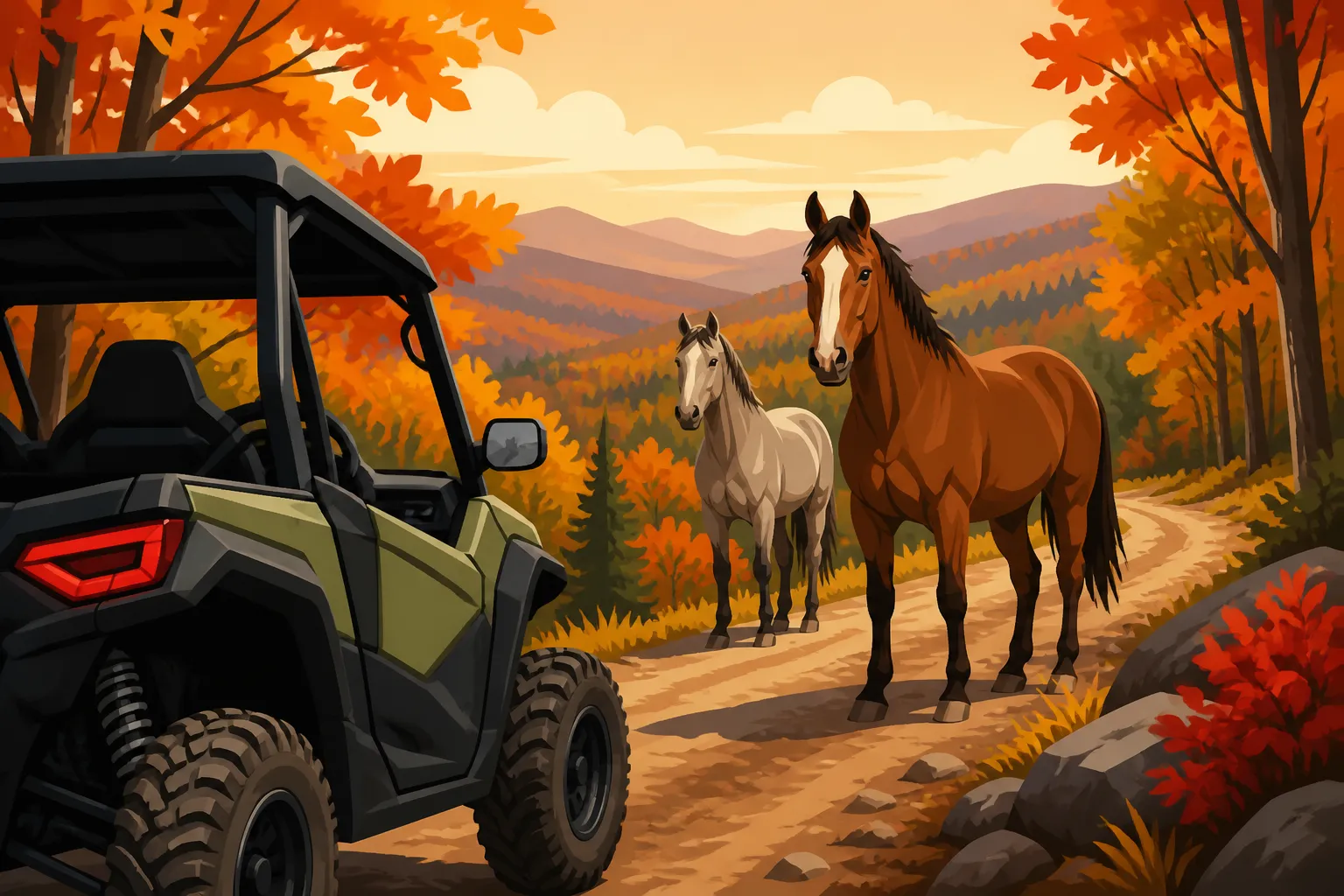
Meeting a horse on an October Mountain fire road can feel tense when your ATV or UTV is noisy, the trail is narrow, and there is nowhere obvious to pull over. The safest response is to slow early, stop well back, give the horse space, and wait for the rider’s direction before moving again.
Why horses and off-highway vehicles need extra care on October Mountain
A quiet fire road can still be a shared space
October Mountain State Forest sits in the Berkshires, where forest roads and trails can wind through wooded, hilly terrain. A stretch that feels empty one moment may bring you around a bend toward hikers, riders on horseback, or another off-highway vehicle. Dust, limited sightlines, and uneven shoulders can make a routine encounter feel surprisingly close.
Do not assume that every fire road is open to every kind of use. Access can depend on the specific route, current restrictions, posted signs, and land-management rules. Follow the signs at the trailhead and along the route, and check official forest information before hauling your machine to the area. October Mountain State Forest Riding in Massachusetts offers a useful starting point for understanding the riding area, while Massachusetts Trail Planning and Closures is relevant when conditions or access may have changed.
A map can help you prepare, but it cannot grant permission to use a route. If you use onX Offroad to plan a ride, compare the displayed route with current signs and official guidance. Treat the map as a navigation aid, not as proof that horses, ATVs, or UTVs are permitted on a particular section.
Why an approaching ATV can alarm a horse
A horse may react to an engine before the rider can see the machine clearly. The sound may echo through the trees, while the vehicle’s movement, vibration, and dust can add to the horse’s uncertainty. Even a calm horse can startle if a machine suddenly appears around a bend or accelerates nearby.
Horses are large, but that does not make them predictable around unfamiliar noise. A startled horse may sidestep, turn, bolt, or kick. The rider may have only a moment to respond, particularly on a narrow road with a slope, ditch, or soft shoulder. That is why the goal is not simply to avoid a collision; it is to give the horse and rider enough time and room to stay in control.
The same caution applies in a side-by-side. A UTV’s size and engine noise can feel imposing from horseback, and passengers may not realize how close the vehicle is to the animal. Keep the group quiet, avoid leaning out or making sudden gestures, and make sure everyone understands that the machine stays stopped until the rider says it is safe to proceed.
What to do when you meet a horse on a fire road
Slow down and stop before the horse feels crowded
As soon as you see a horse or hear the rider, ease off the throttle and reduce your speed smoothly. Do not race toward the group to find a place to pull over. Stop at a distance that gives the rider room to assess the situation and tell you what would help.
If you can safely move out of the horse’s path, do so slowly and without climbing onto an unstable bank or blocking the rider’s route. On a narrow road, the best place to wait may be a wider, level area behind you rather than trying to squeeze past. Keep enough room for the rider to turn or lead the horse away if needed.
Once stopped, turn off the engine if doing so is safe and practical. Avoid revving, honking, or calling out loudly. If the rider speaks to you, answer in a calm voice. Keep pets secured and passengers seated; a dog barking or someone stepping suddenly into the road can add another source of surprise.
Ask the rider before passing
There is no single passing maneuver that works for every horse or every trail. A rider may prefer that you stay put while they lead the horse past, or they may ask you to move to a particular side. Follow their instructions rather than guessing. If you cannot hear one another, use a calm, brief signal and wait for a clear response.
Only pass when the rider has indicated that it is safe. Move slowly and steadily, leaving as much space as the road allows. Do not accelerate sharply once you are alongside or immediately after passing. Give the horse time to see and hear the machine, and avoid throwing dust toward the animal or rider.
If the rider does not wave you through, keep waiting. It may be inconvenient, especially if other riders are behind you or you are trying to keep to a schedule, but a short pause is far safer than a rushed pass. For more on courteous encounters in shared spaces, see Massachusetts Trail Etiquette Locals Expect and Yielding on a Narrow Berkshire Trail.
| Situation | Safer response | Avoid |
|---|---|---|
| You hear or see a horse ahead | Slow smoothly and stop well back | Charging forward to find a passing spot |
| The road is narrow | Wait for the rider’s direction and keep the route clear | Squeezing past or forcing the horse onto a slope |
| The horse seems unsettled | Shut off the engine if safe and stay quiet | Revving, honking, or making sudden movements |
| The rider signals you to pass | Move slowly with ample space and steady throttle | Accelerating beside the horse |
| You are unsure what the rider wants | Ask calmly and wait for a clear answer | Assuming a wave or movement means “go” |
How to prepare for shared trail encounters
Ride so you can stop in time
On a forest road, visibility can change quickly around turns, rises, and dense vegetation. Keep your speed low enough to stop within the distance you can see clearly. If dust, darkness, rain, or rough ground reduces visibility, slow further. A rider who is prepared for an encounter has more options than one who arrives at it at speed.
Pay attention to trail signs and other users, not only the line immediately ahead of your tires. Where sightlines are limited, avoid sudden acceleration and be ready to stop. A passenger can help watch for activity, but the driver remains responsible for controlling the machine and should not rely on a passenger to direct the vehicle from outside it.
Before leaving home, check the route and access information for the forest. onX Offroad can be useful for planning and following a route, but posted signs and official land-management instructions take priority. If the map and the sign disagree, follow the sign and confirm the route with the appropriate forest contact before continuing. You can also review Massachusetts Trail Conditions Before You Tow and Massachusetts DCR Riding Season as part of trip planning.
Make the machine less startling
A well-maintained machine is easier to manage during a close encounter. Check that the brakes work, that the throttle responds predictably, and that the exhaust system is in proper condition. Massachusetts rules address equipment such as brakes and mufflers, and forest or riding-area requirements may add further expectations. The relevant background is covered in Massachusetts Equipment Requirements.
Keep your group’s riding orderly. Leave space between machines so a horse rider is not confronted by a tightly packed line of vehicles. If the lead rider stops, the rest of the group should stop too, without crowding the horse from behind. Avoid unnecessary engine noise while waiting, and do not let a machine idle close to the animal if it can safely be shut off.
If you are new to a route, pause at the trailhead to review the map, signs, and planned turnaround point. onX Offroad may help you keep track of where you are, but it does not replace a paper map, a charged phone, or common-sense route planning in an area where signal may be limited. Make sure the group knows how to regroup if someone stops and agrees not to pass another rider or trail user without a clear view ahead.
What to do after the encounter
Give the horse time to settle before moving again
Once you have passed, do not immediately accelerate away. Move a safe distance ahead at a controlled pace, then continue normally only when the rider and horse are no longer close to your machine. If the horse is still unsettled, stop again if needed and let the rider choose how to proceed.
Keep the encounter brief and respectful. There is no need to crowd the horse to ask questions, touch it, or take a close photo. If the rider wants to talk, wait until they have brought the horse to a comfortable stop. A friendly greeting is welcome when it does not distract the rider or put you in the horse’s space.
If you encounter multiple horses, do not assume that one has passed and the rest will follow immediately. Stay stopped until the rider confirms the whole group is clear. This is especially important on a bend or narrow section where the last horse may be partially hidden from view.
Report a hazard without escalating the situation
If a road is blocked, a sign is confusing, or you see a condition that could create a safety problem, note the location and report it through the appropriate forest or land-management contact. Do not move barriers, ignore closures, or create a new route around an obstruction. A detour made to avoid waiting can damage the trail and put riders or other visitors in danger.
When you plan another visit, check the access information again rather than relying on memory from a previous ride. Conditions and restrictions can change, and a route that was open on one visit may not be appropriate later. For wider context on sharing public forest routes, Sharing a State Forest Trail With Hikers explains why patience and clear communication matter among different trail users. If you reach a closed or gated road, What a Locked Gate on a Woods Road Means is a useful reminder to stop and respect the restriction.
The practical rule is simple: slow down early, stop where you have room, keep the engine quiet, and let the horse’s rider decide when passing is safe. That small pause can prevent a frightening encounter and help keep October Mountain’s roads welcoming to everyone who is allowed to use them.
Disclaimer
This article is for general informational purposes only and does not constitute professional advice. Laws, prices and regulations vary by location and change over time. Consult a qualified professional for guidance on your specific situation.