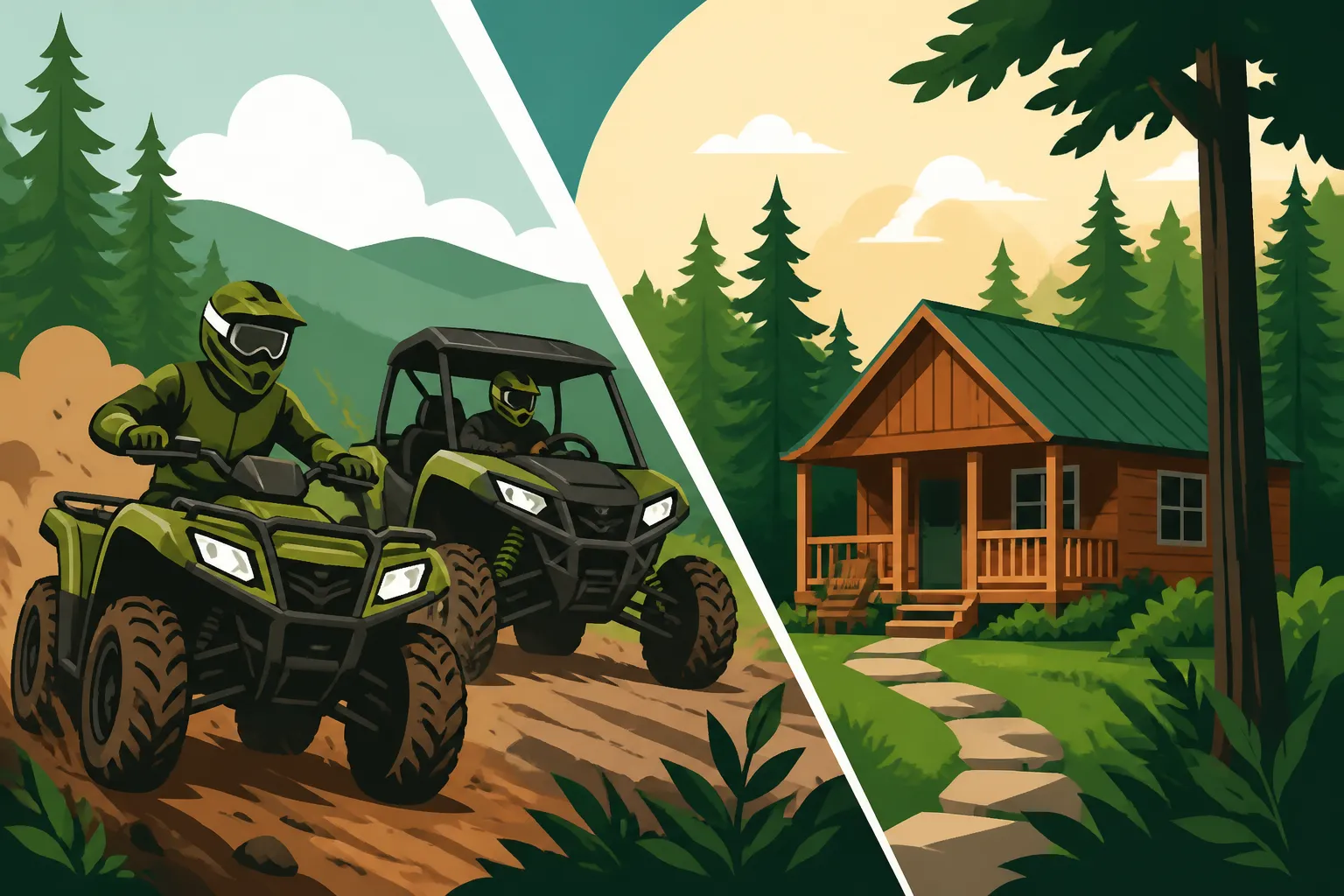
Massachusetts Cabins at State Forests
Planning a Massachusetts ATV or UTV weekend around a state-forest cabin takes more than finding a roof near a trail. Cabins, camping areas, and legal riding areas do not always share the same entrance or rules, and a short-looking drive can involve a trailer, unfamiliar roads, or limited services. This guide explains how to choose a base, check access, and plan a smoother stay.
What to Know About Cabins at Massachusetts State Forests
Cabin availability and riding access are separate questions
A state-forest cabin can make a comfortable base for a riding trip, but its location does not automatically mean ATVs or UTVs may be ridden from the cabin to a nearby trail. A forest may offer lodging while prohibiting OHV use on most roads or trails within its boundaries. Riding access is typically limited to designated areas and routes, so check both the lodging rules and the riding rules before you reserve.
This distinction matters when you are towing a machine. A cabin may be close to an OHV riding area on a map but still require you to load the machine onto a trailer and drive to the authorized trailhead. Even if a road looks like a convenient connection, don’t assume it is open to ATVs. Confirm that the route is legal for your machine and that the trailhead has appropriate parking.
For a broader look at lodging options and how to think about distance, start with [Massachusetts Cabins Near a Forest] and [Massachusetts Camping Near Riding Areas]. They can help you compare a state-forest stay with a nearby campground or other local lodging. The key question isn’t simply “Is there a cabin in the forest?” It’s “Can we stay here comfortably and get our machines to a legal riding area without surprises?”
Check the specific property, not just the forest name
A forest name can describe a large area, while a cabin, campground, parking lot, and riding entrance may all be in different places. Search for the exact lodging site and the exact trailhead you plan to use. Then check the driving route between them, including whether there is room to turn around with a trailer and whether the route uses public roads suitable for your vehicle.
It also helps to confirm what “cabin” means at the property. Some accommodations are simple and rustic; others may have different sleeping arrangements or facilities. Don’t assume a cabin includes cooking equipment, linens, reliable cell service, or a private bathroom. Read the current property description, review its rules, and contact the managing office if an important detail is unclear.
When your lodging and riding plans involve separate locations, build that into the day’s schedule. For example, a group arriving after work may need to unload at the cabin, check the route, and stage machines at the trailhead the next morning. That can be more realistic than expecting to roll straight from the cabin door onto an OHV trail.
Treat the cabin as a base, not permission to ride
State forests are shared spaces. A cabin area may be used by families, hikers, campers, and other visitors who are not there to ride. Keep machines on approved routes, follow posted instructions, and avoid revving or warming them up near sleeping areas. Even legal riding can become a source of conflict if loading, unloading, or late-night noise disturbs other guests.
Ask about parking and trailer arrangements before you arrive. A cabin’s standard vehicle space may not be designed for a truck and a long trailer, and the campground may have rules about where trailers can be parked. If you are traveling with more than one machine or vehicle, clarify how many can be accommodated and whether any separate parking rules apply.
It’s also wise to arrive with a backup plan. If a trail is closed, a parking area is full, or weather affects the route, a cabin reservation doesn’t guarantee that a particular ride will be possible. Check [Massachusetts Trail Conditions Before You Tow] before leaving home and again before committing to a long drive into the Berkshires.
Choosing a State-Forest Base for an ATV or UTV Trip
Compare lodging, trail access, and towing logistics
Choosing a cabin is a balancing act. A place that is appealing for its quiet setting may be farther from the legal riding area than expected. Another option may be convenient for driving but offer fewer cabin amenities or limited availability. Think about the entire trip: where you’ll sleep, where you’ll park, how you’ll reach the trail, and whether food, fuel, and repair help are practical to reach.
The table below is a planning aid, not a claim that every property offers the same facilities or that every forest allows OHV riding. Confirm the current accommodation details and trail rules directly with the relevant property or land manager before booking.
| Planning factor | What to check | Why it matters |
|---|---|---|
| Cabin location | Exact address or reservation map pin | A forest may cover a wide area, and the cabin may not be near the riding entrance |
| OHV access | Designated trails, open dates, and permitted vehicle types | A nearby forest road is not automatically an authorized ATV or UTV route |
| Trailer parking | Space, turning room, and overnight parking rules | A cabin’s vehicle area may not fit a truck and trailer |
| Cabin facilities | Sleeping setup, kitchen access, bathroom, and utilities | “Cabin” can mean a simple shelter rather than a fully equipped rental |
| Travel route | Drive time and road suitability from lodging to trailhead | Towing changes how easy a route feels, especially on narrow or unfamiliar roads |
| Backup options | Other legal riding areas, lodging, or trip dates | Closures and weather can affect plans even when the cabin remains available |
For route planning, an app such as onX Offroad can help you review terrain and organize waypoints, but treat it as a planning aid rather than permission to ride. Confirm access with the land manager and follow posted signs. A line on a map does not establish that a route is open to your vehicle.
Consider October Mountain, Beartown, and Pittsfield separately
The Berkshire OHV areas often discussed by riders include October Mountain, Beartown, and Pittsfield State Forests. Each is its own destination, with distinct trail layouts, access points, and conditions. Before reserving a cabin, match the lodging location to the riding area you actually intend to visit rather than assuming one forest makes a convenient base for all three.
If October Mountain is your main goal, review [October Mountain State Forest Riding in Massachusetts] and identify the correct staging area. The forest’s size and the layout of roads and trails make it especially important to verify where you can legally ride and where you can park. Don’t plan to navigate to a trailhead based only on a general forest name.
For a Beartown trip, consult [Beartown State Forest Riding in Massachusetts] and confirm current access details before towing. For Pittsfield, use [Pittsfield State Forest Riding in Massachusetts] to understand the riding-area context. If a phone call could prevent a wasted drive, [Calling Beartown State Forest Before You Tow] is a useful reminder to confirm details directly rather than relying on assumptions.
Choose for the least stressful whole trip
The closest cabin is not always the best choice. A little more driving may be worthwhile if it gives your group better trailer parking, a more suitable sleeping arrangement, or easier access to groceries and fuel. On the other hand, a beautiful, remote cabin can become frustrating if your group needs to make repeated supply runs or has limited signal for navigation.
Think about the people traveling with you. A group with children or riders who need to rest between outings may value a quiet cabin and dependable facilities more than shaving a few minutes off the drive to a trailhead. A group planning early starts may prioritize straightforward access to the staging area and a place to secure gear overnight.
Use a map to compare the cabin, trailhead, fuel stops, and any planned food stops. onX Offroad can be useful for organizing a route and keeping relevant waypoints together, but verify roads and access with current official information. The more remote the destination, the more helpful it is to know your route before losing reliable phone service.
How to Book a Cabin Without Overlooking the Details
Confirm dates, rules, and what the reservation includes
Start with the property’s official reservation information. Check the available dates, arrival and departure instructions, cancellation terms, maximum occupancy, and any restrictions on pets or equipment. Rules can differ between properties, so don’t assume that a detail from another state forest applies to the cabin you are considering.
Read the description carefully for sleeping arrangements and facilities. A listing may describe bunks or shared amenities without including the items you expect at a conventional rental. If you need cooking facilities, accessible features, a bathroom close to the cabin, or a particular number of beds, confirm those details before booking rather than trying to solve them after arrival.
Then ask how the reservation handles vehicles and trailers. Find out where guests are expected to park, whether a trailer can remain at the cabin, and whether there are limits on the number or size of vehicles. If the cabin area is busy or has narrow access, asking ahead can save you from arriving with a rig that doesn’t fit the designated space.
Ask the right questions before you commit
A quick call or message to the property office can settle practical questions that a general listing may not answer. Be specific: “We’ll arrive with a pickup and an ATV trailer. Where are overnight parking and unloading allowed?” is more useful than asking whether the property is “ATV friendly.” The phrase can mean different things to different people.
Ask about the relationship between lodging and OHV access. Is riding permitted on any route leading from the cabin area to the trail system? Where should you stage your machine? Are there seasonal closures or restrictions on particular vehicle types? If the answer is unclear, ask which office or agency handles the riding rules.
For reservations, [Massachusetts Camping Reservations at a Forest] offers a useful starting point for understanding the booking side of a forest stay. Keep a written note of the answers you receive, including the office you contacted and any directions or rules they provided. That way, everyone in your group has the same information when you arrive.
Book with the riding season in mind
A cabin reservation and a riding window are two separate pieces of the plan. Check the riding season and trail status for your intended destination before choosing dates. A cabin may be available when the OHV trails are closed, or a late-season storm may change conditions even when your reservation remains in place.
Spring can bring wet, soft ground, while fall weather can shift quickly in the hills. Those conditions affect more than comfort: riding on vulnerable trails can cause damage and may violate closures or restrictions. Keep an eye on official notices and be willing to adjust the ride if the land manager closes a route.
If your dates are flexible, consider booking around your group’s priorities rather than choosing the first open weekend. A weekday stay may feel quieter, while a peak-season weekend may require earlier planning. Before committing, check whether your group can handle the drive, unloading, and trail access within the time available.
Planning the Ride From Your Cabin
Confirm trail access before leaving the property
On the morning of the ride, verify that the intended trail is open and that your machine is allowed. Look for official trail information and posted notices, and don’t treat a route shown on a general map as proof of legal access. Designated OHV trails can have restrictions that differ from nearby roads, footpaths, or other forest routes.
A useful approach is to choose a primary trailhead and a backup option before you set out. Save the locations, note the driving route, and make sure the driver understands where the trailer can be parked. If conditions change, the group can make a clear decision rather than improvising at a closed gate.
onX Offroad can help you save a planned route and identify waypoints before the trip, but it should not replace official land-manager information. Check for closures and restrictions through the responsible office or posted signage. If a trail is closed, do not ride around the barrier or use an unofficial bypass.
Carry what you need, even for a short ride
A cabin stay can make it tempting to leave basic items behind, especially when the trailhead seems close. Still, a remote ride can take longer than expected, and cell service may be unreliable. Bring water, weather-appropriate layers, a basic first-aid kit, and the machine-specific tools or supplies your group may need.
Keep key documents and required equipment accessible rather than buried beneath luggage in the truck. Before leaving the cabin, check fuel, tires, lights, brakes, and any protective equipment required for your ride. If you are riding with a group, agree on a meeting point in case anyone gets separated.
A paper map or offline navigation backup is sensible in areas where reception is inconsistent. You can use onX Offroad to prepare route notes ahead of time, but download or save anything you need before you enter a low-signal area. Tell someone who is not riding where you plan to go and when you expect to return.
Respect other forest visitors and cabin guests
A state forest stay may put your group beside hikers, campers, anglers, and families who are enjoying a quieter kind of visit. Keep machines on authorized trails, reduce unnecessary noise around the cabin area, and avoid blocking roads or shared parking. Leave room for emergency vehicles and other guests to pass.
Be thoughtful during loading and unloading. Organize helmets, fuel, and equipment before moving vehicles around, and avoid running machines near cabins early in the morning or late at night. If several people are traveling together, agree on a staging routine so the group is not creating avoidable congestion.
Pack out everything you bring to the trail and lodging area. Check the cabin and parking spot before you leave, and make sure no straps, bottles, food wrappers, or small parts have been left behind. Responsible behavior helps keep forest recreation welcoming for people who ride and people who don’t.
A Practical Checklist for a Cabin-Based Riding Weekend
Before you reserve
First, pick the riding area you are actually planning to visit. Read the relevant forest information, then locate the trailhead and the cabin separately. Compare the driving route between them and check whether the trip is manageable with your truck and trailer.
Next, verify the cabin’s current booking details and rules. Confirm the sleeping setup, facilities, occupancy, parking, trailer arrangements, and any restrictions that matter to your group. Ask the property office directly if a listing leaves an important question unanswered.
Finally, make sure the riding plan fits the dates. Check that the trail system is open for the period you are considering and that your machine is suitable for the permitted routes. It is easier to choose another weekend before you reserve than to discover later that the lodging and riding calendars do not line up.
Before you leave home
Save the cabin address, reservation instructions, and trailhead location. Share the plan with everyone traveling, including where you intend to park and what time you expect to start. If you are relying on an app such as onX Offroad, prepare the route information before leaving areas with dependable signal and still check official access notices.
Inspect your machine and trailer. Confirm that tie-downs are secure, tires are in good condition, lights work, and the towing vehicle is ready for the route. Pack clothing for changing weather, plus basic supplies for the cabin and the trail. A remote location can make a forgotten essential much harder to replace.
Check the weather and trail conditions once more before departing. If heavy rain or a closure changes the plan, decide whether to ride elsewhere, spend the weekend hiking or relaxing, or reschedule. A cabin reservation is most enjoyable when the group has a realistic backup instead of treating the original ride plan as guaranteed.
At check-in and at the trailhead
On arrival, follow the property’s instructions for parking, unloading, and cabin use. Keep your trailer where the site allows it and avoid blocking shared access. If the directions are confusing, ask before moving equipment or taking a vehicle onto an unmarked route.
At the trailhead, read posted rules and confirm that your intended route is open. Keep registration and other required items with you, and follow the applicable Massachusetts rules for your machine and riders. For a wider overview of camping options linked to riding destinations, see [Massachusetts Trails With Camping].
Before heading back to the cabin, check your machine for damage or debris and secure it for the night. Respect quiet hours and keep fuel or maintenance work within the property’s rules. A considerate routine makes it easier to enjoy the trip and helps ensure that cabin guests and trail users can continue sharing these public spaces.
Disclaimer
This article is for general informational purposes only and does not constitute professional advice. Laws, prices and regulations vary by location and change over time. Consult a qualified professional for guidance on your specific situation.