Which Plate Sets Your Massachusetts Parking Fee
When you tow an ATV or UTV to a Massachusetts trailhead, it can be unclear whether the parking charge depends on the machine’s registration, the trailer, or your truck’s license plate. In most cases, the fee is tied to the vehicle bringing you to the parking area and the rules at that specific site—not the OHV sticker. Here’s how to check before you unload.
Which plate usually determines your parking fee
The tow vehicle’s plate is the key detail
At a Massachusetts recreation area that charges different parking fees for residents and visitors, staff generally use the license plate of the vehicle parked in the lot to identify which category applies. If you arrive in a pickup with an ATV on a trailer, expect the pickup’s plate to be the relevant one—not the ATV’s registration decal.
That distinction matters if your machine is registered in Massachusetts but you’re towing it with a vehicle registered elsewhere. An in-state OHV sticker does not necessarily make the tow vehicle eligible for a resident parking rate. The reverse may also be true: an out-of-state-registered ATV on a trailer does not automatically make a Massachusetts-plated tow vehicle a visitor vehicle.
The practical rule is to check the parking policy for the destination and be ready to provide the plate details of the vehicle you actually park. Some facilities have attendants, kiosks, or other payment procedures, so follow the instructions posted at the entrance rather than assuming the ATV’s registration decides the fee.
An OHV sticker and a parking charge are separate
Your Massachusetts OHV registration allows the machine to meet registration requirements for riding where that registration is accepted. It does not automatically pay for parking, reserve a space, or cover a day-use charge at a forest or recreation area. A valid sticker and a separate parking payment can both be required for the same trip.
That’s easy to overlook when you’ve already handled registration and loaded the trailer. But trail access, parking access, and machine registration are different things. Before heading out, review [Massachusetts Registration and Trail Access] and [Why the Sticker Does Not Cover Your Parking] so you don’t confuse permission to ride with the rules for leaving your vehicle at a particular lot.
A useful way to think about it: the sticker relates to the off-highway vehicle, while a parking fee relates to the place where you leave your tow vehicle. The two may be checked by different people and may follow different rules.
The lot’s posted policy takes priority
Parking fees are not necessarily identical across all Massachusetts forests, trailheads, and recreation areas. A policy at one location may not apply at another, and a particular lot may have seasonal arrangements, limited payment options, or different instructions for visitors. A sign at the entrance or directions from the managing agency are more useful than relying on what you paid somewhere else.
If you are visiting a Berkshire trailhead, for example, don’t assume that a fee or payment method you encountered near another forest applies at the next one. Confirm the current details for the specific destination before loading up. [Massachusetts DCR Parking and Access Fees] and [Massachusetts Parking Fees for Residents] are useful starting points for understanding the distinction between resident and visitor parking categories.
How resident and visitor plate categories work
Resident status is commonly checked through the vehicle plate
Where a parking area distinguishes Massachusetts residents from nonresidents, the vehicle’s registration plate is a straightforward way for staff to sort the categories. That’s why the truck or SUV you drive to the trailhead matters more than the state shown on the ATV’s registration card.
The plate is a practical indicator, not a reason to skip the posted instructions. If your vehicle has a specialty plate, a temporary plate, or a registration situation that makes residency unclear, ask the parking staff or the managing office how to pay. Keep any payment confirmation where you can retrieve it, especially if the lot uses a kiosk or digital process.
For example, suppose you live in Massachusetts and bring a registered ATV on a trailer pulled by a Massachusetts-plated truck. The relevant parking category would generally be assessed using the truck’s plate, subject to the facility’s specific policy. If you borrow a friend’s out-of-state truck for the same trip, don’t assume your own address or the ATV sticker will automatically qualify that vehicle for the resident rate.
Out-of-state plates may mean a higher visitor rate
Some Massachusetts locations charge visitors differently from residents. The reference information for this topic identifies a $30 visitor parking charge for out-of-state plates, but don’t treat that amount as a universal fee for every trailhead or every visit. The applicable amount and payment rules can depend on the facility.
If you’re driving in from New Hampshire, Rhode Island, Connecticut, New York, or another state, check the destination’s instructions in advance. [Massachusetts Parking Fees for Visitors] and [Out-of-State Plates Pay $30 to Park] can help clarify the visitor-fee issue, but the specific location’s posted rules should settle what applies to your trip.
It’s also worth separating parking from the OHV registration sticker. A visiting rider may need a Massachusetts registration even when the machine already has an out-of-state sticker, and parking payment can still be a separate requirement. For the registration side of a visit, see [Massachusetts Visitors Buy a One-Year Sticker] and [Massachusetts Has No Reciprocity for Visitors].
A trailer plate does not usually replace the tow vehicle’s plate
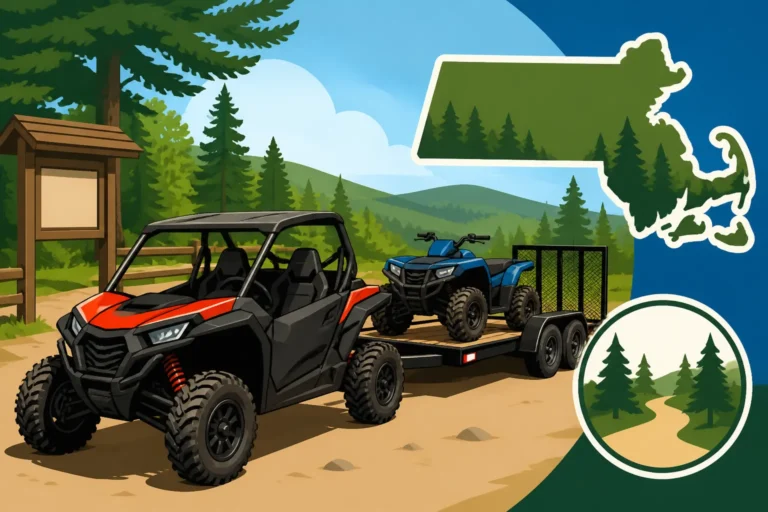
When you arrive with a trailer, it’s natural to wonder whether the trailer’s plate sets the parking category. In the usual trailhead scenario, the tow vehicle is the vehicle being parked and the one whose plate staff can use to identify the resident or visitor category. The trailer carries the ATV, but it generally does not replace the truck or SUV as the central parking reference.
There can be exceptions in how a facility manages parking, especially where vehicles and trailers occupy separate spaces or the lot has special instructions. If signs direct you to pay based on a different vehicle, follow those directions. When in doubt, ask before unloading rather than discovering the issue after you’ve parked and walked to the trail.
| Your arrival setup | Plate to check first | What to confirm |
|---|---|---|
| ATV on a trailer behind a Massachusetts-plated truck | Tow vehicle plate | Resident parking category and site-specific fee |
| ATV on a trailer behind an out-of-state-plated truck | Tow vehicle plate | Visitor category, current fee, and payment method |
| ATV carried in a truck bed | Truck plate | Whether the lot charges by resident status or vehicle type |
| Side-by-side driven into a designated parking area | Side-by-side plate, if the site treats it as the parked vehicle | Whether that area permits the machine and how parking is assessed |
| Vehicle and trailer occupying marked spaces | Tow vehicle plate, unless posted directions say otherwise | Whether the trailer needs a separate space or payment |
Check the rules before you tow
Confirm the fee for the exact trailhead
A trail system can have different access points, and the closest parking lot is not always managed under the same rules as another lot serving the same general area. Look up the specific forest, entrance, or recreation area you plan to use. Check for details about day-use charges, resident and visitor categories, payment methods, seasonal closures, and whether a lot accommodates trailers.
If you’re choosing among Berkshire destinations, it may help to review [Massachusetts ATV Trails: Three Berkshire Forests] before deciding where to stage your ride. Then check the individual destination details for [Beartown State Forest Riding in Massachusetts], [October Mountain State Forest Riding in Massachusetts], or [Pittsfield State Forest Riding in Massachusetts]. A parking policy at one forest should not be assumed to apply to the others.
For navigation, onX Offroad can help you organize a route and keep track of trail locations, but it should not be treated as the final authority on parking fees, lot availability, or current closures. Use the relevant agency’s posted information for those decisions. A map can help you get to the right entrance; it cannot replace a sign at the gate.
Read the signs before unloading
When you reach the parking area, pause long enough to read the entrance and payment signs. Confirm whether the fee applies to the tow vehicle, whether you need to display a receipt, and whether there are separate instructions for trailers. If a kiosk asks for a plate number, enter the vehicle plate requested by the system rather than the ATV’s registration number unless the prompt explicitly asks for the machine’s information.
Take a moment to check that the receipt or payment confirmation is visible or saved as directed. If the system rejects your plate, the kiosk is out of service, or the sign is unclear, use the contact instructions posted at the site. Guessing can lead to a frustrating start to the day, particularly when your group is waiting to unload.
This is also a good time to make sure your machine’s registration card and decals are in order. Parking payment doesn’t replace machine paperwork. See [The Registration Card You Must Carry in Massachusetts] for a reminder about carrying the card while riding.
Plan for a group arriving in multiple vehicles
If your group includes several trucks or SUVs, don’t assume that one payment covers every vehicle. Parking rules may be assessed per vehicle, and a mix of Massachusetts and out-of-state plates can mean different categories apply to different drivers. Confirm whether the lot charges each vehicle separately and whether there is enough space for all the tow vehicles and trailers.
A simple pre-trip message can prevent confusion: ask everyone to share the state shown on the tow vehicle’s plate, confirm the destination’s parking instructions, and agree on who will handle payment. If a group is meeting at a forest entrance, specify the exact lot rather than only naming the forest. That helps avoid one vehicle paying at a different access point under different rules.
For route planning, onX Offroad may be useful for coordinating where riders intend to meet and for keeping a route handy. Still, check official notices for access and parking before you leave. If the lot is full, closed, or unsuitable for a long trailer, having a backup plan is far better than trying to find one after arriving with a loaded machine.
A quick pre-trip parking checklist
Use this checklist before driving to a Massachusetts ATV or UTV riding area:
- Identify the exact trailhead or parking lot, not just the forest or town.
- Check the destination’s posted parking fee and resident or visitor categories.
- Use the tow vehicle’s plate as the first point of reference when checking which category applies.
- Confirm whether the trailer takes a separate space or requires separate payment.
- Check payment instructions, including whether you need a kiosk, permit, or displayed receipt.
- Verify that the lot allows the size of your vehicle and trailer.
- Keep your OHV registration and required documents separate from parking proof.
- Recheck for notices or closures before setting out.
The main takeaway is simple: for a typical truck-and-trailer trip, start with the tow vehicle’s plate, then follow the rules for the exact lot. Your ATV or UTV sticker does not, by itself, determine the parking fee or pay for parking. Taking a few minutes to check the destination’s instructions can save you a surprise charge and keep the day focused on the ride instead of a parking dispute.
Disclaimer
This article is for general informational purposes only and does not constitute professional advice. Laws, prices and regulations vary by location and change over time. Consult a qualified professional for guidance on your specific situation.