Massachusetts Visitors From Rhode Island
A Rhode Island registration or trail sticker may feel like it should travel with your ATV or UTV, but Massachusetts does not treat it as a substitute for its own OHV registration. Here’s what visiting riders need to arrange before crossing the state line, and what registration does—and does not—let you do once you arrive.
Rhode Island registration does not carry over
Massachusetts does not reciprocate with Rhode Island OHV registrations. A valid Rhode Island sticker, card, or other home-state document does not replace the Massachusetts registration required for riding here. Visitors need to obtain a Massachusetts registration for the machine they plan to operate.
That requirement is separate from permission to use a particular trail. A Massachusetts registration does not automatically open every forest, private property, or trail system to riding. You still need to check where the machine is allowed, whether the site is open, and whether any access or parking rules apply.
It also helps to distinguish registration from a trail pass. Massachusetts does not sell a separate statewide OHV trail pass that replaces the registration sticker. Registration is handled through the Massachusetts Environmental Police, rather than the Registry of Motor Vehicles. The state’s process and the paperwork involved are covered in Where a Visiting Rider Applies for a Massachusetts Sticker and Why the Environmental Police Register ATVs, Not the RMV.
| What you have or need | Does it meet the Massachusetts requirement? | What to do |
|---|---|---|
| Rhode Island ATV or UTV registration | No; Massachusetts does not accept it as a substitute | Apply for Massachusetts registration |
| Massachusetts non-resident registration | Yes, for the machine and term shown on the registration | Carry the registration card and display the decals as required |
| Rhode Island trail or club pass | No; it does not replace Massachusetts registration or site permission | Check the Massachusetts riding location separately |
| Massachusetts registration alone | It covers registration, not every riding or parking rule | Confirm the trail is open and the machine is allowed |
| A registration decal without the card | Do not assume the decal is enough | Keep the required card with the machine |
The registration is tied to the machine, not simply to the rider’s state of residence. If you bring two machines, do not assume one registration covers both; check the application process for each machine. The rules for a non-resident registration term and its sticker are explained in Massachusetts Non-Resident OHV Registration and Why a Non-Resident Sticker Expires a Year Sooner.
Apply before the trip and bring the right paperwork
The practical goal is to finish registration before you tow the machine to Massachusetts. Start with the Environmental Police registration process and confirm the current application options, required documents, and payment methods directly with the state. Requirements can depend on whether the machine is new, used, previously registered, or missing ownership documents.
Be ready to establish who owns the ATV or UTV and identify the machine. Depending on the purchase history, useful documents may include a manufacturer’s certificate of origin, a bill of sale, prior registration records, and the machine’s vehicle identification number. For a new machine, the certificate of origin is a key ownership document; Why a New Quad Needs a Certificate of Origin explains why it matters. For a private purchase, review What a Bill of Sale Must Show to Register before applying.
Massachusetts also requires sales-tax documentation as part of registration. The form and supporting proof depend on the transaction and whether tax was collected or paid elsewhere. Do not assume that a Rhode Island receipt, dealer paperwork, or tax payment automatically satisfies the Massachusetts requirement. Check Massachusetts Requires Form ST-6 Proof and Massachusetts Sales Tax Forms at Registration for the relevant paperwork, and confirm with the registration office what applies to your purchase.
A useful preparation list is:
- Gather proof of ownership. Use the document that matches the purchase: for example, a certificate of origin for a new machine or a bill of sale for a used one.
- Record the VIN accurately. Check that the number on the machine matches the paperwork. If it is hard to read, take a clear photograph before applying; Where to Find the VIN on an ATV or Side-by-Side can help you locate it.
- Prepare the required tax documents. Determine which Massachusetts form applies to your transaction and keep copies of any tax records.
- Apply for each machine you intend to ride. Confirm whether each ATV or UTV needs its own application and registration.
- Check the current non-resident process and payment options. Procedures can change, so use the official Environmental Police registration channel rather than relying on an old form or a seller’s instructions.
- Wait until you have the registration materials. Make sure you have the card and the decals before planning a ride that depends on Massachusetts registration.
If ownership paperwork is incomplete, resolve that before the trip rather than expecting a trailhead officer or forest office to fix it. A missing bill of sale, unclear VIN, or mismatch between a document and the machine can delay the application. Massachusetts Registration Without a Bill of Sale discusses a common paperwork problem, but a special case is not a reason to travel without confirming that your own documents will be accepted.
Registration cards and decals have separate requirements. The card must be carried with the machine, and decals must be placed according to Massachusetts rules. Keep the card somewhere accessible and protected from water and damage; do not leave it behind in the tow vehicle or at home. See The Registration Card You Must Carry in Massachusetts and Massachusetts Decal Placement Rules for the details.
Registration is not permission to ride anywhere
Once the registration is in hand, check the rules for the specific place you intend to ride. Massachusetts riding opportunities are limited to locations where OHV use is allowed, and the rules can differ between state forests, private riding parks, and privately owned land. A state registration does not override a seasonal closure, a machine restriction, a parking rule, or a landowner’s decision to deny access.
For state forest riding, confirm that the forest currently permits the type of machine you are bringing. Some riding areas may allow ATVs but not side-by-sides, or may have trail conditions and operating rules that affect access. The overview at Massachusetts ATV Trails: Three Berkshire Forests describes a prominent riding area, while Massachusetts Trails That Allow Side-by-Sides is a better starting point if you are bringing a UTV. Check current information before making a long tow; a trail listing is not a guarantee that every route is open on the day you arrive.
Private land has its own limits. You need permission from the owner, and Massachusetts rules also restrict riding close to a dwelling unless the required permission is in place. A road, woods road, or power-line cut is not automatically a legal OHV route just because it looks rideable or connects two pieces of land. Review [Massachusetts Landowner Permission Forms] and Why 150 Feet From a Dwelling Matters before planning a route across private property.
Do not plan to ride your ATV or UTV on public roads to connect trails. Massachusetts generally prohibits OHVs on public ways, with limited rules for crossing a public way where permitted. A crossing does not turn the road into a route. You must stop and follow the crossing requirements; Massachusetts Rules for Crossing a Road explains the issue in more detail.
Riders should also check age and safety requirements before bringing children or teens. Massachusetts has specific youth rules, and a Rhode Island safety course or rider experience should not be assumed to satisfy every Massachusetts requirement. The relevant starting points are Massachusetts ATV Age Requirements and Massachusetts Safety Certificates Under 18. If a rider is under 18, verify the certificate and supervision rules that apply to that rider and location before leaving home.
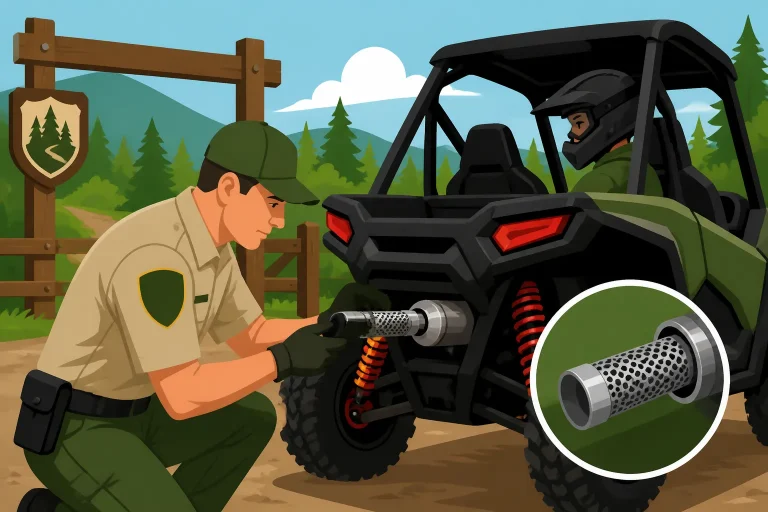
The same care applies to equipment. Registration does not certify that the machine meets operating requirements. Check the applicable helmet, brake, muffler, lighting, and other equipment rules, especially if you will ride after sunset or on public land. Massachusetts Equipment Requirements is a useful checklist to review before loading.
A Rhode Island visitor’s pre-ride checklist
A smooth trip depends on treating registration, trail access, and travel logistics as separate tasks. The following checklist helps keep them from getting mixed together.
- Register the machine in Massachusetts. Do not rely on a Rhode Island sticker or registration as reciprocity.
- Carry the Massachusetts card on the machine. Keep it protected but readily available if an officer asks to see it.
- Display the decals correctly. Check placement and condition before riding, rather than waiting until arrival.
- Confirm the site allows your machine. Check whether the location permits ATVs, UTVs, or both, and whether any width or other equipment restriction applies.
- Check current access conditions. Look for closures, seasonal operating dates, trail damage, and parking or permit instructions. Massachusetts Trail Conditions Before You Tow can help you plan that check.
- Get landowner permission where needed. A registration card is not permission to cross or ride on private land.
- Review rider-specific rules. Confirm youth requirements, supervision, helmets, and safety certificates for everyone who will operate a machine.
- Plan parking and the tow vehicle separately. An OHV registration does not cover vehicle parking fees or guarantee trailer space. Check the forest or riding location’s visitor information.
- Consider insurance even when it is not required. Massachusetts does not impose a general ATV insurance mandate, but damage to another person’s property or an injury can create substantial costs. Coverage terms vary; check with an insurer about your machine and the riding you plan to do.
- Keep the paperwork together. Store registration, ownership records, and any required safety certificates where they can be found quickly, but protect originals from weather.
If the trip is only a day ride, it is still worth confirming the registration and site rules ahead of time. If you plan to stay overnight, add lodging, camping, and parking arrangements to the list; those are independent of the OHV registration. For a final check before towing, Checking Rules Before a Long Drive to the Berkshires offers a useful way to think through access questions.
The key point for Rhode Island visitors is simple: Massachusetts registration is not interchangeable with a home-state sticker, and having the Massachusetts decal does not by itself authorize every ride. Apply through the appropriate state process, carry the card, and verify the rules at the exact destination before unloading.
Disclaimer
This article is for general informational purposes only and does not constitute professional advice. Laws, prices and regulations vary by location and change over time. Consult a qualified professional for guidance on your specific situation.