Massachusetts Non-Resident OHV Registration
It's incredibly frustrating when you're itching to explore new trails with your ATV or UTV, only to find that the rules change the moment you cross a state line. Many of us from neighboring states like New Hampshire, Vermont, Connecticut, or New York dream of venturing into Massachusetts's beautiful forests with our off-highway vehicles, but the idea of navigating a completely different registration system can feel like hitting a roadblock before you even get started. This comprehensive guide will cut through the confusion, walking you through every detail an out-of-state rider needs to know to legally register their OHV in Massachusetts, ensuring your ride is legal and worry-free.
Navigating the Necessity: Why Out-of-State Riders Need a Massachusetts OHV Registration
You might think that because your ATV or UTV is properly registered in your home state, you're all set to ride wherever you go. Unfortunately, when it comes to Massachusetts, that's not quite the case. The Bay State has its own set of rules and a distinct registration process for off-highway vehicles, regardless of where you call home. This isn't meant to be a barrier, but rather a way for the state to manage and fund its trail systems, ensure safety, and track the machines operating within its borders. It's a system designed to protect both riders and the natural resources we all enjoy.
The Bay State's Stance on Off-Highway Vehicles from Elsewhere
Massachusetts takes a clear stance on all off-highway vehicles operating on public or permitted private land within its borders: they must be registered with the state. This includes ATVs, UTVs, dirt bikes, and snowmobiles, whether they're owned by a resident or someone just visiting for a weekend ride. The state treats these machines as requiring specific identification for enforcement and management purposes. It’s part of a broader effort to ensure that all riders contribute to the maintenance of the trails and adhere to local laws. This unified approach simplifies enforcement for the Massachusetts Environmental Police and helps maintain a consistent standard across all riders.
Think of it like this: just as you wouldn't drive your car in another state indefinitely without understanding their traffic laws, you can't assume your OHV registration from another state automatically grants you full legal access to Massachusetts trails. While it might seem like an extra hoop to jump through, the system is designed to create a level playing field for everyone who wants to experience Massachusetts's diverse riding opportunities, from the rugged terrain of October Mountain State Forest to the challenging routes of Beartown.
Reciprocity Realities: Why Your Home State Sticker Isn't Enough
Many states have some form of reciprocity for vehicle registrations, where a valid sticker from one state is recognized by another for a certain period. However, for OHVs in Massachusetts, this simply isn't the case. Your valid registration from New York, Connecticut, or any other state does not grant you the right to ride on Massachusetts public lands or trails. The state explicitly requires its own registration for all machines operating within its jurisdiction. This means even if you're just planning a single day trip, you'll need to secure a Massachusetts non-resident OHV sticker.
This lack of reciprocity can definitely be a point of frustration for riders who are used to more lenient rules in other areas. It often catches visitors off guard, leading to potential fines or having their riding day cut short. The logic behind this strict policy ties back to funding and accountability. A Massachusetts registration directly contributes to the state's OHV program, including trail maintenance and safety initiatives. It's how the state ensures that all users of its trail system are contributing to its upkeep, rather than solely relying on its resident population.
The Environmental Police and Enforcement on Massachusetts Trails
The Massachusetts Environmental Police (MEP) are the primary authority for enforcing OHV laws in the state. They routinely patrol public riding areas, state forests, and permitted trails, checking for valid registrations, appropriate safety gear, and adherence to riding rules. For non-residents, an invalid or missing Massachusetts sticker is one of the quickest ways to attract their attention. MEP officers are highly familiar with the regulations, and they won't hesitate to issue citations for non-compliance. [Massachusetts Penalties for Riding Unregistered] can be quite substantial, potentially including fines and even the impoundment of your machine.
It's not uncommon to see MEP officers at popular trailheads, especially during peak riding seasons, performing spot checks. They're not just looking for registration decals; they're also checking for proper helmet use, age restrictions for riders, and general safe operating practices. For non-residents, being able to present a valid Massachusetts non-resident registration card and having the decal correctly displayed is paramount. Understanding their role helps you appreciate why adherence to these rules is so important, not just for your own legality but for the safety and sustainability of the entire OHV community in Massachusetts.
Decoding the Dollars and Dates: Non-Resident Registration Term and Costs
So, you've accepted that you need a Massachusetts sticker. The next logical questions are "how long is it good for?" and "how much will it set me back?" The Bay State's non-resident OHV registration is distinct from its resident equivalent in both its term and its fee structure. It's designed specifically for visitors, offering a straightforward, single-year option to cover your riding adventures.
The One-Year Validity Period for Visitors
Unlike Massachusetts residents who typically receive a two-year registration sticker, non-residents are issued a one-year registration. This means your non-resident sticker is valid for a single calendar year from the date of issuance, expiring on December 31st of that year. So, if you register your machine in June, it's good until December 31st of the same year, not June of the following year. This is a crucial detail that often catches visiting riders off guard. It's important to keep this expiration date in mind, especially if you plan multiple trips throughout the year or across different seasons.
This annual expiration aligns with the state's system for tracking and managing visitor access to its OHV trail network. It simplifies renewals and ensures that the system is consistently updated with active users. If you're planning a trip towards the end of the year, say in November, remember that your sticker will still expire on December 31st. This might influence when you choose to register, especially if you want to maximize the sticker's usable lifespan for subsequent visits within the same calendar year. [Why a Non-Resident OHV Sticker Costs $33] is directly tied to this one-year term.
Breaking Down the Non-Resident Registration Fee
The fee for a non-resident OHV registration in Massachusetts is a specific amount, which is generally lower than the two-year resident fee. As a non-resident, you're looking at paying a set fee for your one-year sticker. This fee contributes directly to the state's Off-Highway Vehicle Program, which is responsible for everything from trail maintenance and development to safety education and enforcement. So, while it's an expense, it's also your contribution to keeping the trails rideable and enjoyable for everyone.
It's important to remember that this fee is subject to change, so always check the most current figures on the Massachusetts Environmental Police website before you begin your registration process. The cost is generally a flat rate, regardless of the type of OHV you're registering (ATV, UTV, dirt bike, or snowmobile). This straightforward pricing aims to make it easy for visitors to understand what to expect financially, without hidden complexities. This fee is a direct investment into the trails you'll be enjoying, making every dollar count towards better riding experiences.
Why the Term and Cost Differ from Resident Stickers
The difference in registration terms and fees between residents and non-residents is a common question. For Massachusetts residents, the two-year sticker often comes with a higher upfront cost but averages out to a similar annual rate as the non-resident fee. This distinction primarily serves administrative purposes and reflects the state's ongoing relationship with its own residents. Residents are typically more consistent users of the trails and may have additional state-level responsibilities or contributions that justify a longer registration term.
From an administrative standpoint, offering a one-year term for non-residents simplifies the process for visitors who might only come for a season or a specific event. It reduces the overhead of tracking longer-term registrations for transient users. Ultimately, both resident and non-resident fees funnel into the same [The OHV Trail Fund Your Sticker Pays Into], ensuring that the money collected from all riders goes back into the program that benefits them directly. This funding mechanism helps maintain the integrity and accessibility of the state's OHV trail network, supporting everything from signage to trail erosion control.
Gathering Your Gear: Essential Documents for Non-Resident OHV Registration
Before you even think about filling out a form or clicking "submit" online, you need to gather the right paperwork. This step is crucial, as any missing or incorrect documentation can cause significant delays in processing your registration. The Massachusetts Environmental Police are quite particular about having all your ducks in a row. Think of it as preparing your manifest before embarking on a journey – you want to ensure everything is accounted for.
Proving Ownership: Bill of Sale or Manufacturer's Certificate of Origin
The most critical piece of documentation you'll need is proof of ownership for your ATV or UTV. This typically comes in one of two forms: a Manufacturer's Certificate of Origin (MCO) for new machines, or a bill of sale for used machines.
- Manufacturer's Certificate of Origin (MCO): If your OHV is brand new and has never been registered anywhere before, you'll need the original MCO. This document, provided by the dealership, serves as the birth certificate for your machine and establishes you as the first legal owner. Ensure it's signed over to you correctly. [Why a New Quad Needs a Certificate of Origin] is a common question for first-time buyers.
- Bill of Sale: For used machines, a clear and comprehensive bill of sale is essential. This document must include specific details: the full names and addresses of both the buyer and seller, the date of sale, the purchase price, and a clear description of the OHV including its make, model, year, and most importantly, the Vehicle Identification Number (VIN). Without a VIN, you'll be stuck. Many riders use templates from legal document services like LawDepot to ensure all necessary fields are included on their bill of sale, especially for private sales where official dealer paperwork isn't available. A well-prepared bill of sale prevents headaches down the line.
The Environmental Police will carefully scrutinize these documents to ensure legitimate ownership. If any information is missing or appears altered, they will likely reject your application until it's corrected. For machines purchased out-of-state, ensure the bill of sale clearly indicates where the transaction took place.
Personal Identification and Contact Information Requirements
In addition to proving ownership of your OHV, you'll also need to provide personal identification and detailed contact information. This is standard procedure for any vehicle registration and helps the state identify the responsible party for the machine.
- Proof of Identity: While you generally don't need to send in a copy of your driver's license for an online or mail-in registration, the information you provide on the application (name, address, date of birth) must match your official identification. If registering in person, you would need to present a valid driver's license or state-issued ID.
- Contact Information: You'll need to provide your current mailing address, phone number, and often an email address. This is how the Environmental Police will send your registration card and decals, and how they might contact you if there are any issues with your application. Even if you have a Massachusetts mailing address (perhaps for a vacation home), if your primary residency is out-of-state, you must still apply for the non-resident registration.
Accuracy is key here. Double-check all spellings and numbers before submitting your application. Any discrepancy could lead to your registration materials being sent to the wrong place or your application being flagged for review. Keeping this information up-to-date is important for future renewals or if you ever need a duplicate sticker.
Navigating Sales or Use Tax for an Out-of-State Purchase
This is where things can get a bit tricky for non-residents, especially if you've recently purchased your OHV and are bringing it into Massachusetts for the first time. Massachusetts has a 6.25% sales tax that applies to the purchase of ATVs and UTVs. If you bought your machine from a dealer within Massachusetts, they would have collected this tax at the time of sale. However, if you bought your OHV from a private seller, or from a dealer in another state, you may be subject to Massachusetts Use Tax.
The Use Tax applies when you bring a taxable item into Massachusetts for use in the state, and you haven't paid at least 6.25% sales tax on it in another state. If you paid sales tax in your home state, and that tax was less than 6.25%, you'd owe the difference to Massachusetts. If you paid no sales tax, you'd owe the full 6.25%. This tax must be paid before you can successfully register your OHV. You'll need to file [A Sales Tax Form Called ST-6] (or ST-6E for exemptions) with the Massachusetts Department of Revenue. It's often recommended to get this sorted before you apply for your OHV registration, as proof of tax payment (or exemption) is a requirement. If you are unsure about your tax obligations, especially with private sales or gifts, consulting a professional or checking the Massachusetts Department of Revenue website is always a good idea. Using forms from reliable sources like LawDepot can also help ensure you're documenting the sale correctly for tax purposes.
The Path to Permitted Riding: Your Step-by-Step Non-Resident Registration Guide
Once you've gathered all your necessary documents, it's time to actually apply for your registration. The Massachusetts Environmental Police (MEP) offers a few ways to get this done, with the online system being the most convenient for most non-residents. Understanding each option will help you choose the best route for your specific situation and timeline.
Registering Online Through the Massachusetts Environmental Police Portal
For many non-residents, the online registration system is by far the easiest and quickest method. The Massachusetts Environmental Police maintains a dedicated online portal where you can complete your application from the comfort of your home. This system is designed to streamline the process, allowing you to enter your information, upload supporting documents, and pay the fee electronically.
- Accessing the Portal: You'll typically find the link to the OHV registration portal on the official Massachusetts Environmental Police website or the Department of Conservation and Recreation (DCR) site. Look specifically for "OHV Registration" or "ATV/Snowmobile Registration."
- Filling Out the Application: The online form will prompt you for all the necessary details, including your personal information, OHV make, model, year, and VIN. You'll also need to attest to proof of ownership and confirm your tax obligations.
- Uploading Documents: Be prepared to upload digital copies (scans or clear photos) of your MCO or bill of sale. If you've just moved to Massachusetts and need to apply for a resident sticker, you'll be asked for additional documents. For a non-resident sticker, the ownership proof is key.
- Payment: The system will guide you through the payment process for the non-resident registration fee. You'll typically be able to pay with a credit or debit card.
- Confirmation and Processing: After successful submission, you'll usually receive an email confirmation. The MEP will then process your application, and if everything is in order, they will mail your registration card and decals to the address you provided. Processing times can vary, so it's wise to apply well in advance of your planned trip. [Massachusetts Registration Processing Time] can fluctuate depending on the season and volume of applications.
The Mail-In Option for Non-Residents
While the online system is preferred for its speed and convenience, you still have the option to register by mail. This might be a good choice if you're not comfortable with online transactions or if you're having trouble with the digital submission process.
- Downloading Forms: You'll need to download the official OHV registration application form from the Massachusetts Environmental Police website. Make sure you get the most current version.
- Completing the Form: Fill out the application carefully, ensuring all required fields are completed legibly. Missing information is a common reason for delays.
- Attaching Documents: You'll need to make copies of your MCO or bill of sale and include them with your mailed application. Do NOT send original documents unless explicitly instructed, as they may not be returned.
- Payment: You'll typically need to include a check or money order for the registration fee, made out to the Commonwealth of Massachusetts. Ensure the amount is correct to avoid your application being returned.
- Mailing: Send your completed application, copies of documents, and payment to the address specified on the application form. Again, allow ample time for mail delivery and processing. This method can take longer than online registration, so plan accordingly, especially if you're riding during peak season.
In-Person Registration: A Less Common But Available Route
While not always practical for non-residents living far from Massachusetts, in-person registration is sometimes an option. This is typically done at certain Environmental Police regional offices. It can be beneficial if you have complex questions or need immediate assistance, but it requires travel.
- Locating an Office: Check the Massachusetts Environmental Police website for a list of regional offices that handle OHV registrations. It's highly recommended to call ahead to confirm their operating hours and whether they process OHV registrations on-site. Not all offices may offer this service, and some may require appointments.
- Bringing All Documents: Be sure to bring all your original documents (MCO, bill of sale, personal ID) as they may need to be verified in person.
- Payment: Be prepared to pay the registration fee, usually by check, money order, or sometimes credit/debit card (confirm payment methods when you call).
- Immediate Assistance: The main advantage of in-person registration is the ability to ask questions directly and resolve any issues on the spot. If everything is in order, you might even receive your temporary registration card right away, with decals mailed later. However, given the distance for most non-residents, this is often a last resort or for those with unique circumstances.
Displaying Your Due Diligence: Decal and Card Placement Rules
Getting your non-resident registration approved is only half the battle. You also need to properly display your decals and carry your registration card as required by Massachusetts law. Failing to do so can lead to a citation, even if your machine is technically registered. These rules are in place to make it easy for Environmental Police officers to quickly verify a machine's compliance, ensuring everyone on the trails is legally authorized to be there.
Where Your Massachusetts Non-Resident Decal Must Be Affixed
The state of Massachusetts has very specific rules regarding the placement of your OHV registration decals. For ATVs and UTVs, these decals must be affixed in a visible and specific location.
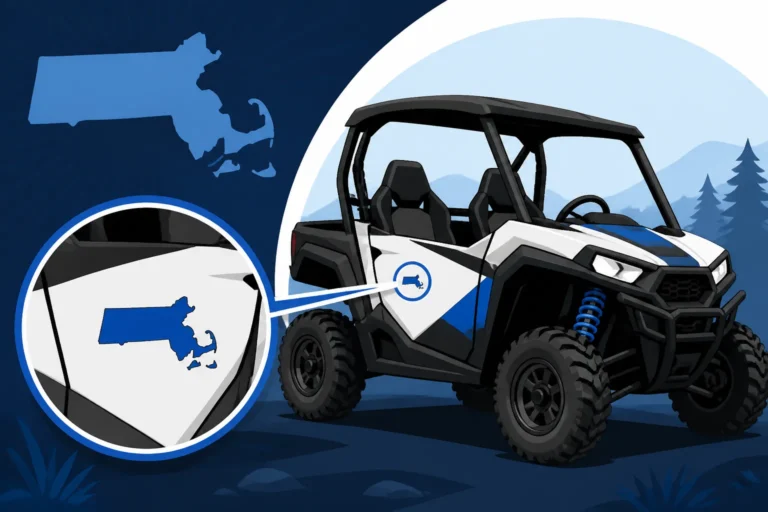
- Both Sides, Forward Half: Your Massachusetts registration decals must be clearly displayed on both sides of the OHV, on the forward half of the machine. This means they should be placed on the front fenders or bodywork, not on the rear or hidden areas. The goal is for them to be easily seen by an officer approaching from either side.
- Expiration Decal: In addition to the main registration decals, you'll also receive a small expiration decal. This smaller sticker must be placed on the left side of the OHV, near the main registration decal. This allows officers to quickly see the validity period. [Massachusetts Decal Placement Rules] are non-negotiable, and incorrect placement can result in fines.
- Clean and Visible: Ensure the surface where you apply the decals is clean and dry to ensure proper adhesion. The decals must be unobscured and readable at all times. Do not place them on parts that are easily removed or obstructed by bags or accessories. This seems like a small detail, but it's one of the first things an MEP officer will look for during a trail stop.
The Importance of Carrying Your Registration Card
Beyond the physical decals on your machine, you are legally required to carry your Massachusetts OHV registration card with you whenever you are operating your ATV or UTV on public or permitted private land.
- Physical Card Required: This isn't a rule where a photo on your phone will suffice. You must have the physical registration card on your person or securely carried within the machine. Many riders keep it in a waterproof bag in a pocket, a fanny pack, or a secure compartment on their machine. [Why Your Registration Card Must Ride With the Machine] is simple: officers need to verify the details.
- Verification: The registration card contains vital information, including your name, the OHV's details (VIN, make, model), and the expiration date. An Environmental Police officer may ask to see this card to cross-reference it with the decals on your machine and to confirm your identity.
- Safety and Information: Carrying the card also serves as a quick reference for your OHV's details in case of an accident or if you need to report an incident. It’s a key piece of documentation that validates your right to be on the trail.
Specifics for Side-by-Sides vs. Traditional ATVs
While the general rules apply to all OHVs, there are slight nuances in decal placement that might be helpful for side-by-side (SxS) owners, given their often larger and more varied body styles.
- ATVs: For traditional quads, the front fenders are the most common and appropriate placement for decals, ensuring they are on the "forward half" and clearly visible from both sides.
- Side-by-Sides: With UTVs, the larger body panels offer more options, but the principle remains the same. Place the decals on the forward half of the vehicle, typically on the front doors, hood, or front quarter panels, where they are unobstructed and easily visible. Avoid placing them low on the rocker panels where they might get obscured by mud or debris, or high on the roof where they're hard to read from ground level. [Massachusetts Decal Placement on a Side-by-Side] emphasizes visibility and adherence to the "forward half" rule. In both cases, ensure the decals are flat and securely adhered to prevent peeling, especially in varying weather conditions common to Massachusetts trails.
Beyond the Sticker: Sales Tax and Other Considerations for Out-of-State Buyers
While the main focus for non-residents is typically getting that OHV registration sticker, there's another significant hurdle to consider, especially if you've recently acquired your machine: sales or use tax. Massachusetts is quite diligent about collecting its fair share, and this can be a sticking point if not addressed properly before you attempt to register.
Understanding Massachusetts Use Tax for Machines Brought Into the State
Massachusetts imposes a 6.25% sales tax on most purchases. If you buy an OHV from a dealer in Massachusetts, they'll collect this tax at the point of sale. Simple enough. However, if you bought your ATV or UTV from a private seller, or from a dealer outside of Massachusetts, you're likely subject to the state's "Use Tax." The Use Tax is essentially a sales tax on items purchased outside of Massachusetts but brought into and used within the state.
- The Principle: The idea is to level the playing field between in-state and out-of-state purchases, ensuring that consumers don't avoid sales tax by buying across state lines. If you paid sales tax in another state, and that state's rate was less than 6.25%, you'll owe the difference to Massachusetts. If you paid no sales tax in the other state, you'll owe the full 6.25% to Massachusetts.
- Calculating the Tax: You'll calculate 6.25% of the purchase price of your OHV. This amount must be paid to the Massachusetts Department of Revenue. This process is distinct from your OHV registration fee, but proof of payment (or exemption) is often a prerequisite for registration.
This is a common area of confusion for new residents or those bringing vehicles into Massachusetts. Don't assume that because you bought it elsewhere, you're exempt. [Massachusetts Use Tax on a Machine Brought Home] is a real obligation that needs to be addressed.
When to File and Pay: The 20-Day Rule for Use Tax
Massachusetts doesn't give you forever to pay your Use Tax. There's a specific window you need to adhere to, or you could face penalties.
- The Deadline: You are required to file Form ST-6 (Sales and Use Tax Return) and pay any Use Tax due within 20 days of bringing the OHV into Massachusetts or within 20 days of purchase if you acquired it in Massachusetts from a private seller. If you miss this window, the tax is due on the 20th day of the month following the purchase.
- How to File: This is typically done through the [Massachusetts Online Registration System] or MassTaxConnect, the state's online tax portal. You'll need to create an account if you don't already have one. It's a fairly straightforward process but does require careful data entry of your purchase details.
- Importance for Registration: The Environmental Police will often check to ensure that the Use Tax has been handled for newly acquired machines. If there's no record of tax payment or a valid exemption, your OHV registration could be delayed or denied. It's truly a "chicken or the egg" scenario – sort out your tax first, then pursue registration.
Exemptions and Documentation for Gifts or Inherited Machines
There are specific circumstances where you might be exempt from paying sales or use tax on an OHV. These typically include machines received as a bona fide gift or those inherited from a deceased owner.
- Gifts: If you received your ATV or UTV as a gift, you may be exempt from the sales/use tax. However, you'll still need to file Form ST-6E (Sales Tax Exemption Certificate) to claim this exemption. This form requires clear documentation from the donor confirming it was a gift and providing details about the machine. Using a structured document, perhaps a gift affidavit from a service like LawDepot, can provide the necessary legal backing for your claim.
- Inheritance: Similarly, if you inherited an OHV, you would typically be exempt from sales/use tax. You'd need documentation like a death certificate and probate documents (if applicable) showing the transfer of ownership to you.
- Required Documentation: In both gift and inheritance scenarios, proper documentation is key. The state needs to see clear evidence that no money changed hands in a taxable transaction. Without the correct forms and supporting paperwork, the exemption may not be granted, and you could still be on the hook for the Use Tax. Always ensure your paperwork is thorough and accurately reflects the circumstances of ownership transfer. [Claiming a Gift Exemption With Form ST-6E] can be a huge relief if you qualify.
Hitting the Trails: What Your Massachusetts Non-Resident Sticker Means for Riding
Once you've navigated the registration process, secured your sticker, and handled any tax obligations, you're ready for the fun part: hitting the trails! But even with a valid Massachusetts non-resident sticker, it's essential to understand what it means for your actual riding experience, especially when it comes to accessing land and interacting with authorities. Your sticker is your key, but you still need to know how the lock works.
Accessing Public Lands with Your Valid Registration
Your Massachusetts non-resident OHV registration opens the door to the state's designated public OHV trails. These are primarily found in several state forests, predominantly in the western part of the state, such as Beartown State Forest, October Mountain State Forest, and Pittsfield State Forest.
- Designated Trails Only: It's crucial to remember that your registration allows you to ride only on marked, designated OHV trails. Massachusetts has very strict laws about where you can and cannot ride. You cannot simply ride on any forest road, logging trail, or unposted land. Trespassing laws are strictly enforced. [Massachusetts Bans Riding on Public Ways] and [Massachusetts Bans Riding Others' Land] without explicit permission.
- Trail Season: Be aware of the Massachusetts DCR riding season. OHV trails in state forests are typically open from May 1st through November 30th. Riding outside of these dates is prohibited, regardless of your registration status. Always check the DCR website for current trail conditions and any temporary closures due to weather or maintenance before you head out.
- Additional Permits: Some specific riding areas, like Tolland State Forest, might require an additional, free ranger station permit in addition to your state registration. Always check the specific rules for the forest you plan to visit. Your non-resident sticker is essential, but it doesn't automatically grant access everywhere without understanding local nuances.
What Environmental Police Officers Look For During Checks
When you're out on the trails in Massachusetts, it's highly probable you'll encounter Environmental Police officers. They're there to ensure safety and compliance, and they conduct routine checks. Knowing what they're looking for can help you feel prepared and confident.
- Valid Registration Decals: As discussed, they'll check for the Massachusetts non-resident decals on both sides of your OHV's forward half, with the expiration decal on the left side. They'll want to see them clearly affixed and readable.
- Registration Card: They will ask to see your physical Massachusetts OHV registration card. Make sure it's easily accessible and not buried deep in your gear.
- Safety Equipment: Officers will also check for compliance with safety equipment laws, most notably the Massachusetts helmet law, which requires all riders, regardless of age, to wear a DOT-approved helmet. Other equipment like functioning brakes, a spark arrester, and lights (if riding after dark) will also be checked. [Massachusetts Helmet Law for Every Rider] is a non-negotiable requirement.
- Age and Rider Restrictions: If you're riding with younger family members, officers will verify that all riders meet the [Massachusetts ATV Age Requirements] and engine size restrictions. They'll also ensure that any riders under 18 have completed a Massachusetts-approved safety course and are carrying their certificate. For non-residents, this can be a particular point of scrutiny.
Trail Etiquette and Local Rules for Visiting Riders
Beyond the legal requirements, being a responsible visiting rider means understanding and respecting local trail etiquette and rules. Massachusetts trails are often multi-use, shared with hikers, mountain bikers, and sometimes even equestrians.
- Yielding: Always yield to non-motorized users. This means slowing down, moving to the side, and, if necessary, stopping and shutting off your engine to allow horses or hikers to pass safely. A friendly greeting goes a long way.
- Noise and Speed: Keep your speed in check, especially in areas near homes or campgrounds. Massachusetts has muffler requirements, and excessive noise can lead to complaints and further restrictions. [Massachusetts Muffler Requirements] are part of Chapter 90B.
- Stay on Marked Trails: This cannot be stressed enough. Going off-trail damages sensitive ecosystems, causes erosion, and can lead to immediate fines. Respect all signage, barriers, and closed areas.
- Leave No Trace: Pack out everything you pack in. Do not litter. Help keep Massachusetts trails beautiful for everyone.
- Written Permission Rule: Be especially mindful of the [Massachusetts Requires Written Permission] rule for riding on private land. This applies to all land that isn't publicly designated OHV trails. Without written consent, you are trespassing.
By adhering to both the letter of the law and the spirit of responsible trail riding, you'll ensure a positive experience for yourself, other riders, and the Massachusetts environment.
Smooth Sailing: Avoiding Common Pitfalls for Visiting OHV Riders
Even with the best intentions, it's easy to stumble into common traps when registering and riding your OHV as a non-resident in Massachusetts. Being aware of these frequent mistakes can help you sidestep unnecessary frustration, delays, and potential legal issues. A little foreknowledge goes a long way in ensuring a smooth and enjoyable trip.
Overlooking Sales Tax Obligations on a New Purchase
One of the biggest surprises for out-of-state buyers bringing a machine into Massachusetts is the Use Tax. Many assume that because they paid tax in their home state, or bought from a private seller, they are exempt from any further tax obligations in Massachusetts. This is a common misconception that can bring your registration process to a screeching halt.
- The Trap: Failing to file Form ST-6 and pay the appropriate Use Tax (or claim a valid exemption with ST-6E) within the mandated 20-day window. The Massachusetts Environmental Police are increasingly cross-referencing registration applications with Department of Revenue records for newly acquired machines. If your tax status isn't clear, your registration will be held up.
- How to Avoid It: Before you even submit your OHV registration application, determine your sales/use tax obligations. If you bought from a private seller or out-of-state dealer, calculate the 6.25% Use Tax on your purchase price and file [Massachusetts Sales Tax Forms at Registration] through MassTaxConnect. Keep a copy of your filed form or payment confirmation. If you're claiming an exemption (e.g., a gift), ensure you have all the necessary documentation, potentially using templates from services like LawDepot for clarity, and file Form ST-6E.
Misunderstanding the One-Year Expiration
The difference in registration terms between resident (two-year) and non-resident (one-year) stickers often leads to confusion, especially for those who visit Massachusetts infrequently or across calendar years.
- The Trap: Assuming your non-resident sticker is valid for a full 12 months from the date of issuance, rather than expiring on December 31st of the same calendar year. This can lead to riding with an expired sticker if you're not paying close attention to the date on your decal. Imagine planning a spring trip in April, having registered in July of the previous year, only to find your sticker expired on December 31st!
- How to Avoid It: Always remember that your non-resident Massachusetts OHV registration expires on December 31st of the year it was issued, regardless of when you purchased it. Make a note of the expiration date as soon as you receive your decals. If you plan to ride in the new year, you'll need to renew your registration. [Massachusetts ATV Registration Renewal] for non-residents is an annual task if you plan to keep visiting. Plan your registration purchase strategically; if you register in November, you only get two months of validity, which might not be cost-effective for you.
Incorrect Decal Placement Leading to Citations
The rules for where and how your registration decals are displayed are very specific in Massachusetts. This isn't just about aesthetics; it's about quick identification and enforcement.
- The Trap: Placing decals in obscure locations, on easily removable parts, or failing to have them clearly visible on both sides of the forward half of the machine. Another common error is forgetting to affix the small expiration decal to the left side. An officer cannot easily verify your registration at a glance if your decals are hidden or improperly placed, leading to a stop and potential citation.
- How to Avoid It: Take the time to carefully read and understand the decal placement rules when you receive your registration packet. For ATVs, the front fenders are usually ideal. For side-by-sides, choose a prominent, flat surface on the front half of the vehicle, such as the front doors or hood area. Ensure the surface is clean and dry before applying for maximum adhesion. Double-check that both the main decals and the expiration decal are correctly placed and clearly visible from a reasonable distance. [Massachusetts Decals on Both Sides] means exactly that, and it's a critical detail.
By being mindful of these common pitfalls, non-resident OHV riders can significantly reduce their chances of encountering issues, allowing for a much more enjoyable and legal riding experience on Massachusetts's fantastic trails.
Disclaimer
This article is for general informational purposes only and does not constitute professional advice. Laws, prices and regulations vary by location and change over time. Consult a qualified professional for guidance on your specific situation.