Massachusetts Stickers for a Visiting Machine
A valid ATV or UTV sticker from your home state may feel like the obvious paperwork to bring on a Massachusetts ride. But Massachusetts does not treat another state’s registration as a substitute for its own. Here’s what visiting riders need to arrange, what to carry and why a Massachusetts sticker still does not guarantee trail access.
Why a Visiting ATV or UTV Needs a Massachusetts Sticker
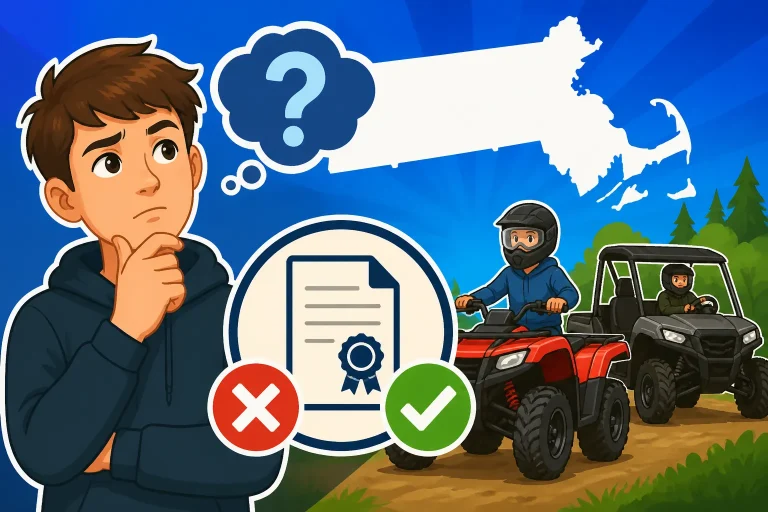
Massachusetts requires visiting riders to obtain a Massachusetts OHV registration for a machine they bring to ride in the state. A home-state registration or sticker does not take the place of the Massachusetts one. This lack of reciprocity is an important part of planning a trip, whether you are visiting from a nearby state or traveling from farther away. See Massachusetts Has No Reciprocity for Visitors and Out-of-State OHV Stickers Are Not Valid in Massachusetts.
The registration is handled through the Massachusetts Environmental Police, not the Registry of Motor Vehicles. That distinction matters: an OHV sticker is not a vehicle plate, and registration for trail use does not make an ATV or UTV street legal. You still cannot use the machine on public roads simply because it has a Massachusetts decal. For more about the agency and registration process, see Why the Environmental Police Register ATVs, Not the RMV.
A Massachusetts registration for a visiting machine generally has a one-year term. The sticker and registration card identify the registration period, so check the expiration information rather than assuming the registration will remain valid for a full year from the day you ride. Terms and fees can change, so confirm current details with the Environmental Police before you apply. Massachusetts Visitors Buy a One-Year Sticker explains the visitor term in more detail.
A Massachusetts sticker is a state registration requirement, not a statewide trail pass. It does not by itself give you permission to ride on a particular forest, town property or private parcel. You must still check whether the area allows your type of machine, whether it is open, and whether it requires separate access arrangements. Massachusetts Trail Access Without a Pass explains the distinction between registration and trail access.
| What you have or need | What it does | What it does not do |
|---|---|---|
| Home-state registration or sticker | Shows registration in your home state | Replace Massachusetts OHV registration |
| Massachusetts visitor registration | Registers the visiting machine for the applicable term | Make the machine street legal or grant access to every trail |
| Trail or property permission | Allows access where the owner or land manager permits riding | Replace required Massachusetts registration |
| Registration card and displayed decal | Help show that the machine is registered | Prove that a trail is open or that riding is allowed there |
If you are crossing the state line with the ATV or UTV on a trailer and will not ride it in Massachusetts, the registration question may be different from the situation of riding it here. Focus on where the machine will be operated, and check the current official rules if your plans are unusual. Once you intend to ride in Massachusetts, plan on getting the state’s registration rather than relying on the sticker from home.
Applying for the Massachusetts Visitor Registration
Start with the Massachusetts Environmental Police registration process and check its current instructions for nonresidents. The agency’s online service may be available for registration tasks, but don’t assume every application or unusual ownership situation can be completed the same way. Use the current official directions or contact the registration office if you are unsure which route applies. See Where a Visiting Rider Applies for a Massachusetts Sticker and Registering an ATV on the Environmental Police Website.
Before beginning, gather the information that identifies both the machine and the owner. The exact documents requested can depend on the machine’s history and the application, so check the current checklist rather than relying on a generic list. In general, it is useful to have:
- The machine’s make, model and vehicle identification number
- Your identifying and contact information
- Proof of ownership, such as a bill of sale or manufacturer’s certificate of origin when applicable
- Any existing registration information for the machine
- Payment in a form accepted by the registration service
A home-state registration can be useful supporting information, but it is not a substitute for proof of ownership if Massachusetts asks for ownership documents. If you bought the machine recently, confirm that the seller provided paperwork that clearly identifies it. A missing, mismatched or hard-to-read VIN can delay an application. Use Massachusetts Registration Paperwork Checklist to prepare, and see Where to Find the VIN on an ATV or Side-by-Side if you need to locate the identification number.
Be especially careful if the machine is borrowed, leased, financed, inherited or owned by a business. The person applying may need to show how they are authorized to register it, and the name on the supporting paperwork may not match the rider’s name. Don’t guess at what to submit: contact the registration office before traveling if the ownership chain is complicated. Fixing a paperwork problem at home is usually easier than discovering it after towing the machine to Massachusetts.
The registration fee and accepted payment options can change. Check the Environmental Police’s current information before applying, and confirm that the visitor term and expiration date work for your trip. Do not use an old receipt, saved application or another rider’s fee information as a reliable indication of the current process.
Once the registration is issued, review the card and decal before leaving. Check that the machine’s identifying details are correct, that the registration is current for your planned ride, and that you understand where the decal must go. If anything is wrong, ask the registration office how to correct it rather than altering the card or sticker yourself.
Carrying and Displaying the Sticker
A registration is useful only if you can show it when required and the decal is displayed properly. Keep the registration card with the machine while riding, not locked in a vehicle parked far away or left at home. The card and decal serve different purposes: the decal is displayed on the machine, while the card is the document you can present to an officer. For the carry requirement, see Massachusetts Registration Cards Carried on Board.
Follow Massachusetts placement instructions for your machine type. Do not assume that a sticker belongs wherever your home state puts its registration decal. Placement can matter for visibility and inspection, and a side-by-side may have instructions that differ in practical detail from those for a quad. See Massachusetts Decals on Both Sides and Massachusetts Decal Placement on a Side-by-Side.
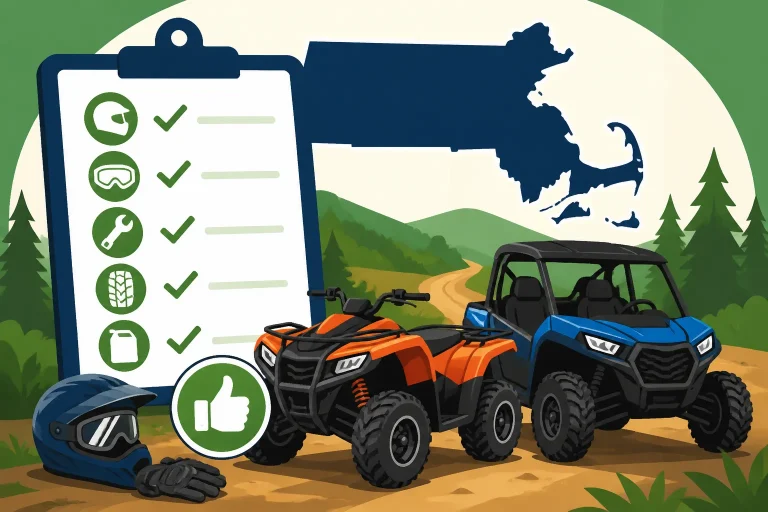
Before your first ride, check that:
- The decal is attached in the specified location and is easy to see.
- The registration information corresponds to the machine you are riding.
- The registration card is aboard and readable.
- The registration has not expired.
- The machine’s VIN is legible and matches the registration information.
Avoid placing the decal where bodywork, a rack, mud or routine contact will hide or damage it. Clean the mounting surface and apply the sticker according to the current instructions. If a decal is damaged or lost, ask the Environmental Police about replacement rather than trying to recreate it or moving a decal from another machine. A registration belongs to the machine and term shown on the official record; it should not be treated as a transferable trail pass.
Carrying a photograph of the registration card may be convenient as a backup, but do not assume a photo replaces the required card. Bring the original card unless the Environmental Police confirms that another format is accepted. If the card is lost before your trip, sort out a replacement before riding, using the current agency process.
The same careful approach applies to the home-state paperwork. Keep it available if it helps explain the machine’s ownership or history, but don’t present it as proof that Massachusetts registration is unnecessary. When an officer checks the machine, the Massachusetts registration and the machine’s identifying details should be consistent.
Registration Does Not Guarantee a Place to Ride
One of the most common planning mistakes is treating the sticker as permission to ride anywhere in Massachusetts. Registration addresses the machine’s registration status; access depends on the land and the rules that apply there. A registered ATV or UTV can still be prohibited from a trail, forest, town property or private parcel.
Before towing, identify the specific riding area and verify that it permits your machine type. Check for operating dates, temporary closures, parking arrangements, permits, fees and restrictions on vehicle dimensions. Do not rely only on an old map, a social media post or a route shared by another rider. Land rules and conditions can change, and a road or trail shown online may not be open to OHVs.
State forest access is not uniform. Some places allow certain types of off-highway riding under defined conditions, while others do not offer OHV trails. Parking or day-use charges may also be separate from registration. Check the relevant land manager’s current information and see Massachusetts DCR Parking and Access Fees before setting out.
Private land requires permission from the landowner. A registration decal does not create permission to cross a property, follow a woods road or use a trail that appears to connect two public areas. Get clear authorization before riding, and respect posted signs and closed gates. Rules can also apply to noise, equipment, youth riders and where a machine may travel, so check requirements for your trip rather than assuming that registration covers them.
A practical pre-trip sequence is:
- Identify where you intend to ride and confirm that ATVs or UTVs are allowed there.
- Check current closures, operating dates, parking instructions and any separate permit or access requirements.
- Apply for Massachusetts OHV registration through the Environmental Police and allow time to resolve paperwork questions.
- Confirm that the decal is correctly displayed and the registration card is aboard.
- Recheck the destination’s information close to your trip, especially after storms or during seasonal changes.
If you are visiting from New Hampshire, Rhode Island, Connecticut, New York or another state, the key point is the same: don’t plan around the assumption that your home sticker carries over. Review Massachusetts Rules for an Out-of-State Machine for issues that may apply to your situation. For a New Hampshire visitor, Massachusetts Rules for a Visiting New Hampshire Rider offers a more specific starting point.
A little preparation can prevent a wasted trip, but it cannot guarantee that every trail will be open when you arrive. Keep the Massachusetts registration, land access and machine rules as separate checks. That way, a valid sticker is one part of a lawful ride plan, not a reason to assume the rest is automatically settled.
Disclaimer
This article is for general informational purposes only and does not constitute professional advice. Laws, prices and regulations vary by location and change over time. Consult a qualified professional for guidance on your specific situation.