Massachusetts Bans Riding on Highways
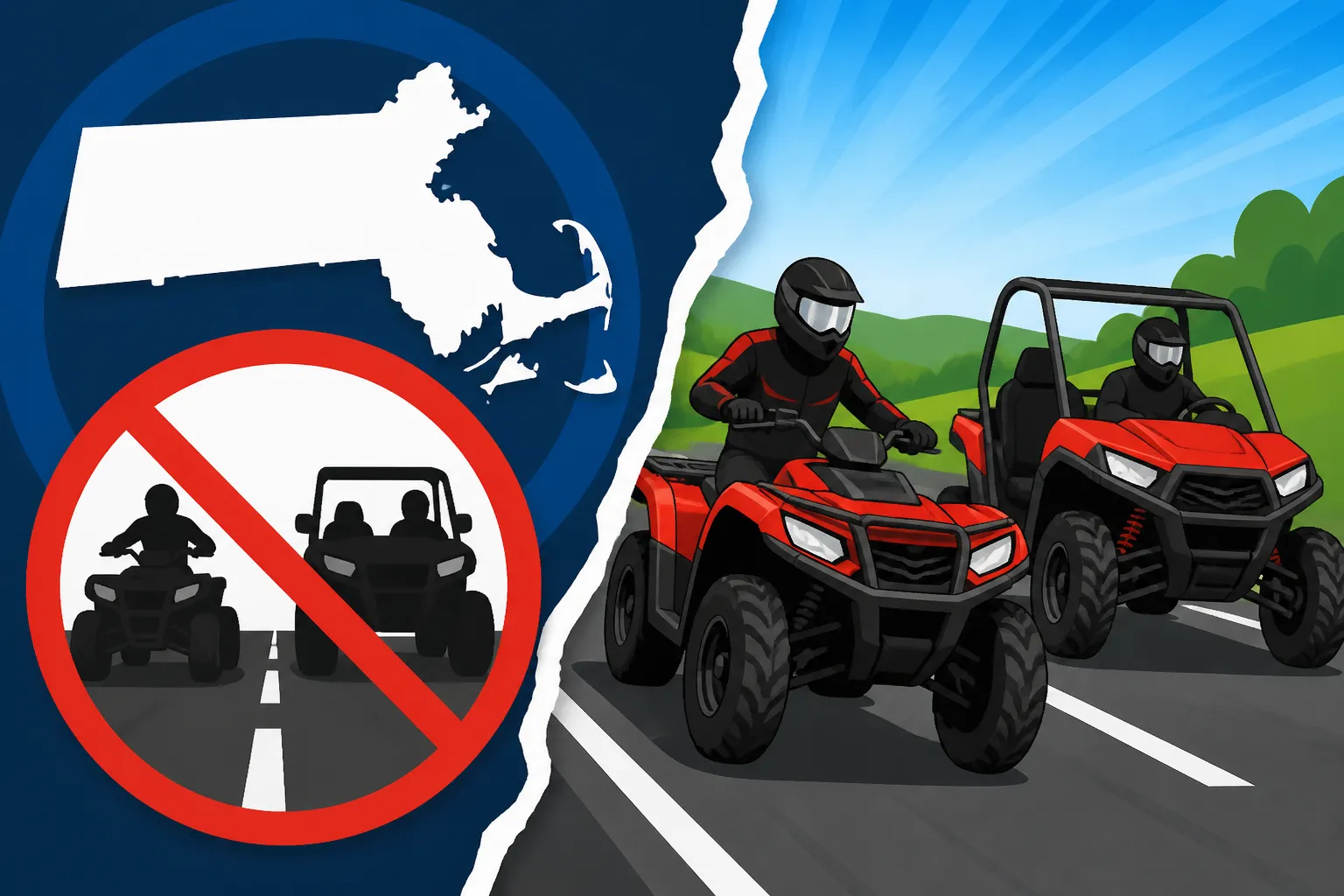
It’s a common fantasy for many of us who own ATVs and UTVs in Massachusetts: just hop on the machine, ride out of the driveway, and cruise down the road to hit the trails, or even connect between a couple of local spots. But the truth is, this dream runs headfirst into a very solid wall of law here in the Bay State, especially when it comes to riding on highways. This guide is here to untangle the confusion and help you understand exactly why highways are off-limits for your off-road machine and what you can do instead.
The Harsh Reality: Why Massachusetts Bans ATVs on Highways
Let's face it, the convenience of riding your ATV or UTV on a paved road to get to a trail system, or even just to a friend's house a few streets over, is incredibly appealing. However, Massachusetts has very clear and strict laws that put a firm stop to this idea, particularly concerning highways. It's not just a suggestion; it's a legal mandate rooted deeply in safety and the specific design of these machines.
Defining "Highway" in Massachusetts Law
When we talk about a "highway" in Massachusetts, it's easy to picture just the major interstates like I-90 or I-91, or even big state routes like Route 2. And you wouldn't be wrong to think of those. But the legal definition under Chapter 90B, which governs off-highway vehicles (OHVs), is often much broader than what the average person might consider a "highway." Essentially, it includes nearly all public roads and ways designed for conventional motor vehicle traffic. This means that many state routes, town roads, and even some paved county roads that aren't quite "interstates" are still considered highways in the eyes of the law when it comes to OHV operation.
The core issue isn't just speed limits. It's about the design of your ATV or UTV. These machines are built for dirt, mud, rocks, and uneven terrain. They have knobby tires for grip, high ground clearance, and suspension systems that excel off-road. On pavement, these very features become liabilities. Traction is reduced, handling can be unpredictable, and the overall stability at road speeds is compromised compared to a car or truck. Think about trying to quickly swerve to avoid a hazard on a highway; an ATV simply isn't engineered to perform that maneuver safely at 55 MPH. The law recognizes this fundamental design difference and acts to prevent dangerous situations. For a deeper dive into the legal framework, you might want to review [Massachusetts ATV Laws Under Chapter 90B].
Safety Concerns and Public Trust
The ban on OHVs on highways isn't just about technicalities; it's primarily a matter of public safety. Imagine a scenario: you're driving your car down a busy two-lane highway, and suddenly, an ATV appears ahead of you, traveling at a much slower speed, maybe weaving slightly on its knobby tires. The speed differential alone creates a huge hazard, increasing the risk of rear-end collisions or dangerous overtaking maneuvers. ATVs and UTVs lack the visibility of larger vehicles, often sitting lower than truck bumpers, and don't have the same safety features like airbags, crumple zones, or enclosed cabins that protect occupants in a collision.
Beyond the immediate physical dangers for both the OHV rider and other motorists, there's also the issue of public perception and trust. When people see OHVs riding illegally on public roads, it erodes support for off-road recreation in general. It makes it harder for responsible riders and clubs to advocate for more legitimate trail access. The state's stance is a clear one: keep these machines on designated trails to ensure everyone's safety and maintain what limited access we do have. Upholding these rules helps prevent accidents and fosters a better relationship between the OHV community and the general public.
Understanding "Public Ways" and Other Restricted Roads
While the focus here is on highways, it's crucial to understand that the prohibition against riding ATVs and UTVs extends far beyond just major interstates. Massachusetts law broadly restricts the use of off-highway vehicles on most "public ways." This distinction is critical for any rider trying to navigate the complex landscape of legal riding areas.
The Broader Prohibition: Beyond Just Highways
When Massachusetts law refers to "public ways," it's encompassing a vast network of roads. This includes city streets, town roads, paved rural routes, and even many dirt or gravel roads that are maintained by a municipality or the state and are open to the general public for vehicular travel. The intention is clear: if it's a road primarily used by cars, trucks, and other registered motor vehicles, your ATV or UTV likely doesn't belong on it.
This means you can't simply take your UTV to the grocery store, or ride your quad down the road to a neighbor’s house, even if it feels like a small, quiet street. The law doesn't differentiate between a bustling main street and a quiet cul-de-sac; if it's a public way, the general ban applies. This is one of the most common misunderstandings riders have, often leading to citations. Many riders, especially those new to the state or coming from areas with more lenient laws, are surprised to learn how extensive this prohibition is. It's not about being a killjoy; it's about ensuring safety where conventional traffic and off-road machines simply don't mix. For a thorough explanation of what's off-limits, check out [Can You Ride an ATV on the Road in Massachusetts?].
Exceptions and the Strict Crossing Rule
Now, are there any exceptions? Very, very few. The primary, and almost singular, exception for an OHV interacting with a public way is a direct crossing. And even this comes with extremely strict conditions. You are allowed to cross a public way at approximately a right angle, after coming to a complete stop and yielding the right of way to all motor vehicles and pedestrians. The moment your wheels touch the public way, you must prioritize the safety of others and complete the crossing as quickly and directly as possible. You cannot ride down the public way for any distance, even a few feet, before or after the crossing. It must be a straight-shot, stop-and-go maneuver.
Think of it like this: if you’re riding on a legal trail and that trail happens to intersect a public road, you can cross that road to continue on the trail on the other side. But you cannot use that public road as part of your trail, even for a short connector section. This rule is designed to minimize the time an OHV spends on pavement, reducing exposure to conventional traffic. It’s not an invitation to commute or even connect segments of your ride via public roads. An Environmental Police officer watching you will be looking for that complete stop, that yielding, and the immediate exit from the road. Deviate from these strict rules, and you're in violation. The details on this critical maneuver are covered in [Massachusetts Crossings Require a Full Stop].
Legal Consequences of Riding an ATV on a Massachusetts Highway
Ignoring the clear prohibitions against riding ATVs and UTVs on Massachusetts highways and public ways isn't just about bending the rules; it carries tangible and often expensive legal consequences. These aren't just minor infractions; they can escalate quickly, impacting your wallet and even your ability to enjoy your machine in the future.
Fines and Penalties You Could Face
Getting caught riding your off-highway vehicle on a highway or public way in Massachusetts will almost certainly result in a citation, and those citations come with fines. The exact amount can vary depending on the specific violation and the discretion of the issuing officer, but they are not insignificant. We're not talking about a parking ticket here. These fines are designed to deter illegal activity and reflect the safety risks involved. For instance, operating an unregistered OHV on a public way, or operating a registered OHV on a prohibited public way, will both draw hefty penalties.
Beyond the initial fine, you could also face additional court costs if you decide to dispute the ticket or if the violation is severe enough to warrant a court appearance. This means not only the fine itself but potentially administrative fees, time off work for court dates, and the stress of a legal process. These costs can add up quickly, turning a moment of convenience or a misjudgment into a substantial financial hit. It’s crucial to understand that law enforcement, particularly the Environmental Police, takes these violations seriously. For an idea of the financial implications, you might want to look into [Massachusetts Ticket Costs for Riders].
Machine Seizure and Other Serious Ramifications
Perhaps one of the most severe consequences, and certainly one that hits hardest for any OHV owner, is the potential for your machine to be seized by law enforcement. If you're caught riding illegally on a highway or other prohibited public way, an Environmental Police officer has the authority to impound your ATV or UTV. This means your pride and joy could be towed away on the spot, leaving you stranded and facing a complicated and expensive process to get it back.
Retrieving a seized machine is rarely simple or cheap. You'll likely be responsible for towing fees, daily storage fees at the impound lot, and possibly administrative fees from the state or municipality. These costs can quickly accumulate, sometimes exceeding the value of older machines. In addition to the financial burden, there’s the inconvenience and the potential for damage during towing or storage. In some egregious cases, especially if other laws are being broken (like operating under the influence), or if there's a history of violations, the machine could even be subject to forfeiture. This truly drives home the state's zero-tolerance policy for OHVs on restricted roads. For more information on dealing with such a situation, consult [Getting a Seized Quad Back From the State]. Beyond seizure, repeated violations or particularly reckless behavior could lead to even more severe charges, including those under [Massachusetts Penalties for Illegal Riding] or [Massachusetts Penalties Under Sean's Law].
Safe and Legal Alternatives for ATV & UTV Riding in Massachusetts
Given the strict regulations against riding ATVs and UTVs on highways and most public ways in Massachusetts, it's natural to wonder, "Where can I ride?" The good news is that legal, safe, and incredibly enjoyable options do exist. The key is to know where they are and to always operate your machine responsibly and within the bounds of the law.
Exploring Designated State Forest Trails
Massachusetts offers some fantastic riding opportunities within its state forest system, primarily concentrated in the western part of the state. These designated OHV trail systems are specifically designed and managed for off-highway vehicles, providing miles of challenging and scenic terrain. You won't find yourself sharing these trails with cars, and they are patrolled by the Environmental Police to ensure everyone is following the rules and staying safe.
The three primary state forests that allow ATV and UTV riding are Beartown State Forest, October Mountain State Forest, and Pittsfield State Forest. Each offers a unique experience, from rocky climbs to winding wooded paths. Before you haul your machine to one of these locations, it's always a smart move to check the specific Department of Conservation and Recreation (DCR) website for current trail conditions, opening hours, and any specific permits or regulations. Seasons of operation can also vary; for instance, the [Massachusetts DCR Riding Season] generally runs from May through November. These trails are where your machine truly belongs, where you can safely explore and enjoy the sport without the constant worry of breaking the law. Discover more about these areas in [Massachusetts ATV Trails: Three Berkshire Forests].
Private Lands and the Written Permission Rule
Beyond state forests, another significant avenue for legal ATV and UTV riding in Massachusetts is on private land. This can open up a lot of possibilities, whether it’s a friend’s property, a local club with leased land, or your own acreage. However, there’s a crucial caveat: you must have the express written permission of the landowner. This isn't just a suggestion; it's a legal requirement. Trespassing, even accidentally, can lead to fines, legal action, and further restrictions on OHV access.
Always carry a physical copy of this written permission with you whenever you're riding on private land. It should clearly state who granted permission, for what dates or duration, and ideally describe the specific area where riding is allowed. A good practice is to make sure the landowner knows exactly where and when you plan to ride. Building and maintaining positive relationships with private landowners is absolutely essential for expanding and preserving riding opportunities outside of the state forests. Remember, respect for private property is paramount, and it’s a privilege, not a right, to ride on someone else’s land. Learn more about this vital rule in [Massachusetts Landowner Permission in Writing].
Equipping Your Machine for Proper Trail Use, Not Roads
If you own an ATV or UTV in Massachusetts, your focus for modifications and accessories should be squarely on enhancing your trail riding experience, not attempting to make it suitable for road use. Trying to modify an OHV to be "street legal" is generally a dead end in Massachusetts; there simply isn't a legal pathway for recreational off-highway vehicles to be registered for public roads like cars or motorcycles.
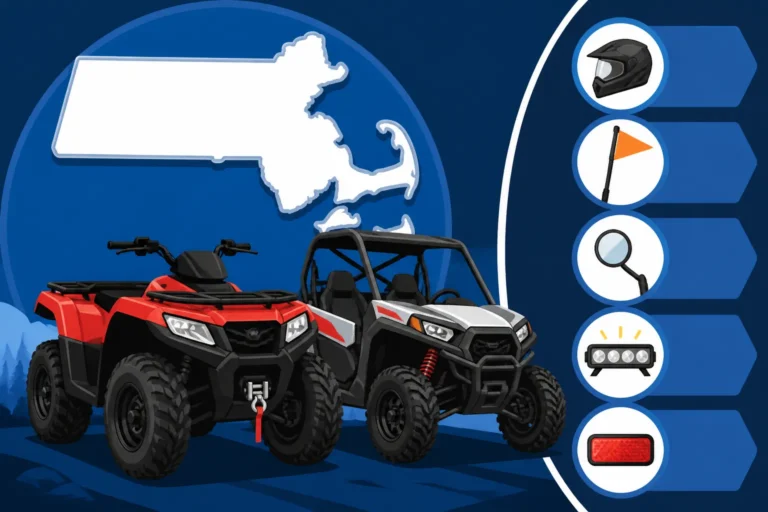
Instead, channel your efforts into gear that improves safety, performance, and enjoyment on the authorized trails. For instance, protecting your investment from the rough terrain of the Berkshire trails is smart. Investing in heavy-duty skid plates or A-arm guards from reputable brands like SuperATV can save you a lot of grief (and money) by shielding critical components from rocks and stumps. Or perhaps you're looking for more utility on the trail; a robust winch, also available from SuperATV, is an invaluable tool for self-recovery or helping a fellow rider out of a sticky situation in the dense woods. Many riders also upgrade their lighting for better visibility on wooded trails, not public roads. Accessories such as LED light bars, often found at retailers like SuperATV, can dramatically improve your ability to see and be seen by others on shared trails, especially during the shorter days of the fall riding season. For UTV owners, an upgraded roof or full enclosure from a company like SuperATV can make a huge difference in comfort and protection from the elements during a long day of trail riding, keeping you focused on the terrain rather than the weather. These kinds of modifications truly enhance your off-road experience within the legal boundaries.
The "Street Legal" Myth: What Massachusetts Doesn't Allow
One of the biggest areas of confusion and frustration for ATV and UTV owners, especially those new to Massachusetts or coming from other states, is the persistent myth of making their machines "street legal." It's a tempting idea – the freedom to drive your UTV wherever you want – but in Massachusetts, it simply isn't a reality for recreational off-highway vehicles.
No Conversion Path for Street Legality
Let’s be direct: for the vast majority of ATVs and UTVs intended for recreational off-road use, Massachusetts does not offer a legal conversion path to make them street legal. You cannot add turn signals, a horn, mirrors, and a license plate, and suddenly drive your quad down Main Street or take your side-by-side on the highway. The state's motor vehicle laws and OHV regulations are distinct and generally keep these categories separate.
The fundamental issue lies in the design, safety standards, and registration categories. ATVs and UTVs are designed for off-road use, not for highway speeds, traffic interaction, or the safety demands placed on conventional vehicles. They typically don't meet the federal motor vehicle safety standards (FMVSS) required for road vehicles. Attempting to modify them to meet some of these standards doesn't change their fundamental classification or open up a path to street registration. There is no special process, no forms to fill out, and no inspections you can pass to transform your recreational OHV into a street-legal vehicle in Massachusetts. This is clearly outlined in the state's regulations, which state there is [Massachusetts Has No Street Legal Path] for these machines.
Why Other States' Rules Don't Apply Here
It's completely understandable why this might be confusing. You might have friends or family in states like Arizona, Utah, or even parts of New Hampshire, where it is possible to make an ATV or UTV street legal under certain circumstances. You might have seen videos online of people cruising their UTVs down city streets in other parts of the country. So, why not Massachusetts?
The simple answer is that vehicle laws are set at the state level, and each state has its own unique regulations. What's permissible in one state is often explicitly prohibited in another. Massachusetts has chosen to maintain a strict separation between off-highway vehicles and road-legal vehicles, largely due to concerns about safety on its often-congested roads and highways. Therefore, carrying a registration from another state where your machine is street-legal won't grant you that privilege in Massachusetts. When you're in the Bay State, you must adhere to Massachusetts law, regardless of where your machine was purchased or registered. This applies even to visitors; [Massachusetts Rules for an Out-of-State Machine] clearly state that you're still subject to local regulations. It's a classic example of "when in Rome," or rather, "when in Massachusetts, follow Massachusetts law."
Massachusetts OHV Road Use Table
To help clarify where you can and cannot ride your ATV or UTV in Massachusetts, here's a table summarizing common "road" types and their legal status for OHV use.
| Road Type | OHV Legal Status (Generally) | Key Restrictions / Notes |
|---|---|---|
| Interstate Highways (e.g., I-90, I-91) | Illegal | Absolutely no ATV/UTV operation allowed. High speeds, high traffic. |
| State Routes (e.g., Route 2, Route 9) | Illegal | Considered "public ways" and generally prohibited. Some limited exceptions for direct crossing only, under strict conditions. |
| City Streets / Town Roads (Paved) | Illegal | Considered "public ways" and generally prohibited. Direct crossing allowed, with full stop and yielding, but no riding along the road. |
| City Streets / Town Roads (Unpaved/Gravel) | Illegal | Still considered "public ways" if maintained by the municipality. Direct crossing allowed, but no riding along the road. |
| Designated State Forest OHV Trails | Legal | Specifically authorized and maintained for OHVs. Check DCR rules, season, and potential permits. This is where your machine belongs. |
| Private Land (with permission) | Legal | Permitted only with express written permission from the landowner. Carry permission with you. |
| Private Roads / Driveways (not public access) | Legal | If owned or controlled by you or with specific permission, generally permitted as it's not a "public way." |
| Railroad Tracks / Rights-of-Way | Illegal | Prohibited and extremely dangerous. Considered private property, often active lines. |
| Beaches / Coastal Dunes | Illegal | Prohibited to prevent environmental damage and for public safety. |
Disclaimer
This article is for general informational purposes only and does not constitute professional advice. Laws, prices and regulations vary by location and change over time. Consult a qualified professional for guidance on your specific situation.