Why a Hunting License Opens No OHV Trails
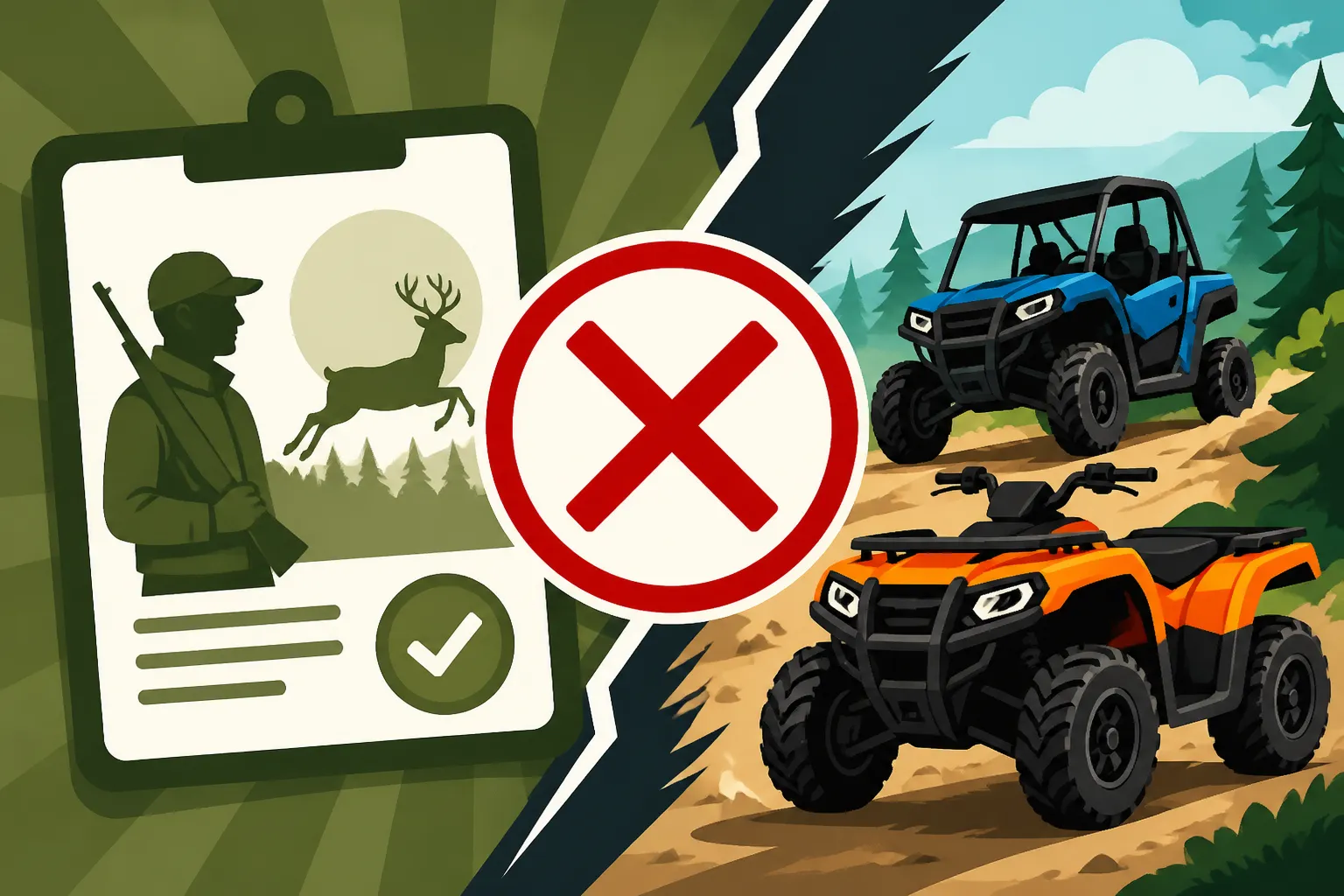
A Massachusetts hunting license may let you hunt where hunting is permitted, but it does not give you permission to ride an ATV or UTV there. The two activities are governed by different rules. Here’s how to tell whether a place is open to OHV riding, what paperwork still matters, and what to check before taking a machine along on a hunt.
A hunting license and OHV access are separate permissions
A hunting license is not a general pass to public land. It authorizes hunting under applicable wildlife rules; it does not authorize motorized travel wherever a hunter may walk. An ATV or UTV is a motor vehicle, so riding it requires separate legal access to the particular trail or area.
That distinction matters on state land, town land, private property, and other places where hunting may be allowed. A location can be open to hunting while motorized recreation is restricted, limited to certain routes, or not allowed at all. Even when vehicles are allowed for a particular purpose, that does not automatically mean recreational trail riding is allowed.
The same principle applies to a hunting license from another state. A home-state license does not grant OHV access in Massachusetts, and a vehicle’s registration from another state does not replace Massachusetts requirements for visiting riders. Massachusetts does not recognize other states’ OHV stickers as permission to ride here. See Massachusetts Has No Reciprocity for Visitors and Out-of-State OHV Stickers Are Not Valid in Massachusetts for the separate registration issue.
It helps to think of a ride and a hunt as two checks, not one:
- Is hunting permitted at this location, at this time, and for this activity?
- Is OHV travel permitted on this exact route or parcel?
A “yes” to the hunting question does not answer the OHV question. Before riding, confirm the access rules for the land itself, not just the hunting rules.
| What you have or want to do | What it does not automatically authorize |
|---|---|
| A Massachusetts hunting license | Riding an ATV or UTV on public or private land |
| Permission to hunt on private land | Riding across that land or using a trail beyond it |
| A valid out-of-state OHV sticker | Riding an OHV in Massachusetts |
| A route used by hunters on foot | Motorized access along that route |
| Permission to retrieve game | General riding before or after retrieval |
| A trailhead parking permit | Riding trails that are closed or not approved for your machine |
This separation can feel inconvenient when a machine would make a hunting trip easier, especially when the land is remote or the gear is heavy. But a hunting license is tied to hunting privileges, not a blanket right to operate a vehicle. The relevant land manager or owner controls whether motorized access is allowed, subject to applicable state and local rules.
Check the land and route, not just the hunting opportunity
Before loading an ATV or UTV, identify who manages the land and what routes are specifically open to that kind of machine. A map showing public land or hunting access is not necessarily an OHV trail map. Likewise, a trail visible on a general recreation map might be hiking-only, closed seasonally, or subject to machine-size or vehicle-type limits.
On state forest land, OHV riding is limited to approved riding areas and routes under the applicable rules. A hunting season does not open additional trails. A forest may allow hunting in areas where OHV riding is not permitted, and an approved OHV route may have operating dates or conditions that differ from hunting seasons. Confirm current access and closures with the relevant land manager before traveling.
Town conservation land, wildlife areas, and other public parcels can have their own restrictions. Some areas may permit hunting while prohibiting motor vehicles, or allow vehicles only for specific management or accessibility purposes. Do not assume that a gate, woods road, utility corridor, or old logging track is open because it looks passable. A route’s appearance does not establish permission.
Private land requires its own care. Written permission to hunt does not necessarily include permission to drive, park, or cross the property by ATV. Ask the landowner specifically about the machine, route, dates, parking location, and intended purpose. Permission for one parcel also does not grant access through neighboring land. Massachusetts rules require written permission in certain riding situations; see Massachusetts Landowner Permission in Writing and Written Permission From a Bay State Owner for more on the distinction.
A useful way to check access is to work from the destination backward:
- Name the parcel or riding area. Avoid relying on a broad description such as “state land near the hunting spot.”
- Find the managing authority or landowner. It may be a state agency, town, private owner, or recreation operator.
- Ask about the exact route. Confirm whether ATVs, UTVs, or both are permitted, and whether there are width or other equipment limits.
- Check dates and closures. Seasonal restrictions, weather damage, maintenance, or temporary closures can affect access.
- Confirm your machine meets the conditions. A route open to one type of OHV may not be suitable or legal for another.
For designated Massachusetts riding areas, use current trail information rather than assuming every forest road is open. Massachusetts ATV Trails: Three Berkshire Forests describes established OHV riding areas, while Massachusetts Trail Planning and Closures is relevant when access may have changed. If you plan to ride on state land, also review Massachusetts DCR Riding Season. A hunting opportunity elsewhere in the same forest does not extend the designated riding area.
When information is unclear, ask the land manager a specific question: “May I ride this ATV on this named route on these dates?” That is more useful than asking whether the property is “open.” The answer may depend on the route, machine, season, or purpose. Keep a note of the office or owner you contacted and any conditions they gave you.
Hunting with an OHV does not create a general exception
There are several reasons a hunter might want an ATV or UTV: hauling equipment, traveling between a parking area and a permitted location, or retrieving a harvested animal. Those practical needs do not by themselves create a right to ride. The permission must come from the applicable rules and the land manager or owner.
In particular, distinguish riding for recreation from access allowed for a narrow purpose. If an agency or landowner expressly permits a vehicle for a specific task, follow the limits precisely. Permission to use a particular route to retrieve game, for example, should not be treated as permission to explore side trails, make additional trips, or use the machine for unrelated riding. Ask what is allowed before relying on such an exception.
Do not assume that an access accommodation, a management road, or a route used by agency staff is open to the public. Some roads may be closed to public motor vehicles even when they are visible on a map or used for official work. A locked gate, posted sign, or barrier is a clear reason to stop and verify access rather than detour around it.
The same caution applies when hunting and riding seasons overlap. A trail that is open to OHVs does not necessarily make every nearby area available for riding, and hunting activity does not change the trail boundary. Stay on authorized routes, follow posted signs, and avoid driving through areas where motorized access is prohibited. If trail conditions or activity make safe, lawful travel uncertain, choose another route or postpone the ride.
For a hunt on private land, get permission that clearly covers the vehicle use you expect. For a hunt on public land, check the rules for both hunting and OHV access with the appropriate managing office. If you cannot confirm a route is open, leave the machine at a permitted parking area and use another lawful way to reach the hunting location.
Registration and safety requirements remain separate from land access. Having a valid registration does not make a closed trail legal, just as a hunting license does not replace OHV registration. Riders should understand the state’s registration rules and carry the required documents. Massachusetts Requires Its Own Registration explains why a visitor may need a Massachusetts sticker, and The Registration Card You Must Carry in Massachusetts covers the document riders need to have with the machine.
A practical pre-trip check for hunters who want to ride
A short check before departure can prevent a long drive to a closed route or a misunderstanding at a gate. Do not rely on a hunting map, an old online post, or another rider’s recollection as the only confirmation. Check the rules for the parcel and the route you actually plan to use.
Use this checklist:
- Confirm the hunting rules. Verify that hunting is allowed on the parcel and that your license, season, species, and method comply with current requirements.
- Confirm OHV access separately. Ask whether the specific ATV or UTV may use the route, and whether access is recreational or limited to a defined purpose.
- Check registration. Make sure your machine meets Massachusetts requirements. A resident or visitor may have different registration terms; Massachusetts Registration Terms by Residency explains why residency matters.
- Check safety and equipment rules. Confirm the applicable rider, machine, and document requirements. Massachusetts Equipment Requirements is a useful starting point.
- Ask about parking and gates. Verify where the trailer or machine may be left, whether access hours apply, and whether a gate is expected to be open.
- Get private permission in writing. Make sure it covers motorized travel, not only hunting, and identify the route and dates.
- Plan a non-riding option. If access is denied, the trail is closed, or the rules are uncertain, do not improvise a route across land that has not been opened to OHVs.
Visitors should be especially careful not to treat an out-of-state sticker as permission to ride. A Massachusetts hunting license or a nonresident hunting privilege does not change the state’s OHV registration rules. Check Massachusetts Stickers for a Visiting Machine and Where a Visiting Rider Applies for a Massachusetts Sticker before bringing a machine across the state line.
Keep in mind that approval can be site-specific. An office may confirm that one trail is open but not another; permission from one landowner may not cover a connecting road. If your route crosses parcels or jurisdictions, verify each segment. Do not assume you can bridge a gap over a public road, town property, or private land simply because the destination is open.
The safest rule is straightforward: treat hunting access, OHV access, and vehicle registration as three separate questions. A hunting license answers only the first. Ride only where the route is specifically open to your machine, get any required permission, and confirm current rules before setting out.
Disclaimer
This article is for general informational purposes only and does not constitute professional advice. Laws, prices and regulations vary by location and change over time. Consult a qualified professional for guidance on your specific situation.