Massachusetts Fire Restrictions in Dry Months
Dry-weather fire restrictions can change faster than a riding plan. In Massachusetts, a machine may be registered and a trail normally open while a temporary fire rule still limits campfires or other activities. The safest approach is to check current land-manager and local fire notices before you leave, then adjust your ride and camping plans to match.
How fire restrictions affect an ATV or UTV trip
A fire restriction is not always a statewide ban, and it does not necessarily close every trail. It may apply only to a particular town, state forest, campground, or type of activity. A restriction can limit open flames while allowing riding, or it can accompany a trail closure or broader access limits. Do not assume that one notice answers every question about your destination.
The rules may also come from different authorities. A state forest manager can set conditions for state land, while a municipal fire department or other local authority may announce restrictions for a town. Private riding areas can have their own rules. A general weather forecast or a notice from a neighboring town is not a substitute for checking the specific place where you plan to ride or camp.
It helps to separate three questions before traveling:
- Is riding allowed? Confirm that the trail or riding area is open to your machine and type of use.
- Are open flames allowed? Check rules for campfires, charcoal, and other flame-producing activities at your campsite or day-use area.
- Are there machine-specific restrictions? Ask whether the land manager has requirements related to exhaust systems, spark arresters, parking, or other equipment.
A registration sticker does not grant permission to ride during a closure or override a temporary fire restriction. Likewise, being allowed to ride does not automatically mean you can build a fire or use a stove. Registration, trail access, and fire rules are separate issues. For background on how those pieces differ, see Massachusetts Has No Separate Trail Pass and Massachusetts Trail Access Without a Pass.
Dry conditions can develop outside the part of the year when riders expect them. A dry spell, wind, low humidity, or unusually little recent rain can raise concern even when the surrounding landscape looks green. Conditions can also differ between towns and forest areas. Instead of relying on a familiar calendar or a previous trip, verify the current status for the date you plan to go.
Check the right notices before you head out
Start with the agency or owner responsible for the land you intend to use. For a state forest, check the current information from the relevant state land manager and contact the forest office if the online notice is unclear. For a town-owned area, check with the municipality or local fire department. A private riding park should be contacted directly about its operating status and fire policies.
If you are riding in the Berkshires, do not treat a general regional update as confirmation that every riding area is open. Forest rules, trail conditions, and local fire restrictions may not match from one place to another. [Questions Worth Asking a Berkshire Forest Office] can help you prepare a focused call, and Checking Rules Before a Long Drive to the Berkshires is useful when you need to confirm access before towing.
Use a practical check-in routine:
- Identify the exact property and trailhead. The nearest town is not always the authority that manages the riding area.
- Check the current closure and restriction notices. Look for date-specific updates, not just a general recreation page.
- Ask about the activity you plan to do. “Are there restrictions?” is less useful than asking whether a campfire, grill, stove, or overnight stay is allowed at the particular site.
- Confirm any equipment requirement. If a notice mentions an exhaust or spark-arresting device, ask what standard applies and whether the requirement is for all riders or only certain areas.
- Check again shortly before departure. A restriction can be introduced or changed after you make a reservation or load the machine.
- Read signs at the entrance and campsite. A posted notice may be more current or more specific than information you checked earlier.
Keep a note of who you contacted and what they said, especially when a trip involves several days or more than one property. That record is not permission to ignore a later sign or closure, but it can help you remember which rules applied to which location.
Do not rely on an old social media post, a forum comment, or a friend’s report from a prior weekend. Those can be useful clues about where to look, but they can become inaccurate as weather and local conditions change. If two sources appear to conflict, contact the land manager or local authority before using the area.
Campfires, cooking, and equipment
A fire restriction can distinguish between kinds of heat or flame, so avoid treating “no campfires” as a complete description of what is permitted. A rule might address a ground fire, a contained fire, charcoal, or a cooking device differently. The details depend on the current notice and location. If the wording does not clearly say whether your planned cooking setup is allowed, ask before lighting or using it.
The same caution applies to overnight stays. A campsite may remain open while fires are restricted, or a closure may affect both camping and riding. Confirm each part of the plan rather than assuming that a campsite reservation settles every question. For a Berkshire trip, see Campfire Rules in a Dry Berkshire Autumn for additional planning considerations.
| Activity or issue | What to verify before the trip |
|---|---|
| Campfire | Whether fires are allowed at that specific site and whether a designated fire area is required |
| Grill or cooking stove | Whether the restriction covers that device or fuel type |
| Overnight camping | Whether the site is open and whether separate fire rules apply |
| ATV or UTV exhaust | Whether the property has a spark-arrester or other equipment requirement |
| Trail riding | Whether the route is open to your machine and has any temporary limits |
| Parking and staging | Whether the lot or trailhead is open and whether any access conditions have changed |
A machine’s exhaust is worth checking before a dry-weather ride, but do not assume every Massachusetts riding area uses identical equipment rules. Ask the land manager what is required and inspect your machine before hauling it. The related topics Does a Massachusetts Trail Machine Need a Spark Arrester? and Spark Arrestor Checks at a Park Gate explain why this equipment question matters and what to clarify.
Even when riding is permitted, use careful habits around dry vegetation. Park only in an approved area, avoid stopping on tall dry grass, and keep the machine away from brush where its exhaust or other hot components could make contact. Do not leave a running machine unattended. If you notice smoke, a burning smell, or a small fire, stop in a safe place and report it promptly; do not put yourself at risk trying to control a fire that is spreading.
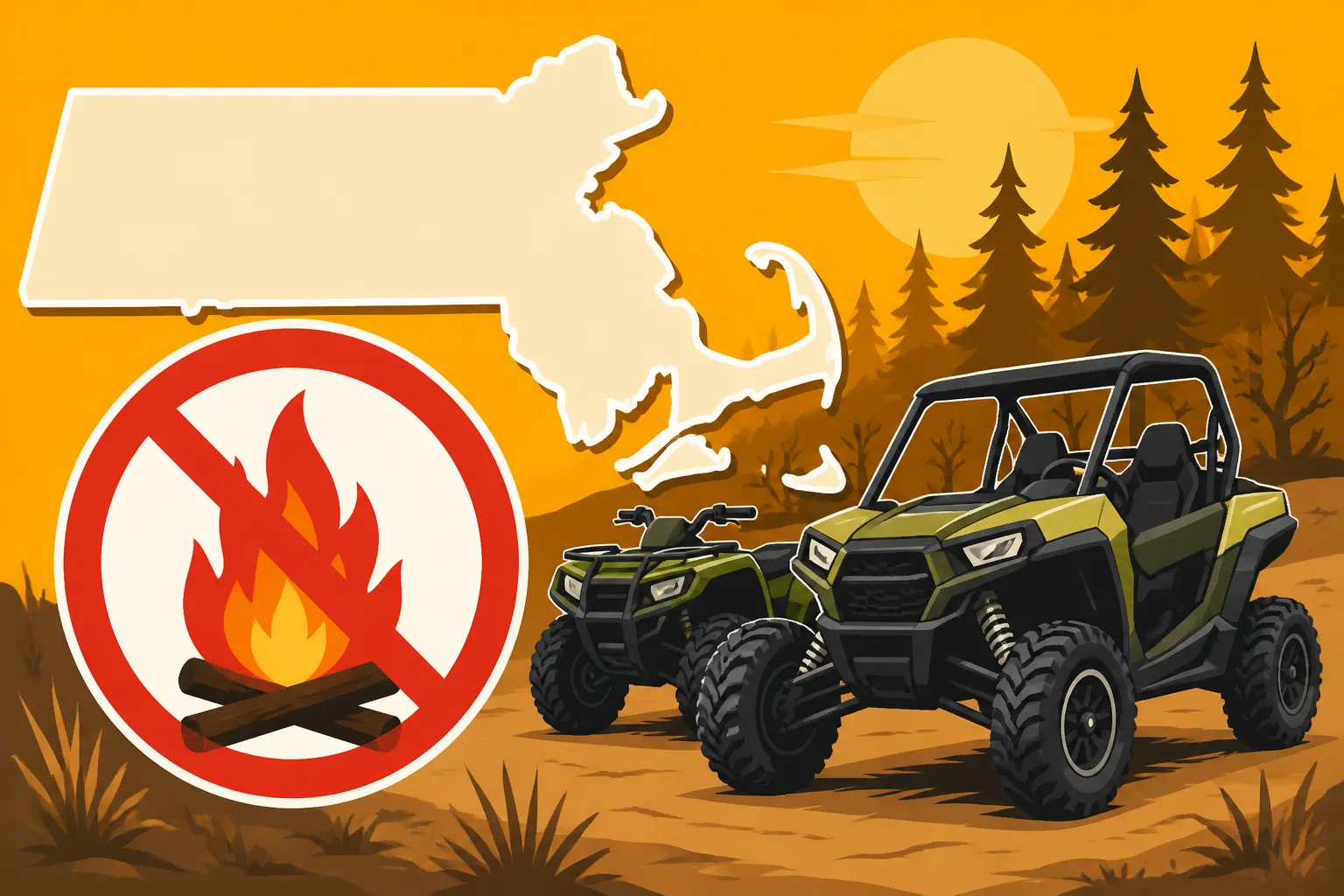
If fires are prohibited, do not look for a workaround. A fire ring, portable device, or cooking setup is not automatically exempt just because it is contained or brought from home. Follow the exact restriction and ask the responsible authority when the notice is ambiguous. In dry conditions, a cautious interpretation is safer than guessing.
If restrictions change during your visit
A trip plan should leave room for a change in conditions. If a fire restriction is announced after you arrive, follow it immediately. If the notice says the area is closed, leave or avoid the closed section as directed. Do not use a different trail or campsite on the same property unless the land manager confirms it is open.
Before riding, make sure everyone in your group knows how to receive updates and what to do if the plan changes. Agree on a meeting point, keep phones charged, and carry enough water and basic supplies for a delay. Cell service may be unreliable in some forest areas, so do not depend on being able to look up a notice once you are far from the trailhead.
If a fire is visible, report it using the appropriate emergency channel and provide the clearest location information you can: the property, trail or road name if known, nearby landmark, and direction of travel. Do not ride toward the fire to investigate or attempt to pass through smoke. Follow instructions from emergency personnel and land managers, and leave room for response vehicles.
A closure can also affect access routes or parking, not just the specific trail you had planned to ride. Recheck Massachusetts Trail Planning and Closures and Massachusetts Trail Conditions Before You Tow when weather or land notices have changed. If you are unsure whether a closure applies to your route, wait for confirmation rather than entering and hoping to turn around later.
The simplest rule is to treat fire status as a day-of-ride check, alongside registration, trail access, and equipment. Massachusetts restrictions can be local and temporary; checking with the authority responsible for the property helps prevent a wasted trip and reduces the chance that a recreational outing contributes to a fire. When in doubt, skip the flame, respect the sign, and choose another open activity.
Disclaimer
This article is for general informational purposes only and does not constitute professional advice. Laws, prices and regulations vary by location and change over time. Consult a qualified professional for guidance on your specific situation.