Does a Massachusetts Trail Machine Need a Spark Arrester?
A spark arrester can help keep hot exhaust particles from starting a fire, but whether your ATV or UTV needs one depends on where you plan to ride. Massachusetts riders can face different rules on public land, at private parks, and on trails with seasonal restrictions. Check the specific riding area’s requirements before you haul your machine.
Does Massachusetts require a spark arrester on every trail machine?
Do not assume that one answer applies everywhere in Massachusetts. A machine may be subject to statewide equipment rules as well as separate conditions set by the land manager or riding-area operator. Those requirements can differ by location, and rules may change with fire danger, trail conditions, or other temporary restrictions.
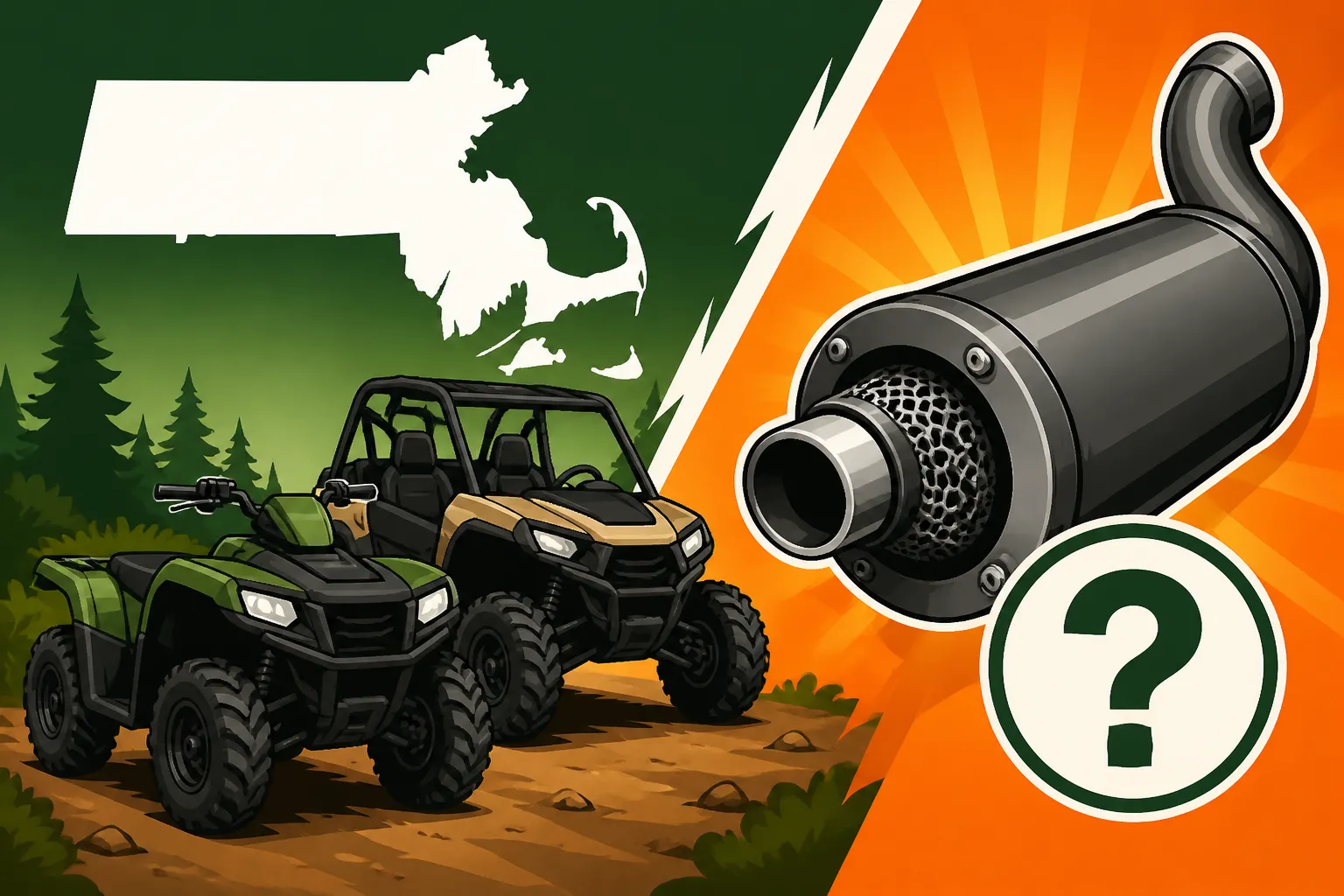
A spark arrester is a device in the exhaust system designed to reduce the chance that burning particles leave the tailpipe. It is not the same thing as a muffler: a muffler reduces exhaust noise, while a spark arrester addresses sparks and hot debris. Some exhaust systems combine both functions, but a quiet exhaust is not automatically proof that it has a spark arrester.
That distinction matters when you are checking your machine. If a trail rule calls for a spark arrester, a stock muffler or an aftermarket exhaust should not be treated as compliant unless you can verify that it includes the required device and meets the site’s stated standard. Likewise, a machine that has a spark arrester may still fail a separate noise or muffler requirement.
The practical answer is to check the rules for the exact place you intend to ride. Massachusetts has different public riding areas, and private parks set their own admission and equipment conditions. A trail’s general listing may not cover every inspection requirement. For an overview of the locations and access considerations, see Massachusetts ATV Trails: Three Berkshire Forests. For private venues, review Massachusetts Private Park Waivers and Rules and confirm current rules with the park itself.
| Where you plan to ride | What to verify before leaving | Why it matters |
|---|---|---|
| State-managed riding area | Whether a spark arrester is required, and whether there is a specified standard or inspection | Public-land rules may include equipment and seasonal conditions |
| Private riding park | The park’s current equipment checklist, including spark-arrester and sound rules | A park can set entry conditions in addition to general state law |
| A trail with a temporary closure or restriction | Whether fire conditions or trail notices add temporary requirements | Restrictions can change even when the machine’s equipment has not |
| A trail system with unclear online information | Which office or operator can confirm the rule for the specific trail | A general webpage may not answer a detailed equipment question |
This is why it is useful to separate three questions: Is the equipment required by law or land rules? Does the particular riding area require it for entry? And can you show that the part fitted to your machine satisfies the stated requirement? An answer to one does not automatically answer the others.
The state’s broader equipment and sound rules may also be relevant. See Massachusetts Equipment Requirements and Massachusetts Muffler and Noise Rules for related topics, and check Massachusetts Sound Limits on State Land if you are riding on public land. Those requirements should not be treated as a substitute for checking whether a spark arrester is specifically required at your destination.
How to check a riding area’s spark-arrester rule
Start with the official source responsible for the land or facility. That may be a public-land office, a trail operator, or a private park. If the rule is not clear online, contact the office before traveling; a quick confirmation can prevent a long drive ending at a gate or inspection point.
Use the exact name of the riding area and ask about the machine you will bring. If you are taking a side-by-side, specify that rather than asking only about “an ATV.” Some sites have different access or equipment rules depending on machine type, trail width, or the area being used. Also ask whether the rule applies to all riding areas on the property or only certain trails.
When you contact the operator, ask:
- Is a spark arrester required for my ATV or UTV on the trails I plan to use?
- Does the requirement apply all season, or can it change with fire conditions?
- Is there a particular certification, marking, or type of device the site accepts?
- Is equipment inspected at the entrance or elsewhere?
- Are there separate muffler or sound limits?
- Are any trails or riding areas closed or restricted when I plan to visit?
Keep a note of the response, including the name of the office or person who provided it and the date you checked. This is especially helpful if you are planning a group ride or hauling several machines. The most current answer from the responsible office is more useful than a general assumption based on what another park allows.
Before setting out, also check for general access and trail updates. Massachusetts Trail Conditions Before You Tow can help with trip planning, while Massachusetts Permit Questions Riders Ask covers related access questions. A permit or registration does not necessarily confirm that a machine meets an equipment rule, so verify those items separately.
If you are unable to reach anyone, do not interpret silence as permission. Look for current posted notices, official trail pages, and signs at the entrance. If the rule remains unclear and you cannot verify that your machine qualifies, the lower-risk choice is to postpone the trip or choose a location whose requirements you can confirm.
Checking the machine and choosing a replacement
Once you know what the site requires, check the exhaust system on the machine you intend to ride. Start with the owner’s manual and the manufacturer’s information for the exact year, make, and model. A replacement exhaust, modified silencer, or missing internal component can make a machine different from its original configuration.
Look for clear documentation that identifies the part as a spark arrester and states what standard or approval it meets, if the riding area specifies one. A product description that only says “quiet,” “performance,” or “off-road exhaust” is not enough to establish compliance. Do not rely on a generic fitment claim when the part is meant for a different model or engine configuration.
If you are buying a replacement, confirm all of the following before ordering:
- The part is made for your exact machine configuration.
- The manufacturer identifies it as a spark arrester, not only as a muffler or silencer.
- Any stated certification or standard matches what the riding area accepts.
- The design does not remove or bypass a device required by the machine or trail operator.
- Installation instructions and maintenance requirements are available.
An online marketplace listing, including one on Amazon, can be a starting point for finding a part, but it is not proof that the item fits your machine or satisfies a trail rule. Read the manufacturer’s specifications, check the exact model fitment, and confirm the riding area’s required standard before purchasing. When the listing is vague, ask the manufacturer or seller for documentation rather than guessing from product photos.
A mechanic or dealer may be able to identify the exhaust configuration and explain whether a particular part fits. Ask for the part number and documentation, then compare those details with the park or land manager’s requirements. If your machine has been modified, mention the changes; a stock-equipment answer may not apply to an aftermarket system.
Do not modify or remove exhaust components simply to improve sound or performance without checking the consequences. A machine can become louder, fail a site’s noise test, or lose equipment that the operator expects to be present. Also avoid assuming that passing a sound check proves spark-arrester compliance. Noise and spark control address different concerns.
Before you ride
A spark arrester is a small part of a larger pre-ride check. It is sensible to verify that the exhaust system is complete, secure, and maintained, and to inspect it periodically for damage or blockage. Follow the manufacturer’s instructions for cleaning and servicing any screen or other component. A damaged or neglected device may not work as intended, even if the machine originally came with one.
Use this short checklist before towing:
- Confirm the rules for the specific riding area and the trails you plan to use.
- Ask whether the requirement applies to your type of machine.
- Check whether the site specifies a particular spark-arrester standard or marking.
- Verify that the installed part fits your machine and has supporting documentation.
- Check separate muffler and noise requirements.
- Look for temporary fire, access, or trail restrictions.
- Carry any registration or permit documents required for the ride.
For broader enforcement and inspection context, see What an Environmental Police Officer Checks at a Trailhead. That information does not replace a site’s own entry requirements, but it can help you think through what to have ready.
The safest approach is straightforward: do not rely on a general statement that “Massachusetts requires” or “Massachusetts does not require” a spark arrester for every trail. Confirm the rule with the land manager or park you will visit, then make sure the actual equipment on your ATV or UTV meets that rule. If the answer is unclear, get clarification before loading up.
Disclaimer
This article is for general informational purposes only and does not constitute professional advice. Laws, prices and regulations vary by location and change over time. Consult a qualified professional for guidance on your specific situation.