Massachusetts Classroom Course Length
Massachusetts riders trying to schedule an off-highway vehicle safety class need to know whether the classroom session fits into a busy day—and whether it is the entire course. The classroom portion is about two hours, but the full certification process can take longer. Here’s what to expect, how to plan, and what to confirm before you travel.
How long is the Massachusetts classroom course?
Plan for about two hours for the classroom portion of Massachusetts’ OHV safety course. That is a useful scheduling estimate, not a guarantee that every session will end at the exact two-hour mark. Sign-in, questions, breaks, and any practical activities can affect the time.
The classroom session is one part of a broader safety course. Riders may also need to complete an online component and an in-person skills test. As a result, “two hours in the classroom” does not necessarily mean the complete course takes only two hours. Check the current instructions for your course and allow time for every required part.
| Course activity | What it involves | How to plan |
|---|---|---|
| Online course work | Safety material completed online, when required for the course | Finish it before the in-person date if instructed |
| Classroom session | Instructor-led material on safe and responsible OHV operation | Allow about two hours, plus a buffer |
| Skills test | Practical demonstration of riding skills, when required | Confirm the location, equipment, and timing |
| Certificate processing | Completion recorded and certificate issued or made available | Ask how and when to access proof of completion |
The classroom length is only one part of the schedule. If the course combines classroom instruction and practical work on the same day, the total visit will take longer than the classroom estimate. If the online portion must be completed beforehand, add that time to your preparation rather than expecting to finish it at the class.
The class is also not a substitute for checking the age rules that apply to the rider. A certificate does not automatically make every rider eligible to operate every machine or ride in every location. For the broader course requirements, see Massachusetts Two-Part Safety Course and How to Get a Massachusetts Safety Certificate.
What happens during the classroom session?
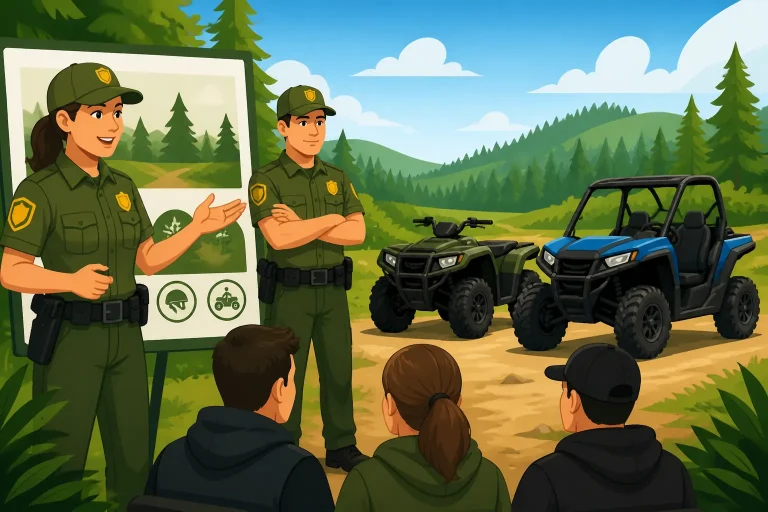
The classroom portion is intended to prepare riders to make safer decisions before they operate an OHV. It covers more than the controls on a machine. Riders need to understand how their choices affect other people, land, and their own safety, including when a trail is narrow, visibility is poor, or conditions change.
Topics can include responsible riding, hazards, safe operating practices, and relevant rules. The class provides a chance to hear the material explained and ask questions. It can also help riders connect basic safety ideas to situations they may actually face: choosing a route that matches their ability, avoiding unsafe speed, and responding appropriately when they encounter other trail users.
The classroom session should not be treated as a quick formality. A rider who knows how to start, steer, and stop a machine may still need guidance on riding within their limits, keeping a safe distance, using protective equipment, and recognizing when not to continue. Good judgment matters as much as familiarity with the controls.
Classroom instruction and practical skills are different
Classroom instruction is about information and decision-making. A skills test, where required, is a practical assessment of how a rider handles a machine. They serve different purposes, so completing one does not necessarily mean the other part has been completed.
If your course includes a practical test, ask what the rider will be expected to demonstrate and whether the test follows immediately after the classroom session. It may involve basic machine handling and controlled maneuvers. The specific activities and arrangements can depend on the course schedule and instructor, so use the instructions for the session you booked. For details about that part, see Massachusetts In-Person Skills Test and What Riders Have to Do on the Skills Test.
Do not assume that passing a classroom quiz or finishing online lessons alone completes the state’s course process. Check the completion requirements for both parts, and keep confirmation of each step until the certificate is available.
The course is safety training, not riding permission
A safety certificate and permission to ride are not the same thing. The certificate does not grant access to land, override age restrictions, or replace registration requirements. Riders still need to follow the rules that apply to the machine, operator, and riding location.
For example, Massachusetts has distinct rules for young riders, and some age groups face limits on where or how they may ride. A rider and supervising adult should review those requirements separately from course enrollment. See Massachusetts Safety Certificates Under 18 and Massachusetts Rules for Young Riders on Public Land for related information.
How to plan your class day
The best way to avoid a wasted trip is to confirm the details before leaving home. A session that is listed as a two-hour classroom course may have a check-in time, prerequisites, or practical component that changes the total visit. If a parent or guardian needs to attend, that can affect the family’s schedule too.
Use this checklist when preparing:
- Confirm the session’s start time and expected end time. Ask whether the posted duration covers only classroom instruction or the complete in-person session.
- Check the prerequisites. Find out whether online work must be finished before arrival and whether you need proof of completion.
- Ask about the skills test. Confirm whether it is included that day, how much additional time to allow, and what the rider should bring.
- Verify who must attend. A parent or guardian may have to participate for younger students. Confirm the requirement for the rider’s age before booking.
- Ask about equipment and clothing. If practical riding is part of the appointment, find out what gear is expected and whether the course provides a machine.
- Plan for a buffer. Travel, check-in, questions, and practical activities can extend the day beyond the classroom estimate.
- Confirm how completion is recorded. Ask how the certificate is issued or accessed and what proof the rider should carry.
If the schedule is not clear, ask the course contact a specific question: “Does the listed time include the classroom portion only, or the classroom and skills test?” That is more useful than asking simply how long the course takes, because the answer may otherwise refer only to instruction time.
Arrive with enough time to check in and follow the instructor’s directions. Late arrival can be a problem if the class begins with required material or if the session has a fixed schedule. If you are traveling a long distance, confirm the location and any changes shortly before you leave.
If the rider is a minor
For a young rider, confirm attendance rules before booking. A parent or guardian may need to attend with a student under a specified age, and age-related rules can affect the rider’s eligibility for the course or the type of riding allowed. Don’t rely on another family’s experience or assume that a rider’s age alone settles every requirement.
Also distinguish the course rules from the legal riding rules. A class may be open to a rider who is not yet allowed to operate a machine in a particular setting. Conversely, completing the course does not remove restrictions that apply to a rider’s age, machine size, supervision, or location. Review Massachusetts Parent Attendance Rules and Massachusetts Age and Engine Size Limits by Age before planning a child’s first ride.
For supervised riding, the adult should understand the rules too. Supervision requirements are not necessarily satisfied just because an adult is present somewhere nearby. The applicable rules may set expectations for proximity and communication. A certificate is useful, but it does not transfer responsibility away from the adults responsible for a young rider.
What the two-hour estimate does and does not tell you
A two-hour classroom estimate is useful for blocking out a morning or afternoon, but it does not tell you how long it will take to become fully ready to ride. It also does not guarantee that every scheduled session follows the same format. Treat the estimate as the classroom time to plan around, then confirm the course’s exact arrangement.
The total time depends on what remains to be completed. If the rider has already finished the online portion and the in-person appointment covers only classroom instruction, the visit may be close to the classroom estimate, plus check-in and wrap-up. If a skills assessment is scheduled as part of the same visit, plan for additional time. If online work is still outstanding, that is separate preparation.
It helps to think of readiness as a sequence rather than a single appointment:
- The rider completes any required online learning.
- The rider attends the classroom session.
- The rider completes any required practical test.
- The course provider records completion and makes the certificate available.
- The rider checks that the certificate and any other required documents are ready before riding.
For an overview of the practical classroom material, Inside the OHV Safety and Responsibility Class may help clarify what to expect. For information about completion and proof, see Getting the Certificate After Both Parts Are Done.
Keep a record of course completion. If the rider needs to carry a certificate while operating on public land, make sure the proof is accessible and in the form required. Having taken the class is not always enough if an officer asks for evidence. Requirements can vary with age and setting, so confirm what applies to the rider rather than assuming the card or record will be checked the same way everywhere.
Build in time for questions
The instructor-led setting is a good opportunity to clarify points that are confusing in written material. It is reasonable to ask questions about a topic that affects the rider’s plans, such as what counts as appropriate supervision or how to prepare for the skills portion. Do not expect the course to answer every land-access question, however. A safety certificate is not a trail permit, and access rules may depend on the specific landowner or riding area.
If your goal is to ride at a particular state forest or private park, check that location’s access rules separately. Likewise, if you plan to ride across state lines, do not assume a Massachusetts certificate or sticker automatically satisfies another state’s requirements. The course and the right to ride are separate issues.
Before and after the classroom course
Before the session, read the course instructions carefully and complete prerequisites in the order given. If an online component is required, use the correct course and make sure its completion is recorded. Bring any requested confirmation, and contact the organizer if your name or information does not match the booking.
After the session, confirm that all course components show as complete. If a practical test is part of the requirement, make sure it has been recorded too. Ask when the certificate will be available and what to do if it does not appear as expected. Keep the completion information with the rider’s other riding documents.
Before the first ride, check the rules that apply to the machine and the location. These may include registration, decals, age restrictions, safety equipment, landowner permission, and limits on where an OHV may be operated. The safety course does not replace those obligations. If you are unsure what documentation must be carried, Riders Under 18 Must Carry the Certificate and The Registration Card You Must Carry in Massachusetts cover two separate documents that may matter.
A simple pre-ride check can prevent a course certificate from becoming the only item you remembered. Confirm that the machine is properly registered for Massachusetts, that the required decal is correctly displayed, and that the operator has any required proof of training. Make sure the planned route is open to the machine type and that the rider meets the rules for age, supervision, and equipment.
The most reliable planning assumption is straightforward: set aside about two hours for classroom instruction, then add time for check-in, any skills work, and other course steps. Confirm the details directly with the course contact before traveling, especially when the rider is a minor or the appointment is far from home.
Frequently Asked Questions
Is the Massachusetts classroom course exactly two hours?
About two hours is a practical estimate for the classroom portion, not a guarantee of an exact end time. Check the session instructions and allow a buffer for sign-in, questions, or practical activities.
Does the two-hour classroom session include the entire safety course?
Not necessarily. The course may include online learning and an in-person skills test in addition to classroom instruction. Confirm which parts are included in your scheduled appointment and which must be completed separately.
Should a rider finish the online portion before attending?
Follow the instructions for the specific course. If online work is a prerequisite, finish it beforehand and make sure completion is recorded. Ask the course contact if the instructions are unclear.
Does completing the course mean a rider can use any Massachusetts trail?
No. A safety certificate does not provide land access or remove registration, age, supervision, or equipment requirements. Check the rules for the rider, machine, and specific riding area.
Disclaimer
This article is for general informational purposes only and does not constitute professional advice. Laws, prices and regulations vary by location and change over time. Consult a qualified professional for guidance on your specific situation.