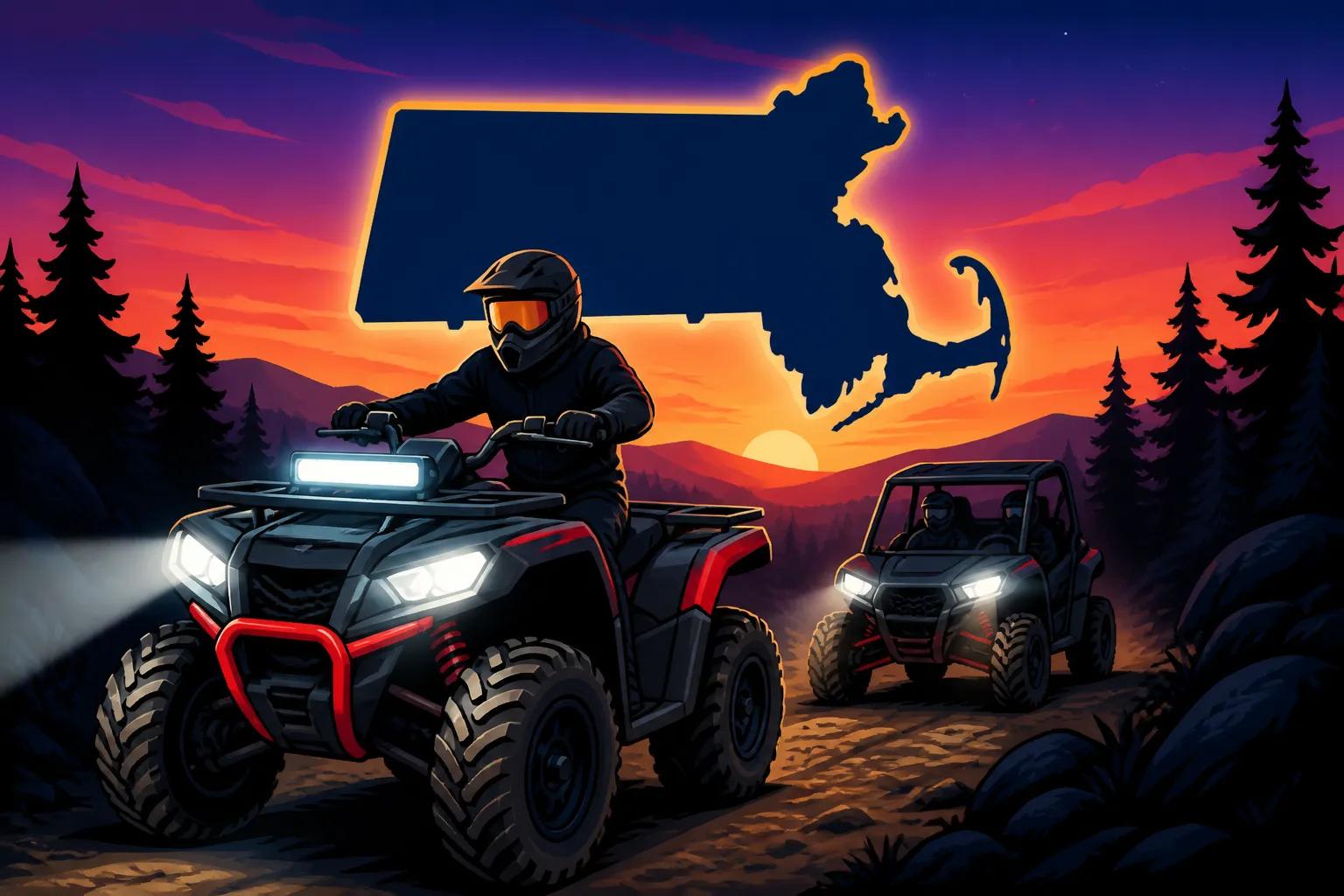
Massachusetts Lighting After Sunset
Navigating the ins and outs of Massachusetts ATV and UTV laws can feel like trying to find your way through a dense forest without a map, especially when it comes to riding after the sun dips below the horizon. Many riders get frustrated, wondering exactly what lights their machine needs, what standards those lights must meet, and what the real-world consequences are if they don't comply. This comprehensive guide aims to shed some light on the specific lighting requirements for off-highway vehicles in Massachusetts, helping you ride safely and legally once twilight sets in.
Understanding the Basic Lighting Requirements
Massachusetts Chapter 90B, the law governing off-highway vehicles (OHVs) like ATVs and UTVs, doesn't leave much to interpretation when it comes to being seen after dark. The primary goal of these laws is to ensure visibility for your safety and the safety of others, whether you're on a trail or making a quick, legal road crossing. It's not just about seeing where you're going; it's crucially about being seen by anyone else who might be out there, from fellow riders to passing motorists or even hikers.
Why Lighting is Non-Negotiable After Sunset
The moment that sun begins to dip below the horizon, or even when visibility is poor due to fog or heavy rain, your machine transforms from a daylight companion to a potential hazard if it's not properly lit. The state takes this very seriously because an unlit or poorly lit OHV is incredibly difficult to spot, leading to dangerous situations. Imagine trying to navigate a winding trail or a snow-covered path in the fading light, only to encounter another machine that's barely visible. The anxiety of that situation for all parties involved is exactly what these regulations are designed to prevent. It's about proactive safety, not reactive consequences.
Beyond the obvious safety aspects, proper lighting is also a sign of responsible riding. When you're out on shared state forest trails or even crossing a rural road, other users expect you to adhere to the rules. Showing up with a machine that's dimly lit or missing required lights signals a disregard for these shared responsibilities, and it can unfortunately reflect poorly on the entire OHV community. Investing in good lighting is an investment in your safety and the reputation of the sport.
Defining "After Sunset" and "Low Visibility"
While "after sunset" might seem straightforward, the law often uses broader terms like "between ½ hour after sunset and ½ hour before sunrise" or "at any time when there is not sufficient light to render clearly discernible persons and vehicles on the way at a distance of 500 feet ahead." This means that even if the sun hasn't fully set, but a storm rolls in making it significantly darker, you're expected to have your lights on. It’s not just about the clock; it’s about actual visibility conditions.
Think of those overcast, gloomy days where it feels like perpetual dusk. Or consider riding through dense tree cover, even in the middle of the afternoon, where the light is significantly diminished. In these scenarios, adhering to the "sufficient light" clause means your lighting should be active. It’s always better to err on the side of caution and flip on your lights if you have any doubt about visibility. An Environmental Police Officer isn't going to appreciate an argument about the exact minute the sun officially set if you're struggling to be seen. You'll want to be familiar with [Massachusetts Lighting After Sunset] to avoid any confusion.
Headlights: What You Need and When
Your headlight is your primary tool for both seeing and being seen when light is low. Massachusetts law is quite specific about what your machine needs to have, and it goes beyond just "a light on the front." It's about having an effective beam that illuminates your path adequately and makes your presence known to others. This is particularly critical on trails where terrain can be unpredictable, or when you might encounter wildlife.
Headlight Requirements and Standards
Under Massachusetts law, every OHV operated during periods of insufficient light must be equipped with at least one headlight that emits a white light visible from a distance of 500 feet to the front. This isn't just about having a light; it needs to be effective enough to project its beam that far. Many stock headlights on older machines might struggle to meet this standard, especially as bulbs dim over time or if lenses become cloudy. For modern machines, especially those designed for trail riding, the factory lights usually suffice, but it's always worth testing them.
When we talk about "standards," we're often looking at brightness (lumens), beam pattern (how wide and far the light spreads), and reliability. While the law doesn't specify lumen counts, a weak, flickering headlight isn't going to cut it. Aftermarket solutions, such as those offered by brands like SuperATV, often provide significantly brighter and more durable options that can easily exceed the minimum requirements, giving you better visibility and a wider field of view. These upgrades can be a real game-changer for night riding, especially on challenging terrain in the Berkshires.
Auxiliary Lighting and Light Bars
Many riders choose to supplement their standard headlights with auxiliary lights or light bars, and this can be a smart move for safety and performance. While these aren't typically required by law for general OHV operation, they can vastly improve your ability to see and navigate at night. A good LED light bar, for example, can turn night into day on a dark trail, revealing obstacles and trail conditions that a standard headlight might miss.
However, there's a nuance to auxiliary lighting: make sure they are used appropriately. While fantastic for off-road use, overly bright light bars are generally not permitted when crossing public ways, as they can blind oncoming motorists. You should always be able to switch between your main, street-legal-compatible headlights and your high-intensity auxiliary lights. Think of it like your vehicle's high beams – you use them when needed but dim them for approaching traffic. This is a common part of [Massachusetts Lighting Requirements for an OHV].
Taillights and Reflectors: Being Seen from Behind
While headlights help you see, taillights and reflectors are all about being seen by others, which is arguably even more critical. Imagine a scenario where you're riding a twisty trail, and another rider is approaching from behind. Without proper rear lighting, they might not see you until it's too late, especially if they're also navigating around corners or over hills. Massachusetts law ensures that your machine is visible from the rear, protecting you from potential collisions.
Taillight Specifics
Massachusetts law dictates that every OHV must be equipped with at least one red taillight that is visible from a distance of 500 feet to the rear. Just like with headlights, visibility is the key. The light needs to be consistently on and clear, not dim or obscured by mud or debris. Regular cleaning of your taillight lens, especially after a muddy ride, is just as important as the light itself working properly.
Some ATVs and UTVs come with brake lights that are integrated into the taillight assembly. While brake lights are an excellent safety feature, the law specifically calls for a constantly illuminated taillight. Your taillight should be on whenever your headlight is on, regardless of whether you are applying the brakes. This constant red glow from the rear provides continuous warning to anyone behind you.
Red Reflectors and Their Placement
In addition to a taillight, Massachusetts also requires every OHV to have at least one red reflector on the rear, visible from 50 to 500 feet when illuminated by the headlights of another vehicle. This serves as a crucial backup safety measure. Even if your taillight fails, a properly placed reflector can still make you visible to others, giving them a chance to react.
The placement of this reflector is important. It should be securely mounted, clean, and not obstructed by any gear, mud flaps, or aftermarket accessories. Often, these reflectors are integrated into the taillight housing or mounted just below it. Ensuring your machine meets [Massachusetts Red Light or Reflector] standards could be the difference between a close call and a serious incident on a busy trail. Many riders forget about the reflector, focusing only on the active lights, but it's a non-negotiable part of the state's safety standards.
Legal Consequences of Improper Lighting After Dark
Ignoring Massachusetts's lighting requirements isn't just a minor oversight; it can lead to direct legal and financial repercussions. The Environmental Police, who are responsible for enforcing OHV laws, are well-versed in these regulations and will not hesitate to issue citations for violations. These aren't just slaps on the wrist; they can be costly and disruptive to your riding season.
Fines and Citations for Violations
Operating an OHV without the required lighting during the specified times is a citable offense. The specific fine amount can vary, but generally, you're looking at a penalty that can certainly put a dent in your riding budget. These fines aren't just for missing lights; they can also apply if your lights are too dim, improperly colored, or obstructed. An Environmental Police Officer might pull you over for a safety check if they observe your machine is difficult to see after dark.
Beyond the initial fine, repeated offenses or more egregious violations could lead to further action. It's not uncommon for OHV laws to carry escalating penalties, especially if the lack of proper equipment is deemed to contribute to an unsafe situation. Familiarize yourself with [Massachusetts Penalties for Illegal Riding] to understand the full scope of potential consequences. The best way to avoid these headaches is simply to ensure your machine is always compliant before you head out, especially if you plan to be riding during those low-light hours.
Safety Implications and Liability
The most severe "consequence" of improper lighting is, of course, the increased risk of an accident. An unlit OHV is a collision waiting to happen, whether with another machine, a pedestrian, or even a fixed object you couldn't see. These accidents can result in serious injuries, property damage, and even fatalities. No rider wants to be in that situation, and certainly no one wants to be responsible for harming someone else due to negligence.
In the event of an accident, if your machine was found to be in violation of lighting requirements, you could face significant liability. This could impact insurance claims, personal injury lawsuits, and even criminal charges depending on the severity of the incident. While Massachusetts doesn't mandate OHV insurance, the lack of it combined with a lighting violation could leave you personally exposed to immense financial strain. Ensuring your lights are up to par is not just about avoiding a ticket; it's about safeguarding your well-being and financial future.
| Component | Requirement | Visibility Distance (Min) | Color | Purpose |
|---|---|---|---|---|
| Headlight | At least one, constantly illuminated | 500 feet (front) | White | Illuminate path, be seen from front |
| Taillight | At least one, constantly illuminated | 500 feet (rear) | Red | Be seen from rear |
| Rear Reflector | At least one, when illuminated by headlights | 50-500 feet (rear) | Red | Passive visibility from rear, emergency backup |
Enhancing Your Machine's Visibility for Safety
Meeting the minimum legal requirements is essential, but many experienced riders go above and beyond to maximize their visibility. After all, the goal isn't just to be legally compliant; it's to be as safe as possible out on the trails. Enhancing your lighting can make a huge difference, especially if you frequently ride in challenging conditions or areas with other trail users.
Upgrading Headlights and Taillights
One of the most common and effective upgrades is to replace stock halogen bulbs with LED alternatives, or even entire LED headlight and taillight assemblies. LEDs are significantly brighter, draw less power from your machine's electrical system, and typically last much longer than traditional bulbs. They offer a crisper, whiter light that illuminates obstacles more clearly and makes your machine stand out more effectively. For example, SuperATV offers a wide range of LED lighting solutions, from full headlight replacements to powerful light bars, that are designed for the rigors of off-road riding. These can provide a much broader and farther-reaching beam, improving both your ability to see and your conspicuity.
When upgrading, consider the beam pattern. Some LED headlights offer a flood pattern for wide illumination, while others provide a spot pattern for distance. A combination of both, or a dedicated light bar for off-road segments, can be ideal. For taillights, brighter LEDs ensure you're seen earlier, giving riders behind you more time to react. You might also consider adding additional auxiliary rear lights (in red, of course) if your machine allows for it, as long as they don't overpower your brake lights or violate any state statutes.
Reflective Gear and Auxiliary Markers
Beyond your machine's built-in lights, you can significantly enhance your overall visibility by adding reflective elements. This isn't specifically mandated for the machine itself, but it's a smart safety practice. Reflective tape can be added to helmets, clothing, and even strategic points on your ATV or UTV. Look for high-visibility reflective vests or jackets, especially if you plan to be off your machine walking around in low light conditions, such as during a trailside repair.
Auxiliary marker lights, especially amber lights on the sides of your UTV, can also increase your profile. While not legally required for OHVs, they certainly don't hurt and can make a large UTV more noticeable from different angles. Some riders also install small, durable LED "rock lights" that illuminate the ground around their tires. While primarily for navigating technical terrain, they also increase the overall ambient light around your machine, making it more visible to others, particularly if you're stopped. When you're out there, you always want to maximize your chances of being seen, especially on popular trails within state forests.
Specific Scenarios: Road Crossings and Private Land
Massachusetts OHV laws often distinguish between riding on authorized public trails, private land, and the very specific rules around crossing public roads. Lighting requirements can subtly shift or become even more critical depending on your immediate environment. Understanding these nuances is key to staying legal and safe.
Road Crossings and Public Ways
Legally crossing a public way in Massachusetts is already a tightly regulated maneuver for OHVs, and these regulations become even stricter after sunset or in low visibility. When you make a legal road crossing, your machine is essentially operating in an environment designed for plated, street-legal vehicles. This means your lighting must be absolutely unambiguous and fully functional to prevent dangerous encounters with cars or trucks.
Specifically, during these crossings after sunset, your headlight, taillight, and reflector must all be in perfect working order. Any auxiliary lights that are excessively bright or could blind oncoming traffic must be turned off. You must also come to a complete stop, yield to all traffic, and cross at a right angle. The Environmental Police will be particularly vigilant about lighting compliance during these crossings, as the risk of an accident is significantly higher. Riders should review [Massachusetts Rules for Crossing a Road] to ensure they are fully compliant with all aspects of this critical action.
Riding on Private Land After Dark
While the state's OHV laws generally apply to all operations, riding on your own private property or with written permission on another's private land often comes with slightly different practical considerations regarding enforcement. Technically, if you're operating an OHV "upon or in any way of this Commonwealth," the lighting laws apply. However, if you are exclusively on private property, far from public view or access, the enforcement might be less direct from state authorities.
That being said, the safety reasons for proper lighting don't disappear just because you're on private land. If you're riding your ATV on your own farm fields after dusk, you still need to see obstacles, fences, or equipment, and anyone else on your property (family, farmhands, guests) needs to see you. For your own safety and the safety of anyone else present, adhering to full lighting standards is always the wisest choice. Even on private land, a well-lit machine is a safer machine. Remember to always have [Massachusetts Landowner Permission in Writing] if you're on someone else's property, regardless of the time of day.
Maintaining Your Lighting System
Having the right lights installed is only half the battle; maintaining them is crucial for consistent performance and legal compliance. Over time, components can degrade, wires can fray, and dirt can obscure your precious beams. A proactive approach to maintenance will save you headaches, fines, and potentially prevent an accident.
Regular Checks and Inspections
Before every ride, especially if you anticipate being out after sunset, perform a quick visual check of all your lights. Are they clean? Are they free of cracks or damage? Turn on your machine and cycle through all your lighting functions – headlights (high and low beam, if applicable), taillights, and brake lights. Have a friend stand behind you to confirm the taillight and brake light are working properly. Don't forget to check your reflectors for cleanliness and secure mounting.
Periodically, you should also inspect the wiring connections. Vibrations from riding can loosen connections or cause wires to rub and fray, leading to intermittent failures. Look for corrosion on terminals, especially if your machine sees a lot of mud or water. A simple spray of dielectric grease on electrical connections can go a long way in preventing future issues. If you notice any dimming or flickering, investigate it immediately rather than waiting for a complete failure.
Troubleshooting Common Lighting Issues
If a light isn't working, start with the easiest fix: the bulb. Replace any burned-out bulbs with the correct type. If it's an LED assembly, the entire unit might need replacing, though they generally have a long lifespan. Next, check the fuse box. A blown fuse for your lighting circuit is a common culprit and often an easy fix if you carry spares.
If the bulb and fuse are good, you'll need to trace the wiring. Look for obvious breaks, pinches, or loose connections. A multimeter can be invaluable for checking for continuity and power at different points in the circuit. Sometimes, issues can be caused by a faulty switch, especially if other lights on the same circuit are working. If you're not comfortable with electrical troubleshooting, it's always best to consult with a professional ATV mechanic or an experienced friend. Investing in quality, robust wiring harnesses and connectors, like those sometimes offered by SuperATV for their lighting products, can also reduce the frequency of these issues.
Disclaimer
This article is for general informational purposes only and does not constitute professional advice. Laws, prices and regulations vary by location and change over time. Consult a qualified professional for guidance on your specific situation.