Massachusetts Rules for Passengers on a Quad
Riding an ATV in Massachusetts offers incredible freedom and access to some beautiful trails, but knowing the rules, especially when it comes to carrying passengers, can feel like navigating a dense forest without a map. It's a common point of confusion and frustration for many riders, leading to uncomfortable situations or even citations. This guide will clarify Massachusetts' specific regulations around carrying passengers on ATVs and UTVs, helping you understand the law and prioritize safety for every ride.
The Massachusetts Stance on ATV Passengers: Why It's Tricky
Massachusetts takes a very clear, and some might say strict, stance on who can ride on an All-Terrain Vehicle (ATV) at any given time. The fundamental principle revolves around the manufacturer's design and intent for the machine. This isn't just a quirky local rule; it's deeply rooted in safety and the physical dynamics of how ATVs are meant to be operated. Many riders naturally assume that if there's a bit of space on the seat, or if they're just going for a slow putter around a field, an extra person won is no big deal. But the law, and the design of the machine itself, often tell a different story.
The primary frustration here is often the disconnect between what feels safe or convenient and what the law explicitly permits. You might see a youth quad with a seat long enough for two small kids, or an adult utility quad with a rear rack that looks like a perfect perch, and think, "What's the harm?" The harm, as the law defines it, comes from the machine not being engineered for that specific passenger capacity. This distinction is critical and forms the bedrock of passenger rules in the Bay State.
Manufacturer's Design Dictates Passenger Capacity
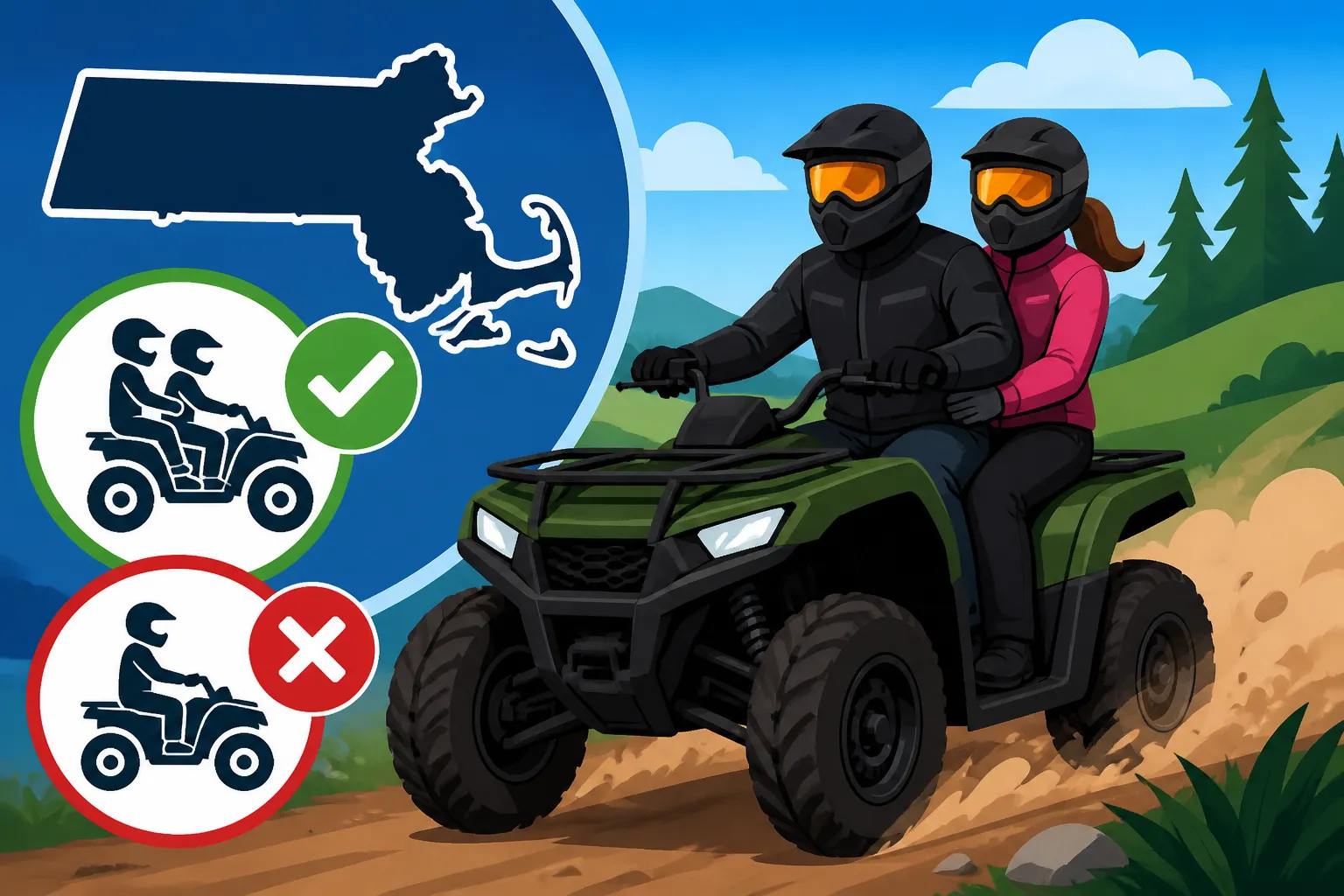
The core of Massachusetts' passenger rule for ATVs is straightforward: an ATV can only carry the number of people for which it was specifically designed by the manufacturer. For the vast majority of traditional, straddle-seat ATVs, this means one operator. These machines are engineered for a single rider to shift their weight, lean into turns, and actively participate in balancing the vehicle. Introducing a passenger, even a small one, completely alters this dynamic.
Imagine trying to navigate a rocky, uneven trail or make a sharp turn while someone else's weight is unexpectedly shifting behind or in front of you. The balance point changes dramatically, making the machine much harder to control. The suspension, brakes, and even the engine's power delivery are all calibrated for a single rider's weight. Overloading it can strain these components, leading to premature wear or, more critically, failure when you need them most. The state's focus on manufacturer design isn't arbitrary; it's a direct response to the engineering limitations and safety considerations inherent in ATV operation.
Understanding Chapter 90B and Passenger Rules
The laws governing ATVs and other recreational vehicles in Massachusetts are primarily found in [Massachusetts ATV Laws Under Chapter 90B]. This chapter explicitly addresses who can operate and ride on these machines. When it comes to passengers on ATVs, the language typically prohibits carrying a passenger unless the ATV is "specifically designed by the manufacturer to carry more than one person." This is a crucial distinction that often catches riders off guard.
Many common sport and utility ATVs, despite having a long seat or even a small padded area behind the driver, are fundamentally single-rider machines. Their weight distribution, handlebar configuration, and footrest placement are all optimized for one person. Environmental Police officers, who enforce these regulations, are trained to look for these manufacturer design cues. If you're pulled over with a passenger on a single-rider ATV, even if you feel you were operating it safely, you could face penalties. It's not about your skill as a rider; it's about the machine's inherent design limitations and the legal framework built around them.
What to Look For: Manufacturer's Design and Seating
When you're trying to figure out if your ATV can legally carry a passenger in Massachusetts, the most important thing to do is consult your machine's owner's manual and look for specific design features. This isn't just about reading the fine print; it's about understanding the physical evidence of the manufacturer's intent. Don't go by what seems "comfortable" or "possible" for a short ride. The law is concerned with the machine's certified design.
It's common to see after-market accessories that add a "passenger seat" to the rear rack of a single-rider ATV. While these might seem like a practical solution, they do not change the fundamental design classification of the ATV. Adding a pad and some handholds doesn't magically transform a single-rider machine into a two-up model in the eyes of the law or, more importantly, in terms of its safe handling characteristics. Always remember that modifications, while they might enhance comfort or utility, rarely alter the legal definition of your vehicle's passenger capacity.
Identifying a Single-Rider ATV
Most ATVs you encounter, especially the sport and utility models, are designed for one rider. Key indicators of a single-rider ATV include:
- Seat Length: The seat will typically be just long enough for one adult to sit comfortably with their feet on the footrests. There usually isn't an extended, distinct second seating area.
- Footrests: You'll find one set of footrests positioned for the operator. There won't be a separate, dedicated set of footrests positioned further back for a passenger.
- Handholds: There will likely be no dedicated handholds for a passenger. The operator uses the handlebars for control, but there isn't typically a grab bar or strap specifically for someone riding behind them.
- Weight Capacity Labels: Check the stickers on your ATV or your owner's manual. They often clearly state the maximum weight capacity, and often this refers to the operator's weight plus any cargo, not an additional passenger.
- Manufacturer's Designation: The most definitive answer will be found in the manufacturer's specifications. If it's a "one-up" model, it means one rider.
Trying to carry a passenger on one of these machines, even if they're holding onto you, fundamentally changes the weight distribution. This makes it harder to steer, brake, and maintain stability, especially on uneven terrain or during emergency maneuvers. A sudden bump or dip can throw off a passenger, or their shift in weight can send the machine veering unexpectedly.
What Makes an ATV "Two-Up" or Multi-Passenger Designed?
If an ATV is truly designed to carry a passenger, it will have very specific features that distinguish it from a single-rider model. These "two-up" or multi-passenger ATVs are less common than their single-rider counterparts but do exist. Here's what to look for:
- Extended and Contoured Seat: The seat will be noticeably longer, often with a raised or contoured section clearly indicating a separate space for a second person. It's not just a flat, extended pad; it's shaped for two.
- Dedicated Passenger Footrests: This is a crucial indicator. There will be a second set of footrests positioned further back, specifically for the passenger to place their feet securely. These are often distinct from the operator's footrests.
- Passenger Handholds/Backrest: A genuine two-up ATV will almost always include sturdy handholds for the passenger to grip, often integrated into a backrest. These provide stability and security for the second rider.
- Larger Overall Frame and Suspension: Two-up ATVs are generally built on a longer wheelbase and have a more robust suspension system designed to handle the increased weight and different weight distribution of two riders.
- Clear Manufacturer Designation: The owner's manual and often the decals on the machine itself will explicitly state its capacity for "2 persons" or "driver + 1 passenger."
Examples of such machines often come from specific manufacturers that build dedicated two-up models. These are distinct from single-rider machines and are engineered from the ground up to safely accommodate an additional person. Without these specific design features, attempting to carry a passenger on what is essentially a single-rider ATV is not only illegal in Massachusetts but significantly increases the risk of an accident.
Safety First: The Dangers of Unapproved Passengers
The rules against carrying unauthorized passengers on ATVs in Massachusetts aren't just about bureaucracy; they are fundamentally about preventing serious injuries or worse. It’s easy to dismiss these rules as overly cautious, especially if you’ve been riding for years and feel confident in your skills. However, the dynamics of an ATV, particularly a single-rider model, are drastically altered with an unexpected second person on board. This can turn a casual ride into a very dangerous situation in an instant.
Think about a sudden stop, an unexpected obstacle, or even just a tight turn on a familiar trail. These are moments where an ATV operator relies heavily on their body weight and agility to control the machine. When you add a passenger, you're not just adding weight; you're adding an unpredictable second center of gravity that can react differently than yours. This dramatically amplifies the risk of losing control, tipping over, or being ejected from the vehicle. Even the most experienced rider can be caught off guard by the altered handling.
Compromised Balance and Control
The primary danger of carrying an unapproved passenger on a single-rider ATV is the immediate and severe compromise of the machine's balance and the operator's control. ATVs are designed to be ridden actively, meaning the operator uses their body weight to lean into turns, shift for stability on inclines, and absorb bumps.
- Center of Gravity: With a passenger, the center of gravity of the ATV shifts upwards and often rearwards. This makes the machine much more top-heavy and prone to tipping, especially during turns or when traversing uneven terrain. A machine designed for one person, like a nimble sport quad, simply isn't equipped to handle this added instability.
- Steering and Braking: The added weight affects steering responsiveness and braking distance. The front end might feel lighter, making it harder to steer precisely, while the brakes have to work harder to stop more mass, increasing stopping distances. In an emergency situation, those extra feet can mean the difference between a near miss and a collision.
- Limited Maneuverability: Your ability to make quick evasive maneuvers is severely reduced. If a branch suddenly appears in your path, or another rider makes an unexpected move, your reaction time and the ATV's ability to respond will be significantly hampered by the extra person. The machine becomes less agile and much harder to "place" accurately on the trail.
This isn't just theoretical; countless accident reports highlight passenger involvement as a major contributing factor. An off-road machine, even something equipped with SuperATV accessories for durability, isn't immune to the laws of physics when overloaded.
Increased Risk of Injury for Both Riders
Beyond the loss of control, the physical consequences for both the operator and the passenger in an incident are significantly higher when carrying an unauthorized rider.
- Ejection and Impact: A passenger, especially one not properly seated with dedicated handholds and footrests, is much more likely to be ejected from the ATV during a sudden stop, turn, or roll-over. Their position is precarious, and they have no direct control over the machine. The force of impact, whether with the ground, a tree, or the machine itself, can lead to severe head injuries, broken bones, or internal trauma.
- Operator Trapped: The operator is also at increased risk. In a roll-over situation, the weight of a second person can pin the operator or exacerbate their injuries. What might have been a minor tip-over with one rider could become a much more serious incident with two.
- Lack of Proper Safety Gear: While [Massachusetts ATV Helmet Law] requires all riders to wear helmets, a passenger might not be wearing appropriate gear or protective clothing, further increasing their vulnerability. Furthermore, the seating position for an unauthorized passenger often means they are not as well protected by the machine's existing structure as the operator.
Ultimately, the rule against unapproved passengers on ATVs is a proactive measure to protect lives. It's about recognizing the inherent dangers and ensuring that every ride, whether on a local trail or deeper in the Berkshire forests, is as safe as possible for everyone involved. Don't let convenience or a desire for company override common sense and the strict safety guidelines put in place.
Side-by-Sides: A Different Story for Passengers
While traditional ATVs generally fall under strict single-rider rules unless specifically designed otherwise, Utility Terrain Vehicles (UTVs), more commonly known as side-by-sides, operate under a different set of expectations and regulations regarding passengers. This is where a lot of the confusion often stems from, as both are off-road machines, but their design philosophy for carrying people is fundamentally different.
Side-by-sides are engineered with multiple occupants in mind, resembling small off-road cars more than traditional ATVs. This design choice directly impacts the legal framework for their use in Massachusetts. If you're looking to share your off-road adventures with friends or family, a side-by-side is often the machine that allows you to do so legally and safely.
Designed for Multiple Occupants
The most significant difference between a side-by-side and a single-rider ATV is its fundamental design for multiple occupants. When you look at a side-by-side, you immediately notice features that scream "passenger friendly":
- Bench or Bucket Seating: Side-by-sides typically feature bench seats or individual bucket seats, arranged side-by-side (hence the name) just like a car. These are clearly defined seating positions, often upholstered for comfort and support, and designed to keep occupants securely in place. Some models, especially those from popular brands like Polaris or Can-Am, even offer four-seat or six-seat configurations.
- Seatbelts and Restraints: Crucially, side-by-sides come standard with seatbelts, typically three-point or four-point harnesses, for every designated seating position. These are vital for keeping occupants secured in the event of bumps, jolts, or a roll-over. This is a critical safety feature that traditional ATVs lack for passengers.
- Roll Cages and Protection: Side-by-sides are built with integrated roll-over protective structures (ROPS) or roll cages. These provide a protective frame around the occupants, offering significant safety in the event of a tip-over or roll. This structural protection is a game-changer for passenger safety compared to an open ATV.
- Steering Wheel and Foot Pedals: The controls are automotive-style, with a steering wheel and foot pedals (accelerator and brake), which also contributes to a more stable and controlled operating experience, even with passengers. This ergonomic design reduces the active body movement required by the operator of a traditional ATV, making it easier to manage with multiple people aboard.
Because of these design elements, side-by-sides are explicitly manufactured and marketed as multi-passenger vehicles. This aligns perfectly with Massachusetts' emphasis on manufacturer intent for passenger capacity.
Passenger Rules Specific to Side-by-Sides
Given their design, the rules for carrying passengers on side-by-sides in Massachusetts are more accommodating, but still adhere to strict safety principles. It's not a free-for-all; you must still follow the guidelines for safe operation.
- Capacity Limits: A side-by-side can only carry the number of passengers for which it was designed and equipped by the manufacturer. If your side-by-side has two bucket seats and two seatbelts, you can carry one passenger. If it's a four-seater with a bench seat and four seatbelts, you can carry three passengers. Overloading is strictly prohibited and can result in citations, just as it would with an ATV.
- Seatbelts are Mandatory: Every passenger, and the operator, must wear a seatbelt at all times while the side-by-side is in motion. This is a non-negotiable safety requirement that ensures occupants stay inside the protective structure of the vehicle.
- Proper Seating: Passengers must remain seated in their designated seating positions with their feet inside the vehicle and on the floorboards, not hanging out or on the roll cage. Standing up or riding in the cargo bed is extremely dangerous and illegal.
- Age and Size Considerations: While [Massachusetts Age and Engine Size Ladder] primarily applies to ATVs, general safety practices dictate that younger or smaller passengers in a side-by-side should be able to sit properly, reach the floorboards, and be secured by the seatbelt system. Using appropriate child restraints, if available and compatible with the side-by-side's seating, is highly recommended for very young children.
- Helmets: Just like ATVs, everyone riding in a side-by-side in Massachusetts is required to wear a helmet, regardless of age. This provides crucial head protection, even with the presence of a roll cage and seatbelts.
Knowing these rules is essential for any side-by-side owner in Massachusetts. You can find more specific guidance on operating these machines safely and legally in guides like [Massachusetts Rules for a Side-by-Side Driver]. Always check your owner's manual for specific weight and passenger limits for your particular model.
For those who enjoy customizing their side-by-side, companies like SuperATV offer a range of accessories that can enhance safety and comfort for passengers, such as upgraded harnesses, grab handles, and windshields. Just remember that any modification should align with the manufacturer's original design intent and comply with state regulations.
Here's a quick comparison to help visualize the key differences:
| Feature | Traditional ATV (Single-Rider) | Side-by-Side (UTV) |
|---|---|---|
| Passenger Rule | Generally one operator, unless specifically designed by manufacturer for more | Designed for multiple occupants as indicated by seating and seatbelts |
| Seating Type | Straddle seat, designed for active rider input | Bench or bucket seats |
| Seatbelts | Not typically present for a passenger | Mandatory for all designated seating positions |
| Roll-Over Protection | Minimal to none | Integrated roll cage (ROPS) |
| Footrests | One set for operator | Dedicated floorboards and footwells for all occupants |
| Handholds | Operator grips handlebars | Dedicated grab handles for passengers |
| Operator Input | Active body weight for balance and control | Automotive-style controls, less body input required |
| Legal Status in MA | Passengers generally prohibited unless "two-up" model | Passengers allowed up to manufacturer's capacity |
Remember, whether you're on a powerful quad or a comfortable side-by-side, safety should always be your top priority. Understanding and adhering to Massachusetts' rules for passengers ensures a more enjoyable and responsible experience for everyone exploring the state's trails. When in doubt, always err on the side of caution and consult your owner's manual or the Massachusetts Environmental Police for clarification.
Disclaimer
This article is for general informational purposes only and does not constitute professional advice. Laws, prices and regulations vary by location and change over time. Consult a qualified professional for guidance on your specific situation.