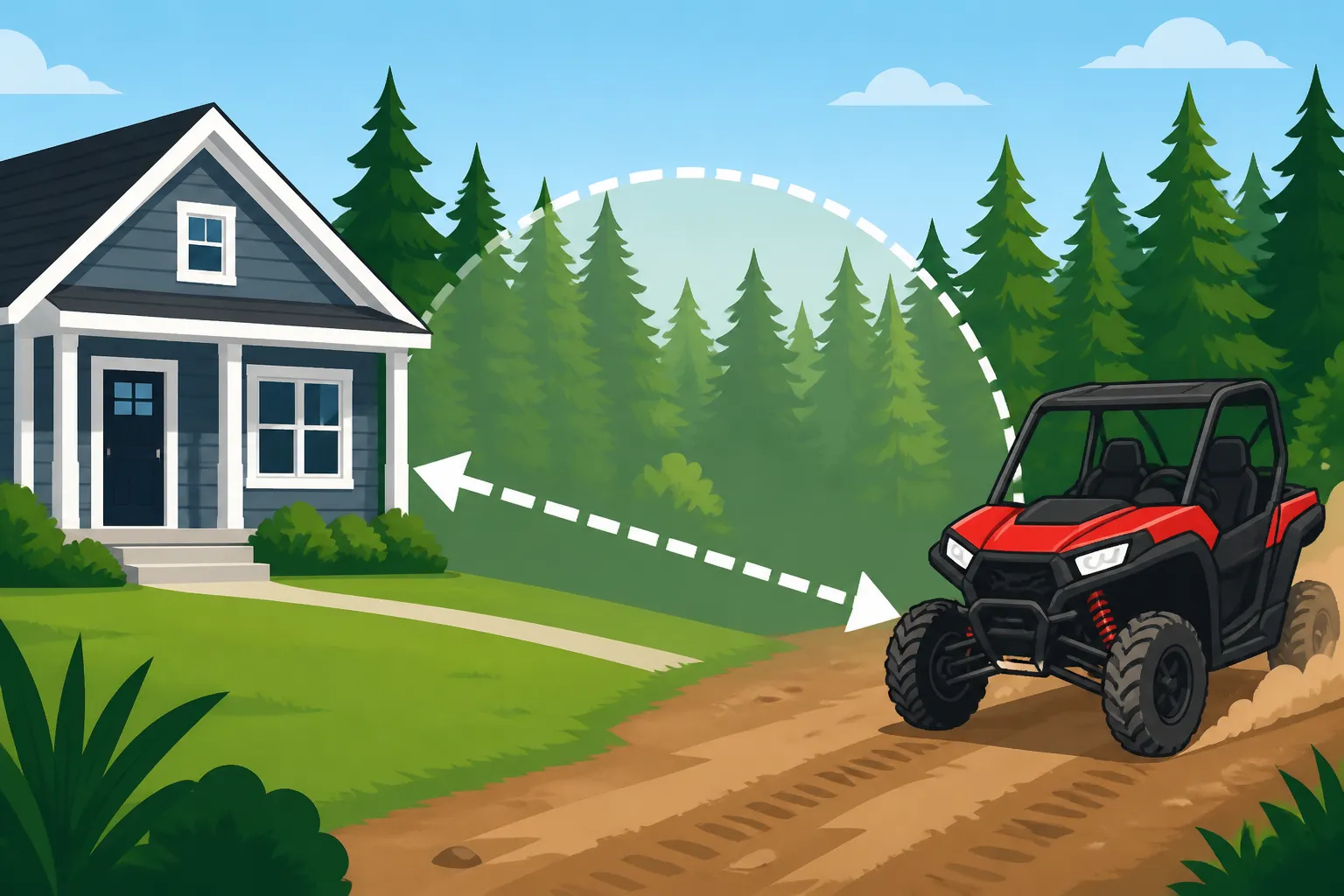
How 150 Feet Is Measured From a Dwelling
It's incredibly frustrating when you're out enjoying the beautiful Massachusetts landscape on your ATV or UTV, only to find yourself constantly worrying about a specific, often misunderstood, regulation: the 150-foot dwelling rule. Many riders struggle with knowing exactly how to apply this rule in the real world, especially when you're deep in the woods or navigating unfamiliar terrain. This guide will clear up all that confusion, detailing precisely how that 150 feet is measured, what it means for your riding, and how you can legally and responsibly enjoy the trails without violating anyone's peace.
Understanding the Massachusetts 150-Foot Dwelling Rule
Massachusetts General Law Chapter 90B, Section 26, lays out a very clear, yet often tricky, rule for off-highway vehicle (OHV) operators: you cannot operate an ATV or UTV within 150 feet of a dwelling without the express written permission of the dwelling's owner. This rule exists for very good reasons – primarily to protect residents from excessive noise, dust, and invasion of privacy, and to ensure the safety of those living nearby. However, knowing the spirit of the law is one thing; understanding its practical application on the ground is another entirely.
The ambiguity often comes from the phrase "within 150 feet." What exactly constitutes a "dwelling"? And how do you measure 150 feet accurately when you're not carrying a tape measure and the terrain is anything but flat and open? It's a question that can cause significant anxiety for riders, leading some to avoid certain areas altogether just to be safe. We want to empower you with the knowledge to make informed decisions and enjoy your rides with confidence, knowing you're respecting the law and your neighbors.
What Counts as a Dwelling
Before you can measure 150 feet from a dwelling, you first need to understand what the law considers a "dwelling." Generally, a dwelling is defined as any building or structure occupied or intended for occupancy as a residence. This includes a wide range of structures, from year-round family homes to seasonal cabins, hunting camps, and even mobile homes. The key is that it's a place where people live or could live, even if it's not currently occupied.
So, while a detached garage used solely for vehicle storage or a simple garden shed might be close to a house, they typically wouldn't be classified as a "dwelling" on their own for the purposes of this specific rule. However, if that garage has an apartment built into it, or the shed is actually a tiny house, then it absolutely counts. Always err on the side of caution. If it looks like someone could be living there, treat it as a dwelling. The purpose of the rule is to protect people, not just structures, so consider the human element.
The Intent Behind the Rule
The core purpose of the 150-foot dwelling rule is multifaceted. First and foremost, it's about noise pollution. ATVs and UTVs, especially those with aftermarket exhausts, can be quite loud. The constant rumble or high-pitched whine of an engine can be extremely disruptive to those trying to enjoy the peace and quiet of their home, particularly in rural or semi-rural areas. It’s also about privacy; no one wants an unexpected machine roaring past their window or through their backyard without their knowledge or consent.
Beyond noise and privacy, there's a safety aspect. Uncontrolled off-highway vehicle operation too close to residences could pose a risk to children playing, pets, or even just general foot traffic around a home. The rule serves as a buffer, creating a respectful distance between recreational riding activities and private living spaces. Understanding this intent can help riders appreciate why the rule is in place, even if its practical application can sometimes feel challenging. It's about being a good neighbor and ensuring shared enjoyment of the Massachusetts outdoors.
Practical Measurement: How 150 Feet Is Actually Calculated
Now for the crucial part: how do you actually measure this 150 feet? It's not always as simple as it sounds, especially when you're dealing with winding trails, dense foliage, and uneven terrain. The law doesn't expect you to carry a surveyor's chain, but it does expect you to make a reasonable effort to comply.
The measurement is taken from the nearest point of the dwelling to any point where your machine is operating. This is a critical distinction. It's not just the main trail you're on, but any spot where your tires might be, whether you're actively moving, stopped, or even parked. It's a straight-line distance, often referred to as "as the crow flies," not following the curves of a road or trail. Imagine drawing an invisible straight line from the closest part of the dwelling to the closest part of your ATV or UTV.
Consider a situation where you're riding a trail that seems far from any houses, but a dense patch of trees is concealing a small cabin just beyond the tree line. If your machine, even for a moment, comes within that straight-line 150-foot radius, you're technically in violation unless you have permission. This is why awareness of your surroundings and any potential structures, even those out of sight, is paramount. How 150 Feet Is Measured From a Dwelling is a rule that demands constant vigilance.
From Where to Where
Let's break down the measurement more precisely. "From where" means from any part of the exterior of the dwelling. This includes the walls, porches, decks, or even a foundation that is part of the habitable structure. It's not just the front door, but the closest corner of the building to your machine. "To where" means to any part of your machine – the tires, the handlebars, the front bumper, etc.
Think of it this way: if you laid a 150-foot long rope from the closest point of a dwelling, your OHV should not touch that rope at any point without written permission. This method of measurement can be tricky in the field. What seems like a safe distance visually can quickly become too close if there's an unexpected bend in the trail or a building hidden behind a rise. It means you can't rely solely on your intuition; you need to be actively looking for potential dwellings and gauging distances.
| Scenario | Distance Measurement | Compliance Action |
|---|---|---|
| Open Field | Easy to eyeball, but can be deceptive. Straight line from dwelling to machine. | Stay clearly beyond 150 ft. If closer, secure [Written Permission From a Bay State Owner]. |
| Dense Woods | Extremely difficult. Dwellings can be hidden. Assume higher risk. Straight line, ignoring trees. | Use maps/GPS. Avoid areas near known or suspected dwellings. Get permission proactively. |
| Winding Trail | The trail might be long, but the straight-line distance to a dwelling could be short. | Constant awareness of surroundings. Scout ahead if possible. |
| Property Line | A dwelling on an adjacent property line can suddenly be within 150 ft of your trail. | Respect all property lines. Verify land ownership via public records if unsure. |
| Blind Rise/Corner | A dwelling can appear unexpectedly close after cresting a hill or turning a corner. | Reduce speed, proceed with caution, and be ready to stop if a dwelling comes into view quickly. |
Challenging Terrain and Property Lines
One of the biggest challenges for riders is navigating this rule in Massachusetts's varied terrain. On flat, open land, judging 150 feet might be relatively straightforward. However, the Bay State is full of rolling hills, dense forests, and winding trails where visibility is often limited. A dwelling that is out of sight due to trees or a dip in the landscape can still be well within that 150-foot radius. This is where many riders inadvertently get into trouble.
Consider a situation where you're on a multi-use trail in a state forest. While the trail itself might be approved, adjacent private property could have dwellings right up to the property line. Without clear signage or a property line marked on a map, you could easily stray too close. This is why knowing the lay of the land, using GPS devices or mapping apps, and respecting [Massachusetts Landowner Permission in Writing] are all critical. A good GPS unit, or even a smartphone app with satellite imagery, can often give you a better sense of nearby structures, even if they're hidden from view on the ground. Some riders use rangefinders, similar to what golfers use, to get a precise distance if they feel they are close to a dwelling.
Technology to Help You
In today's world, you don't have to rely solely on guesswork. There are several technological tools that can help you gauge distances and be more aware of your surroundings, though none are foolproof in every scenario.
- GPS Devices and Smartphone Apps: Many dedicated GPS units and smartphone apps (like OnX Offroad, Gaia GPS, or even Google Maps with satellite view) allow you to view topographical maps and satellite imagery. By zooming in, you can often identify dwellings near trails. Some apps even have tools to measure distances on the map, which can be invaluable for pre-ride planning. You can mark potential "no-go" zones or areas where you absolutely need [Getting an Owner's Consent to Ride Within 150 Feet].
- Rangefinders: As mentioned, a laser rangefinder can give you a very accurate real-time distance measurement to a visible dwelling. This is particularly useful if you find yourself on a trail and a house comes into view that looks like it might be close.
- Property Line Apps: Some advanced mapping apps integrate parcel data, allowing you to see property lines directly on your device. While not always 100% accurate, they can give you a much better understanding of who owns what and where potential dwellings might be located relative to your planned route.
While these tools are helpful, remember their limitations. Satellite imagery might be outdated, and GPS signals can be spotty in dense tree cover. Always combine technology with common sense and a cautious approach. It’s better to turn around or find an alternative route than risk a violation or upset a homeowner. Whether your machine is stock or upgraded with parts from a brand like SuperATV, respecting this distance is non-negotiable.
Obtaining Written Permission: Your Best Defense
If you find a fantastic trail that happens to pass within 150 feet of a dwelling, or if you simply want to broaden your riding options, the best and most legal solution is to obtain written permission from the dwelling owner. This isn't just a loophole; it's explicitly allowed by the law and demonstrates respect for private property rights.
Getting permission transforms a potential violation into a perfectly legal ride. It builds goodwill within the community and can even open up opportunities for responsible riding where it might otherwise be prohibited. Many landowners are reasonable and might grant permission, especially if you approach them respectfully and assure them of your commitment to responsible riding, such as riding slowly past their home or during specific hours. Remember, even with permission, loud pipes or excessive dust can still create friction, so always ride courteously.
Why Written Permission Is Key
The phrase "express written permission" is critical here. Verbal permission, while a nice gesture, is not legally binding or defensible if an Environmental Police Officer questions your presence. A simple "yeah, sure, go ahead" could easily be denied later, leaving you exposed to a violation. Written documentation provides clear proof that you have the owner's consent, protecting both you and the landowner.
Furthermore, written permission shows a proactive effort on your part to be a responsible rider. It demonstrates that you understand the law and are willing to take the necessary steps to comply. This can go a long way in fostering a positive image for the OHV community. Imagine if you're riding a trail in the Berkshires, and a local resident reports you. If you can immediately produce a signed permission slip, the situation is likely resolved without further issue, saving you from potential fines or a long conversation with law enforcement.
What Written Permission Should Include
A good written permission slip doesn't need to be a formal legal document, but it should contain specific details to make it clear and unambiguous. Here's what it should generally include:
- Date: When the permission was granted.
- Names of Parties: Your full name (the rider) and the full name of the dwelling owner.
- Property Address: The specific address of the dwelling to which the permission applies.
- Description of Area: Clearly define the area where OHV operation is permitted (e.g., "along the existing woods road crossing the northeast corner of the property").
- Duration/Terms: Specify if the permission is for a single day, a season, or ongoing, and any specific conditions (e.g., "only between 9 AM and 5 PM," "must stay on designated trail").
- Explicit Statement: A clear sentence stating that the dwelling owner grants permission for you to operate an ATV/UTV within 150 feet of their dwelling on the specified property.
- Signatures: Both the dwelling owner's signature and your signature.
It’s always a good idea to carry this document with you whenever you're riding in that specific area. An Environmental Police Officer may ask for [Your Registration Card Must Ride With the Machine], and they might also inquire about permission if you're near a dwelling.
Approaching Landowners
Asking for permission can feel daunting, but approaching landowners respectfully and transparently can often yield positive results. Here are some tips:
- Be Polite and Prepared: Introduce yourself, explain why you're there (you're an OHV rider interested in riding responsibly), and mention the 150-foot rule. Have a blank permission form ready, or at least a pen and paper.
- Explain Your Intentions: Reassure them you're a responsible rider, emphasize safety, and offer to stick to specific paths or times.
- Address Concerns: Be ready to listen to any concerns they might have about noise, dust, or property damage, and offer solutions. Maybe you agree to ride at a slower speed or only during certain hours.
- Respect "No": If a landowner declines, accept it gracefully. Pushing the issue will only create animosity and reflect poorly on the entire riding community.
- Offer Something in Return (Optional): Sometimes, offering to help with a small chore (like clearing a fallen tree limb on their property or assisting with trail maintenance) can open doors, but never assume this is necessary or expected.
Remember, building trust with local landowners is invaluable for expanding and preserving riding opportunities in Massachusetts. [Massachusetts Requires Written Permission] is not just a law; it's a foundation for good community relations.
Consequences of Violating the Rule
Ignoring the 150-foot dwelling rule can lead to some pretty unwelcome consequences, ranging from legal penalties to strained community relationships. It's truly not worth the risk, especially when solutions like obtaining written permission are readily available. The Massachusetts Environmental Police take these regulations seriously as part of their mission to protect both natural resources and public safety.
Getting caught riding too close to a dwelling without permission is more than just a slap on the wrist. It can result in fines, potential impoundment of your machine in severe or repeat cases, and a black mark on your record. Beyond the legal ramifications, such violations erode public trust and can contribute to negative perceptions of OHV riders, making it harder to maintain or gain access to trails in the future.
Penalties and Fines
While specific dollar amounts can change, [Massachusetts Penalties for Illegal Riding] under Chapter 90B can be significant. A violation of the 150-foot dwelling rule typically results in a fine for operating an OHV unlawfully. These fines are designed to deter irresponsible behavior and reinforce the importance of respecting private property and residents' peace. Repeat offenses can lead to escalating fines and more severe actions, potentially including the seizure of your machine.
It's also worth noting that in addition to state penalties, local towns or municipalities might have their own bylaws or ordinances that could add to the repercussions. While the state law sets the baseline, local communities sometimes implement stricter rules or additional enforcement mechanisms. Always prioritize adherence to the law to avoid an unexpected and costly interruption to your riding day.
Impact on Relationships
Perhaps even more important than the legal penalties is the negative impact violating this rule can have on relationships between riders and local communities. Every time a rider ignores the 150-foot rule, it fuels negative stereotypes about OHV enthusiasts being reckless, disrespectful, and noisy. This makes it harder for legitimate ATV and UTV clubs to work with towns and landowners to develop and maintain legal riding areas.
Good relationships are built on respect and understanding. When riders consistently respect rules like [Massachusetts Rules for Riding Near a House], they become ambassadors for the sport. This can lead to more opportunities, not fewer, as communities see that riders are responsible and considerate. Conversely, frequent violations contribute to calls for stricter bans, closures of existing trails, and a general loss of public goodwill towards the OHV community. Let's all strive to be the kind of riders who foster positive connections and expand our riding horizons, rather than limiting them.
Disclaimer
This article is for general informational purposes only and does not constitute professional advice. Laws, prices and regulations vary by location and change over time. Consult a qualified professional for guidance on your specific situation.