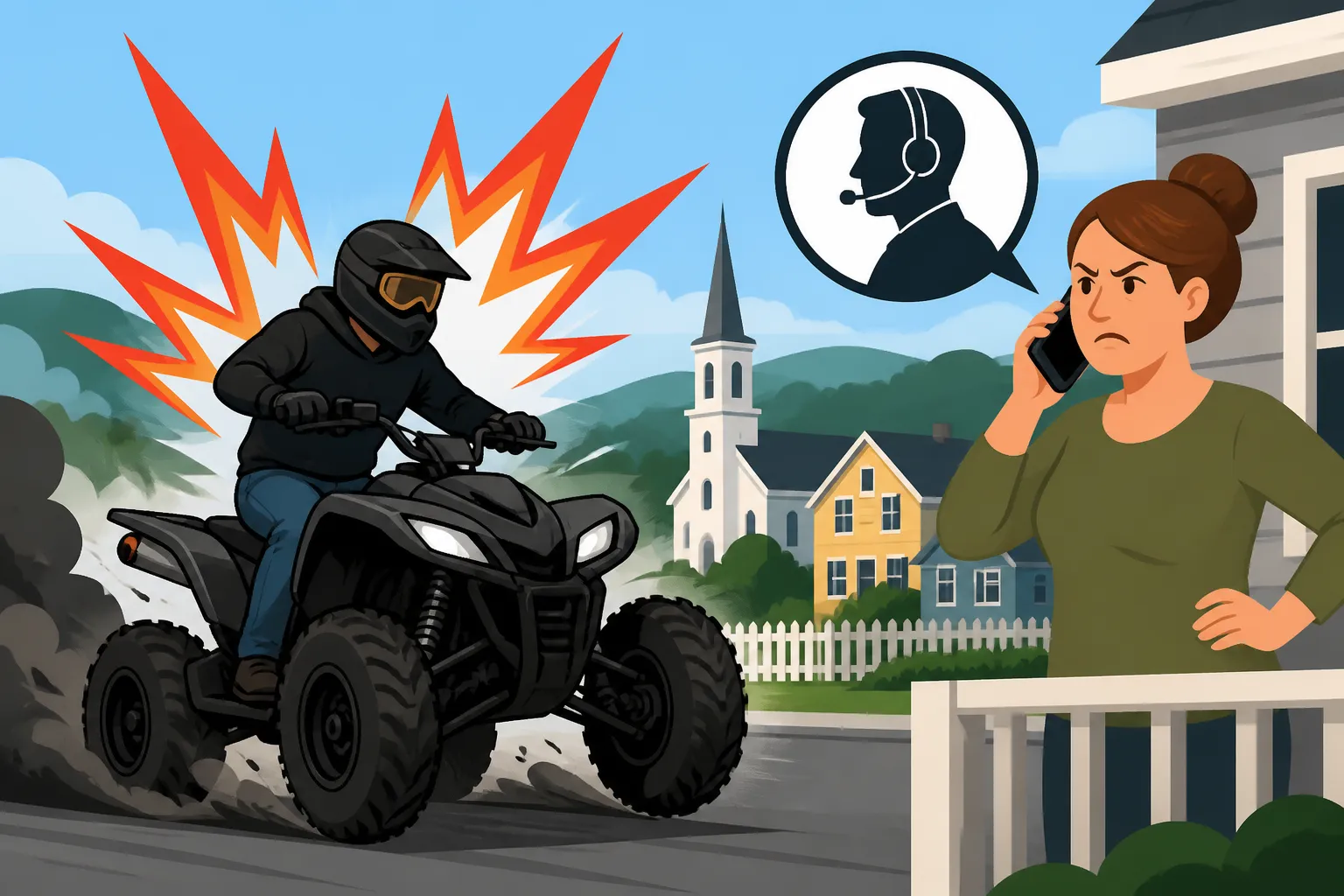
When a Loud Quad Draws a Town Complaint
A loud quad can turn a relaxing ride into a tense conversation with a neighbor, a call to local police, or a complaint to town hall. In Massachusetts, the right response depends on where you were riding, what equipment is on the machine, and whether a local rule applies. This guide explains how to handle a noise complaint and reduce the chance of another one.
Why a town might receive a complaint about a quad
A complaint is not automatically a violation
A neighbor’s call or email does not, by itself, prove that you broke a law. It may prompt a town official, police officer, or Environmental Police officer to look into what happened. The issue might be whether the machine’s exhaust is too loud, whether you were riding somewhere you were allowed to ride, or whether repeated riding is disturbing nearby residents.
Location matters. A noise concern on private land may involve different rules and local processes than one involving a state forest or another public riding area. A town may also have local noise rules or ordinances to consider. Don’t assume that one statewide rule answers every question—or that a complaint automatically means you will receive a ticket.
A practical first step is to find out who contacted you and what they say happened. Was it one brief pass on a trail, repeated riding near a home, a modified exhaust, or operation during a quiet period? Specific details help you understand the concern without treating every complaint as proof of wrongdoing.
Noise can be only one part of the problem
A quad may sound unusually loud because its muffler is damaged, missing, modified, or poorly fitted. But even a machine with intact equipment can annoy nearby residents if it is ridden repeatedly near homes, revved while stationary, or operated at a time when engine noise carries across a quiet area.
The complaint may also involve where you rode. Massachusetts generally restricts riding off-highway vehicles on public ways, and private land is not open for riding simply because it looks accessible. If a dispute includes trespass or an unauthorized route, consider the location and landowner permission as carefully as the exhaust. See [Massachusetts Bans Riding on Public Ways] and [Massachusetts Landowner Permission in Writing].
This is why it helps to separate the complaint into parts: noise or equipment, time and frequency, and riding location. A neighbor might be bothered by the sound, while the town’s follow-up could focus on a separate concern such as riding near a dwelling or crossing a road. For context on that particular issue, review [Massachusetts Riding Within Sight of a House].
What to do after someone complains
Stay calm and get the details
If a neighbor approaches you, try not to argue about whether the quad is “too loud.” That description is subjective, and a tense exchange rarely clarifies what needs to change. You can acknowledge that they are concerned, ask when and where the sound is bothering them, and say you will check the machine and the applicable riding rules.
If a town employee or officer contacts you, listen carefully and ask what conduct or equipment is at issue. Write down the date, location, person or department you spoke with, and any instructions you were given. If you receive a written notice or citation, keep it and note any response deadline or instructions on the document. Don’t ignore it, even if you believe the complaint is mistaken.
Avoid confronting a neighbor at their home, filming them in a way that escalates the dispute, or continuing to ride past their property to make a point. If a complaint seems inaccurate, a calm record of your route, timing, machine condition, and communications is more useful than an argument. For help understanding possible enforcement concerns, see [Massachusetts Penalties for Illegal Riding] and [What an Environmental Police Officer Checks at a Trailhead].
Inspect the machine before riding again
Start with the basics: check that the muffler and exhaust components are present, secure, and not visibly damaged. Listen for a sudden change in sound, rattling, or an exhaust leak. A noise that has become sharper or louder than usual can be a sign that something has loosened or failed.
If you recently installed or changed a part, check the instructions and confirm that the component is intended for your exact machine and is compatible with the exhaust system. If you are considering an aftermarket exhaust from SuperATV or another maker, verify the product’s intended use and whether it meets the rules for the place where you ride before installing it. A part being sold for an off-road machine does not automatically mean it is appropriate for every location or riding condition.
When you are not sure what you are hearing, have a qualified mechanic inspect the machine rather than trying to diagnose an exhaust problem by revving it repeatedly near homes. A repair can address a genuine mechanical issue, but it won’t resolve a location or riding-hours problem. For a broader equipment checklist, see [Massachusetts Equipment Requirements] and [Massachusetts Muffler and Noise Rules].
How to reduce the chance of another complaint
Make sensible changes to how and where you ride
If you ride on private property, make sure you have permission and understand any conditions the landowner has set. Permission to enter does not necessarily mean permission to ride wherever you want, at any hour, or as often as you like. A property owner may also ask you to stop or change your route.
Where riding is allowed, avoid unnecessary engine revving, long warm-ups near homes, and repeated passes along a property line. A quieter route, fewer laps, or a different staging area can make a real difference—especially in a rural neighborhood where sound carries over open fields or through wooded areas. If dust is also part of the concern, [Keeping Dust Down When You Ride Past Houses] offers related riding considerations.
Use locations that are designated for the kind of machine you have, and check access rules before towing to a trail. A route that appears on an old map or is familiar to a friend may not be open to ATVs or UTVs. For guidance on trail access for wider machines, see [Massachusetts Trails That Allow Side-by-Sides].
Keep a simple record of repairs and conversations
If you repaired the exhaust or changed a component after a complaint, keep the receipt or a note describing the work. If you contacted a town office or landowner, record the date and what you were told. This is not a guarantee that a future complaint will go away, but it can help you explain the steps you took and avoid relying on memory if the issue comes up again.
If complaints continue, look for a practical pattern. Does the issue happen only at a certain time, on one section of your route, or after a particular repair? A small log of dates, riding locations, and maintenance observations may point to a fix more clearly than guessing. It can also help you describe the situation accurately if you need to ask a town office which local rule applies.
| What the complaint may involve | A useful first step | What to avoid |
|---|---|---|
| A suddenly louder or rattling exhaust | Stop and inspect the muffler and exhaust system | Repeatedly revving the machine near homes |
| Riding close to a residence | Check your route and the applicable location rules | Assuming permission for one area covers every nearby route |
| Repeated riding or inconvenient timing | Change the route, reduce unnecessary passes, or adjust timing | Treating a neighbor’s concern as an invitation to argue |
| A notice or citation | Read it carefully, keep a copy, and follow its instructions | Ignoring the document or missing a stated deadline |
| Unclear local noise rules | Ask the relevant town office which rule or process applies | Assuming every town handles complaints the same way |
When to seek clarification or professional help
Ask the right office a specific question
If you cannot tell whether the issue is a local noise rule, an equipment requirement, land access, or a complaint about repeated disturbance, contact the appropriate town office and ask a focused question. You might ask which department handles off-highway vehicle noise complaints, whether a local ordinance applies at the location, or where to find the written rule. Be ready to give the town, road or property area, and a clear description of the machine and situation.
If an officer has already contacted you, you can ask which agency is handling the matter and what rule they believe may apply. Keep the conversation factual and polite. A general question about “quad noise laws” may not get a useful answer if the key detail is that you were riding on a specific type of property or using a modified exhaust.
For disputes involving public land, landowner permission, a citation, or a possible violation, consider speaking with a qualified attorney or another appropriate professional. The right next step depends on the notice and the facts, so don’t rely on an online description as a substitute for reviewing the actual document and applicable local requirements.
Treat a complaint as a chance to prevent a repeat
The most useful response is usually practical: inspect the machine, check where you rode, and understand what the complainant says is happening. If the issue is an exhaust fault, repair it. If it is a route or access problem, change the route and confirm permission. If the issue is timing or repeated passes, adjust your riding habits.
A complaint can feel personal, especially when you believe you were simply enjoying a machine you own. Still, a measured response protects your ability to keep riding responsibly and can prevent a small concern from turning into a larger dispute. If you are unsure what is permitted, check the relevant location’s rules before your next ride rather than assuming the same access applies everywhere.
Disclaimer
This article is for general informational purposes only and does not constitute professional advice. Laws, prices and regulations vary by location and change over time. Consult a qualified professional for guidance on your specific situation.