What Continuous Visual Contact Means in Massachusetts
Navigating the trails of Massachusetts with young riders can be an incredible family experience, but it comes with a strict set of rules designed to keep everyone safe. One of the most talked-about and often misunderstood regulations revolves around "continuous visual contact" for supervising adults. It's not just a suggestion; it's a legal requirement that can leave many parents and guardians scratching their heads, wondering what it really means when the trail gets dusty or winding. This guide aims to demystify this critical aspect of Massachusetts ATV law, offering clarity and practical advice so you can hit the trails confidently and legally with your young adventurers.
The Heart of Massachusetts' Youth ATV Laws: Sean's Law
Massachusetts has some of the most stringent laws regarding youth ATV operation in the country, and for very good reason. These regulations were put in place to prevent serious injuries and fatalities, ensuring that young riders are always under the watchful eye of a responsible adult. Understanding the spirit of these laws is just as important as knowing the letter of them.
Why "Continuous Visual Contact" Matters So Much
The phrase "continuous visual contact" isn't just bureaucratic jargon; it's a cornerstone of the state's commitment to rider safety, particularly for minors. For parents and guardians, it represents a significant responsibility that goes beyond simply being on the same trail. The core intent is to ensure that the supervising adult can immediately observe and react to any situation involving the young rider. Imagine a child encountering an unexpected obstacle, taking a spill, or even just stopping suddenly. If you can't see them, you can't help them, and that fraction of a second can make all the difference.
This critical rule directly stems from [Sean's Law: The 2010 Ban Named for a Boy], a pivotal piece of legislation enacted to address a tragic accident involving a young rider. The law emphasizes that while riding an ATV can be a fantastic outdoor activity, it carries inherent risks, especially for those still developing judgment and motor skills. The supervising adult is essentially the child's lifeline on the trail, constantly assessing their riding, anticipating hazards, and being ready to intervene. This isn't just about avoiding a ticket; it's about safeguarding the most precious cargo you'll ever have on the trail.
Defining "Continuous" and "Visual Contact" in Practice
So, what exactly does "continuous" mean in the context of trail riding? It doesn't mean you have to be staring unblinkingly at the child for every single second, but it does mean that any interruption in your ability to see them must be momentary and immediately rectified. Think of it as always having them in your field of vision, even if that field shifts slightly with the terrain. A quick glance away to check your own path is one thing; letting them disappear behind a rise or a bend for an extended period is quite another.
"Visual contact" means just what it says: you must see the child and their ATV or UTV. This isn't about knowing they are somewhere ahead or hearing their machine. You need to observe their riding behavior, their posture, and the immediate environment around them. This is where real-world trail conditions can throw a wrench into things. Dense foliage, especially in lush Berkshire forests during summer, can obscure sightlines. Heavy dust kicked up by multiple machines can create temporary white-out conditions. And of course, sharp turns, elevation changes, and dips in the trail can make maintaining that uninterrupted view incredibly challenging.
For instance, if you're riding a winding trail in [October Mountain State Forest Riding in Massachusetts], and your child takes a sharp turn around a clump of pines just as you hit a dust cloud from the rider in front of you, you've momentarily lost "continuous visual contact." The expectation is that you would immediately slow down, perhaps even stop, to regain sight of them. Accessories like tall safety flags, especially those from brands like SuperATV, can actually help in situations like this, extending the visual line of sight over small obstacles or through light brush, providing a little extra lead time to react. The key is that the law demands proactive measures to keep eyes on the young rider at all times possible.
Practical Implications for Supervising Adults
For any adult bringing a minor onto Massachusetts OHV trails, the role of a supervisor carries significant weight, both morally and legally. It’s not a passive role; it’s an active one that requires constant vigilance and understanding of the law.
The Supervising Adult's Legal Responsibilities
As a supervising adult, you are essentially held accountable for the young rider's adherence to the law. This is a crucial point: [Massachusetts Supervisors Held Liable] for any violations committed by the youth under their supervision. This means if a child is caught riding without continuous visual contact, or commits any other infraction like riding in a prohibited area, the supervising adult is the one who will face the legal consequences, not just the child. This liability underscores why understanding and strictly adhering to the "continuous visual contact" rule is so important.
The law is specific about who qualifies as a supervising adult; they must be at least 18 years old and competent to operate an OHV. [Massachusetts Supervising Adult Defined] clarifies this, ensuring that the person in charge possesses the necessary maturity and experience. This isn't a job you can delegate to an older sibling who is still a minor themselves. Imagine a scenario where you're riding in Pittsfield State Forest. If an Environmental Police officer observes your 12-year-old riding around a bend, out of your sight, even for a short period, you, as the supervising adult, could be issued a citation. This isn't to scare anyone away from riding, but to highlight the seriousness with which Massachusetts regards youth rider safety.
Strategies for Maintaining Visual Contact on the Trail
Given the legal weight of continuous visual contact, developing strategies to maintain it is paramount. Many experienced riders find that riding position is key. Should the adult lead, or should the child? Each has its merits. If the adult leads, they can set a safe pace, clear the path, and alert the child to upcoming hazards. However, it can be harder to keep an eye on the child's riding style and react to their specific actions. If the child leads, the adult has a direct view of their riding, but the child might set too fast a pace or miss obstacles. Often, a flexible approach works best, with the adult taking the lead on unfamiliar or challenging sections and allowing the child to lead on simpler, open stretches where visibility is excellent.
Beyond positioning, clear communication and equipment can make a huge difference. Pre-arranged hand signals for "slow down," "stop," or "hazard ahead" are invaluable, especially when engines are roaring. Planning regular stops to regroup and check in also helps ensure nobody gets separated. From an equipment standpoint, anything that enhances visibility for the young rider's machine is a plus. Brightly colored riding gear, especially high-visibility vests, make them easier to spot. Furthermore, adding accessories like a tall, brightly colored safety flag can greatly improve visibility, especially on undulating terrain or through light brush. Some riders even install additional, highly visible LED lights – perhaps bright, compact light bars from a brand like SuperATV – to their child's machine, ensuring they stand out more against the natural backdrop, even in daylight. These proactive measures not only contribute to safety but also make it easier for the supervising adult to maintain that continuous visual connection.
Common Challenges and Misconceptions
Even with the best intentions and preparation, Massachusetts trails can present real-world obstacles to maintaining continuous visual contact. Understanding these challenges and, more importantly, how to proactively address them, is key to a safe and legal riding experience.
When Visual Contact Becomes Difficult (and What to Do)
Let's be realistic: trails are not perfectly flat, straight, and clear. You're going to encounter dust clouds, especially on dry, unpaved sections, or through the dense canopy of trees in [Beartown State Forest Riding in Massachusetts] where visibility can quickly diminish. Elevation changes, sharp turns, and sections with heavy foliage can all momentarily break that visual connection. It's frustrating when you're doing your best, but nature and trail conditions conspire against you.
When these situations arise, the absolute best course of action is to slow down immediately. If necessary, come to a complete stop until you regain sight of the young rider. This isn't just a suggestion; it's a necessity. Trying to push through a dust cloud or around a blind corner hoping they're still there is taking an unacceptable risk. [Verbal Communication on the Trail] via helmet-to-helmet communicators can be a helpful supplement, allowing you to ask, "Are you still there? Are you okay?" but remember, the law explicitly requires visual contact. Audio alone doesn't satisfy the requirement. A good practice is to establish a "stop and wait" rule: if the lead rider (adult or child) loses sight of the other, they immediately stop and wait until contact is re-established. This simple rule can prevent a momentary loss of sight from turning into a full-blown separation and potential hazard.
The Difference Between Visual Contact and Proximity
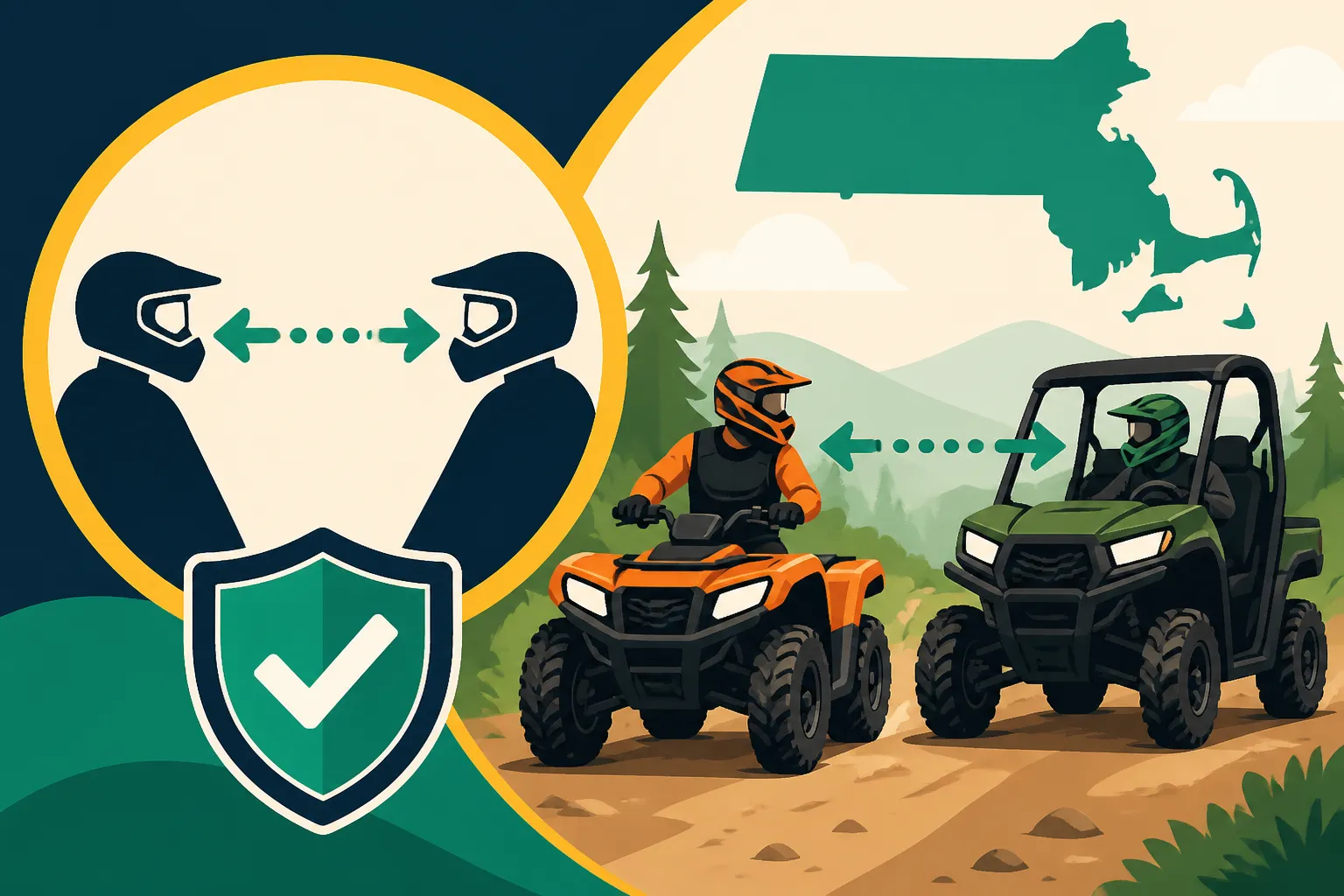
It's a common misconception that simply being "close by" is enough. Many parents think, "I can hear them, so I know they're there." Or, "They're just around that corner, I'll see them in a second." But the law doesn't care about proximity alone; it demands visual contact. You could be only 20 feet away from your child, but if a thick patch of ferns or a large rock formation completely obscures your view of their machine, you are technically not maintaining continuous visual contact.
The law doesn't specify [How Close a Supervising Adult Has to Stay] in terms of feet or yards, because that distance is entirely dependent on the terrain and conditions. On a wide-open gravel road, you might be able to maintain visual contact from a greater distance than on a tight, winding single track. The critical element is the ability to see. This distinction is vital, as it shifts the focus from mere physical closeness to active observation.
To help clarify this, let's look at a simple comparison:
| Scenario | Proximity | Visual Contact | Legal Compliance (Massachusetts) |
|---|---|---|---|
| Child 100 ft ahead on straight, clear trail | Close enough | YES | Compliant |
| Child 20 ft ahead around blind corner | Very close | NO | Non-compliant |
| Child behind dust cloud | Very close | NO | Non-compliant |
| Child on parallel trail, visible through trees | Close enough | YES (if truly clear) | Compliant (if truly clear) |
| Child out of earshot, but visible across field | Distant | YES | Compliant |
As you can see, sound or even general direction isn't enough. If an Environmental Police officer sees you, as the supervising adult, and cannot see your child's machine because of an obstruction, you're at risk of a citation, even if you know exactly where they are. This means that if you're communicating with your child via an intercom system, and they tell you they've stopped just around the bend, you still need to get yourself into a position to see them before you are back in compliance with the continuous visual contact rule.
Ensuring Compliance and Safety
Understanding the intricacies of "continuous visual contact" is one thing; putting it into practice consistently, year after year, is another. It ties directly into broader safety requirements and demands a thoughtful approach to planning every ride.
Rider Age and Machine Size Considerations
The "continuous visual contact" rule doesn't exist in a vacuum; it's part of a larger framework of youth rider safety. Massachusetts has clear guidelines on [Massachusetts Age and Engine Size Ladder], which dictates what size ATV or UTV a child can operate based on their age. For example, children under 14 are generally [Massachusetts Bans Riders Under 14] from operating ATVs, with very specific exceptions for sanctioned events. For those aged 14 to 16, there's often an engine size cap (typically 90cc or less), and supervising adults are still mandatory.
These age and size restrictions are in place because younger riders, and those on machines too powerful for their skill level, require even more direct supervision. The potential for loss of control or unexpected situations increases, making continuous visual contact even more paramount. Before you even head to the trailhead, ensure your child meets the age and engine size requirements for their machine, and that they have completed the mandatory safety training. Remember, all riders under 18 years of age operating on public lands must carry a valid [Massachusetts Safety Certificates Under 18]. This training equips them with foundational skills, but it never negates the need for an adult's watchful eye.
Best Practices for a Safe Family Ride
Making "continuous visual contact" a seamless part of your family's riding routine starts long before you even fire up the engines. A pre-ride briefing is invaluable. Discuss the "stop and wait" rule, hand signals, and what to do if someone gets separated. Remind everyone that safety is the priority, not speed or conquering every obstacle. If you're riding with a group of ten, consider breaking into smaller, manageable sub-groups where each adult is directly responsible for a specific number of young riders, ensuring they can maintain that vital visual link.
Choosing the right trails also makes a huge difference. Start with [Best Massachusetts ATV Trails for Beginners], which are typically wider, less technical, and have fewer blind spots. As skills improve and you become more comfortable with the dynamic of maintaining visual contact, you can gradually explore more challenging terrain. Even then, always prioritize visibility. Regular checks—pulling over every so often to make sure everyone is still accounted for and feeling good—are an excellent habit.
Beyond these operational practices, equipping your machine and yourself for safety is crucial. This includes carrying a first-aid kit, a fully charged cell phone (though be mindful of [Cell Dead Zones in the Berkshire Hills]), tools, and plenty of water. While [Massachusetts Has No Insurance Mandate] for ATVs, many experienced riders opt for optional insurance coverage for peace of mind. Thinking through these details, from the type of trail to the gear you carry, ensures that every family ride, whether it's a quick afternoon spin or a full day exploring [October Mountain State Forest Riding in Massachusetts], is as safe and enjoyable as possible, with continuous visual contact being a natural, ingrained part of the experience.
Disclaimer
This article is for general informational purposes only and does not constitute professional advice. Laws, prices and regulations vary by location and change over time. Consult a qualified professional for guidance on your specific situation.