Staying Visible on a Berkshire Road After Dark
Riding your ATV or UTV through the majestic Berkshire landscape is an experience unlike any other, but when the sun dips below those rolling hills and twilight descends, the game changes entirely. The serene beauty can quickly turn into a high-stakes challenge, especially if you find yourself needing to navigate near or briefly cross a public way. The concern isn't just seeing where you're going; it's about making sure every other driver out there sees you. This guide is dedicated to helping Massachusetts riders understand the critical importance of visibility after dark, the legal mandates, and practical steps you can take to enhance your presence when operating your machine in low-light conditions near any road in the Bay State.
The Legal Landscape of Night Riding and Road Crossings in Massachusetts
Let's face it, Massachusetts isn't exactly known for being lenient when it comes to off-highway vehicle (OHV) laws, especially concerning public roads. The legal framework is designed with safety in mind, and while it might feel restrictive at times, understanding it is your first line of defense, particularly after dark.
Why Massachusetts Bans Riding on Public Ways Especially at Night
It's a common frustration for riders: the scenic dirt road that connects two fantastic trails, or the short stretch of paved road separating you from your next adventure. However, Massachusetts law, specifically Chapter 90B, is crystal clear: ATVs and UTVs are generally prohibited from operating on public ways. This isn't just about convenience; it's fundamentally about safety, and this becomes critically important when darkness falls.
Imagine a situation where you're on a familiar trail, enjoying the last rays of sunlight, and suddenly realize you need to make a quick dash across a town road to get back to your truck. In broad daylight, you might feel a fleeting sense of visibility, but at night, that feeling is a dangerous illusion. Regular vehicles, even with their powerful headlights, aren't looking for ATVs or UTVs on the road. The low profile of some machines, combined with the often-minimal factory lighting, makes you practically invisible until it's far too late for a driver to react. The law recognizes this inherent danger, aiming to prevent tragic collisions between machines designed for off-road use and cars operating at highway speeds. Trying to sneak across or ride a public way after dark not only risks a hefty fine but, more importantly, puts your life and the lives of others in grave danger. [Massachusetts Bans Riding on Public Ways] because the risks, particularly in the dark, are simply too high.
Lighting Requirements When Darkness Falls
While Massachusetts prohibits general riding on public ways, it does acknowledge that you might need to make a legal crossing or operate on private land where it gets dark. For these situations, your machine absolutely must meet specific lighting requirements to ensure some level of visibility. It's not optional; it's the law.
Every ATV and UTV, regardless of whether it's operating during the day or night, is required to have at least one headlight and one taillight. When operating after sunset, or when visibility is otherwise reduced (think heavy fog, rain, or snow), both your headlight and taillight must be illuminated and clearly visible from specific distances. Your headlight needs to project a beam that can illuminate objects for a certain distance ahead, and your taillight must be visible from a specified distance from the rear. Additionally, a red reflector is required on the rear of your machine. These aren't just suggestions; they are minimum safety standards. Many factory setups meet these basic requirements, but it's vital to regularly check that all your lights are functional, clean, and properly aimed. A dirty lens can drastically reduce visibility, and a burned-out bulb means you’re operating illegally and dangerously. Always double-check your machine before heading out, especially if there's any chance you'll be riding into dusk or beyond. [Massachusetts Lighting After Sunset] isn't just a rule; it's your lifeline.
Understanding Road Crossing Protocols After Dark
Even under the strictest regulations, there are situations where a quick, legal crossing of a public way is necessary to access another section of a trail system or reach private property. These moments are inherently risky, and at night, they demand an even higher degree of caution and adherence to protocol.
The law requires you to come to a complete stop before entering any public way. You must then yield to all vehicular traffic on that public way. This means all traffic, regardless of how far away it seems. After dark, judging distance and speed of oncoming vehicles becomes significantly harder. Those headlights that look far off can be on you in seconds. You need to look both ways, several times, and listen intently. Ensure your machine's headlights and taillights are clean and fully operational to maximize the slim chance of being seen by an approaching motorist. If you're riding with a group, coordinate your crossing. Do not assume that because the first rider made it across, the path is clear for everyone else. Each crossing is an individual decision. It's also crucial to cross at a right angle to the road, as directly as possible, minimizing your time on the public way. Lingering or traveling any distance along the road is strictly prohibited and incredibly dangerous, especially when visibility is poor. Never, ever rush a crossing, and if in doubt, wait until you are absolutely certain it's safe. [Massachusetts Rules for Crossing a Road] are there to keep you alive.
Essential Gear and Machine Upgrades for Enhanced Night Visibility
Meeting the legal minimum for lighting is one thing, but truly prioritizing your safety when operating an OHV near public ways after dark in the Berkshires means going above and beyond. Think of it as creating layers of visibility.
Personal Reflective Gear: Your First Line of Defense
Your machine might have lights, but you, the rider, are a crucial part of the visibility equation. A driver's eyes are often drawn to movement and contrast. This is where personal reflective gear becomes absolutely non-negotiable for night riding, especially if there's any chance you'll be near a road.
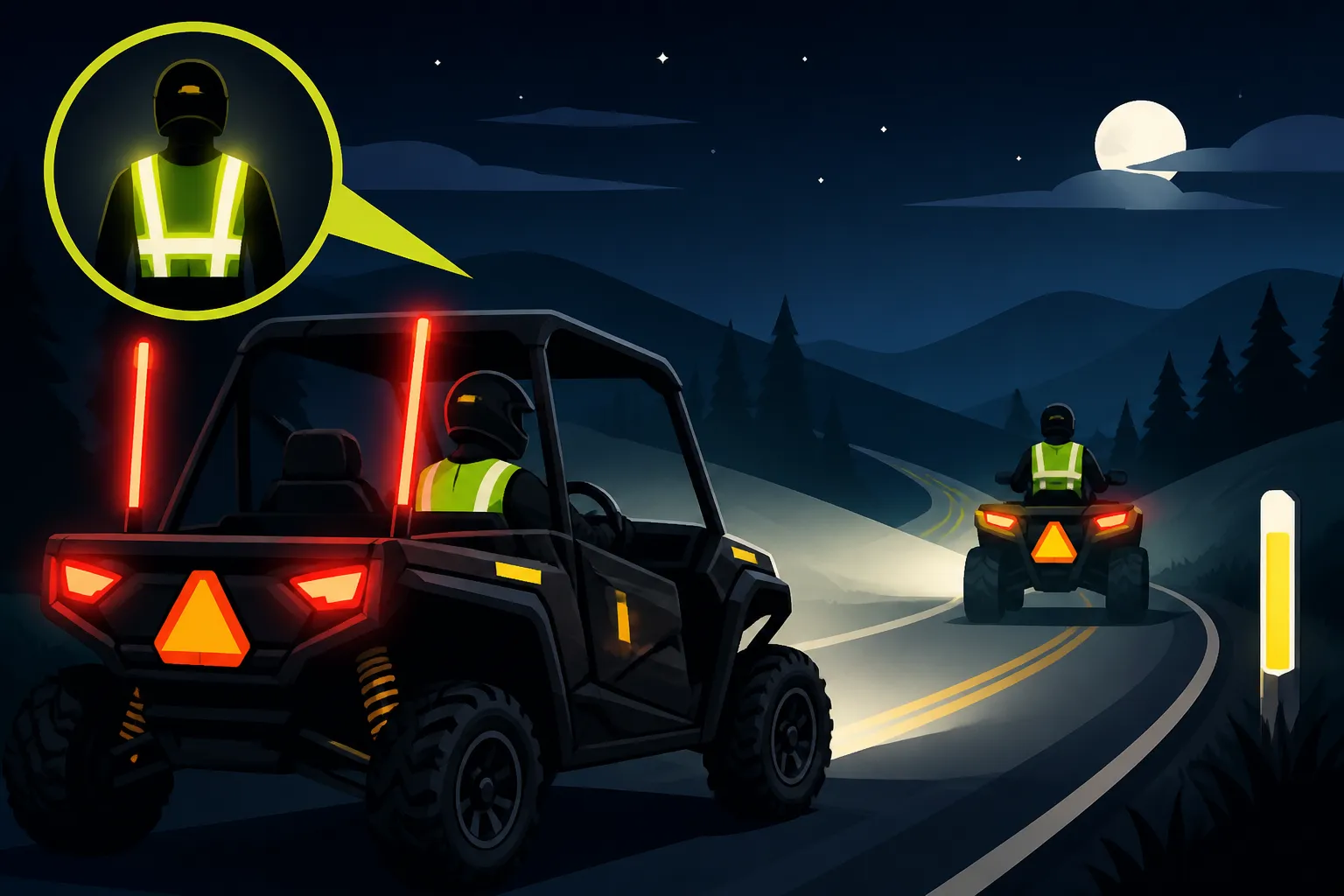
Imagine you're standing next to your machine, perhaps checking a map or making a quick adjustment. If your machine's lights are on, great, but if you step away, you might vanish into the darkness. Wearing a high-visibility reflective vest or jacket is paramount. These aren't just for road crews; they're for anyone needing to be seen in low-light conditions. Look for vests that use retroreflective materials, which bounce light directly back to its source, making you glow brightly in a vehicle's headlights. Beyond a vest, consider your helmet. Many helmets come with reflective decals, or you can add your own. Brightly colored riding gear, even if not explicitly reflective, also helps. The goal is to break up your silhouette and provide a clear, bright target for anyone whose lights sweep across you. Don't rely solely on your machine's lights to protect you; wear your own beacon. [Reflective Gear Worth Adding to Your Quad] can make all the difference.
Auxiliary Lighting and Visibility Enhancements for Your Machine
While factory lighting handles the legal minimum, you can significantly boost your machine's visibility with aftermarket additions. These enhancements are primarily for off-road use, but they dramatically improve your ability to see and be seen on trails, which then translates to better safety during legal road crossings.
Consider adding auxiliary LED light bars to the front of your ATV or UTV. While these are typically too bright and illegal for public road use (and should be covered or turned off during any road crossing), they transform your visibility on the trail itself. Brands like SuperATV offer a wide array of high-quality LED light bars, cube lights, and work lights that can turn night into day on the deepest Berkshire trails. Beyond sheer illumination, think about side visibility. Reflective tape, strategically placed on the sides and rear of your machine, can catch stray light from car headlights approaching from angles your factory lights might not cover. Lighted whip flags, popular on sand dunes, are also gaining traction in wooded areas for group visibility and can be a significant help in ensuring you stand out. Just remember to use them responsibly and understand local regulations for trail use.
Here's a quick comparison of basic versus enhanced lighting:
| Component | Basic Factory Setup | Enhanced Aftermarket Setup | Purpose |
|---|---|---|---|
| Headlight | One or two basic halogen lights | LED headlight bulbs, auxiliary LED light bar | See obstacles, be seen from front |
| Taillight | One red bulb | Brighter LED taillight, additional red strobes/pods | Be seen from rear |
| Reflectors | Small red rear reflector | Additional reflective tape on sides, front, rear | Catch light from all angles |
| Side Visibility | Minimal | Lighted whip flag, side marker lights, reflective tape | Be seen from sides, especially at intersections |
| Personal Gear | None (if rider chooses) | High-visibility reflective vest/jacket, helmet decals | Rider visibility, even dismounted |
When you're equipping your machine, consider the full spectrum of situations you might encounter. Having [Massachusetts Brake Requirements] met is vital for stopping, but being seen is just as important to avoid having to stop suddenly.
Maintaining Your Visibility Equipment
Having the best lights and reflective gear in the world is useless if they're not in top working order. Maintenance isn't just about the engine; it's about every component that contributes to your safety, especially your visibility aids.
Regularly inspect all your lights: headlights, taillights, brake lights (if applicable), and any auxiliary lighting. Check for burned-out bulbs, cracked lenses, or loose wiring. Mud, dust, and grime are the enemies of light, so keep your lenses sparkling clean. After a muddy ride through October Mountain State Forest, it's easy to forget that a thick layer of mud on your taillight effectively makes it invisible. Take a moment to wipe them down before and after each ride. For reflective tape and decals, check for peeling or damage. Over time, exposure to the elements can degrade their effectiveness. If you notice any wear, replace them. Don't forget your battery. Poor battery health can lead to dim lights, or worse, no lights at all. Ensure your charging system is functioning correctly to keep everything powered up. A few minutes of pre-ride inspection can prevent a serious incident later, particularly as daylight fades.
Safe Riding Practices for Low-Light and Night Conditions
Beyond the gear, how you ride makes a monumental difference when the sun goes down. Safe practices are about anticipation, caution, and clear communication.
Situational Awareness and Speed Management
Riding after dark isn't just a matter of turning on your lights; it's about fundamentally altering your approach to the trail and your surroundings. Your situational awareness needs to be heightened, and your speed needs to be significantly adjusted.
The familiar contours of a trail in Beartown State Forest can look entirely different at night. Shadows play tricks on your eyes, small ruts become gaping chasms, and a fallen branch can appear out of nowhere. Reduce your speed drastically, giving yourself ample time to react to unexpected obstacles, wildlife, or other trail users. Your stopping distance at night needs to be longer because your reaction time is often slower and your visibility limited, even with auxiliary lights. Scan far ahead with your eyes, not just directly in front of your tires. Pay attention to subtle changes in terrain that might indicate a drop-off or a tricky section. Listen for sounds that might indicate approaching vehicles (if you're near a public way) or animals. This heightened sense of awareness is crucial. It’s not just about seeing; it’s about anticipating what you can't see. Remember, [Massachusetts Rules for Riding After Dark] prioritize safety above all else.
Planning Your Night Rides and Avoiding Unnecessary Road Encounters
The best way to stay safe near roads after dark is to avoid them entirely. While this isn't always possible, proactive planning can significantly reduce your exposure.
Before you even load your machine, study your route. Know exactly where the legal road crossings are and identify any stretches of trail that run parallel to or unusually close to public ways. If you anticipate riding into dusk or after dark, plan your route so you minimize time near roads. Consider turning around earlier in the day if you realize you're getting close to sunset and have a long way back that involves sensitive road-adjacent sections. Pack a good map, a compass, or a GPS device with pre-loaded trail maps. Cell service can be spotty in the Berkshires, so don't rely solely on your phone. Always inform someone of your planned route and estimated return time. If conditions deteriorate unexpectedly, such as a sudden fog rolling in, don't hesitate to pull over and wait for conditions to improve, or find the safest, quickest path back to your staging area. Checking [Massachusetts Trail Conditions Before You Tow] can also help you avoid unforeseen challenges that might prolong your ride into darkness.
Communicating with Other Riders and Motorists
Effective communication is a cornerstone of safe riding, and it becomes even more critical when visibility is low. This applies both to other riders in your group and any motorists you might encounter.
When riding in a group after dark, maintain tighter spacing than you might during the day. Use hand signals clearly, and if you have helmet communicators, use them to relay information about trail conditions, hazards, or approaching crossings. When nearing a public way, clearly signal your intention to stop and then to cross. Don't assume a motorist sees your headlights, especially if they're still some distance away. Make eye contact if possible. If you need to stop near a road due to a mechanical issue or to check a map, ensure your machine's lights are on and you're wearing reflective gear. Have a flashlight or headlamp readily available to illuminate yourself if you need to dismount and work on your machine. The key is to be predictable and obvious. Motorists are often surprised to see an OHV, even in daylight, so at night, you must assume they haven't seen you until you have confirmation.
Common Mistakes and How to Avoid Them After Dark
Even experienced riders can make mistakes, especially when fatigue sets in or conditions become challenging. Knowing the common pitfalls of night riding can help you sidestep them.
Underestimating the Dangers of Limited Visibility
One of the biggest mistakes riders make is assuming that because they know a trail well in daylight, they know it equally well in the dark. This couldn't be further from the truth. The human brain relies heavily on visual cues, and when those are diminished, our perception can be wildly inaccurate.
Night riding fundamentally alters your depth perception, your ability to judge distances, and your identification of hazards. A puddle that's easily navigable in the afternoon might conceal a deep rut at night. A gentle slope can appear much steeper or flatter than it truly is. There's a psychological component here too – a feeling of overconfidence can creep in, leading riders to maintain speeds that are simply unsafe for the conditions. Animals, like deer or moose, are far more active at dawn, dusk, and night, and their dark coats make them incredibly difficult to spot until they are right in your path. Always approach night riding as if you're on an unfamiliar trail, even if it's your backyard loop. This heightened caution can prevent costly accidents and keep you safe.
Forgetting the Human Element: Driver Distraction
You can have the brightest lights and the most reflective gear, but you are still vulnerable to the most unpredictable element: the distracted driver. It's a harsh reality on today's roads, and it amplifies the danger during night crossings.
Even in well-lit areas, drivers are often focused on their phones, their passengers, or simply lost in thought. Their brains are not primed to look for an ATV or UTV suddenly appearing from a wooded trail. They are looking for cars, trucks, and maybe motorcycles. The unique visual signature of an OHV can be missed, even if it's technically visible. This means that as a rider, you must always operate defensively. Assume you are invisible until you have undeniable proof that a driver has seen you and is yielding. Don't pull out just because a car is far away; wait until you have a huge margin of safety. This is especially true at night, when judging speed and distance is already compromised. Your safety rests on your ability to ride defensively and anticipate that others might not see you, regardless of how well-lit you are.
Legal Consequences of Inadequate Visibility or Illegal Road Use
Beyond the immediate physical dangers, there are significant legal ramifications for operating an OHV on public ways in Massachusetts, especially if your machine isn't adequately lit after dark. Environmental Police Officers are trained to spot these infractions, and the penalties can be substantial.
Operating an unregistered OHV, or an OHV on a public way, can result in fines, and potentially even the seizure of your machine. If you're involved in an accident while illegally operating on a public way, your liability could be immense, particularly if your inadequate lighting contributed to the incident. [Massachusetts Penalties for Illegal Riding] are not to be taken lightly. An officer stopping you at night will meticulously check your lighting, registration card (which you must carry on board), and ensure you are operating legally. They have the authority to ask for your registration information and inspect your machine. [What an Environmental Police Officer Can Ask] extends to verifying that your machine meets all required equipment standards, including proper lights, brakes, and mufflers. Don't give them a reason to write you a ticket or, worse, tow your machine away. Adhering to the law and maximizing your visibility are simply smart choices to protect both your wallet and your freedom to ride.
Disclaimer
This article is for general informational purposes only and does not constitute professional advice. Laws, prices and regulations vary by location and change over time. Consult a qualified professional for guidance on your specific situation.