Massachusetts Two-Part Safety Course
A Massachusetts ATV safety course can feel confusing when the registration rules, age limits, and training steps are all described separately. This guide explains how the two-part course generally works, what to prepare for the in-person session, how certificates fit into Massachusetts riding rules, and what families should check before booking or heading to a trail.
How the Massachusetts ATV safety course is organized
The two parts serve different purposes
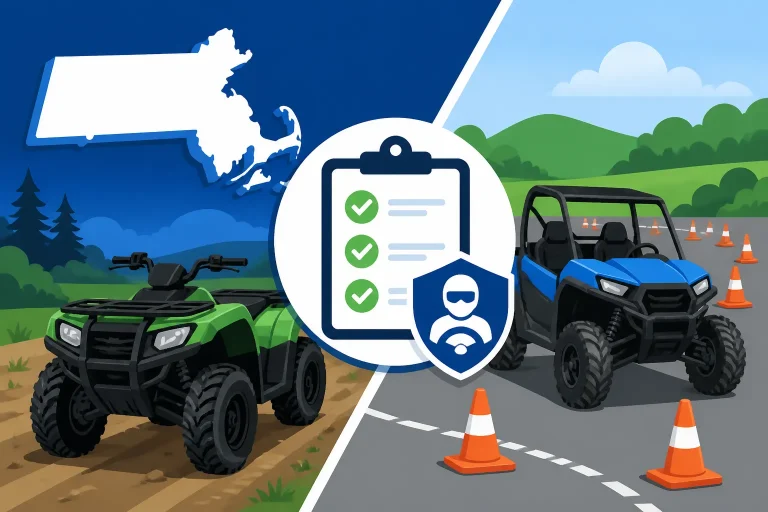
The Massachusetts OHV safety course is designed to teach both the knowledge and the practical judgment riders need before operating an off-highway vehicle. In broad terms, the process includes an online learning component and an in-person component. The online portion gives students a chance to study foundational material at their own pace; the in-person session gives them an opportunity to discuss safety, ask questions, and work through practical skills.
That structure can be helpful, especially for a teenager who has never taken a safety course before. Reading about safe braking is one thing. Thinking through what to do when a trail narrows, a machine behaves unexpectedly, or another rider appears around a bend is another. A course is meant to connect those ideas rather than treat safety as a list of facts to memorize.
The exact sequence, session availability, and completion steps may depend on the course arrangements. Before a student starts, check the instructions for the specific course they plan to take. The online module may need to be completed before the in-person session, and a student who arrives without finishing the required material may not be able to complete the course that day. For a breakdown of the overall format, see Massachusetts Two-Part Safety Course.
What the online portion is for
The online component introduces core topics that riders need to understand before they operate a quad, dirt bike, or side-by-side. These may include basic controls, riding readiness, protective equipment, trail awareness, risk recognition, and the responsibilities that come with operating an OHV. The goal is not simply to get through a screen of questions. It is to make safe choices feel familiar before a rider is facing them in the woods.
Students should work through the online material somewhere they can concentrate. A noisy kitchen table, a phone with constant notifications, or a rushed session right before bed can make it harder to retain details. A young rider may benefit from taking notes about rules or concepts that seem unclear and bringing those questions to the in-person portion.
Families sometimes look for a study guide or notebook to help keep course information together. A plain notebook is enough; it does not need to be a special ATV product. If you are already shopping on Amazon for a basic notebook or a folder for course paperwork, treat it as organization—not as an official study resource or substitute for course materials. Always follow the instructions provided by the course itself.
What happens at the in-person session
The in-person session is the chance to learn with an instructor rather than only from a screen. Students can hear safety concepts explained in context, ask about situations they may encounter, and take part in practical instruction. Depending on the course format, hands-on skills may be included as part of the in-person experience. Check the course’s own description so you know what the student is expected to bring and whether any riding or equipment activity is planned.
A student who is nervous about demonstrating skills should know that the purpose is learning, not showing off. Instructors need to see that a rider can pay attention, follow directions, and approach basic control tasks thoughtfully. A teenager who feels uncertain should say so rather than trying to hide it. Learning to pause, ask for help, and proceed carefully is part of responsible riding.
For a closer look at what the in-person instruction may cover, read Inside the OHV Safety and Responsibility Class. If the course includes a practical evaluation, Massachusetts In-Person Skills Test explains why the hands-on portion matters and what students should confirm before attending.
Who should take the course and why it matters
Training and age rules are related but not interchangeable
A safety certificate is one part of Massachusetts OHV rules, but it does not replace the state’s age restrictions. A rider may need to meet the age and machine-size rules, have appropriate supervision, and follow land-access requirements even after completing a course. In other words, passing training does not automatically make every rider eligible to operate every machine in every place.
This distinction is easy to miss in a family setting. A parent may hear that a teenager needs a certificate and assume that the certificate settles the whole question. But a certificate does not override restrictions on a young rider’s age, engine size, supervision, or where riding is allowed. Review Massachusetts ATV Age Requirements alongside the training requirements, especially when the rider is under 18.
The rules can also differ depending on whether the rider is on public land, private property, or at an organized event. Do not assume that the same rules apply everywhere. If a family is planning a ride on state land, check the relevant safety certificate and access requirements before towing a machine to the trailhead. Massachusetts Rules for Young Riders on Public Land is a useful companion topic.
Why young riders benefit from structured instruction
A new rider may be confident because they have watched an older sibling or parent ride. That confidence is understandable, but familiarity is not the same as training. A younger operator may not yet recognize how quickly speed, uneven ground, poor visibility, or a sudden obstacle can turn a routine ride into a dangerous situation.
Structured instruction gives young riders a chance to practice thinking ahead. They can learn to check their surroundings, respect other trail users, avoid risky maneuvers, and recognize when to stop. That last skill matters more than many beginners expect. A rider who can admit, “I am not sure how to handle this,” is often making a safer choice than someone who presses on to avoid looking inexperienced.
Parents can reinforce the lessons without turning every ride into a lecture. Ask the young rider to explain their plan before starting: where they will ride, what signals they will use, what they will do if separated, and when they will stop. This helps turn course material into habits. Families should also review Massachusetts Parent Attendance Rules to understand when a parent or guardian must be involved in training.
When a certificate needs to be carried
For riders who are required to hold a safety certificate, completing the course is only part of the practical routine. The rider or accompanying adult should confirm how the certificate must be carried or presented for the type of riding planned. Keep the certificate information accessible rather than assuming it will be available through a phone signal in a remote area.
A paper copy stored safely with the ride paperwork can be useful, particularly where cell service is unreliable. That does not mean a paper copy replaces any official card or documentation the course issues. Follow the instructions provided when the student completes the course, and check the applicable requirements before riding.
It helps to keep course documentation together with other machine records. A small folder in the tow vehicle can hold the registration card, course information, emergency contacts, and any land-access paperwork. For the specific document-carrying question, see Massachusetts Certificates Carried on Public Land and The Registration Card You Must Carry in Massachusetts.
What to prepare before taking the course
Confirm eligibility and course details first
Before registering, verify the student’s age, the course’s intended audience, and what components are required. Course information should explain whether the student completes an online portion before attending an in-person session, what identification or paperwork is needed, and whether a parent or guardian has to attend. Do not rely on a friend’s experience from a different course date or a different provider; practical arrangements can vary.
Families should also review the course schedule early. In-person sessions may not be offered at a convenient time or nearby location, and waiting until the week before a planned trip can create unnecessary stress. If a particular date is full, ask about other available sessions or the process for finding the next one. For scheduling guidance, see Massachusetts Course Schedule Lookups.
If a student has a learning, mobility, or communication need that could affect participation, contact the course organizer before the session. Asking in advance is not making a fuss. It gives the organizer a chance to explain what the student will be asked to do and what accommodations or arrangements may be possible. A clear answer ahead of time is far better than discovering a concern at check-in.
Bring only what the course asks for
Read the course instructions carefully and bring the requested materials. Depending on the arrangements, that may include proof of online completion, identification, forms, or other specified items. Do not assume that a screenshot, email, or photocopy will be accepted if the instructions ask for something else.
For the practical session, wear clothing suitable for the activity described by the course. If riding or equipment demonstrations are part of the session, follow the organizer’s directions about footwear, protective gear, and any machine requirements. A student who arrives in clothing that is unsafe or unsuitable may not be able to participate in a hands-on activity, even if they have completed the online material.
Amazon may be one place families look for general protective gear, but buying something online does not make it compliant with a course or legal standard. Check the relevant requirements first, including fit and condition. A helmet that is uncomfortable or poorly fitted is not a good solution just because it was easy to order. For helmet rules, consult Massachusetts ATV Helmet Law.
Help a nervous student feel ready
A student who is anxious about a class may be worried about being tested, making a mistake in front of others, or not knowing enough. Those worries are common. Tell them that the point of training is to learn, and that asking for clarification is a responsible choice. It is far better to ask an instructor to repeat a direction than to guess during a practical activity.
Parents can help by keeping the lead-up calm and practical. Confirm the date, travel time, paperwork, and clothing the night before. Avoid framing the course as a hurdle the student must “get over” to earn a ride. It is better to describe it as preparation for making good decisions and respecting the responsibilities that come with operating a machine.
If the student wants to review a concept beforehand, use the official course materials rather than random videos or social posts. Online advice may come from another state, another type of machine, or a riding park with different rules. Keep a list of questions and bring it along. The instructor can help distinguish a general safety principle from a Massachusetts-specific requirement.
What students learn beyond machine controls
Reading the riding environment
Safe riding depends on noticing what is happening around the machine. A rider needs to think about trail width, visibility, surface changes, other people, and the possibility of encountering a hazard beyond the next bend. In a forest, a clear stretch can turn quickly into a muddy section, loose stone, a steep slope, or a place where hikers are walking.
New riders often focus on the machine directly in front of them and forget to scan farther ahead. Training encourages riders to look beyond the immediate ground and make decisions early. If a turn looks blind, slow down before reaching it. If a group is approaching, leave room and communicate. If a trail condition feels beyond the rider’s ability, stopping or turning back is not failure.
The setting matters, too. Public land has rules about where riding is permitted, and a trail visible on a map is not automatically open to OHVs. Conditions and access can change. Before a ride, check the location’s rules and closures, and do not treat a safety certificate as permission to ride any route. Massachusetts Trail Planning and Closures can help readers think through access as part of trip preparation.
Managing risk instead of reacting late
A central safety habit is noticing risk before it becomes an emergency. That may mean leaving more space between machines, slowing down when visibility is limited, avoiding a hill that feels too steep, or stopping when the rider is tired. These choices are ordinary, not dramatic, but they prevent many avoidable problems.
A helpful way to think about risk is to consider the rider, the machine, and the surroundings together. A skilled rider can still be placed at risk by poor visibility or a mechanical problem. A well-maintained machine can still be unsafe in the hands of a tired or distracted operator. Safe riding depends on all three factors, not just on the machine’s condition.
Families can make this approach part of their pre-ride routine. Before starting, ask each rider how they feel, whether the machine is ready, and what conditions to expect. If a rider is upset, exhausted, or uncomfortable with the route, adjust the plan. A safety course is more valuable when its lessons continue to shape decisions after the student receives a certificate.
Equipment checks and responsible habits
Students should learn that the machine must be in suitable condition before a ride. That includes checking controls and key equipment, listening for unusual sounds, and paying attention to anything that seems loose or damaged. The right inspection depends on the machine, so owners should follow the manufacturer’s instructions and ask a qualified mechanic about concerns they cannot resolve.
The course can also reinforce habits that protect other people and the land. Riders should avoid damaging trail surfaces, respect posted closures, yield appropriately, and keep noise under control. A rider’s choices affect access for everyone. When a trail is damaged or people feel unsafe around machines, it can make future riding more difficult for the community.
A basic checklist can help a new rider remember routine steps. Keep it simple and machine-specific rather than relying on a generic list found online. If you use Amazon to purchase a small storage pouch or notebook for a checklist, make sure it is secured so it cannot interfere with the machine or become litter. The checklist is a reminder, not a substitute for learning how to inspect the vehicle properly.
Completing the course and keeping records
Confirm that every required step is complete
Do not assume that finishing the online material automatically means the student has earned a certificate. The course may require attendance at the in-person session, participation in the required activities, or completion of a practical evaluation. Check the completion instructions and make sure the student has satisfied each step.
After the session, keep any confirmation, card, or certificate information the student receives. Check the student’s name and other identifying details for errors. If something is wrong or a document does not arrive as expected, contact the course administrator rather than waiting until the day of a ride to sort it out.
Some families keep a photo or digital copy of important paperwork as a backup, but a digital image should not be assumed to meet an official requirement. Store the official document as instructed and keep a backup in a secure place. If you need help looking up course completion information, Looking Up a Massachusetts Safety Certificate is a relevant next step.
Keep training records separate from machine registration
A safety certificate and an OHV registration are different records. The certificate relates to rider training; registration relates to the machine. Completing one does not complete the other, and keeping one document does not replace carrying another when the rules require it.
This distinction matters when a family has multiple machines or several riders. A parent may have registration paperwork for the ATV but no record of a teenager’s course completion. Or the young rider may have a certificate but be using a machine whose registration is expired or whose documents are not available. Check both sets of requirements before a trip.
Create a routine that makes paperwork easy to find. Store machine documents together and rider documents in a clearly labeled folder, while keeping any required items accessible during the ride. For registration questions, use Massachusetts Registration Paperwork Checklist and Massachusetts Requires Its Own Registration as related reading.
If a student does not pass or misses a session
A missed session or incomplete course can be frustrating, particularly when the family has already arranged transportation and time away from other commitments. Start by checking the course’s policy for rescheduling, make-up work, or repeating a component. Do not assume the student can simply show up at another session without approval.
If a student struggles with a practical skill, ask what specifically needs more work. They may need more time understanding a control, following directions under pressure, or managing nerves. A useful response is a clear plan: review the relevant course material, practice only where and how it is allowed, and ask the instructor what the student should focus on before trying again.
A certificate should represent a real understanding of safety, not just a completed appointment. If the student is still uncomfortable operating a machine, waiting to ride is a reasonable decision. Training is a starting point, not proof that every rider is ready for every trail or condition.
Using the certificate as part of a safe ride plan
Check the rules for the place you intend to ride
A course does not provide land access. Before setting out, confirm that the location permits the type of machine you plan to use and that the route is open. State forests, private riding areas, town land, and private property may have different rules. A trail’s appearance on a map or in a social-media post is not enough to establish that it is legal to ride.
For a state forest trip, check access information, operating seasons, parking arrangements, and any specific restrictions. A rider may have the right machine and valid paperwork but still be turned away because the route is closed or the vehicle type is not allowed. If you are planning a Berkshire ride, Massachusetts ATV Trails: Three Berkshire Forests offers useful context for the available riding areas.
Private land also requires care. Permission should come from the landowner or an authorized person, and it should be clear where and when riding is allowed. Do not assume that a neighbor’s informal permission applies to a different property or to every trail crossing. Follow posted signs, gates, and instructions even if you have ridden the area before.
Match the machine and route to the rider
A young rider who has completed a course still needs a machine that fits their age, experience, and physical ability. A vehicle that is too powerful, too large, or difficult to control can make even a familiar route risky. Adults should resist choosing a machine based only on what the rider may “grow into.”
Route choice matters just as much. A beginner should not be pushed onto a steep or technical trail to keep up with more experienced riders. Plan a route that allows the student to ride at a comfortable pace, stop when needed, and turn back without pressure. A good family ride is one where everyone can ride within their ability, not one where the least experienced person is trying to keep up.
Talk through expectations before leaving the parking area. Agree on how the group will communicate, where riders will stop, and what to do if someone becomes separated. Keep the plan manageable, especially on a first ride after training. A new certificate is a reason to keep learning—not a reason to test limits.
Turn course lessons into a family routine
The most useful safety course is the one whose habits continue after class. Before every ride, make time for a quick machine check, a route discussion, and an honest conversation about how each rider feels. If anything has changed—weather, trail conditions, the group, or the rider’s confidence—adjust the plan.
Adults set the tone. If a parent ignores a closure, rides too fast for the group, or skips protective equipment, a young rider may conclude that the course rules are only for the classroom. Modeling patience and respect makes safety feel like part of riding, not an inconvenience imposed on children.
Use the course as a starting point for ongoing conversations. Ask what the student remembers, what still feels uncertain, and what they would do in a specific situation. Revisit those questions after a ride, too. The goal is not to quiz the young rider; it is to build the confidence to make careful decisions when an adult is not prompting every step.
Common questions about the Massachusetts two-part course
Does completing the course mean a rider can use any ATV or UTV
No. Training does not remove age restrictions, machine-size limits, supervision requirements, registration rules, or land-access restrictions. Families need to check each of those separately before riding. A certificate should be treated as one part of readiness, not a universal permission slip.
A rider should also be matched with a machine they can control safely. Passing a course does not prove that a particular quad or side-by-side is suitable for a particular person. If you are uncertain about age-specific rules or machine restrictions, review Massachusetts Engine Size Limits by Age and the relevant rules for the rider’s location.
Does an online course alone complete the requirement
Do not assume so. The two-part process includes an online component and an in-person component, and the student should follow the completion instructions for the specific course. If the course requires attendance, participation, or a skills activity, online study by itself will not complete those steps.
Families should keep a record of what has been completed and what remains. If the online portal shows completion but the student has not attended the required in-person session, ask the course organizer before planning a ride. For information on the online component and how to approach it, see Massachusetts Online Course Provider.
Does a parent need to attend
Parent attendance can depend on the student’s age and the course requirements. Families with younger students should confirm the rule before booking and should not rely on assumptions based on another child’s experience. Check Massachusetts Parent Attendance Requirements and the course instructions directly.
Even when a parent is not required to sit in, involvement can help. A parent can make sure the student arrives prepared, understands the rules for the planned ride, and knows what to do if there is a problem. The adult’s role continues after the class, especially when the student is still learning to make safe decisions on a trail.
Is the course the same as a trail permit or registration
No. A safety certificate, a machine registration, and permission to ride at a particular location are separate things. The certificate addresses training; registration concerns the machine; and access rules determine where the machine may be operated. A rider may need to address all three before a trip.
This is especially important for visitors and families who ride across state lines. Do not assume that another state’s registration or sticker automatically meets Massachusetts requirements. For the visitor-specific issue, see Out-of-State OHV Stickers Are Not Valid in Massachusetts. Check each requirement before hauling a machine across the border.
Disclaimer
This article is for general informational purposes only and does not constitute professional advice. Laws, prices and regulations vary by location and change over time. Consult a qualified professional for guidance on your specific situation.