Massachusetts Skills Tests and What They Cover
Massachusetts Skills Tests and What They Cover
A skills test can feel like the least predictable part of getting an off-highway vehicle safety certificate: riders want to know what they’ll be asked to do, what to practice, and whether passing the test is enough to ride. Here’s how the test fits into Massachusetts’ safety course, what it is designed to assess, and what to confirm before booking.
How the Skills Test Fits Into Massachusetts’ Safety Course
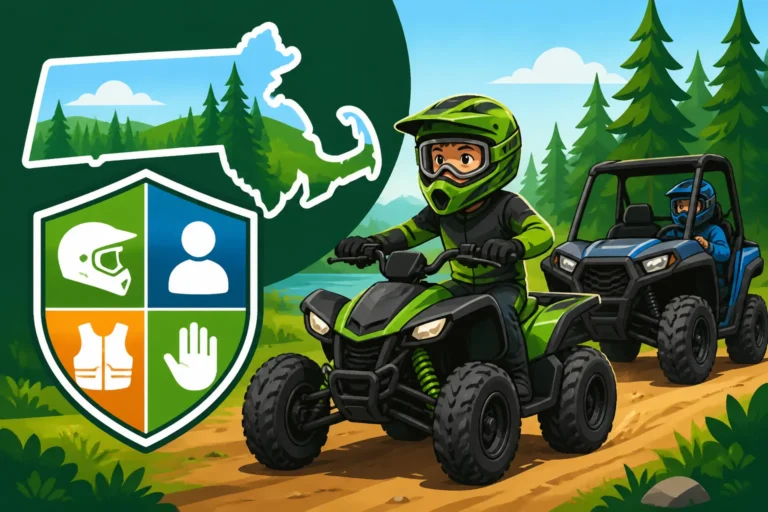
In Massachusetts, a skills test is part of the safety training process for riders who must earn an off-highway vehicle safety certificate. It is not an ATV or UTV registration test, a road-driving exam, or permission to ride on any trail you choose. Its purpose is to assess whether a rider can handle the machine safely in the practical setting provided by the course.
The course has more than one part. Riders should expect safety instruction as well as practical assessment, though the specific course format, scheduling, and test arrangements should be confirmed with the provider or course organizer. The practical component is commonly described as an in-person skills test. The broader two-part process is explained in Massachusetts Two-Part Safety Course, and [Massachusetts Skills Test Requirements] is a useful companion when checking what participation involves.
This distinction matters because passing a practical test does not replace the other course requirements. A rider may need to complete the required instruction and attend the in-person session as well as demonstrate basic machine control. Ask the course provider what must be completed before the test and whether any online work, registration, or confirmation is required in advance. For the full certificate process, see How to Get a Massachusetts Safety Certificate.
The test is also separate from the machine’s registration. A safety certificate does not register an ATV or UTV, and registration does not prove that a rider has completed required safety training. Riders should check both obligations independently. Massachusetts Requires Its Own Registration covers the registration issue, while Riders Under 18 Must Carry the Certificate explains the certificate-carrying requirement for young riders.
| Item | What it means | What it does not do |
|---|---|---|
| Safety instruction | Teaches safe operation and responsible riding | Does not register the machine |
| Skills test | Assesses practical riding ability in the course setting | Does not grant access to every trail or property |
| Safety certificate | Documents successful completion of required training | Does not replace registration or landowner permission |
| Registration | Identifies the machine under Massachusetts requirements | Does not prove the rider passed a skills test |
Riders should also avoid assuming that a certificate from another state automatically satisfies Massachusetts requirements. Massachusetts has its own rules for visiting riders and out-of-state machines. Check Massachusetts Has No Reciprocity for Visitors before traveling with an out-of-state certificate or sticker.
What the Test Is Designed to Assess
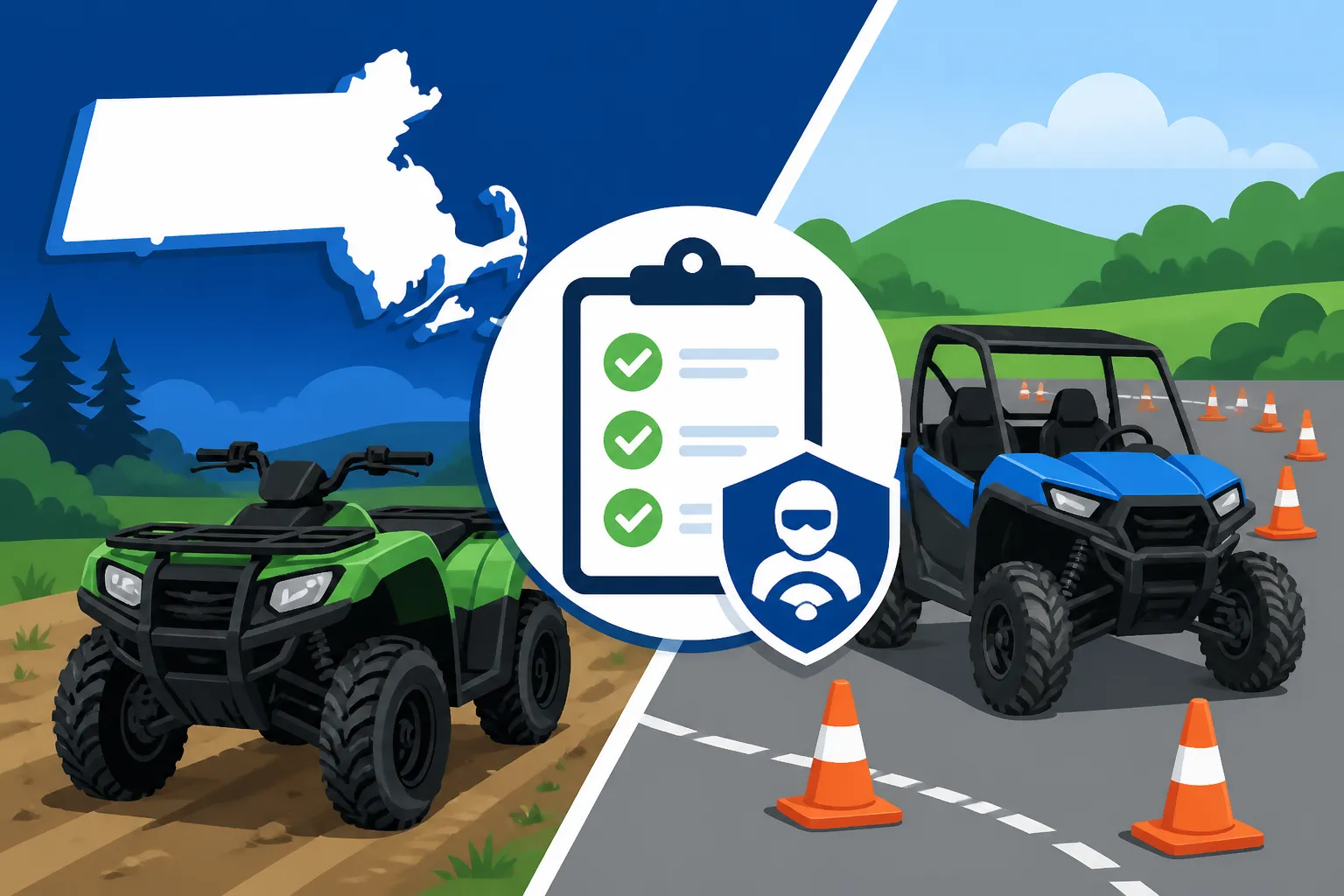
A practical skills test is meant to check whether the rider can control the machine and make safe choices during basic riding tasks. The exact exercises can depend on the course, the equipment, the instructor, and the conditions on the day. Treat any sample list as a way to prepare—not as a promise that every course will use the same test layout.
A rider may be asked to demonstrate some combination of these abilities:
- Identify and use the main controls correctly.
- Start, move, and stop in a controlled manner.
- Maintain a suitable speed for the exercise.
- Steer through turns without losing control.
- Keep a stable riding position and balanced posture.
- Look ahead and respond to directions or obstacles.
- Follow instructions and keep a safe distance from others.
- Bring the machine to a controlled stop when asked.
These are basic examples of what practical instruction and assessment may focus on. The course organizer is the best source for the actual test format, required equipment, and any practice or arrival instructions. The article What Riders Have to Do on the Skills Test can help you think through the practical side, but it should not replace the course’s own directions.
The test is about safe, deliberate control—not speed or aggressive riding. A rider who can accelerate quickly but struggles to stop smoothly or follow directions is not showing the kind of control the assessment is intended to build. On the other hand, a slow, careful approach is not automatically a problem. Riders should focus on completing each instruction accurately, maintaining awareness, and asking for clarification if they do not understand what the instructor wants.
The machine itself can affect how a rider performs. An ATV and a side-by-side have different controls, seating arrangements, and handling characteristics. If the course specifies a particular machine or equipment setup, follow those instructions. Don’t assume that a test on one type of vehicle automatically confirms competence on every other type. For vehicle-specific rules, see Massachusetts Rules for a Side-by-Side Driver.
Some useful ways to prepare are simple:
- Review the course instructions. Confirm what to bring, what clothing is expected, and whether you must complete other course work first.
- Learn the controls on the machine you will use. Know how it starts, stops, steers, and responds before attempting a maneuver.
- Practice only where you have permission. Use a legal, controlled area with enough open space, and avoid practicing on public roads or land where riding is not allowed.
- Work on smooth starts, turns, and stops. Keep the pace modest and concentrate on predictable control rather than speed.
- Ask the instructor about anything unclear. A test is a poor time to guess at an instruction or try a maneuver you have not been told to perform.
If you practice on private land, make sure the owner has allowed it and that the location is appropriate for riding. A test does not change where Massachusetts law permits an ATV or UTV to operate. The rules on property access and permission are covered in [Massachusetts Landowner Permission Forms].
Who Needs to Take the Test and What Age Rules Matter
The skills test is tied to the safety course and certificate requirements—not to every rider in every situation in exactly the same way. In Massachusetts, age affects what training and supervision rules apply. A family arranging a course for a young rider should verify the rider’s age category and the current course instructions before booking.
For younger participants, parent or guardian attendance may be required as part of the training process. The age rules and parent attendance details are not something to infer from a general test description. See Parents Must Attend With Students Under 16 and confirm the requirement with the course organizer when registering. A parent attending the course should also understand that completing the training does not remove the adult’s responsibility to supervise a young rider as required by law.
There are additional age-related limits on riding itself. A safety certificate is not an exception to those limits, nor does passing the skills test make an otherwise prohibited ride lawful. Massachusetts’ youth rules can include restrictions on age, engine size, supervision, and where a rider may operate. Review Massachusetts Rules for Young Riders on Public Land and Massachusetts ATV Age Requirements for the riding rules that apply beyond the course.
| Rider situation | What to check before the course | Why it matters |
|---|---|---|
| Rider under 18 | Whether a safety certificate and practical test are required, and what documents to carry | Youth training and certificate rules apply separately from registration |
| Student under 16 | Whether a parent or guardian must attend and participate | Attendance requirements may affect course eligibility |
| Visiting rider | Whether a Massachusetts course or certificate is required | An out-of-state document may not satisfy Massachusetts requirements |
| Rider changing vehicle types | Whether the course equipment and practice apply to the machine they intend to ride | Control and handling differ between vehicle types |
Parents should avoid treating course completion as an all-clear for unsupervised riding. The rider still needs to follow age restrictions, helmet and equipment requirements, land-access rules, and any applicable supervision conditions. A course certificate is evidence of training; it does not expand a rider’s legal privileges.
There is also a practical reason to check eligibility before paying or traveling to a course: a rider who arrives without the required adult, paperwork, or prior course completion may not be able to participate as expected. Ask in advance whether the rider’s age changes registration, attendance, test, or certificate procedures. For detailed information about youth training, Massachusetts Safety Certificates Under 18 is another relevant resource.
How to Prepare, What to Bring, and What to Ask
Good preparation is mostly about avoiding preventable surprises. Course schedules and requirements can vary, so use the course organizer’s current directions rather than relying on an old post or another rider’s recollection.
Start with the schedule. Confirm the location, arrival time, registration process, and whether the practical skills portion is conducted at the same session as the classroom instruction. Ask whether any online component must be completed first and how completion is recorded. Course dates may be limited or seasonal, so check Massachusetts Course Schedule Lookups before arranging travel.
Before the course, ask the organizer:
- Is the skills test included in this session, or scheduled separately?
- Does the rider need to complete online instruction first?
- Is there a particular ATV or UTV type the rider must bring or use?
- What clothing, footwear, helmet, and other protective equipment are required?
- Does a parent or guardian need to attend?
- What should the rider do if weather or surface conditions change?
- How will the organizer communicate whether the rider completed the course?
- What is the process if the rider needs extra instruction or does not pass on the first attempt?
Do not assume that every course supplies the machine, protective equipment, or practice time. Get a clear answer before showing up. If the rider must bring a machine, confirm the acceptable type and condition. It should be mechanically sound, with controls that work properly. A problem with the machine can interfere with safe participation even when the rider is prepared.
A simple pre-course check can include:
- Tires inflated and in usable condition.
- Brakes functioning as expected.
- Throttle returning properly.
- Steering operating without obvious binding or damage.
- No visible leaks or loose parts that could make riding unsafe.
- Fuel and battery condition suitable for the session.
This is not a substitute for a professional inspection if the machine has a known defect. If a control is sticking, the brakes feel unreliable, or the machine has a serious mechanical issue, resolve it before attempting a practical exercise. The test is not the place to discover a safety problem.
Protective gear should match the organizer’s instructions and the riding conditions. Massachusetts has helmet requirements, and a course may also specify appropriate clothing and footwear. Confirm the expected standard rather than assuming that any helmet or casual footwear will be accepted. See Massachusetts ATV Helmet Law for the legal helmet context.
For independent practice, choose a controlled location where riding is permitted and where the surface is appropriate. If you want to mark a simple turning path, a few cones from a local hardware store or Amazon can make the layout easier to see, but the cones do not make an otherwise prohibited location legal. Practice slowly, keep bystanders clear, and do not create a course that encourages high-speed turns or abrupt maneuvers.
Avoid trying to imitate a test video or a friend’s course from memory. The test may differ, and unnecessary practice on unfamiliar obstacles can increase risk. Basic control, listening carefully, and following the instructor’s directions are more useful than rehearsing a specific sequence that may not appear.
If a Rider Is Nervous
Nervousness is common, especially for a young rider or someone who has not operated the machine before. It helps to separate the test into small actions: listen to the instruction, check the direction, move at a manageable speed, and stop when directed. If something is unclear, ask before proceeding.
Riders should not hide inexperience from the instructor. The point of training is to teach and assess safe operation, not to reward bravado. If the rider is not comfortable with a maneuver, say so and ask what to do next. A careful question is better than attempting an instruction that was misunderstood.
If the rider does not complete a maneuver successfully, ask what the next step is. The organizer can explain whether additional practice, another attempt, or a new session is available. Do not assume the certificate will be issued automatically just because the rider attended. Confirm how successful completion is recorded and how the rider receives proof.
After the Test: Certificates, Registration, and Riding Access
Passing the skills test is one step toward completing the safety course. It is not, by itself, the certificate, a registration, a trail permit, or permission from a landowner. Make sure the entire course requirement is complete and ask how the certificate is delivered or recorded. The process for obtaining proof after training is described in Getting the Certificate After Both Parts Are Done.
Young riders should know when they must carry their certificate and where it must be available. Keep the document in the form accepted by the applicable rules, and check that the rider can produce it when required. A photograph on a phone may be convenient, but do not assume it is an accepted substitute for the required certificate unless the relevant authority confirms that format.
The machine also needs to satisfy its own obligations. Registration and decal rules are separate from rider training. A newly trained rider should not head to a trailhead assuming that the certificate covers the machine. Check the registration status and display requirements before riding. The Registration Card You Must Carry in Massachusetts and Massachusetts Decal Placement Rules address two different pieces of that preparation.
Finally, legal registration does not guarantee that a particular trail or parcel is open to ATVs or UTVs. Access depends on the land and the rules that apply there. A state forest, private riding area, town property, and private woodlot may each have different access conditions. Confirm that the location allows the type of machine you plan to use and that any required permission or permit is in hand. For an overview, see Massachusetts Registration and Trail Access.
Before the first ride after the course, use this checklist:
- Confirm the rider completed every required part of the safety course.
- Confirm how the certificate is issued and how the rider must carry it.
- Check that the ATV or UTV is properly registered and displays its decals as required.
- Review age, supervision, helmet, and equipment rules for the rider.
- Confirm that the specific trail or property is open to that machine.
- Obtain any required landowner permission or local permit.
- Check current conditions and closures before towing to the riding area.
That separation—rider training, machine registration, and location access—helps avoid a common mistake: assuming one approval covers all three. The skills test is valuable because it checks basic operation and reinforces safe habits, but it is only one part of responsible riding in Massachusetts.
Frequently Asked Questions
Is the Massachusetts ATV skills test the same as a road test?
No. It is a practical assessment associated with off-highway vehicle safety training, not a driver’s-license road test. It does not authorize riding on public roads.
Does passing the test automatically register an ATV or UTV?
No. Rider training and machine registration are separate requirements. Check the vehicle’s registration and decal status independently.
Does every course use the same skills test?
Do not assume so. The test format and logistics may depend on the course. Ask the organizer what exercises, equipment, and attendance requirements apply to the session you plan to attend.
Does a visiting rider’s home-state certificate automatically count in Massachusetts?
Do not rely on that assumption. Massachusetts has its own rules for visiting riders. Confirm the current requirement before riding in the state.
What if a rider is not ready to complete a maneuver?
The rider should stop and ask the instructor for clarification or guidance. Ask the organizer what happens if the rider needs more practice or does not pass during the scheduled session.
Disclaimer
This article is for general informational purposes only and does not constitute professional advice. Laws, prices and regulations vary by location and change over time. Consult a qualified professional for guidance on your specific situation.