Massachusetts Trails Within Two Hours of Boston
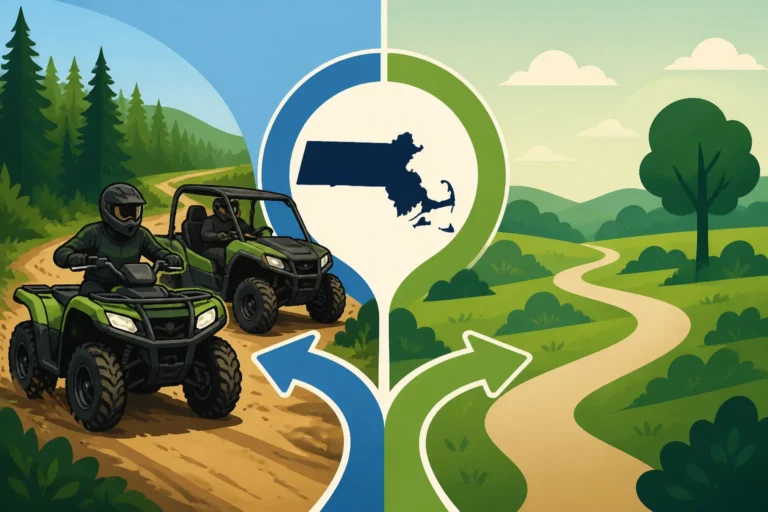
Finding a legal ATV or UTV trail within two hours of Boston can be frustrating: many trails shown on maps are not open to four-wheelers, and some nearby off-road areas are motorcycle-only. This guide explains what’s realistically close, which popular options fall outside the drive-time window, and how to check access before loading up.
What to expect near Boston
Public ATV and UTV riding is limited in eastern Massachusetts
Massachusetts has relatively few public places where recreational ATV and UTV riding is allowed. A trail that looks wide enough, appears on a map, or has tire tracks on it is not automatically open to OHVs. Access depends on the landowner and the rules for that particular property.
That distinction matters around Boston, where wooded conservation land, rail trails, utility corridors, and dirt roads can look tempting from a vehicle or a map. They may be closed to motorized recreation, reserved for other uses, or subject to local restrictions. Before riding, confirm that the specific property allows your type of machine—not just motorcycles or dirt bikes, but the ATV or UTV you plan to bring.
For a broader overview of the area’s limited legal riding network, see [Massachusetts ATV Trails: Three Berkshire Forests]. Those public riding areas are concentrated well west of Boston, rather than in the eastern part of the state.
“Within two hours” depends on more than mileage
A destination that seems close on a map may take longer to reach once you account for Boston traffic, the day of the week, the time you leave, and the final stretch on local roads. A two-hour estimate is best treated as a planning target, not a guarantee.
It also helps to separate three different kinds of destination:
| Destination type | What it may offer | What to confirm before leaving |
|---|---|---|
| Public OHV trail system | Designated riding routes on public land | Whether ATVs or UTVs are allowed, seasonal dates, closures, permits, parking |
| Private riding facility | A managed riding area with facility-specific rules | Vehicle types, admission and reservation rules, age limits, noise requirements |
| Ordinary forest road or trail | A route that may look rideable on a map | Whether motorized use is explicitly permitted |
If you’re comparing routes, a mapping tool such as onX Offroad can help you understand the area and plan a drive. Treat any map as a starting point, though—not proof that a trail is open, legal, or suitable for your machine. Verify access with the land manager or facility before towing several hours.
Nearby options and common mix-ups
Freetown-Fall River is not a general ATV destination
Freetown-Fall River State Forest is a name Boston-area riders may encounter when searching for off-road riding. It is important not to assume that a state forest with designated motorized trails automatically accepts ATVs or UTVs. The riding opportunity associated with Freetown-Fall River is motorcycle-focused, so it is not a substitute for an ATV or side-by-side trail system.
This is an easy mistake to make when search results use broad terms like “off-road,” “OHV,” or “motorcycle trail.” Those labels can refer to different vehicle types. A narrow single-track route intended for dirt bikes is not appropriate for a full-size quad or side-by-side, even if the trail appears on a general-purpose map.
Before heading there, check the current rules and the exact vehicle category allowed. For more context, read [Freetown-Fall River's Motorcycle Trails in Massachusetts] and [Massachusetts Single Track in the East]. If your vehicle is an ATV or UTV, do not count the destination as a legal riding option unless the managing authority explicitly confirms that your machine is permitted.
The Berkshire forests are the main public-trail draw, but often exceed the window
Beartown State Forest, October Mountain State Forest, and Pittsfield State Forest are the best-known public OHV riding areas in Massachusetts. They are in the Berkshires, west of Boston, and commonly require more than a two-hour drive depending on traffic, your starting point, and the trailhead you choose.
They may still make sense for a full-day outing or a weekend trip, but they are not dependable “quick ride after breakfast” destinations from Boston. Before committing, check the relevant forest’s access rules, riding season, parking arrangements, and trail conditions. A route may be closed because of weather, maintenance, or seasonal restrictions, and road access to a trailhead can affect the trip too.
For details on individual areas, start with [Beartown State Forest Riding in Massachusetts], [October Mountain State Forest Riding in Massachusetts], and [Pittsfield State Forest Riding in Massachusetts]. If the drive is already a stretch, planning a full day—or staying nearby—can make the trip feel less rushed. [Massachusetts Camping Near Riding Areas] offers a useful next step for riders considering an overnight visit.
Tolland and other motorcycle trails may not fit ATV plans
Tolland State Forest is another place riders may see mentioned in Massachusetts off-road discussions. Its motorized riding access is associated with street-legal motorcycles, not a general invitation for ATVs and UTVs. The same basic caution applies to other trails advertised for motorcycles: check the vehicle rules rather than assuming that “motorized” means every off-road machine is allowed.
This is especially important for side-by-sides, which can be too wide for narrow routes and may be excluded even where smaller machines are allowed. A UTV’s width, turning radius, and weight can make a trail unsuitable regardless of whether the machine is registered. See [Tolland's Street-Legal Trails in Massachusetts] and [Massachusetts Trails That Allow Side-by-Sides] when checking whether a location matches your vehicle.
How to find a legal ride within two hours
Start with the vehicle and the land manager
Before searching for directions, write down the basics of your planned ride: ATV or UTV, approximate width, whether the vehicle is street-legal, and who will be riding. Then look for destinations whose rules explicitly match that vehicle type. “Off-road access” alone is too vague to make a safe decision.
For public land, look for the managing agency’s current riding rules and contact the office responsible for the specific property if anything is unclear. For a private facility, check its own rules and ask directly about your machine. A location may allow dirt bikes but not quads, or smaller ATVs but not side-by-sides. Ask about access dates, reservations, sound requirements, safety equipment, and whether the trails are open to visitors.
You can use onX Offroad to help organize possible routes and estimate a trip, but confirm the land-use rules separately. A mapped track can be an old route, a private road, or a trail closed to your vehicle. A map app helps with navigation; it does not grant permission.
Verify the full trip, not just the trail
A riding day can fall apart before you reach the trailhead if the parking lot is closed, the access road is unsuitable for a trailer, or the facility does not accept your vehicle. Confirm the details that affect your entire group, especially if you’re towing a larger UTV or bringing young riders.
Use this checklist before setting out:
- Confirm the vehicle category. Ask whether the area permits ATVs, UTVs, dirt bikes, or only a subset of those.
- Check current access. Verify operating dates, temporary closures, weather-related restrictions, and any required permit.
- Ask about trailer parking. A trail may be open while the available lot is too small or unsuitable for a truck and trailer.
- Review rider requirements. Check helmet, age, supervision, safety-course, registration, and equipment rules that apply to your ride.
- Confirm land permission. A forest road, private woodlot, or informal path is not open simply because it is accessible.
- Save the facility’s contact details. If the entrance is unclear or a closure sign is posted, having the right office number can prevent a wasted trip.
Massachusetts has specific requirements for young riders, so check [Massachusetts Rules for Young Riders on Public Land] if children or teens are coming along. Also review [Massachusetts Requires Its Own Registration] before bringing an out-of-state machine. A valid registration from another state does not necessarily satisfy Massachusetts requirements.
Use map apps as planning tools, not permission slips
A mapping app can help you compare driving routes, identify nearby services, and keep track of a destination once you have confirmed that riding is allowed. onX Offroad may be useful for organizing a route and reviewing mapped land information, but map layers should not replace direct confirmation with a land manager.
When you review a route, look for clues that it may not fit your ride: narrow single-track lines, road crossings, private-property boundaries, seasonal gates, or a trail description that specifies motorcycles. If a UTV is involved, pay particular attention to trail width and restrictions on vehicle size. Even an ATV-friendly area may not be suitable for every side-by-side.
It’s also smart to keep a backup plan. If the destination’s official page or office reports a closure, don’t assume nearby unmarked trails are an acceptable substitute. Choose another confirmed riding facility or reschedule. That small check can spare you a long tow, a frustrating arrival, and the risk of riding somewhere you don’t have permission to be.
Planning a Boston-area ride without a wasted drive
Set expectations about travel time
For riders starting in Boston, the closest result in a search is not always the closest legal ATV or UTV destination. Some nearby motorized areas are intended for motorcycles, while the main public ATV riding areas are farther west. Private facilities may offer other possibilities, but their vehicle rules and public access can change, so confirm before making plans.
Build your schedule around the actual trailhead or facility entrance, not just the town name. If a route takes you through busy roads or requires a trailer, allow extra time for fuel, stops, and parking. Use onX Offroad or another navigation tool to plan the drive, then check the facility’s directions and access information directly.
Make the destination work as a day trip or weekend
If a confirmed riding area is farther than you hoped, a weekend plan can make the drive worthwhile. Check lodging and camping options, confirm whether overnight parking is permitted, and keep the machine secured when it is not in use. A nearby campsite does not automatically allow riding from the campground to the trail, so follow the facility’s instructions for transporting your machine.
For a shorter outing, focus first on finding a private facility that explicitly accepts your ATV or UTV and is within your practical driving range. Call before you load up, especially if you have a wide side-by-side, a youth machine, or a group with mixed vehicle types. Ask the staff to confirm the exact machine category and any restrictions that could affect your visit.
The main takeaway for Boston-area riders is simple: verify the vehicle and the land before you go. Massachusetts has legal off-road riding opportunities, but nearby trails are not interchangeable, and many familiar “off-road” destinations are motorcycle-only or outside a realistic two-hour drive. A quick confirmation can save you from spending the day towing to a trail you cannot use.
Disclaimer
This article is for general informational purposes only and does not constitute professional advice. Laws, prices and regulations vary by location and change over time. Consult a qualified professional for guidance on your specific situation.