Environmental Police Trainers Run the In-Person Session
Getting an ATV or UTV safety certificate in Massachusetts involves more than completing material online. Riders also need to understand what the in-person session with Environmental Police trainers is for, what to bring, and how it fits into the full course. Knowing what to expect makes it easier to arrive prepared and finish the required steps.
What the in-person session is for
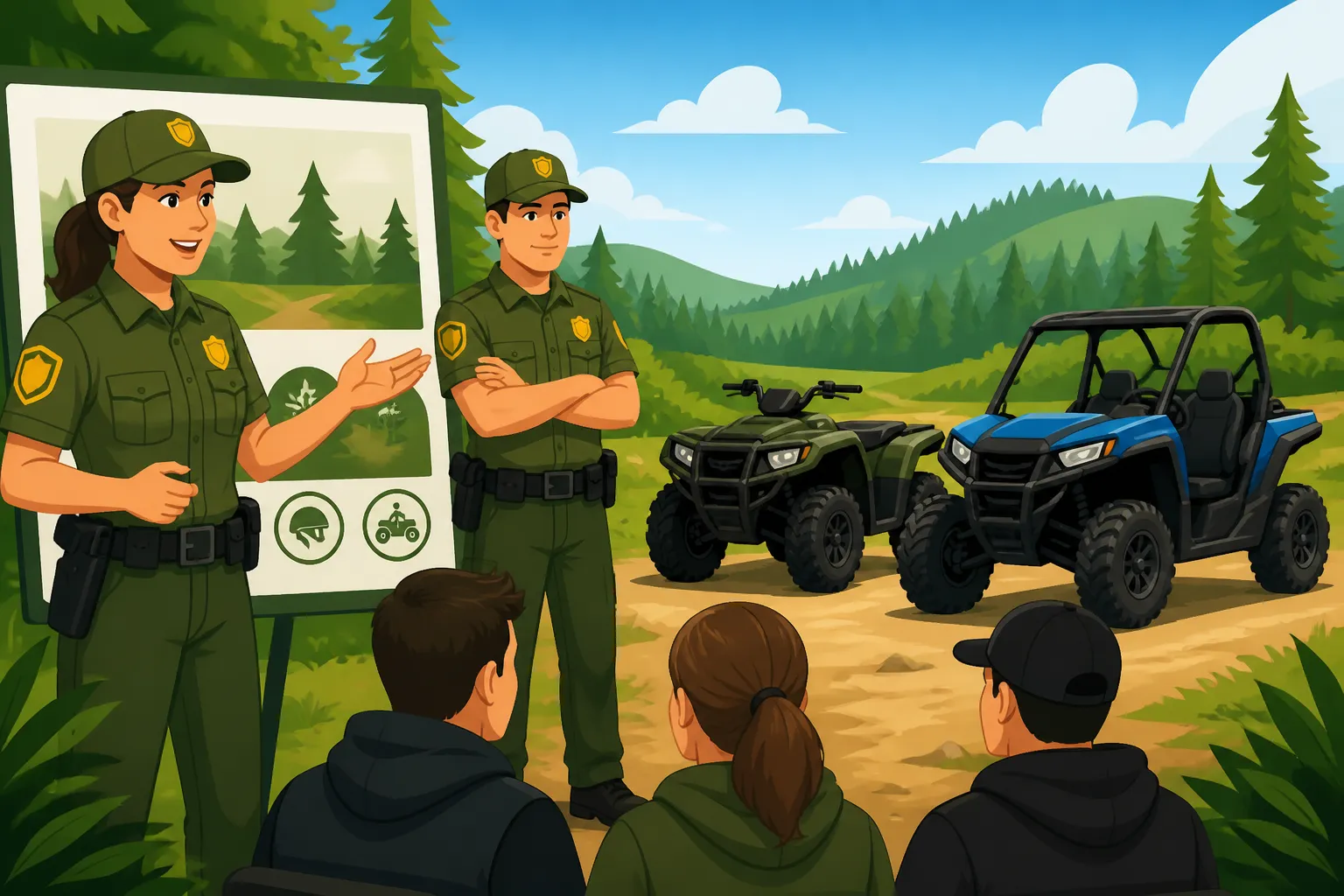
The in-person session is the practical, instructor-led part of Massachusetts’s two-part OHV safety course. Environmental Police trainers lead this portion, giving students a chance to work with instructors rather than relying only on online lessons. The course structure is described in Massachusetts Two-Part Safety Course.
The online portion can cover information that riders need to understand, but it cannot fully replace live instruction and a skills assessment. At the in-person session, students can ask questions, hear safety concepts explained in context, and demonstrate skills as directed. This is especially useful for young or new riders who may not yet know how to translate written guidance into safe habits around a machine.
It helps to think of the course as a sequence rather than a single class:
- Complete the assigned online material, if it is required for the course you are taking.
- Attend the scheduled in-person session led by Environmental Police trainers.
- Take part in the practical instruction and skills evaluation required for your course.
- Confirm that both parts have been recorded as complete and find out how to access or carry your certificate.
The precise arrangement, scheduling process, and instructions may vary. Follow the directions provided by the course administrator, and check current information through the official Massachusetts safety course channels before traveling. Do not assume that finishing an online module alone means you have completed the full course.
The practical session is not a substitute for vehicle registration, permission to ride, or compliance with age and operating rules. A safety certificate addresses training; it does not make every trail or parcel open to riding. Before a trip, review both Massachusetts Requires Its Own Registration and the applicable land-access rules.
What students may do with the trainers
The in-person portion combines instruction with hands-on evaluation. A trainer may explain safe procedures, demonstrate a task, and then ask a student to perform or describe it. The exact activities depend on the course plan and the student’s situation, so it is better to prepare for a practical learning session than to expect one fixed script.
Skills instruction may involve basic control and safe handling concepts. Students might be asked to show that they can respond appropriately to directions, operate controls in a controlled setting, or follow a safe procedure demonstrated by the trainer. The trainer is there to teach and assess; the goal is not to encourage speed or show off riding ability.
The evaluation is an important distinction. Attending is not necessarily the same as passing or completing the session. Students need to participate, follow instructions, and satisfy the course’s practical requirements. The details are covered in Massachusetts In-Person Skills Test, but the course provider’s current directions are the authority on what a particular student must do.
| Course component | What it is for | What the student should do |
|---|---|---|
| Online learning | Covers course information that can be studied before the in-person date | Complete the assigned material and keep any completion confirmation |
| Trainer-led session | Provides live instruction and a chance to ask questions | Arrive on time, listen closely, and take part |
| Practical skills assessment | Lets the instructor evaluate the required skills | Follow each direction and ask for clarification when needed |
| Certificate follow-up | Confirms that course requirements have been recorded | Check how and when the certificate becomes available |
A student who is nervous about the practical part should say so. Trainers can clarify directions and explain what the student is expected to do. Guessing at an instruction is less safe than asking for it to be repeated.
If a student does not understand a demonstration, it is reasonable to ask a question before trying the skill. If a student cannot complete an activity, the right next step is to ask the trainer what options or follow-up steps apply. Do not assume a student has passed simply because the session ended. Confirm completion using the process the course administrator provides.
The session is also a useful time to ask about responsibilities beyond the machine itself. For example, riders should understand that having a certificate does not grant permission to ride on another person’s land. It does not replace required registration, and it does not override restrictions on where and when a machine may be used.
How to prepare for the session
Preparation starts with the course instructions, not a guess about what the class will require. Read the confirmation carefully and check the date, location, arrival time, any prerequisites, and any equipment or clothing directions. If instructions are unclear, contact the course administrator before the session.
Use this checklist as a starting point:
- Confirm prerequisites. Find out whether the online portion must be completed before attending and whether you need to bring proof of completion.
- Check the student’s eligibility and course details. Make sure the student is enrolled in the right course and that the registration information is accurate.
- Plan transportation and arrival. Leave enough time to park, check in, and get oriented. A late arrival may mean missing instruction or being unable to participate.
- Follow clothing and equipment directions. Wear practical clothing and footwear suited to the session. Bring protective equipment only as directed; do not assume a machine or gear will be supplied.
- Bring required documents. Check whether the course asks for identification, parental paperwork, or other forms.
- Tell the trainer about relevant concerns. If a student has a question about a physical task, prior experience, or an instruction, raise it before the assessment begins.
- Keep the confirmation. Save the course email or other confirmation until the certificate and completion status are resolved.
Parents and guardians should pay particular attention to attendance rules. The course requirements for a student under 16 may include a parent’s participation, so confirm the details before booking. See Parents Must Attend With Students Under 16 and do not rely on another family’s experience as a substitute for the current instructions.
It is also worth preparing the student for the tone of the session. The trainer is not there to test whether a child can ride aggressively or perform advanced maneuvers. The purpose is safe operation and learning. Encourage the student to listen, ask questions, and take the time needed to understand each direction.
Do not bring a personal ATV or UTV unless the course instructions specifically say to do so. The session format and equipment arrangements can differ. Showing up with a machine without permission could create a safety or logistical problem. If personal equipment is required, verify the requirements in advance, including whether the machine must meet any particular condition.
If the student is under 18
Age matters in Massachusetts OHV rules, and training requirements should be considered alongside the rules that apply to the rider’s age. Review Massachusetts Safety Certificates Under 18 and Massachusetts Rules for Young Riders on Public Land rather than assuming one course requirement covers every situation.
A parent or guardian should check the course’s attendance instructions and the riding rules before the student operates a machine. Some rules depend on age and where the riding takes place. A student who has completed training may still face restrictions on the machine they can ride, supervision, or access to a particular area.
The certificate is evidence of training, not a general permission slip. Keep the distinction clear when planning rides, especially for a young rider.
What the session does not do
Because the in-person session is an important part of the course, it is easy to overestimate what the certificate allows. Training does not automatically authorize a rider to use every public or private trail. Access depends on the place, its rules, and any required permission or permit.
It also does not replace Massachusetts registration. A machine may need its own state registration even when the rider has completed the safety course. Massachusetts does not treat an out-of-state sticker as a universal substitute for its own registration requirements. For a visiting rider, check [Massachusetts Stickers for a Visiting Machine] before planning a ride.
The course does not turn an off-road machine into a road-legal vehicle. Nor does it guarantee that a particular state forest is open to ATVs or UTVs. Trail access, permitted machine types, closures, parking arrangements, and seasonal rules are separate questions. Check the specific riding location before loading up.
| The certificate can help establish | The certificate does not automatically provide |
|---|---|
| Completion of required safety training | Registration for the ATV or UTV |
| Completion of the course’s practical component | Permission to ride on private land |
| A record of training for situations where it is required | Access to a closed or restricted trail |
| Knowledge of safe operating practices | A road-use license or street-legal status |
| A course credential to carry when required | Exemption from age, supervision, or equipment rules |
A certificate is only useful if the rider can produce it when required. Find out how the course makes the certificate available, whether a physical or digital copy is appropriate, and when the student must carry it. The details are explained in Massachusetts Certificates Carried on Public Land.
Keep the certificate accessible and in good condition. If it is issued electronically, save it somewhere the rider or responsible adult can retrieve it without relying on a weak cell signal at a trailhead. If the certificate has not appeared after the course, contact the course administrator rather than assuming that attendance has been recorded correctly.
Before riding, also check that the machine’s registration card and other required documents are available. Training and registration are separate obligations. The Registration Card You Must Carry in Massachusetts covers the registration-document issue.
Scheduling, completion, and common problems
Course availability can change with the season and location. Some dates may fill, and travel to an in-person session may take planning. Check the current schedule early, especially if training is needed before a particular riding period. The course listing process is covered in Massachusetts Course Schedule Lookups.
When choosing a session, make sure it works for the student and any parent or guardian who must attend. Do not book based only on the first available date if the family cannot arrive on time or meet the participation requirements. A missed session can delay completion and may mean finding another date.
Common problems are usually preventable:
- Assuming the online portion is the whole course. Verify whether the student still needs to attend the trainer-led session and complete the practical assessment.
- Arriving without required preparation. Read the confirmation and bring the documents or equipment it requests.
- Confusing attendance with successful completion. Ask how the course records completion and how to confirm that the certificate is ready.
- Overlooking a parent requirement. Check the rule for the student’s age before registering.
- Treating the certificate as a riding permit. Check registration, landowner permission, trail access, and age restrictions separately.
- Waiting until the last minute. Allow time to find a suitable date and resolve any registration or documentation issue before the intended ride.
If the student needs to reschedule or cannot complete a skill, contact the course administrator for the next step. Policies and make-up options can differ, so do not rely on assumptions about another course or instructor.
Once the course is complete, keep a simple record: the student’s name as enrolled, the completion confirmation, and the instructions for retrieving the certificate. If the name or other information appears incorrect, ask how to correct it promptly. A mismatch between the student’s records and certificate can be inconvenient when proof is needed.
Finally, review riding rules close to the planned trip. A safety course is one part of responsible riding, but local trail access and operating requirements can change. Check the current rules for the specific forest, park, or private property, and confirm that the machine itself is registered and allowed there.
Frequently Asked Questions
Do Environmental Police trainers run the whole safety course?
They lead the in-person portion of the course. The overall process may include separate online learning and practical requirements, so check the course instructions to confirm every required step.
Is attending the in-person session enough to receive a certificate?
Not necessarily. Students must complete the course requirements, which may include an assessment. Confirm completion and certificate availability with the course administrator.
Should I bring my own ATV or UTV?
Only if the course instructions specifically require or permit it. Check with the administrator before bringing a machine or equipment.
Does the safety certificate let me ride on any Massachusetts trail?
No. The certificate does not replace machine registration, landowner permission, age rules, or trail-specific access requirements.
What should a parent do before a child’s session?
Check the attendance and paperwork requirements for the child’s age, confirm the session details, and review the riding rules that apply to the intended location.
Disclaimer
This article is for general informational purposes only and does not constitute professional advice. Laws, prices and regulations vary by location and change over time. Consult a qualified professional for guidance on your specific situation.