Massachusetts Safety Certificates Under 18
A teenager can finish an ATV safety course and still be too young to ride a particular machine or use a particular trail. That distinction is easy to miss when you are juggling class schedules, parent attendance, equipment, and registration. This guide explains how Massachusetts safety certificates work for riders under 18, what the course involves, and what the certificate does—and does not—allow.
What a Massachusetts ATV safety certificate means
The certificate confirms safety training, not riding permission
A Massachusetts OHV safety certificate is proof that a rider completed the required safety education. For a rider under 18, it is an important piece of preparation before operating an ATV, UTV, dirt bike, or other covered off-highway vehicle where the rules require the certificate.
It is not a license to ride anywhere. It does not give a young rider permission to operate a machine that is prohibited for their age, ride on land without permission, use a closed trail, or take an off-road vehicle onto a public way. Think of it as one requirement in a larger set, not as a pass that overrides the rest of Massachusetts law.
That distinction matters in real life. A 15-year-old might complete the course, carry the certificate, and still need to meet the rules that apply to the rider’s age, the machine’s engine size, the setting, and adult supervision. The family still needs to check each of those pieces before planning a ride.
Who should expect to need one
The certificate rules are especially important for riders under 18 using public land. A rider should not assume that being accompanied by a parent, having ridden for years, or holding a safety card from another state automatically satisfies Massachusetts requirements. Massachusetts has its own OHV registration and safety requirements, and a home-state sticker or course card may not substitute for them.
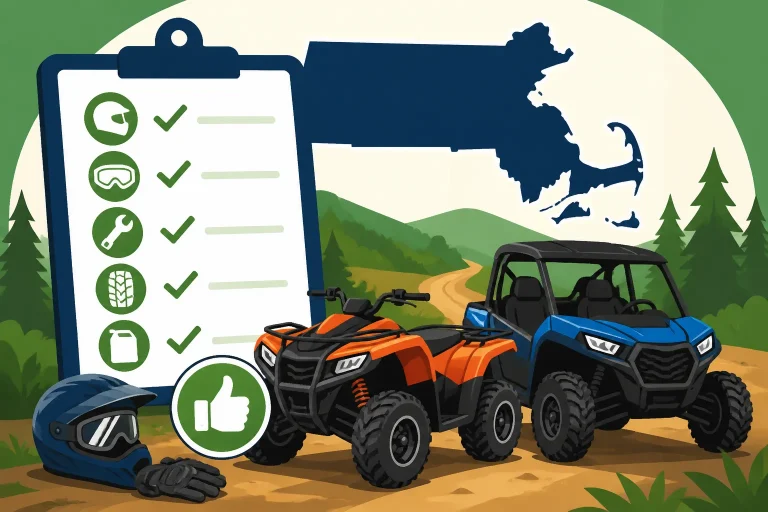
A practical first step is to make a short checklist for the intended ride: rider’s age, machine type and engine size, location, supervision, registration, and certificate. If the ride will be on public land, check the applicable rules for both the site and the rider. The certificate requirement is only one part of that check.
For a broader look at the education requirement, see How to Get a Massachusetts Safety Certificate. If you are trying to distinguish course completion from the rider’s age limits, Massachusetts Certificate Rules Under 16 and Massachusetts Certificate Rules at 16 and 17 address those age-specific questions.
Why families should verify the course requirement before riding
Parents and guardians often discover that “the kid has a certificate” is not the end of the conversation. The certificate may satisfy a training requirement, but it does not prove that the machine is appropriate, that the child can ride in that location, or that the required adult supervision is present.
It helps to ask the exact question for the planned activity rather than a broad one. For instance: “Can this 15-year-old operate this machine on this public trail with this supervising adult?” That is more useful than asking only whether a safety certificate is required.
If the answer depends on details, write them down before you leave home. A quick check can prevent a frustrating trip to a trailhead where a family learns that a rider’s age, machine, certificate, registration, or site rules do not line up.
How the Massachusetts course works
Expect a course with more than one component
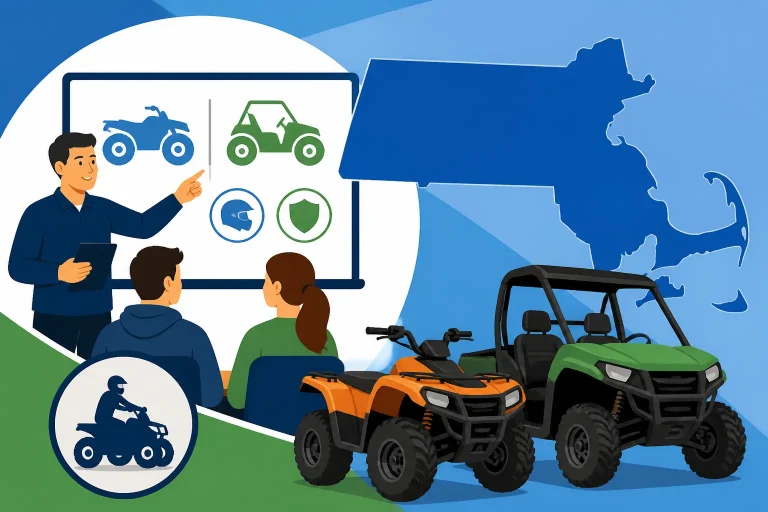
Massachusetts describes the OHV safety course as a two-part process. Riders should be prepared for online learning as well as an in-person component, which may include classroom instruction and practical skills work. The course is intended to cover safe decision-making and responsible operation, not just a few rules to memorize.
The online portion can be convenient for families fitting training around school, work, and other activities. It is still worth treating it as a real course rather than something to rush through in the background. A young rider should understand topics such as speed control, terrain, safe stopping, visibility, protective gear, and how to respond when trail conditions change.
The in-person portion gives riders a chance to engage with instructors and demonstrate practical understanding. Check the course details carefully before enrolling so you know what must be completed first and what the rider needs to bring. The structure and available sessions can be reviewed through Massachusetts Two-Part Safety Course and Massachusetts In-Person Skills Test.
Plan for the practical portion as carefully as the online work
A common planning mistake is to finish the online work and assume the rider is ready to go that weekend. The practical session may require a separate date, registration, travel, and preparation. If a family waits until the day before a trip to look for a course opening, the schedule may not cooperate.
Make a simple timeline. First, check the official course information and identify the required steps. Next, reserve or schedule the in-person session if one is needed. Then confirm whether the rider must bring specific paperwork, protective equipment, or a machine. Finally, leave time for the certificate to be issued or recorded before relying on it for a planned outing.
Course schedules can shift with seasons and local availability. For planning, use Massachusetts Course Schedule Lookups and confirm the details directly with the program before making travel arrangements. A scheduled session is not the same as a completed course, and a completed course is not necessarily the same as having the certificate ready to show.
Keep proof of completion in more than one useful form
Once the rider completes the course, keep the certificate information somewhere easy to access. A parent might store a paper copy with other vehicle records and keep a clear digital copy on a phone. That is not a replacement for any official requirement about what must be carried, but it can make it easier to find the certificate number or confirm completion when organizing a ride.
It is also sensible to keep the rider’s name consistent across course records and registration documents. If a name is misspelled or the family has a question about whether the certificate is recorded correctly, resolve that before an outing rather than hoping an officer or trail staff member can sort it out at the trailhead.
Families can also keep a small “ride folder” with the registration card, safety certificate information, emergency contacts, and any site-specific documents. For the certificate itself, review Riders Under 18 Must Carry the Certificate and the instructions supplied with the course to understand what the rider must have available while operating.
Parent and guardian responsibilities
Parents must attend for some younger students
For students under 16, parent or guardian attendance is part of the course process described in Massachusetts safety-course information. That requirement can catch families off guard, especially if a parent assumes the teen can attend alone after completing the online lessons.
Before booking, check the attendance instructions for the specific course. Confirm who qualifies as the required adult, whether that person needs to remain for the full session, and whether more than one child can attend with the same adult. Avoid making assumptions based on how another family handled a different class or a prior season.
The parent’s role is not just a seat in the room. It is a useful opportunity to hear the same safety guidance the young rider receives, discuss expectations, and agree on boundaries before the first ride. See Massachusetts Parents Must Attend Under 16 for more on this part of the process.
Training does not transfer the adult’s responsibility away
A certificate does not make a parent or supervising adult irrelevant. When the law requires adult supervision, the adult still has to meet the applicable conditions. A young rider’s training may help them make better choices, but it does not remove the need to supervise them in the way Massachusetts rules require.
This can be difficult to balance. Adults may feel that a teen who has completed a course and has experience should be able to ride farther ahead or out of sight. But supervision requirements are legal requirements, not simply a family preference. Review the specific rule for the rider’s age and riding location before deciding what “supervision” looks like on the ground.
A parent should also set expectations that make supervision practical: agree on where the group will stop, what happens if someone falls behind, and what to do if the trail splits. In a wooded area, a few minutes of separation can become a bigger problem than it would on a familiar private property.
Make a family ride plan before the machine starts
A family ride plan should cover the basics in language a young rider can remember. Agree on the route, the pace, the order of riders, and a clear signal for stopping. Explain that the rider must wait if they cannot see or hear the supervising adult when the rules require close supervision.
It also helps to discuss decisions that are tempting in the moment: taking an unmarked shortcut, following another group onto a side trail, riding through a closed gate, or trying a hill that looks more difficult than expected. A safety course introduces good habits, but a pre-ride conversation makes those habits concrete for the day.
For younger riders, keep the route and conditions within their ability. A technically confident child can still become overwhelmed by fatigue, noise, poor visibility, changing weather, or a machine that is too large to manage comfortably. A certificate is a starting point for safer choices, not evidence that every trail or situation is appropriate.
Age, machine size, and location still matter
The age ladder is separate from the certificate
Massachusetts has age-related operating rules that are separate from the safety certificate requirement. A rider may complete training and still be restricted from operating a machine because of age or engine size. Those limits are not waived because a parent is present or because the rider has prior experience.
This is one of the most important points for families: do not use course completion as a substitute for checking the age-and-machine rules. Look at the rider’s exact age and the machine’s specifications, not just its marketing name or the fact that a sibling used it before.
The age rules can be complicated, especially around younger riders, supervised operation, and sanctioned events. Review Massachusetts Age and Engine Size Ladder and the specific age guidance that applies to the child before choosing a machine or location.
A certificate does not make a prohibited ride legal
The certificate does not allow a rider under 14 to do something that Massachusetts law otherwise prohibits. The state’s youth rules include restrictions on who may operate an OHV and under what conditions. Certain sanctioned events may have distinct provisions, but families should not treat an ordinary recreational ride as an event exception.
The same principle applies to public ways. Completing a safety course does not turn an ATV or UTV into a street-legal vehicle, and it does not create general permission to ride on roads or highways. A rider needs to follow the rules governing the place where the machine is being operated.
Private land is not automatically a loophole, either. Landowner permission, age-related restrictions, and other applicable laws still matter. If the family is considering a private property ride, get clear permission and check the rules that apply to that specific activity rather than assuming public-land rules are the only concern.
Public land brings additional checks
Public land adds practical and legal considerations beyond the certificate. Riders may need the correct Massachusetts registration, must follow posted closures and local operating restrictions, and need to stay on authorized routes. A trail that appears open on a map or has tire tracks on it is not necessarily an approved OHV route.
Before driving to a forest or trail area, confirm that OHV riding is allowed there and that the trails are open for the intended vehicle. A certificate does not grant site access, and a registration sticker does not necessarily cover parking or other access costs. Those are separate questions to verify with the land manager.
The rider should also have required documents available while on public land. See Carrying a Safety Certificate on State Land for certificate-carrying considerations, and check the site’s own access rules before loading the machine. A little preparation is much easier than being turned around after towing a quad across the state.
| Question | What the certificate answers | What you still need to check |
|---|---|---|
| Has the rider completed safety education? | It serves as proof of course completion | Whether the course record or certificate is available as required |
| May this rider operate this machine? | It does not decide that by itself | Age limits, engine size, machine type, and applicable supervision rules |
| May the rider use this trail? | It does not grant trail access | Authorized routes, closures, landowner permission, and site rules |
| May the machine be used on a public way? | It does not make an OHV street legal | Road-use laws and any specific crossing rules |
| Is the machine ready for the outing? | It does not certify the machine’s condition | Registration, equipment, maintenance, and protective gear |
Preparing for the course and first ride
Get the paperwork and details in order
Before course day, make sure the family understands the enrollment steps and any eligibility requirements. Confirm the student’s name and contact information, what part of the course comes first, and what proof of completion will be provided. If the young rider has a special accommodation need or a scheduling issue, contact the course organizer ahead of time rather than trying to solve it at check-in.
For the first ride, gather the documents and information that may be relevant: registration details, safety certificate information, emergency contacts, and any site-specific permit or access paperwork. Keep documents protected from mud and weather. A phone screenshot can be helpful, but do not assume it replaces a required original or a particular form of proof.
Make sure the machine information is accurate too. The age rules may depend on engine size, and families should be able to identify the machine rather than relying on a seller’s informal description. If you are uncertain, check the manufacturer’s specifications or the machine’s identification information before using it to decide whether a young rider is eligible.
Treat protective equipment as part of readiness
A certificate does not replace protective equipment. A properly fitting helmet that meets the applicable standard is central, and riders should also consider eye protection, gloves, sturdy clothing, and footwear suited to the activity. A helmet that is too loose, damaged, or difficult for the child to fasten correctly is not a good fit just because it is available.
Parents often discover that equipment needs to be tried on, adjusted, and checked before the day of the ride. A young rider may have grown since the last season, and straps or protective clothing may no longer fit. Set aside time to check the gear before loading the trailer, not at the trailhead when everyone is eager to get moving.
Families sometimes shop for basics through local powersports stores, sporting-goods retailers, or Amazon. Wherever you buy, focus on fit, the relevant safety standard, and whether the item is appropriate for the machine and riding conditions. Amazon listings can include many similar-looking products, so read the product details carefully and do not choose protective gear based only on appearance.
Match the first ride to the rider, not the calendar
A newly certified rider may be excited to take on a long outing, but a short, controlled ride is often a better first step. Choose familiar terrain, manageable conditions, and a route with an easy way to stop. Pay attention to fatigue and concentration; young riders may not recognize early signs that they are tired or uncomfortable.
The first ride is also a chance to practice safe habits: checking the machine before starting, using the brakes smoothly, maintaining space between riders, and stopping when visibility or trail conditions are poor. If the machine feels too powerful, heavy, or awkward for the child to control, pause and reassess rather than pushing through.
Families can use a simple pre-ride routine every time. Check the certificate and registration requirements, inspect the machine, confirm the route is open, review the weather, and make sure each rider has the right gear. If a helmet or other equipment needs replacing, Amazon may be one place to compare options, but check fit and safety specifications rather than treating a listing as proof of suitability.
Common mistakes families can avoid
Assuming a certificate from somewhere else is automatically accepted
A rider may have taken a course in another state, at a private facility, or through a different organization. That history may be useful, but families should not assume it automatically fulfills Massachusetts requirements. Massachusetts has its own rules for registration and safety education, and it may not recognize another state’s sticker or course record as a substitute.
Before traveling, contact the appropriate Massachusetts program or land manager and ask what proof is accepted for the rider’s exact situation. Keep the answer and any supporting details with the family’s trip paperwork. This is particularly important for visitors who plan to ride in Massachusetts for only a weekend; the short trip does not necessarily remove state-specific requirements.
The question to ask is not merely, “Does my child have a safety card?” Ask whether that exact card satisfies the Massachusetts requirement for the planned machine, rider age, and location. For broader visitor questions, Massachusetts Requires Its Own Registration explains why an out-of-state registration sticker may not be enough.
Confusing course completion with immediate certificate availability
A rider may finish the class but not have proof ready in the format or location the family expects. That can lead to a stressful last-minute search through email, a parent’s phone, or an online course account. After completing the course, follow the issuance instructions and confirm how the certificate is accessed.
Check the name on the document, save the confirmation, and know how to retrieve the certificate if the phone has no signal. If a physical copy is required or recommended, keep it protected. Do not wait until an officer, ranger, or event organizer asks for it to discover that the family cannot find the record.
If the course record contains an error, contact the course provider or relevant office promptly. Small mistakes in names or contact details are easier to resolve before a ride than during a trip when the rider is already at the trailhead.
Treating the certificate as a substitute for registration or permission
A safety certificate belongs to the rider’s training record. Registration applies to the machine, and permission applies to the land or route. These are not interchangeable documents. A family can have a valid certificate and still be missing the registration or authorization needed for the outing.
Keep a separate checklist for each category. For the rider, verify age rules, certificate, and supervision. For the machine, verify registration and condition. For the location, verify access, authorized routes, closures, and landowner permission. This avoids the common assumption that one completed task settles everything else.
A sensible way to organize the process is to check the rules in this order: rider eligibility, course completion, machine registration, site access, and gear. If one part is unclear, resolve it before arranging transport or inviting other riders. See Massachusetts Permit Questions Riders Ask for related questions about access and paperwork.
How to confirm details and keep records current
Use official course and agency instructions
Course schedules, enrollment steps, and certificate procedures can depend on the program and location. Use the official Massachusetts safety-course information to confirm what the student must complete, whether a parent must attend, and how the certificate is issued. Do not rely only on a social media post, an old email, or another family’s recollection.
When contacting an office, have the useful details ready: the rider’s age, the type of vehicle, whether the ride is on public or private land, and the planned location. Specific questions usually get more useful answers than asking generally whether a child can “ride an ATV.”
Write down the response and the date you received it. If you receive instructions by phone, note the office or person you spoke with and what they advised. That record can help if you need to follow up or explain why you understood a requirement a certain way.
Check whether the certificate has an expiration rule
Families should not guess whether a safety certificate expires, needs renewal, or remains valid after a rider gets older. A course card may be permanent in one context but not settle every requirement for future riding. Confirm the certificate’s status through the program that issued it and review Does a Massachusetts OHV Safety Certificate Ever Expire?.
Even if the certificate remains valid, other details can change. The rider moves into a different age category, the family buys a different machine, or the intended riding area changes its access rules. Recheck the relevant rules when any of those circumstances change rather than relying on what was true for last year’s machine or route.
It is also worth reviewing the course material periodically as a family. Young riders gain experience, but experience can make them more willing to take risks. A quick conversation about safe speed, stopping distance, trail conditions, and supervision can reinforce the habits the course is meant to build.
Keep a compact record system for the riding season
A simple record system does not need to be complicated. Keep the certificate, registration details, machine identification, emergency contacts, and any land-access instructions in one place. Store a digital copy where a parent can retrieve it, and keep any required physical documents protected from water and dirt.
Before each trip, verify that the route is open and that the machine and rider meet the requirements for that specific outing. A location the family used last season may have different conditions, closures, or restrictions now. Likewise, a certificate may answer the training question while leaving age, machine, or access questions unresolved.
The goal is not to turn a family ride into a paperwork exercise. It is to handle the easy checks in advance so everyone can focus on safe riding. When a young rider knows what the certificate means—and what it does not mean—they are better prepared to make responsible choices on and off the trail.
Disclaimer
This article is for general informational purposes only and does not constitute professional advice. Laws, prices and regulations vary by location and change over time. Consult a qualified professional for guidance on your specific situation.