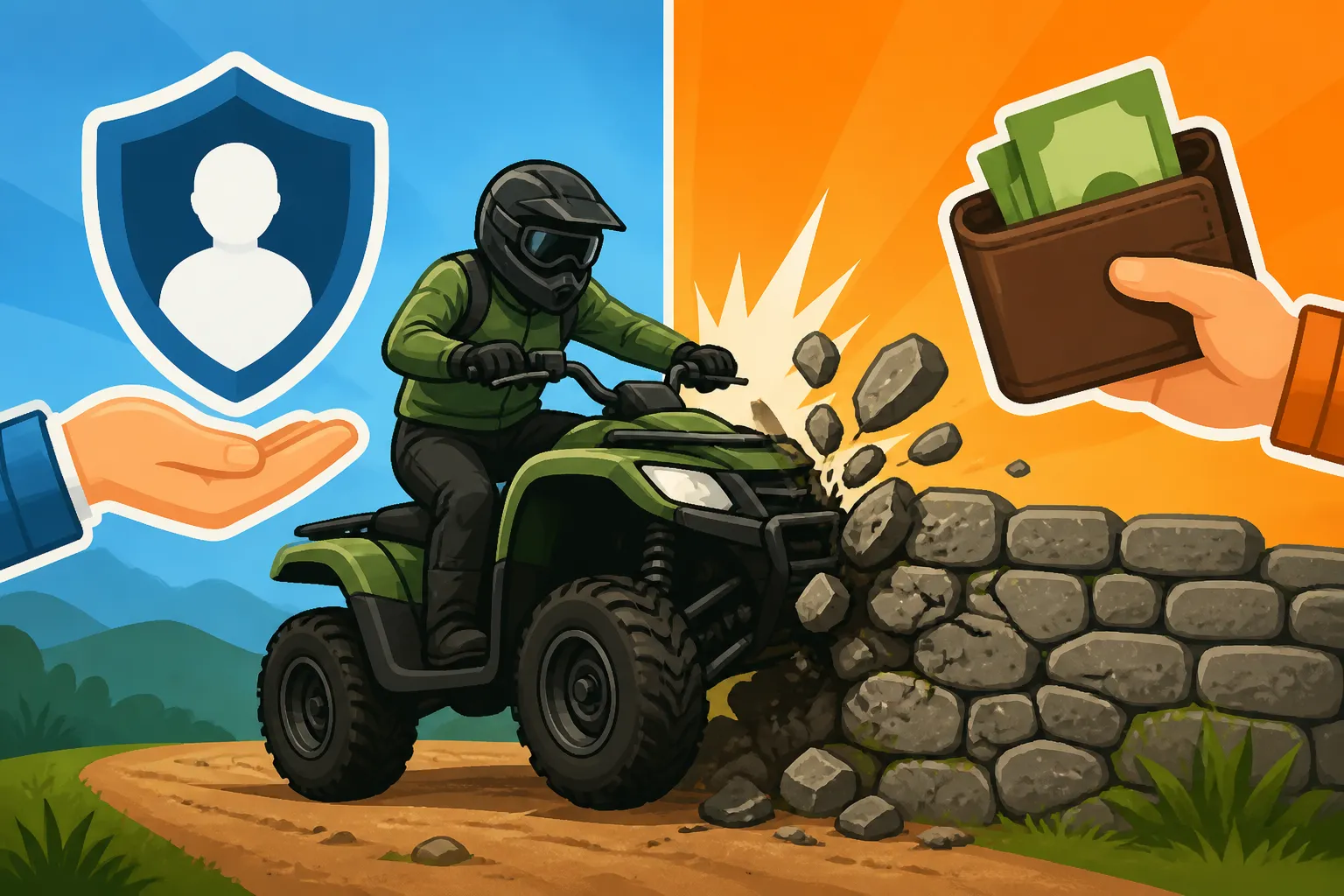
Who Pays When a Rider Hits a Stone Wall
It's a beautiful day for a ride on your ATV or UTV in Massachusetts, cruising through a state forest or enjoying a private property trail, when suddenly, disaster strikes: you misjudge a turn, hit an unseen rut, or simply lose control, and your machine slams into a venerable New England stone wall. In that moment of shock, beyond the immediate concern for your safety, a daunting question often emerges: "Who in the world is going to pay for this?" This guide is here to unravel the complexities of liability and financial responsibility when an off-road machine collides with something as immovable as a Massachusetts stone wall.
Understanding Liability in Massachusetts ATV Incidents
Hitting a stone wall isn't just a physical impact; it's a legal one. Massachusetts has specific laws governing the operation of ATVs and UTVs, and understanding these is your first step in deciphering who foots the bill for damages and injuries. It’s rarely as simple as just "the rider pays" or "the landowner pays."
The Role of Negligence and Massachusetts Law
At the heart of any accident claim, whether it involves a car, a bicycle, or an ATV, is the concept of negligence. In Massachusetts, if you're operating your off-road machine, you have a legal duty to do so safely and responsibly. Negligence, in simplest terms, means you failed to act with the reasonable care that a prudent person would exercise under similar circumstances. When you hit a stone wall, the immediate investigation will often turn to whether your actions, or lack thereof, constituted negligence.
For instance, were you riding too fast for the conditions, perhaps on a narrow, winding trail with poor visibility? Were you operating the machine under the influence of alcohol or drugs? Did you possess the required [Massachusetts Safety Certificates Under 18] if you're a younger rider? Were you wearing a helmet, as required by [Massachusetts Helmet Law for Every Rider]? Even riding outside designated areas or without [Massachusetts Landowner Permission in Writing] can factor into a finding of negligence. If you were zooming through a farmer's back forty, ignoring a posted "No Trespassing" sign, and demolished their historic stone wall, your negligence is likely clear. The more factors leaning towards irresponsible operation, the more likely you, the rider, will be deemed primarily responsible for the damages.
Property Damage vs. Personal Injury
When your ATV or UTV impacts a stone wall, you're immediately dealing with two distinct categories of potential financial fallout: property damage and personal injury. Understanding the difference is crucial for navigating the aftermath.
Property Damage: This refers to the physical harm done to the stone wall itself. Perhaps a section crumbles, stones are dislodged, or the structural integrity is compromised. The cost to repair or rebuild that wall can vary wildly depending on its size, age, construction, and the type of stone. For example, fixing a simple dry-stacked fieldstone wall is different from restoring a historically significant granite wall with mortar. The landowner will want their property restored to its previous condition, and you, as the rider, could be on the hook for those repair costs.
Personal Injury: This refers to any harm to yourself, the rider, or any passengers on your machine. A collision with something as unyielding as a stone wall can lead to serious injuries – broken bones, concussions, internal injuries, or worse. While you might be focused on the wall, the medical bills for treating your injuries could far exceed the cost of the wall's repair. In Massachusetts, ATVs are not typically required to carry personal injury protection (PIP) like cars are, making the financial burden of medical treatment often fall directly on the injured rider's health insurance or out-of-pocket. If a passenger was injured, their ability to seek compensation might depend on your own liability and any optional insurance you might have had.
Let's consider a scenario: Imagine you're riding your SuperATV equipped UTV down a friend's winding woodland path in October Mountain State Forest, admiring the fall foliage. You come around a blind curve a little too fast, and suddenly, a large, moss-covered stone wall appears. You swerve, but it's too late; your front fender clips the wall, sending a shower of rocks and dust. You're thrown forward, breaking your wrist, and a significant section of the wall collapses. Here, you have clear property damage to the wall and a personal injury to yourself. Your friend, the landowner, would likely expect you to cover the cost of rebuilding their wall, and your broken wrist would be a matter for your personal health insurance, as [Massachusetts Has No Insurance Mandate] for ATVs.
Who Bears the Financial Burden? Exploring Payer Scenarios
The question of "who pays" is complex because Massachusetts does not mandate insurance for ATVs in the same way it does for cars. This often leaves riders in a precarious financial position after an incident.
The Rider's Responsibility (and Wallet)
In most scenarios where a rider hits a stone wall, the primary financial responsibility falls squarely on the rider. This is especially true if negligence can be proven. Since [Does Massachusetts Require Insurance on a Registered ATV?] is "no," many riders choose not to carry optional liability or collision coverage. This means that repair costs for the wall, and medical bills for the rider's injuries, often come straight from the rider's own pocket.
Consider the cost of fixing a stone wall. It's not just a matter of putting rocks back. It might involve sourcing matching stone, hiring skilled masons, and potentially dealing with permits if the wall is close to a wetland or historic boundary. These costs can easily run into thousands of dollars. If you're riding a machine from a brand like SuperATV, known for its robust construction, you might think your machine is invincible, but no vehicle is immune to the unforgiving nature of a stone wall.
While rare, some homeowners' insurance policies might offer limited liability coverage for incidents involving recreational vehicles operated on the insured's property, or perhaps even off-property if specifically endorsed. However, these policies often have exclusions for motor vehicles, especially unregistered ones, or for incidents involving negligence or illegal activity (like trespassing). It's crucial not to assume your homeowner's policy will cover an ATV accident; in most cases, it won't. The cost of a repair, whether it's replacing a fender or rebuilding a wall, will typically be an out-of-pocket expense for the rider.
Landowner Liability and Shared Responsibility
While the rider is often the first to be held accountable, there are circumstances where a landowner might share some degree of responsibility for the accident and its costs. This usually stems from the landowner's duty to maintain their property in a reasonably safe condition or to warn visitors of known hazards.
For example, if a landowner explicitly invited you to ride on their property, knowing there was a dangerous, crumbling stone wall completely obscured by overgrown brush, and failed to warn you, they might bear some responsibility. However, this is a high bar to meet. Massachusetts generally places a significant burden on the rider to operate safely. The doctrine of "attractive nuisance," often applied to situations where a landowner's property entices children into danger, could theoretically come into play if a very young rider (e.g., under the [Massachusetts Age and Engine Size Ladder] limits) was injured by a hidden hazard. Even then, the landowner's liability is not a given.
A critical point in Massachusetts is the importance of [Written Permission From a Bay State Owner]. If you're riding on private land without explicit, written permission, you are trespassing. In such cases, the landowner generally owes you a much lower duty of care, essentially only needing to avoid intentionally or recklessly harming you. If you trespass and damage their stone wall, you will almost certainly be solely responsible for the repairs, and they would likely face no liability for any injuries you sustained. Always get permission in writing!
The Limited Role of Insurance (or lack thereof)
As reiterated, Massachusetts does not mandate insurance for ATVs or UTVs. This means that for many riders, there is no safety net when an accident like hitting a stone wall occurs.
However, optional insurance is available. If a rider has purchased an optional policy, it could provide coverage depending on its specifics:
- Liability Coverage: This type of coverage would pay for damages you cause to another person's property (like a stone wall) or for their injuries, up to the policy limits. If you had liability insurance and hit a wall, your policy could cover the repair costs.
- Collision Coverage: This coverage pays for damage to your own ATV or UTV, regardless of fault. If your machine was severely damaged by the impact with the wall, collision coverage would help with the repair or replacement of your machine.
The reality, however, is that many recreational riders opt out of these policies to save money. When an accident happens, they quickly learn the true cost of that decision. Even if you have coverage, remember that deductibles apply. For example, if you have a $500 deductible on your collision policy, you'd pay the first $500 of your machine's repair bill, and your insurer would cover the rest. It's a wise move for any rider, especially those with machines accessorized with SuperATV parts, to investigate optional coverage to protect their investment and their assets.
Here's a quick comparison of who pays in common scenarios:
| Scenario | Rider Negligent (e.g., speeding) | Landowner Negligent (e.g., hidden hazard) | Rider Has Liability Insurance | No Insurance |
|---|---|---|---|---|
| Wall Damage | Rider pays | Landowner might share; rider likely pays primarily | Insurer pays (up to limits) | Rider pays |
| Rider's Medical Bills | Rider's health insurance or out-of-pocket | Rider's health insurance or out-of-pocket | Rider's health insurance or out-of-pocket | Rider's health insurance or out-of-pocket |
| Rider's Machine Damage | Rider pays | Rider pays | Insurer pays (collision, after deductible) | Rider pays |
| Consequences for Rider (beyond costs) | Citation, fines, potential legal action | Potential citation if negligence involved | Potential rate hike | Citation, fines, potential legal action |
The Aftermath: Legal and Practical Steps
So, the unfortunate has happened. Your machine and a stone wall have become intimately acquainted. What do you do next? Acting quickly and correctly can make a significant difference in the outcome.
Reporting the Incident and Gathering Evidence
Your first priority after ensuring safety and checking for injuries (yours and any passengers) is to assess the damage. If there are serious injuries, or if the accident occurred on public land (like a state forest), or if there's significant property damage, you should contact the Massachusetts Environmental Police. They are the primary law enforcement agency for off-highway vehicles in the Commonwealth and would be the ones to issue a citation if laws were broken. [Massachusetts Accident Reporting Rules] would apply here.
Regardless of whether law enforcement is involved, you need to gather evidence. This means:
- Photographs: Take numerous photos from different angles. Get wide shots showing the overall scene, and close-ups of the damage to both the wall and your machine. Document the terrain, any warning signs (or lack thereof), and any factors that contributed to the accident.
- Witness Information: If anyone else saw the incident, get their contact information.
- Notes: Jot down the date, time, location, and a detailed account of what happened. Include weather conditions and anything else relevant.
- Landowner Notification: If you were on private land, even with permission, you must notify the landowner immediately. Transparency is key.
Having a clear record can be invaluable later, whether you're dealing with insurance companies (if you have them) or negotiating directly with the landowner.
Repairing the Wall and Dealing with Claims
Once the immediate aftermath is handled, the practical steps of repairing the damage begin.
- Get Quotes: For the stone wall, the landowner will likely obtain quotes from masons or contractors for the repair work. It's in your best interest to be involved in this process, or at least review the quotes to ensure they are reasonable. You might even offer to get a quote yourself.
- Negotiation: If you don't have liability insurance, you'll be negotiating directly with the landowner regarding payment for repairs. This is where your gathered evidence and an honest assessment of fault become crucial. Be prepared to discuss payment plans if the cost is substantial.
- Small Claims Court: If an agreement cannot be reached, the landowner might pursue legal action in small claims court to recover damages. This is a common path for disputes over property damage in Massachusetts, and could lead to [Massachusetts Court Costs for a Citation] on top of the repair bill.
- Insurance Claims: If you have optional liability coverage, you would file a claim with your insurance company. They would then investigate the incident, determine fault, and negotiate with the landowner on your behalf. This is a far less stressful process than handling it all yourself. If your machine is also damaged and you have collision coverage, you'd file a separate claim for that.
Remember, the goal is to resolve the situation fairly and legally. Ignoring the problem will only make it worse, potentially leading to additional [Massachusetts Penalties for Riding Unregistered] if your machine wasn't properly marked, or even civil lawsuits.
Preventing Future Incidents
The best way to avoid the headache of a damaged stone wall (and a damaged rider) is to prevent the incident from happening in the first place.
- Ride Responsibly: Always operate your ATV or UTV within your skill level, at appropriate speeds, and according to all Massachusetts laws, including [Massachusetts Age and Engine Size Ladder] limits and [Massachusetts Helmet Law for Every Rider]. This means giving extra space to obstacles like old stone walls that are ubiquitous in New England landscapes. Consider adding SuperATV protection like heavy-duty skid plates or rock sliders to minimize machine damage from unexpected impacts.
- Get Proper Training: For new riders, especially youth, taking a safety course is invaluable. Even experienced riders can benefit from refresher courses to hone their skills and stay updated on best practices. [Massachusetts Two-Part Safety Course] and [Massachusetts In-Person Skills Test] are available.
- Maintain Your Machine: Ensure your brakes are in perfect working order, your steering is tight, and your tires have adequate tread. A well-maintained machine is a safer machine.
- Scout Your Trails: If you're riding on unfamiliar private land or a new trail, take it slow. Consider walking sections with potential hazards or going with an experienced local rider. Identify obstacles like stone walls before you're on top of them.
- Get Permission: Always obtain [Massachusetts Landowner Permission in Writing] before riding on private property. This protects both you and the landowner and often sets the stage for a much smoother resolution if an accident does occur.
Riding ATVs and UTVs in Massachusetts offers incredible opportunities for adventure and enjoyment. By understanding the rules, riding safely, and being prepared for the unexpected, you can minimize the risk of financial and legal headaches, ensuring that your next encounter with a stone wall is merely a scenic view, not a costly collision.
Disclaimer
This article is for general informational purposes only and does not constitute professional advice. Laws, prices and regulations vary by location and change over time. Consult a qualified professional for guidance on your specific situation.