Staying Within Earshot of a Young Rider
Staying close to a young ATV or UTV rider in Massachusetts is more than a matter of keeping the group together. The state’s youth rules can require an adult supervisor to remain in visual and verbal contact, and age, machine size, land access, and safety-certificate requirements still matter. Here’s how to understand “earshot” and make supervision practical.
What staying within earshot means in Massachusetts
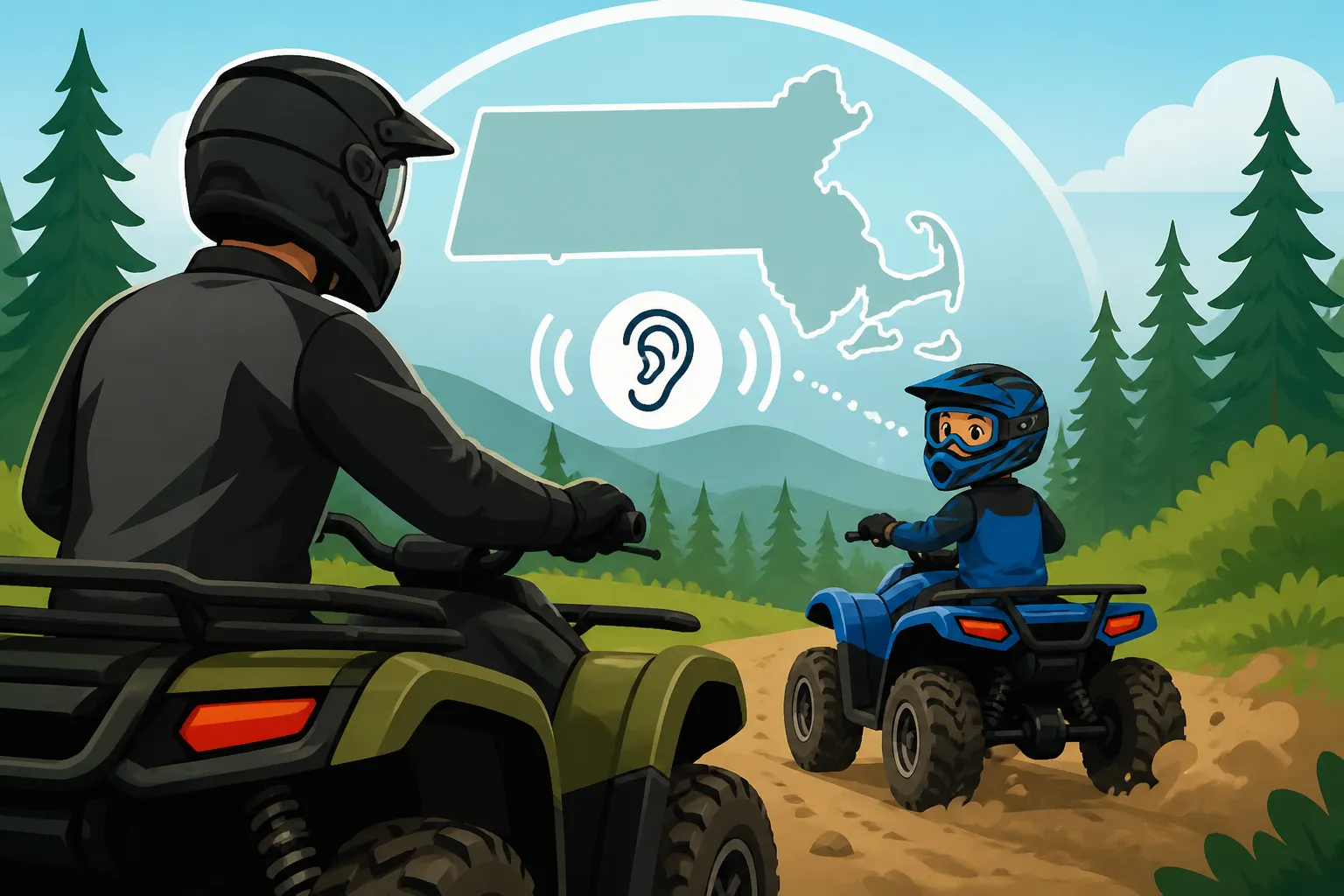
For a young rider who is legally allowed to operate an off-highway vehicle, supervision is not simply an adult being somewhere on the property or available by phone. Massachusetts uses a close-supervision standard: the supervising adult must be able to keep the rider in sight and communicate verbally. In everyday terms, that means the adult should be near enough to see what the rider is doing and speak to them without relying on a phone or radio.
The two parts work together. Seeing a rider disappear around a bend and hearing the engine in the distance is not the same as maintaining continuous visual contact. Being able to see the rider across a field may also be inadequate if the adult cannot communicate clearly when needed. Noise, trees, terrain, and the machine’s movement can all make apparent proximity less useful than it seems.
There is no single distance that makes every ride compliant. A supervising adult may need to stay much closer on a winding wooded trail than on a clear, open area. The important question is whether they can continuously observe the young rider and communicate promptly, not whether they are within a certain number of feet.
| Situation | What close supervision should look like | What can make it fail |
|---|---|---|
| Open, level area | Adult keeps the rider in view and can speak clearly | The adult watches from too far away to intervene or communicate |
| Narrow or wooded trail | Adult stays close enough to maintain sight and voice contact around turns | Trees, bends, or elevation hide the rider |
| Group ride | Adult keeps track of the young rider rather than assuming another adult is doing it | The group stretches out, or the supervisor loses sight of the child |
| Separate machines | The adult rides at a pace and position that allow continuous contact | The adult rides ahead, falls behind, or leaves the young rider alone |
The legal standard is only part of the picture. A supervisor also needs to be able to act if the rider stalls, approaches an unsafe crossing, or gets into trouble. If the adult cannot see what is happening or reach the rider quickly enough, the arrangement is not a sound one, even if the engines can still be heard.
The phrase “within earshot” can sound as if hearing the machine is enough. It is better understood as a practical reminder to stay close and communicative, not as permission to supervise from out of sight. See What Continuous Visual Contact Means in Massachusetts for more on the visual part of the standard.
Check the age and machine rules before planning a supervised ride
Adult supervision does not make every young person’s ride legal. Massachusetts sets age-related limits for off-highway vehicle use, and those limits can depend on the rider’s age, the machine, the type of land, and whether the activity is an authorized event. Confirm those conditions before deciding that an adult’s presence is all that is needed.
A useful starting point is the rider’s exact age and the machine’s engine size. The state’s youth rules are not one general rule for all children and all machines. Some young riders may be subject to engine-size limits, while other ages have different requirements. A larger ATV or UTV is not automatically appropriate just because an adult is nearby. Review Massachusetts Age and Engine Size Ladder and Massachusetts Rules for Young Riders on Public Land before the ride.
Children under 14 face a particularly important restriction: they generally may not operate an off-highway vehicle, with limited exceptions for sanctioned events. This is not a rule that a parent can override by choosing private property or staying beside the child. The narrow event exceptions have their own conditions, so do not treat casual practice as equivalent to a sanctioned event. The distinctions are explained in Why Under-14 Riders Are Banned on Private Land Too.
For older teenagers, other requirements may apply. Riders under 18 may need an approved safety certificate when operating on public land, and the certificate requirement is separate from supervision. Carrying the certificate, when required, does not replace any applicable adult-supervision rule. Likewise, having a supervising adult does not replace a required certificate. See Massachusetts Safety Certificates Under 18 and Massachusetts Certificate Rules Under 16 for the age-specific details.
A supervising adult should be an eligible adult under the applicable rules, not simply an older sibling or another youth who has more experience. Massachusetts describes a supervising adult as someone who meets the required age standard; check Who Counts as a Supervising Adult at 18 rather than assuming that any adult-looking companion qualifies.
Before a ride, work through these questions:
- How old is the rider on the day of the ride? Apply the rule to the rider’s actual age, not an age they will reach soon.
- What machine will they operate? Confirm that the vehicle is allowed for that rider’s age and experience, including any engine-size restriction.
- Where will the ride take place? Public land, private land, and an organized event can have different access and operating rules.
- Is a safety certificate required? Confirm whether the rider needs one and whether they must carry it.
- Who is supervising? Make sure the adult qualifies and can stay in continuous visual and verbal contact.
- Is the route suitable? A legal ride can still be a poor choice if the terrain, traffic, or group pace is beyond the young rider’s ability.
These checks help prevent a common misunderstanding: an adult’s presence does not turn a prohibited ride into an allowed one. Supervision is one condition, not a substitute for the rest of the rules.
Make supervision work on the trail
A supervision plan should fit the terrain and the rider. On a familiar open practice area, an adult may be able to stay close while watching a young rider travel a short distance. On a narrow trail with turns, brush, or changes in elevation, the adult may need to follow much more closely or choose another route.
Before starting, agree on simple instructions. The young rider should know to stop if they lose sight of the adult, cannot hear them, or are unsure where to go. The adult should explain what to do if the machine stalls, the rider falls, or the group reaches a crossing. These instructions are useful only if the rider can remember and follow them under pressure, so keep them brief and practice them in a controlled place.
A responsible setup can include:
- Choose a route where sightlines are realistic. Walk or inspect unfamiliar sections before letting a young rider use them. A route that repeatedly hides the rider makes continuous contact difficult.
- Set a slow pace. The adult should not ride so far ahead that the child has to chase them. The adult’s position should make it possible to observe the rider, not just lead the group.
- Use a clear stop signal. Agree on a voice command or hand signal before moving. Do not assume the rider will hear ordinary conversation over engines.
- Keep the group compact. If several vehicles are involved, identify who is directly supervising the young rider. A group leader at the front cannot automatically supervise a child far behind.
- Stop before contact is lost. If the rider rounds a bend and disappears, pause and re-establish sight and voice contact rather than continuing on the assumption that everything is fine.
- Avoid distractions. A supervisor who is using a phone, helping another rider, or concentrating on their own difficult line may not be able to supervise continuously.
Devices can help a group coordinate, but they are not a replacement for the required closeness. A radio may be useful when riders are separated for reasons allowed by the route and activity, but a working radio does not make loss of visual contact acceptable where continuous sight is required. Nor should a phone be treated as a substitute for an adult being physically close enough to respond.
Basic communication equipment can still be useful as a backup. A whistle, for example, may help get attention if engines are off or a rider is stopped nearby. If you choose to buy one, outdoor retailers and marketplaces such as Amazon carry basic options; prioritize something simple that the rider can use and that the adult has explained in advance. Equipment should support a safe plan, not create a false sense that a distant adult is supervising adequately.
The adult also needs to choose a manageable job. Supervising one young rider while operating their own machine can be demanding, especially on rough terrain. If the adult cannot keep the child in sight while safely controlling their own vehicle, stop and change the arrangement. That may mean having another qualified adult supervise, reducing the group size, moving to an easier area, or ending the ride.
Common mistakes and what to do when contact is lost
A frequent mistake is treating “I can hear the engine” as proof that a young rider remains supervised. Sound travels unpredictably through woods and over hills. The engine may still be audible after the rider has gone beyond sight or beyond the adult’s ability to communicate. If the adult cannot see the rider, they should not assume that hearing alone satisfies the supervision requirement.
Another mistake is letting the adult ride far ahead to scout the route. That can leave the young rider following an uncertain path without immediate guidance. If route-finding is necessary, the group should stop and keep the young rider with the supervising adult while the way forward is checked. Similarly, a child should not be asked to wait alone out of sight while an adult goes to retrieve equipment or assist someone else.
Private land also deserves careful attention. Permission from a landowner is not a waiver of youth operating restrictions. A parent who owns the property cannot simply set aside age rules that apply to the rider or machine. The landowner’s permission and the age-related operating rules are separate issues; Massachusetts Rules for Riding Private Land can help clarify that distinction.
Public-way crossings create another moment when a loose group can become separated. An adult should bring the young rider to a stop, make sure the rider understands the crossing procedure, and keep the required contact while crossing. Do not have a child cross alone because the adult is already on the other side. For the specific crossing rules, see Massachusetts Rules for Crossing a Road.
If visual or verbal contact is lost:
- Stop the adult’s machine safely. Do not continue farther away while hoping the rider will catch up.
- Call or signal for the rider to stop. Use the agreed signal and listen for a response.
- Re-establish contact before moving on. If the rider cannot be seen or heard, go back along the route carefully or use the group’s agreed lost-rider procedure.
- Assess why contact failed. A turn, noise, terrain, confusion, or a mechanical problem may require changing the route or supervision arrangement.
- Resume only when the plan is workable. If the adult cannot maintain contact on that trail, choose an easier route or end the ride.
The supervisor’s responsibility is not limited to standing nearby. Young riders may need help making sound decisions, and an adult should intervene when the child is approaching a hazard or disregarding instructions. Massachusetts also places responsibility on supervising adults in certain circumstances when a young rider violates the law; review Massachusetts Parent Liability for a Young Rider to understand why supervision is a real legal duty, not just a courtesy.
When in doubt, make the ride shorter and simpler. A young rider who can stay in sight, hear instructions, and respond calmly is in a better position to learn than one who is struggling to keep up. The safest choice may be to turn around, change trails, or postpone the ride until the rider has more skill and the right conditions are available.
Disclaimer
This article is for general informational purposes only and does not constitute professional advice. Laws, prices and regulations vary by location and change over time. Consult a qualified professional for guidance on your specific situation.