Massachusetts Registration Compared to Vermont
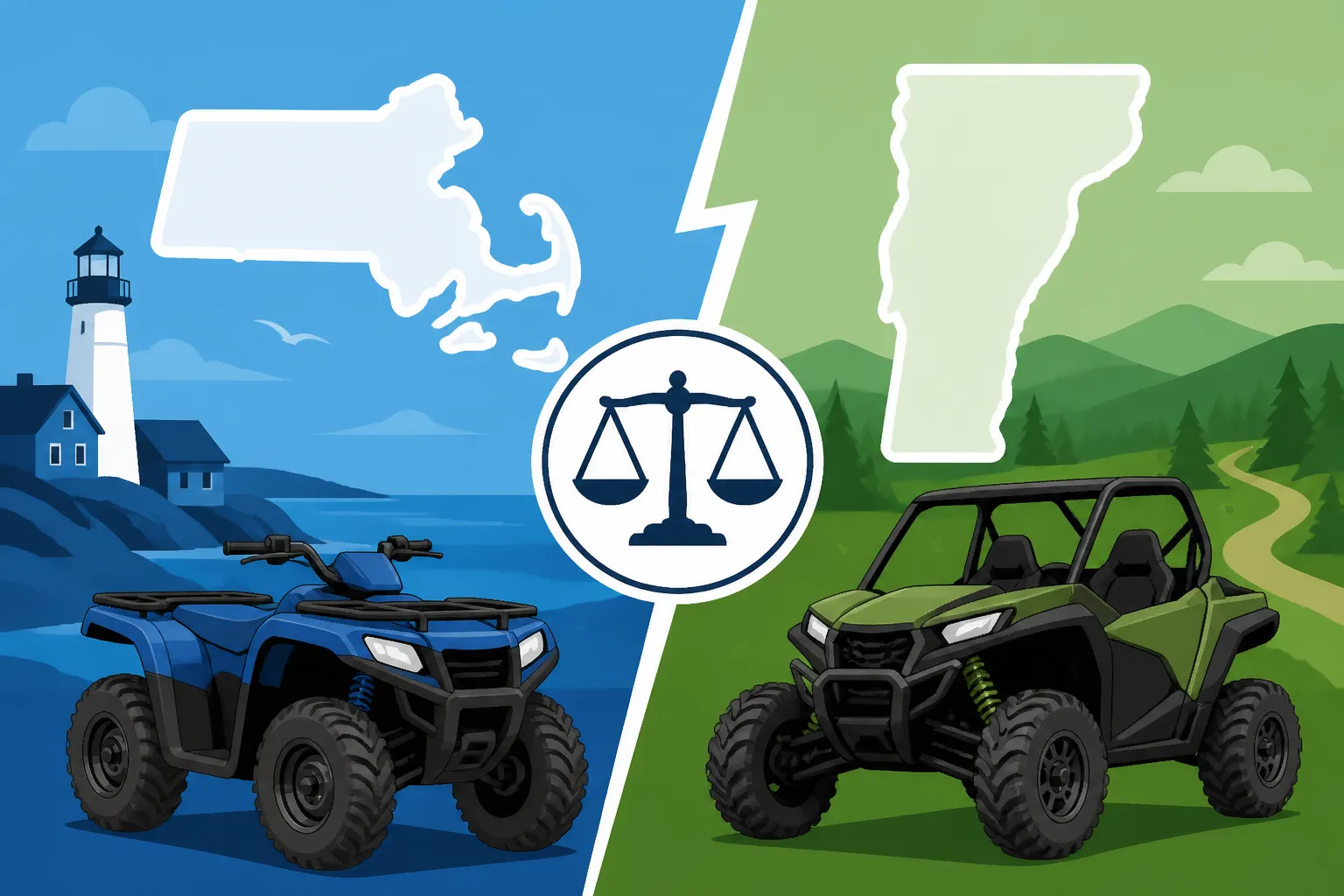
Trying to figure out where you can legally ride your ATV or UTV when you live near a state line, or planning a trip to another state, can be a real headache. It often feels like every state has its own unique rulebook, and deciphering the nuances between them, especially when it comes to something as specific as OHV registration, can be incredibly frustrating. This guide is here to untangle the differences between Massachusetts and Vermont ATV and UTV registration requirements, helping you understand what's needed no matter which side of the border you plan to ride on.
The Core Difference: How Massachusetts Handles OHVs vs. Vermont
When you're trying to compare how two states handle something as particular as registering off-highway vehicles (OHVs), the first thing you notice is often the fundamental approach. Massachusetts and Vermont have distinct systems, and understanding these differences is key to staying legal on the trails.
Massachusetts's Centralized System: Environmental Police
In Massachusetts, the system for registering ATVs and UTVs often catches new residents or visitors by surprise because it’s not handled by the Registry of Motor Vehicles (RMV). Instead, all OHV registrations fall under the purview of the Massachusetts Environmental Police (MEP) through the Office of Law Enforcement. This setup is pretty unique, and it means that when you need to register your machine, you'll be dealing with a specialized branch of law enforcement rather than the typical vehicle department. The MEP issues a specific registration decal that must be prominently displayed on your machine, along with a registration card that you are required to carry with you whenever you're riding. The logic here is that these machines are primarily used in natural, unpaved environments, making their oversight more aligned with environmental protection and safety on public lands. This centralized approach aims to streamline enforcement and trail management under one agency, which can be both a blessing and a curse depending on your needs. For residents, it means understanding a specific channel for all their OHV needs, from initial registration to renewals.
You might be asking, "Why the Environmental Police and not the RMV?" Well, the state views these machines differently than street-legal vehicles. They're primarily for recreational use in specific, often delicate, natural environments. The Environmental Police are already tasked with enforcing laws related to hunting, fishing, boating, and general outdoor recreation, so adding OHVs to their jurisdiction makes a certain kind of sense from a state management perspective. They're the ones out there on the trails, enforcing safety and environmental regulations. It's a system designed to keep the machines on designated trails and off places they shouldn't be, protecting both riders and the natural landscape. Understanding [Why the Environmental Police Register ATVs, Not the RMV] is a crucial first step for any rider in the Bay State.
Vermont's More Decentralized Approach: DMV & VASA
Vermont, on the other hand, takes a slightly different tack. While the Vermont Department of Motor Vehicles (DMV) handles the actual registration of your ATV or UTV, much of the practical trail access and management is deeply intertwined with the Vermont Association of Snow Travelers (VASA), and its ATV counterpart, VASA ATV. You register your machine with the DMV, obtaining a registration certificate and sticker, much like you would for a car or motorcycle. However, for many public and private trails in Vermont, particularly those maintained by local clubs, merely having a state registration isn't enough. You often need to purchase a VASA trail pass. This dual system reflects Vermont's strong tradition of organized recreational trail use, where volunteer associations play a massive role in maintaining and developing trail networks.
This approach means that if you're planning to ride the extensive trail systems that Vermont is known for, you're looking at two layers: state registration for legal operation and a trail pass for access. This can feel like an extra step compared to states where registration automatically grants trail access, but it's designed to fund the maintenance and development of those trails, which are often built and cared for by local clubs. The VASA system is a testament to community involvement in preserving and expanding riding opportunities. It's a collaborative effort that helps keep Vermont's trails in top condition, funded directly by the riders who use them. This model is pretty common in states with vast, interconnected trail systems that rely heavily on private landowner permissions and volunteer efforts.
Residency Matters: Sticker Terms and Costs
The question of where you officially call home plays a huge role in how much you pay and how long your registration lasts in both Massachusetts and Vermont. This is one area where the financial implications can vary significantly.
Massachusetts: Resident vs. Non-Resident Distinction
Massachusetts has a clear and impactful distinction between residents and non-residents when it comes to OHV registration. If you're a Massachusetts resident, you're eligible for a two-year registration sticker. This longer term is a convenience and reflects the expectation that you'll be riding in the state consistently. The cost for residents is a specific amount for that two-year period, which helps fund crucial trail maintenance and administration. For instance, [Massachusetts Charges $44 for Residents] for their two-year OHV sticker.
However, if you're a non-resident planning to bring your ATV or UTV to Massachusetts for a visit, you'll be looking at a different scenario. Non-residents can only obtain a one-year registration sticker. This shorter term is specifically designed for visitors, acknowledging that their riding in the Bay State might be intermittent. The cost for non-residents is typically less than the resident two-year fee, but it's for a shorter duration. For example, [Massachusetts Charges $33 for Visitors] for their one-year OHV sticker. Crucially, Massachusetts does not recognize out-of-state OHV registrations. This means that even if your machine is perfectly legal and registered in Vermont (or any other state), you must obtain a Massachusetts non-resident sticker if you intend to ride on any public land or designated trails within Massachusetts. There's no reciprocity here; your Vermont sticker won't get you a free pass to the Bay State's trails. This is a common point of confusion and frustration for riders planning trips across state lines. The state mandates its own registration to ensure all machines operating within its borders contribute to its OHV fund and adhere to its specific regulations.
Vermont: How They Treat Out-of-Staters
Vermont also has its own approach to residency, but with some key differences. Like Massachusetts, Vermont requires all OHVs operating on its trails to be registered with the Vermont DMV. If you're a Vermont resident, you'll get a standard registration that allows you to operate your machine. However, for out-of-state riders, Vermont's system is a bit more accommodating in some aspects, though it still requires specific steps.
Generally, Vermont registration is for one year, whether you're a resident or non-resident, though specific fee structures may vary. The most significant difference for non-residents wanting to ride Vermont trails is the VASA trail pass requirement. Even if you've registered your machine with the Vermont DMV as a non-resident, you'll almost certainly need to purchase an additional VASA trail pass to access the vast network of trails managed by local clubs. This pass is what truly unlocks Vermont's riding opportunities. While Vermont doesn't typically have formal "reciprocity" in the sense of honoring another state's registration in lieu of its own, its system is designed to allow non-residents to easily register and purchase a trail pass, integrating them into the state's trail system. So, if you're coming from Massachusetts, your Massachusetts Environmental Police sticker won't be valid in Vermont. You'll need to register with the Vermont DMV and likely get a VASA pass. This distinction is vital for planning a successful riding trip to the Green Mountain State.
Paperwork Differences: What to Bring Where
Dealing with paperwork is often the least fun part of getting ready to ride, but it's absolutely essential. Both states have specific requirements, and showing up with the wrong documents or missing a crucial piece can lead to delays and headaches.
Massachusetts: The Key Documents
When you head to the Massachusetts Environmental Police to register your ATV or UTV, you'll need to be prepared with a specific set of documents. This isn't a casual affair; they want to see proper proof of ownership and tax compliance.
First, if you're registering a brand-new machine, you'll need the Manufacturer's Certificate of Origin (MCO). This document is essentially the birth certificate of your ATV or UTV and proves it's never been registered before. Without it, you can't register a new machine. It confirms the VIN and other key details directly from the manufacturer. [Massachusetts Requires an MCO for a New Machine].
For a used machine, the most critical document is a clear and complete bill of sale. This isn't just a scribble on a napkin; it needs to include specific information about both the buyer and seller, the machine itself (including the VIN), the purchase price, and the date of sale. A properly filled out bill of sale is your proof that you legally acquired the machine. You'll often find resources, like forms from LawDepot, that can help you draft a professional and comprehensive bill of sale, ensuring it meets state requirements. This can be especially helpful if you're doing a private sale, as a vague bill of sale can cause real problems. For more details on what's needed, check out [Massachusetts Requires a Bill of Sale for a Used One].
Beyond ownership, Massachusetts also wants to ensure you've paid your sales tax. You'll need to provide proof of sales tax payment (Form ST-6) or claim a valid exemption (Form ST-6E) at the time of registration. This often means filing the sales tax with the Department of Revenue before you even get to the Environmental Police, or at least having the forms ready. Neglecting this step will absolutely hold up your registration. Your machine's Vehicle Identification Number (VIN) is also non-negotiable; it must be clearly visible and match all your paperwork. [Massachusetts Requires a VIN on the Application].
Vermont: Similarities and Variations in Documentation
Vermont's DMV also has clear documentation requirements for ATV and UTV registration, and many of them will feel familiar if you've ever registered a vehicle in another state.
For a new machine, just like Massachusetts, Vermont will require the Manufacturer's Certificate of Origin (MCO). This is standard across most states as the initial proof of ownership. If you're buying from a Vermont dealer, they will typically handle much of this paperwork for you, submitting it directly to the DMV.
For a used machine, a bill of sale or previous registration is usually sufficient to prove ownership. Vermont wants to see a clear chain of title or ownership. While a simple bill of sale might be acceptable, having a more formal document, perhaps generated using a template from a service like LawDepot, can prevent any issues. This is especially true for private sales, where clarity in the transaction documents is paramount. They'll also require proof of the purchase price for sales tax purposes, similar to Massachusetts. The VIN will be essential for all registration applications, ensuring the machine is correctly identified and recorded.
One key thing to note is that while both states require proof of sales tax payment, the process might differ slightly in how and when you submit it. In Vermont, the DMV often handles the collection of sales tax at the time of registration if it hasn't already been paid. It's always best to check the most current Vermont DMV guidelines for exact requirements before you make the trip, as rules and forms can change.
Reciprocity and Trail Access: Can Your Vermont Sticker Get You to Massachusetts Trails?
This is where the rubber meets the road (or rather, the tires hit the dirt). The question of whether one state's registration is valid in another is a primary concern for any rider who lives near a state border or loves to travel with their machine.
The Hard Truth for Massachusetts Visitors from Vermont
Let's cut right to the chase: if you're a Vermont resident with a fully registered ATV or UTV from your home state, that registration will not be recognized in Massachusetts. There is no reciprocity for out-of-state OHV registrations in Massachusetts. This means you cannot simply bring your Vermont-registered machine and ride on Massachusetts public trails. If you do, and you're stopped by an Environmental Police Officer, you will be cited for riding an unregistered vehicle, and that's a fine nobody wants.
To legally ride your ATV or UTV on Massachusetts public lands, you absolutely must obtain a Massachusetts non-resident OHV registration. This is a one-year sticker, and it's mandatory. It doesn't matter how long you plan to stay or how infrequently you ride here; if you're on public land, you need that Massachusetts sticker. This might seem like an extra hassle and expense, especially if you're just planning a weekend trip, but it's how Massachusetts manages its trails and funds its OHV program. The state wants every machine using its resources to contribute to their upkeep and adhere to their safety and environmental standards. For more information, you can look up [Massachusetts Non-Resident OHV Registration] specifics. It's a clear, non-negotiable rule to remember before you even load up your machine to head east.
Vermont's Approach to Out-of-State Riders
Vermont also does not have a formal "reciprocity agreement" in the sense that they will honor your Massachusetts OHV sticker instead of requiring their own. If you're coming from Massachusetts and want to ride in Vermont, you'll need to register your machine with the Vermont DMV as a non-resident. This is a crucial step for any Massachusetts rider planning a trip to Vermont's extensive trail network.
In addition to the state registration, as mentioned earlier, many of Vermont's trails are part of the VASA system. To access these trails, you will almost certainly need to purchase a VASA trail pass. This pass is separate from your state registration and directly supports the clubs that maintain and groom the trails. So, for a Massachusetts rider planning to experience Vermont's OHV opportunities, the process involves two main steps: acquiring a Vermont non-resident registration from the DMV and purchasing a VASA trail pass. While it's a multi-step process, it's fairly straightforward to do, and the fees contribute directly to the fantastic riding experience Vermont offers. Vermont's system is designed to be welcoming to visitors, provided they follow the established procedures which ensure trail funding and responsible use. Understanding these requirements is key to having an enjoyable and legal riding experience in the Green Mountain State.
Trail Systems and Laws: Beyond Just the Sticker
Beyond the paperwork and registration fees, the actual experience of riding—where you can go and what rules you must follow—differs significantly between Massachusetts and Vermont. These differences often reflect each state's landscape, population density, and historical approach to land use and recreation.
Massachusetts's Limited OHV Trail Network
Massachusetts is known for its beautiful coastline, historic towns, and dense population centers, but it's not exactly a mecca for extensive OHV trail riding. The public trail system for ATVs and UTVs is quite limited, primarily concentrated in a few state forests in the western part of the state, such as Beartown State Forest, October Mountain State Forest, and Pittsfield State Forest. These trails are often shared with other users like hikers, mountain bikers, and horseback riders, requiring riders to be extra mindful of trail etiquette. The riding season is also defined, typically running from May to November, with closures during winter months and often during mud season to prevent trail damage.
Beyond the limited public trails, Massachusetts also has some of the strictest OHV laws in the country, particularly regarding youth riders. Sean's Law, enacted in 2010, significantly changed the landscape for young riders. It bans riders under the age of 14 from operating ATVs on public and private land, with very few exceptions for sanctioned events. There are also strict engine size limits for riders between 14 and 16 years old, and requirements for safety certificates and adult supervision for those under 18. [Massachusetts ATV Age Requirements] are a critical piece of information for any family considering riding in the state. Furthermore, Massachusetts has a strict helmet law, requiring all riders, regardless of age, to wear a helmet. There are also laws about riding within 150 feet of a dwelling and the need for written permission from landowners to ride on private property. The regulations are designed with safety and environmental protection as top priorities, reflecting a more cautious approach to OHV recreation in a densely populated state.
Vermont's Extensive Trail System and Rules
Vermont, in contrast, offers a much more expansive and interconnected OHV trail system, largely thanks to the efforts of VASA and its affiliated local clubs. The state's landscape, with its vast tracts of forest and less dense population in many areas, is naturally more conducive to extensive trail networks. Many trails traverse private land, with access granted through agreements facilitated by VASA, making the VASA trail pass essential for most riders. Vermont's trails are often well-maintained and offer diverse riding experiences, from scenic forest roads to more challenging technical sections.
While Vermont's laws are generally considered less restrictive than Massachusetts's, especially regarding youth riders, they still prioritize safety. Vermont requires helmets for all riders under 18, and also has specific age and engine size restrictions, though they may not be as stringent as Massachusetts's blanket ban for those under 14. Riders typically need to carry their registration certificate and proof of their VASA trail pass while on the trails. Similar to Massachusetts, riding on private land almost always requires explicit permission from the landowner, and respect for private property is paramount to maintaining the trail network. Vermont's system encourages responsible riding through education and a strong community of riders and clubs, leading to a vibrant and accessible OHV culture that draws riders from surrounding states. For more details on what's expected, you might want to read about [Massachusetts Rules for a Visiting Vermont Rider].
Here's a quick comparison of the key differences:
| Feature | Massachusetts OHV Registration | Vermont OHV Registration |
|---|---|---|
| Administering Body | Massachusetts Environmental Police (MEP) | Vermont Department of Motor Vehicles (DMV) |
| Registration Term | Residents: 2 years; Non-residents: 1 year | Typically 1 year for all |
| Cost Structure | Resident fee higher, covers 2 years; Non-resident fee for 1 year | Fees vary, generally for 1 year |
| Out-of-State Reciprocity | None. All riders need MA sticker on MA public land. | None. All riders need VT registration on VT public land. |
| Trail Pass Required? | No separate state trail pass; registration covers access (limited) | Often requires additional VASA trail pass for club trails |
| New Machine Docs | Manufacturer's Certificate of Origin (MCO) | Manufacturer's Certificate of Origin (MCO) |
| Used Machine Docs | Detailed Bill of Sale (e.g., from LawDepot), VIN | Bill of Sale or previous registration, VIN |
| Sales Tax Proof | Required at registration (Form ST-6/ST-6E) | Collected by DMV at registration or proof of payment |
| Youth Rider Laws | Very strict (e.g., Sean's Law: <14 banned, engine size limits) | Specific age/engine limits, but generally less restrictive than MA |
| Helmet Law | All riders | All riders under 18 |
| Trail Network | Limited public state forest trails | Extensive, interconnected public & private trails (VASA system) |
Disclaimer
This article is for general informational purposes only and does not constitute professional advice. Laws, prices and regulations vary by location and change over time. Consult a qualified professional for guidance on your specific situation.