Massachusetts Trail Conditions Before You Tow
A dry driveway can hide muddy access roads, a closed gate, or a trail too rough for the machine you’re hauling. Before towing an ATV or UTV across Massachusetts, check the riding area’s rules, recent weather, access conditions, and parking logistics. This guide walks through what to confirm, where to look, and how to avoid a wasted trip.
Start With the Right Trail and the Right Rules
Confirm that the riding area allows your machine
A state forest name on a map does not mean every road or trail there is open to ATVs or UTVs. In Massachusetts, riding is limited to designated areas and routes, and rules can vary between properties. A trail that allows one type of off-highway vehicle may not allow another, so confirm that the specific location accepts your machine before you load it.
This is especially important in the Berkshires, where popular riding destinations include Beartown State Forest, October Mountain State Forest, and Pittsfield State Forest. Each has its own trail layout, access points, and practical considerations. A route that looks connected on a phone map may run onto a road, private land, or a section not open to OHVs. Do not assume you can ride a connecting segment just because it appears passable.
Start with the agency or property manager responsible for the area, then check the relevant details in Massachusetts Trail Planning and Closures and Massachusetts Trails That Allow Side-by-Sides. If you are choosing a location for a UTV, be particularly careful: trail width, vehicle eligibility, and posted restrictions matter as much as the route’s general condition.
Check the season and any temporary restrictions
Massachusetts riding areas can have seasonal operating periods, and a trail may close temporarily even when the broader forest remains open to visitors. Mud, erosion, storm damage, maintenance work, or other land-management needs can change access. A trail shown as open in an older post or downloaded map is not proof that it is open on the day you plan to ride.
The broader Massachusetts DCR Riding Season information can help you understand the usual seasonal framework, but you still need to verify the specific property and date. Late spring can bring saturated ground after snowmelt and rain; autumn weather can shift quickly, while short daylight hours make a late start less forgiving. If you’re planning a trip near the opening or closing edge of the season, confirm access directly before hitching up.
Think of the season dates as a planning guide, not a guarantee that every route is rideable. If a forest office or official notice says a section is closed, do not try to get around the closure by unloading somewhere else or entering from an unmarked access road. Those detours can put you on land where riding is not authorized and can damage wet ground.
Get a Useful Read on Trail Conditions
Look for recent, location-specific information
A forecast for a nearby town is only part of the picture. Conditions at a forest can differ from the weather in the valley, and a storm can leave one route muddy while another drains more quickly. When you check conditions, look for information tied to the exact riding area, access road, or trail system—not just a broad regional forecast or a photo from last season.
Use official notices first, then contact the relevant forest office or property manager if anything is unclear. Ask direct questions: Is the riding area open on the date you plan to visit? Are any trails or access roads closed? Is the parking area accessible to a trailer? Has recent rain affected the route? If the answer is uncertain, ask whether there is a preferred place to check for an update before you leave home.
Community posts can provide useful clues, especially when riders describe what they encountered that day. But conditions change, and an online report may refer to another trail, another entrance, or a different type of vehicle. Treat unofficial updates as supporting information rather than permission to ride. For an additional map reference, some riders use onX Offroad to review route context and nearby roads, but a map app cannot confirm current closures or replace official guidance.
Interpret weather with the trail surface in mind
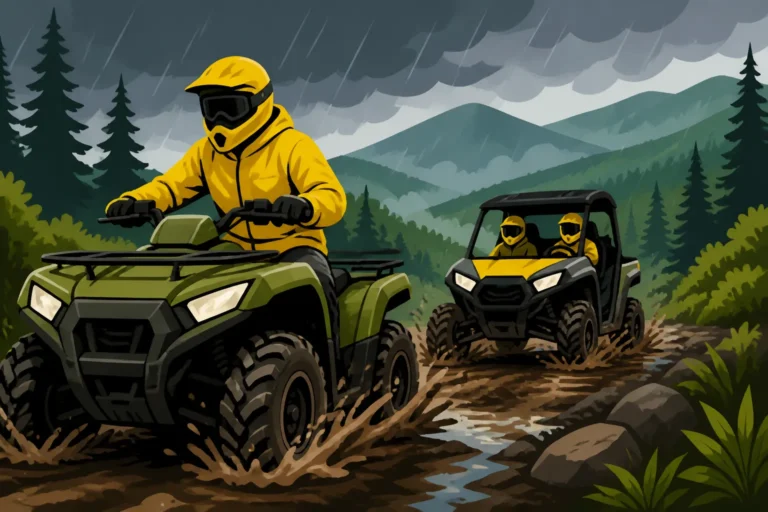
Rainfall affects more than the trail itself. It can soften the approach road, make a sloping parking area slippery, and leave standing water in low spots. A trail that feels manageable under dry conditions may become rutted or harder to navigate after prolonged rain. Conversely, a dry stretch does not guarantee that shaded, low-lying sections have recovered from earlier wet weather.
Consider the full trip: the tow vehicle’s route, the entrance road, the unloading area, and the trail. If the trailer has to cross a muddy shoulder or turn around on a narrow, soft surface, you may have a problem before the ATV or UTV even comes off the ramp. A heavy UTV and trailer can also make a tight or uneven access point much harder to manage than it looks from a map.
When conditions are questionable, choose a conservative plan. Call ahead, give the ground time to dry, or select another authorized location with access you can confirm. Riding through deep mud or around a closure can widen ruts and damage the trail, making access harder for everyone. For more on why weather matters, see Massachusetts Trail Closures After a Storm and Massachusetts Mud Season and Trail Damage.
| What to check | Why it matters | What to ask or look for |
|---|---|---|
| Official opening status | A forest may be open while OHV routes are closed | Is the riding area open for OHVs on your planned date? |
| Recent rain or snowmelt | Wet ground can make trails and access roads vulnerable | Have recent conditions affected specific routes or entrances? |
| Vehicle eligibility | ATV and UTV permissions may differ | Is your exact vehicle type allowed on the designated route? |
| Entrance and parking | A trailer needs suitable access and room to maneuver | Can a truck and trailer reach, park, unload, and turn around? |
| Temporary closures | Storm damage or maintenance may affect only part of a system | Are there closures, detours, or restricted sections? |
| Maps and route markers | Digital maps may not reflect current restrictions | Which map or signs should riders use on site? |
Plan the Tow, Entrance, and Parking
Confirm trailer access before choosing an entrance
The nearest entrance is not always the best entrance for a truck and trailer. Some access points may have limited turning space, narrow approaches, steep grades, or no practical place to unload. A road that is fine for a passenger vehicle can become stressful when you are towing a long trailer and need enough room to pass, turn, or wait without blocking other visitors.
Check the approach from the main road as carefully as the trail itself. Look for posted restrictions, gates, tight turns, and surfaces that could become soft after rain. If you are meeting a group, agree on one access point and confirm that everyone can reach it. A second trailer arriving at a narrow entrance can quickly create a traffic problem, especially if there is no safe shoulder to pull into.
Use Massachusetts Trailheads With Trailer Parking as a starting point for finding places to investigate, not as a substitute for checking the day’s access and parking arrangements. If you are heading to the Berkshires, Calling Beartown State Forest Before You Tow offers a practical reminder: a short confirmation call can save a long drive with a loaded trailer. Ask specifically about the parking area you intend to use, not just whether the forest is open.
Leave room for unloading and a backup plan
Before departure, picture the entire arrival sequence. Where will you park the tow vehicle? Is there room to lower a ramp and unload without blocking the entrance? Can you turn around if the lot is full or unsuitable? These details sound basic, but they are easy to overlook when the focus is on the ride. A parking area that fits a car may not comfortably accommodate a truck, trailer, and several machines.
Build a backup into your plan. Identify another authorized riding area or decide in advance what you will do if the entrance is closed, the lot is full, or the approach has become unsafe. Do not treat a roadside turnout or an unmarked path as an acceptable substitute. If the site is not suitable for unloading, keep the machine secured and choose another legal option rather than improvising at the gate.
On the map, distinguish between a trailhead, a forest road, and a parking area. Apps such as onX Offroad can help you examine the surrounding layout and prepare questions, but do not use a screen route to override posted signs or property rules. A paper or offline map is helpful when reception drops, but it should support—not replace—current instructions from the land manager. For more trip-planning context, see Massachusetts Trailheads With Trailer Parking and Massachusetts ATV Trail Map Downloads.
Prepare for Changing Conditions on the Ride
Match your route to your group and equipment
Trail conditions are only one part of whether a route is a good choice. A rocky or steep section may be manageable for an experienced rider on a suitable machine but unpleasant for a newer rider, a group with mixed abilities, or a UTV that is a tight fit. Before you tow, compare the route’s expected difficulty with your vehicle’s clearance, tires, width, and the experience of the people riding.
Do not let the first few easy miles persuade you to continue onto a route that is beyond your group’s comfort level. Conditions can vary within the same riding area: a smooth section may lead to a rocky climb, a narrow passage, or a wet low point. Agree on a turnaround point and a way to regroup if riders become separated. A simple plan helps prevent pressure to keep going just because the machines have already been unloaded.
For an area-specific perspective, review What to Expect on Pittsfield State Forest Trails before choosing a route. You can also check local trail guidance and use a map to understand the general layout. If you are riding with others, set expectations before departure: what counts as a stop, who leads, who rides at the back, and what the group will do if the trail becomes unsuitable.
Carry essentials and respect closures
Bring what you may need if the ride takes longer than expected or you have to stop. Depending on the trip, that could include water, a basic first-aid kit, a charged phone, a paper map, warm or rain-resistant layers, and equipment appropriate to the machine. Tell someone where you are going and when you expect to return, particularly if your route is remote or cell service is unreliable.
At the trailhead, take a moment to read signs before unloading. Confirm the permitted routes, any vehicle restrictions, and local instructions. If a sign conflicts with a map or an older online post, follow the current posted restriction and seek clarification from the responsible office. Do not move, ignore, or ride around a closure marker. A temporary closure may protect a damaged trail or direct riders away from a hazardous section.
Good trail behavior helps keep riding areas usable. Slow down near other visitors, yield where appropriate, stay on designated routes, and avoid spinning tires in soft ground. If conditions deteriorate during the day, turning back is often the responsible decision—even if you have already driven a long distance. Massachusetts Trail Etiquette Locals Expect is a useful companion for planning how to share routes with other forest users.
Use a Simple Before-You-Tow Checklist
Make the final check the day before and the morning of
A practical routine is to check the route once while planning and again shortly before you leave. The earlier check helps you choose a suitable area and organize the group. The final check catches changes that may have happened overnight, such as a storm, a temporary closure, or a parking issue. If you cannot find a clear answer, contact the property manager rather than guessing.
Keep your questions specific. Instead of asking only, “Are the trails open?” ask whether the OHV area is open, whether your vehicle type is permitted, whether any sections are closed, and whether the trailer entrance and parking area are usable. If your group includes both ATVs and UTVs, make sure the answer covers both. This avoids a frustrating situation where the trail is technically open but not suitable for everyone who has made the trip.
It can help to write the answers down with the date and the office or source you contacted. That way, everyone in the group has the same plan, and you can quickly review the details at the trailhead. Share the address of the intended parking area rather than just a forest name; large properties can have multiple access points, and the wrong entrance can cost time or lead to unauthorized routes.
Decide in advance when you will change plans
A good trip plan includes reasons to postpone, reroute, or turn around. For example, you might decide not to unload if the entrance road is soft, the lot is unsafe for the trailer, a closure affects the planned route, or the trail conditions are beyond the group’s skill level. Making that call in advance takes some of the pressure off when you arrive and realize the day is not shaping up as expected.
Keep an alternate plan realistic. It should be another place where your machine is allowed and where access and parking have also been checked. “We’ll find somewhere nearby” can lead to riding where permission is unclear or unloading at an unsuitable roadside spot. If you have no verified alternative, postponing is safer than improvising.
Before you set out, review Checking Rules Before a Long Drive to the Berkshires alongside the area-specific information you gathered. A few minutes spent confirming current access, trail suitability, and parking can prevent a wasted tow, reduce the risk of damaging a trail, and make the ride better for your group and the people who share the forest.
Disclaimer
This article is for general informational purposes only and does not constitute professional advice. Laws, prices and regulations vary by location and change over time. Consult a qualified professional for guidance on your specific situation.