Massachusetts Bans Riding Others’ Land
It's a common scenario: you’ve got your ATV or UTV all shined up, the weather is perfect, and you see what looks like an inviting path, an old logging road, or just a wide-open field. The temptation to just hit the throttle and explore can be incredibly strong, especially if you don't see any "No Trespassing" signs. But in Massachusetts, that impulse can lead to serious trouble. This guide is here to help you understand precisely why riding on another person's land without explicit permission is a strict no-go in the Bay State, and how to enjoy your off-road machine legally and responsibly.
The Foundation of Massachusetts Land Use Laws for OHVs
Massachusetts has some of the most comprehensive — and, for some, frustrating — laws concerning off-highway vehicles (OHVs) in the country. When it comes to land use, the state takes a very clear stance: assume it's private and off-limits unless you have solid proof otherwise.
Understanding "Others' Land" in the Bay State
When we talk about "others' land," we're really talking about a few different categories. Most commonly, people think of private land, like a farmer's field, a neighbor's woods, or even a vacant lot. But it also extends to land owned by a town (municipal land), a conservation trust, or even certain state-owned properties that aren't specifically designated for OHV use. The critical point is that these lands are not open to the public for riding ATVs or UTVs unless there’s an explicit invitation or a specific designation.
Many riders, especially those new to the state or coming from areas with more relaxed rules, assume that if land isn't fenced, marked with "No Trespassing" signs, or actively being used, it's fair game. This assumption is a quick path to legal issues in Massachusetts. The law operates on the principle that all land is private unless it's clearly public and designated for a specific activity like OHV riding, or if you have direct, permission from the owner. This includes everything from vast forest tracts owned by a timber company to a small wooded parcel behind someone's home.
Why Permission Isn't Just a Courtesy, It's the Law
Here in Massachusetts, getting permission to ride isn't just a polite suggestion; it's a legal requirement enshrined in Chapter 90B of the Massachusetts General Laws. This chapter specifically outlines the rules for operating recreational vehicles, including ATVs and UTVs, and it makes it very clear that operating on private property without the consent of the owner is prohibited. This isn't just about avoiding an awkward conversation with a landowner; it's about adhering to state law.
The penalties for riding without permission can be steep, ranging from significant fines to, in more serious or repeat offenses, the seizure of your machine. The Massachusetts Environmental Police (MEP) are the primary enforcement agency for OHV laws, and they take these violations seriously. They are often out on patrol, responding to complaints, and checking for proper registration and adherence to land use rules. A friendly wave won't cut it if you're caught on land where you don't belong.
Many riders have experienced the frustration of what they thought was an informal agreement or a casual "sure, go ahead" from a landowner, only to find themselves in hot water later. Verbal permissions can be easily misinterpreted, forgotten, or even denied, especially if a new landowner takes over or if a complaint is filed by a neighbor. This is why the state emphasizes a more robust form of permission, which we'll delve into next. It's about protecting yourself and ensuring you're always on the right side of the law, avoiding any unnecessary trouble.
Securing Legitimate Permission to Ride
Navigating the landscape of permissions can feel daunting, but it's crucial for legal and enjoyable OHV riding in Massachusetts. The key takeaway is: get it in writing whenever possible, and for public lands, know the specific regulations.
The Crucial Role of Written Landowner Permission
In Massachusetts, verbal permission, while it might feel friendly and sufficient at the moment, often isn't enough to protect you legally. Imagine you're riding on a friend's sprawling back forty, and a concerned neighbor calls the Environmental Police. When the officer arrives, your friend might not be home, or perhaps the officer is skeptical of a casual verbal agreement. Without something in writing, you're essentially riding on unpermitted land in the eyes of the law, and that can lead to a citation or worse. This is why [Massachusetts Landowner Permission in Writing] is so important.
What exactly constitutes proper written permission? It should be a clear, unambiguous document. Ideally, it includes the date, the specific areas of the property where you're allowed to ride, any limitations (like time of day or specific trails), the duration of the permission, and the landowner's signature. Keeping a copy of this document with you while you ride on that specific property is a smart move. It serves as your immediate proof if questioned. This formalized approach eliminates misunderstandings and provides a legal shield against trespass accusations, making your riding experience much more secure and stress-free.
Navigating Public and Municipal Lands
Massachusetts offers some incredible public lands, but it's vital to understand that "public" doesn't automatically mean "open to OHVs." The vast majority of state forests, parks, and conservation areas are either entirely closed to motorized vehicles or have very specific, designated trails for OHVs. For example, the Department of Conservation and Recreation (DCR) manages many properties, and only a select few, primarily in the western part of the state, permit ATVs and UTVs. These include gems like [Beartown State Forest Riding in Massachusetts], [October Mountain State Forest Riding in Massachusetts], and [Pittsfield State Forest Riding in Massachusetts].
Even within these designated areas, there are strict rules. You must stick to marked trails, adhere to seasonal closures (the [Massachusetts DCR Riding Season] typically runs from May to November), and sometimes even obtain specific permits. For instance, Tolland State Forest requires a free permit from the ranger station before you can hit their trails. Municipal lands, such as town forests or local conservation areas, are almost universally closed to OHVs unless a town has explicitly zoned and designated an area for such use, which is rare. Always check the specific rules for any public land you plan to visit, as ignoring these can lead to fines and even lead to trail closures for all riders. Knowing which [Massachusetts Trails That Allow Side-by-Sides] is also crucial, as not all OHV trails are suitable or open to wider machines.
Common Misconceptions and Risky Behaviors
Even with the best intentions, riders can sometimes fall into traps born of misunderstanding or simple oversight. Massachusetts laws are precise, and a casual approach can quickly become a legal headache.
The "Unposted Land" Trap
One of the most persistent myths among off-road enthusiasts, particularly those new to Massachusetts, is the idea that if land isn't explicitly posted with "No Trespassing" signs, it's fair game for riding. I hear this all the time, and it's simply not true in the Bay State. Unlike some other states where land must be posted to prohibit trespass, Massachusetts operates under the opposite premise: all private land is considered restricted unless you have explicit permission from the owner. This means that empty field, the abandoned logging road, or that power line cut that seems to stretch for miles without a single sign is, by default, off-limits.
This misunderstanding often stems from a misconception about "implied consent" versus "explicit permission." There's no implied consent for OHV use on unposted private land in Massachusetts. Assuming you're welcome because no one has told you otherwise is a risky gamble. Landowners have the right to privacy and to control who accesses their property, regardless of whether they’ve put up signs. The Environmental Police will uphold this right, and a lack of signage will not serve as a valid defense if you're caught riding where you shouldn't be. Always, always seek out and secure that explicit, ideally written, permission.
Riding Near Dwellings and Noise Concerns
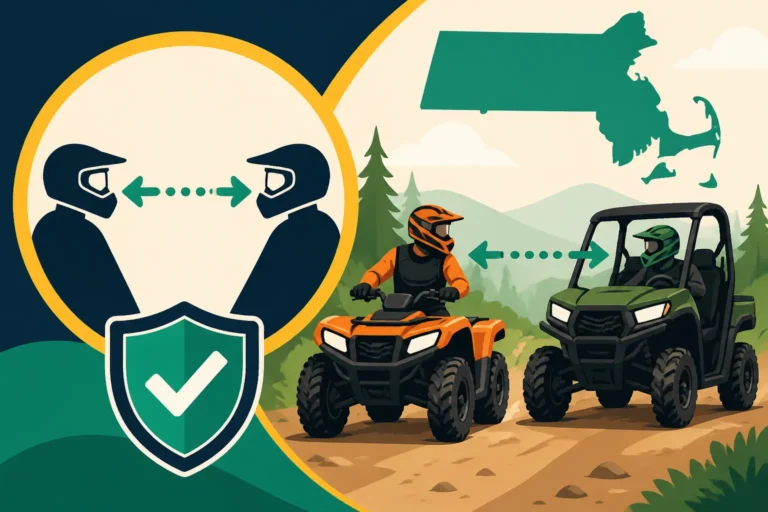
Another critical, and often overlooked, aspect of riding in Massachusetts is the proximity rule regarding dwellings. The state has a "150-foot dwelling rule" which dictates that you cannot operate an OHV within 150 feet of a dwelling or occupied building without the express permission of the owner or occupant. This means even if you have permission to ride on a large tract of land, if your route takes you close to a house, cabin, or even a hunting camp, you need separate permission from that dwelling's occupant for that specific proximity. This is a very specific regulation, outlined in [Massachusetts's 150-Foot Dwelling Rule], and it's designed to protect residents from noise and disturbance.
The issue of noise is particularly sensitive. Even if you're on land where you have permission, a loud ATV or UTV can quickly draw the ire of neighbors, leading to complaints to local law enforcement or the Environmental Police. Aftermarket exhaust systems, while they might boost performance or give your machine a more aggressive sound, can easily exceed legal noise limits and be a source of contention. Manufacturers like SuperATV offer a wide range of accessories, and while many are designed for performance and utility, it's important for riders to consider the impact of any modifications, especially those affecting noise levels, in densely populated areas like parts of Massachusetts. Unchecked noise can lead to [Massachusetts Noise Complaints About Quads] which in turn can lead to fines, even if you are otherwise riding legally. Maintaining a good relationship with any neighbors near your riding area is crucial for the longevity of your riding privilege.
Exploring Trail Connectivity and "Shortcuts"
One of the biggest frustrations for riders in Massachusetts is the fragmented nature of legal OHV trails. You might have a great trail system in one state forest, and another fantastic one a few miles away, but no legal way to connect them. The temptation to take a "shortcut" across a quiet road, an old town way, or a piece of private property to link these trails is incredibly strong. However, this is precisely where many riders run into trouble.
Massachusetts law is very clear: OHVs are generally prohibited on public roads, highways, and even most town-owned dirt roads, except for very limited, specific crossings. Using private land or unauthorized roads as a connector, even for a short distance, constitutes illegal operation and trespass. This is why [Connecting Two Berkshire Forests Without Touching a Road] is such a complex challenge for riders. It requires careful planning and a deep understanding of local laws, often leading to the realization that direct connections are simply not legal. Riders need to resist the urge to create their own paths, as this only exacerbates landowner issues and reinforces negative stereotypes about off-roaders. Sticking to designated trails and legally transporting your machine between riding areas, even if it means loading it onto a trailer, is the only responsible and lawful approach.
Consequences of Unauthorized Riding
Riding an OHV on someone else's land without permission in Massachusetts isn't just a minor infraction; it carries tangible and often costly consequences. These aren't just theoretical; they are real-world penalties that can impact your wallet, your machine, and the future of OHV riding in the state.
Penalties, Fines, and Machine Seizure
Let's not mince words: riding an ATV or UTV on private land without explicit permission in Massachusetts can get you into some serious trouble. The Environmental Police have the authority to issue citations that carry significant fines for trespassing. These aren't just slaps on the wrist; they can quickly add up and become a substantial financial burden. More critically, depending on the severity of the offense, repeat violations, or if you're deemed to be operating recklessly or destructively, the Environmental Police have the power to seize your machine. This means your prized ATV or UTV could be impounded, leading to additional costs for towing and storage, on top of any fines.
The process of getting a seized machine back can be lengthy, complicated, and expensive. It often involves court appearances and demonstrating that you understand and will adhere to the state's OHV laws in the future. Nobody wants to see their machine hauled away, or face the stress and expense of navigating the legal system. Understanding [Massachusetts Penalties for Illegal Riding] is not just about knowing the law; it's about appreciating the real-world impact these rules can have on your recreational activities and your personal finances. It’s a stark reminder that responsible riding means respecting property lines and securing proper authorization before hitting the trails.
Damaging Relationships and Trail Access
Beyond the immediate legal and financial repercussions, unauthorized riding has a broader, more insidious impact: it erodes trust and damages the fragile relationships between the OHV community and landowners, as well as the general public. When a few riders act irresponsibly, trespassing, leaving trash, or causing excessive noise, it paints all OHV enthusiasts with the same brush. This negative perception makes it incredibly difficult for trail advocacy groups and clubs to gain new land access or even maintain existing permissions.
Think about it from a landowner's perspective: if their property is constantly being accessed without permission, leading to damage, litter, or nuisance, they're far less likely to ever consider opening their land for legal, permitted riding in the future. This "bad apple" syndrome can lead to the closure of existing trails or the failure of new trail development projects. Organizations that dedicate countless hours to maintaining trails, organizing cleanups, and advocating for responsible riding are constantly battling these negative perceptions. For instance, when out on legitimate trails, having reliable equipment like a SuperATV winch isn't just for getting yourself unstuck; it can also be invaluable for helping clear fallen trees or moving debris, demonstrating a commitment to trail maintenance and responsible use, which builds positive relationships with land managers and other users. Understanding [Massachusetts Trail Planning and Closures] reveals that trail availability is a dynamic and often precarious situation, heavily influenced by rider behavior.
Finding Legal Places to Ride in Massachusetts
Given the strict regulations in Massachusetts, many riders wonder if there are any legal places to enjoy their ATVs and UTVs. The good news is, yes, there are! But it requires knowing where to go and understanding the rules of designated riding areas.
Designated State Forests and Managed Trails
The primary legal riding opportunities for ATVs and UTVs in Massachusetts are found within a few designated state forests managed by the Department of Conservation and Recreation (DCR). These areas have specific, marked trail systems set aside for OHV use. The "Big Three" in the western part of the state are:
- Beartown State Forest: Located in Monterey, [Beartown State Forest Riding in Massachusetts] offers a network of trails suitable for a range of skill levels. It's a popular spot, but riders must stick to the marked routes.
- October Mountain State Forest: Found near Lee and Washington, [October Mountain State Forest Riding in Massachusetts] is another substantial riding area with miles of trails. Its varied terrain makes it a favorite for many.
- Pittsfield State Forest: Closer to the city of Pittsfield, [Pittsfield State Forest Riding in Massachusetts] provides additional legal riding opportunities, completing the trio of major DCR-managed OHV trail systems.
It's absolutely essential to remember that even within these state forests, you cannot just ride anywhere. You must stay on the designated and marked OHV trails. Veering off-trail, creating your own paths, or entering environmentally sensitive areas is prohibited and can lead to fines and ecological damage. Always check the DCR website or contact the specific forest's ranger station before you head out, as trail conditions, closures, or specific permit requirements can change. The riding season is generally from May to November, but checking for current information is always the smartest move.
Private Riding Parks and Club Lands
Beyond the state forests, another excellent avenue for legal OHV riding in Massachusetts is through private riding parks or club-managed lands. While not as numerous as in some other states, these options often provide a structured, permitted, and often well-maintained riding experience. Private parks operate on a fee-for-access model, meaning your entry fee grants you explicit permission to ride on their designated trails. This removes all the guesswork and stress about landowner permission, allowing you to simply focus on enjoying your ride. These parks often have amenities, safety regulations, and staff on-site to ensure a positive experience.
Joining a local OHV club can also unlock access to legal riding areas. Many clubs, like those listed in [Massachusetts ATV Clubs Worth Joining], work tirelessly with private landowners, towns, and state agencies to establish and maintain permitted trail systems for their members. These clubs often have formal agreements in place, ensuring that their members are riding legally and responsibly. Club membership not only grants you access to these unique trails but also connects you with a community of like-minded riders and often involves opportunities for trail work and advocacy, helping to secure and preserve riding opportunities for everyone. When riding, regardless of the location, investing in quality protection for your machine, such as robust skid plates from SuperATV, can make a huge difference in navigating diverse terrains and protecting your investment, further enhancing your riding experience.
Navigating Legal Riding: A Quick Reference
To help you keep track of where you can and cannot ride, and what kind of permission you'll need, here's a handy table summarizing the Massachusetts OHV land access rules:
| Land Type | Legal to Ride? | Required Permission/Action | Notes |
|---|---|---|---|
| Private Land (Unmarked) | NO | Explicit, written permission from landowner. | Assumed off-limits. Verbal permission is risky and often insufficient. |
| Private Land (Marked) | NO | Explicit, written permission from landowner. | "No Trespassing" signs reinforce the existing law. Do not assume any implied access. |
| Designated State Forests | YES | Adhere to DCR rules, stay on marked trails, observe season dates. (Some may require permit) | Examples: Beartown, October Mountain, Pittsfield State Forests. Check DCR website for current conditions and specific rules. Seasonal closures (May-Nov typically). |
| Other State Parks/Forests | NO | Generally prohibited unless explicitly designated for OHV use. | Most state-owned land, including many parks and conservation areas, do not permit OHVs. Always verify. |
| Municipal/Town Land | NO | Generally prohibited unless explicitly designated and permitted by the town. | Very rare for towns to designate OHV riding areas. Assume off-limits. |
| Private Riding Parks | YES | Pay entry fee, adhere to park rules. | Permission is granted by paying the entrance fee. Often well-maintained and regulated. |
| Club Lands | YES | Membership in the specific club, adhere to club rules. | Clubs often secure specific permissions from landowners for their members, creating private riding opportunities. |
| Public Roads/Highways | NO | Prohibited except for specific, legal crossings. | OHVs are not street legal in Massachusetts. Any road use outside of a legal crossing is illegal. |
| Within 150 ft of Dwelling | NO | Explicit permission from dwelling occupant/owner. | Applies even on land where you do have general permission. This is a separate, specific rule to prevent nuisance. |
Disclaimer
This article is for general informational purposes only and does not constitute professional advice. Laws, prices and regulations vary by location and change over time. Consult a qualified professional for guidance on your specific situation.