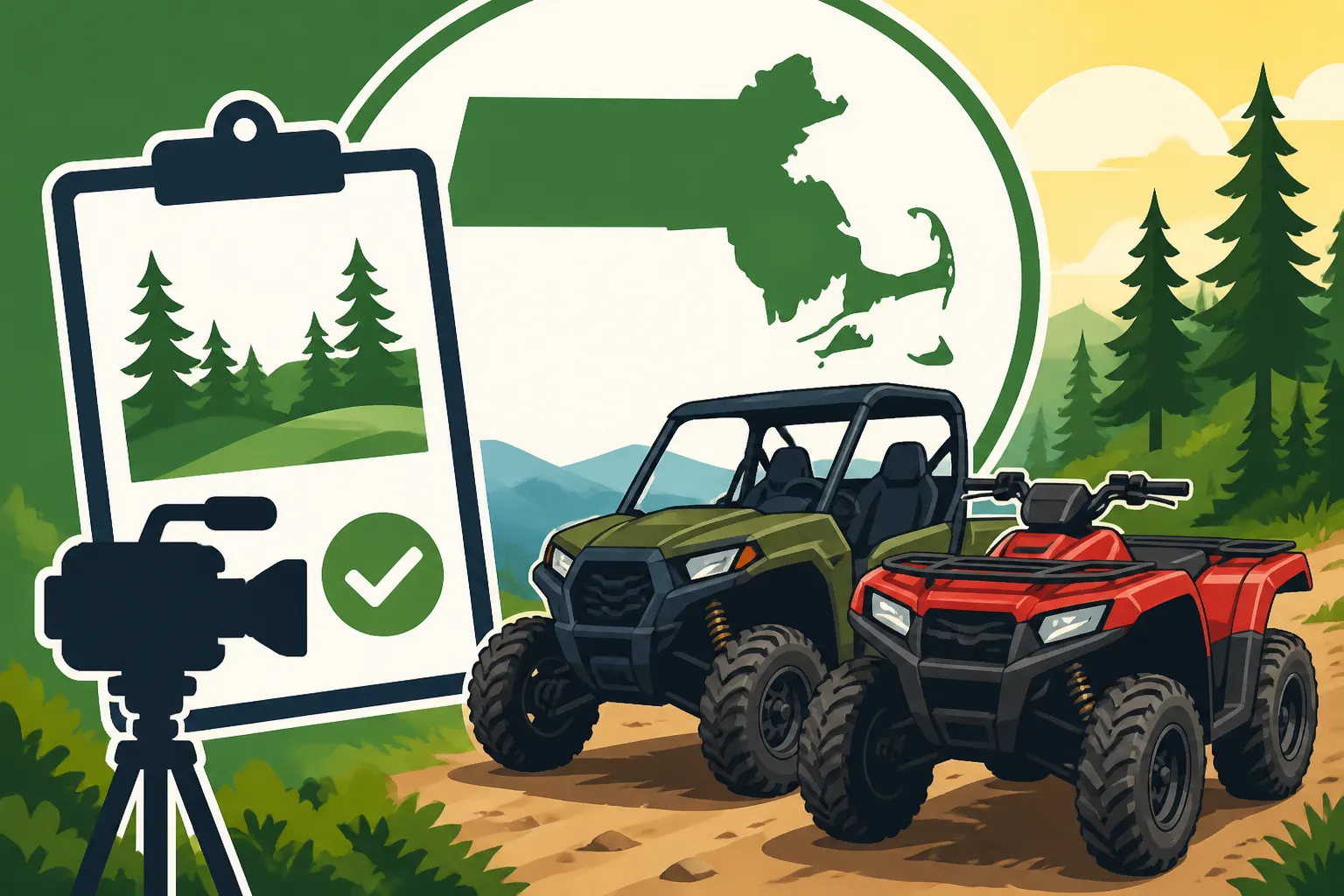
Massachusetts Filming Permits on State Land
Filming on Massachusetts state land can involve more than choosing a scenic trail and bringing a camera. The right permissions depend on who manages the property, what you plan to film, and whether your crew will use vehicles, drones, props, or reserved space. Here’s how to identify the rules, ask the right questions, and avoid treating an ATV registration as permission to film or ride.
Start With the Land Manager, Not the Camera
“State land” covers different properties and uses in Massachusetts. A state forest, wildlife management area, park, and other public property may have different managers and rules. Even land that looks open to visitors may restrict commercial activity, equipment, vehicle access, or filming that affects other users. The first step is to identify the exact property and contact the office responsible for it.
A casual visitor taking personal photos is not necessarily in the same situation as a production crew filming a commercial, documentary, promotional video, or organized project. The distinction matters, but it does not automatically tell you whether a permit is required. Requirements can depend on the location, activity, equipment, crew size, and potential disruption. Ask the land manager directly before you set a date or advertise a shoot.
Be specific when you ask. “Can I film here?” leaves important details unanswered. Explain whether the project is personal, educational, editorial, or commercial; how many people will attend; what equipment you’ll bring; whether you need vehicles or a reserved area; and whether you intend to record other visitors. Ask what authorization is required, how to apply, whether there are fees or insurance requirements, and whether any locations or dates are unavailable.
If the property is part of a state forest with OHV access, do not assume that permission to ride means permission to film commercially. Registration, trail access, filming authorization, and permission to use land are separate questions. For the riding side, review Massachusetts ATV Trails: Three Berkshire Forests and Massachusetts Registration and Trail Access. For filming, confirm the rules with the office that manages the specific property.
| Planned activity | What to clarify before filming |
|---|---|
| Personal photos or handheld video | Whether ordinary visitor use covers your activity and whether any areas are restricted |
| Commercial or organized production | Whether advance permission, an application, insurance, or other conditions apply |
| Filming with an ATV or UTV | Whether riding is allowed on that route and whether the filming activity needs separate authorization |
| Drone footage | Whether the land manager allows takeoff and landing, and what aviation rules also apply |
| A large crew, props, or temporary setup | Whether the location can accommodate it and whether special arrangements are needed |
The table is a starting point, not a substitute for the property’s current rules. The agency may distinguish between small, low-impact filming and a production that changes how a site is used. Get the answer for your actual plan, preferably in writing, and keep it with your production information.
What to Include When You Ask About a Permit
A complete inquiry helps the land manager assess the effect of the shoot and tell you what steps apply. You do not need to guess at the agency’s preferred application format. Start by describing the project clearly, then ask whether the office has a form, deadline, or additional review process.
Include the following details where they apply:
- Property and proposed location: Give the property name and the specific area, trail, road, parking area, or facility you have in mind. If you are uncertain about the exact location, say so and ask where filming might be suitable.
- Purpose and distribution: Explain whether the footage is for personal use, news or editorial work, education, a club project, a business, or advertising. Say where it may appear, such as a website, social media, or a paid production.
- Dates and hours: Provide the preferred date and a backup option, plus the time needed for setup, filming, and removal of equipment.
- People and equipment: Estimate the number of crew members and identify cameras, lighting, tripods, generators, temporary structures, or other equipment that could affect access or require setup.
- Vehicle use: List any ATVs, UTVs, trucks, trailers, or support vehicles. Explain whether they are for transportation, on-camera use, or both, and identify the routes you expect to use.
- Effects on other visitors: Describe how you will keep trails, roads, parking, and public facilities available. Be candid about whether you expect to film identifiable visitors or ask people to participate.
- Special activities: Identify drone use, sound recording, stunts, staged riding, demonstrations, props, or activities involving minors.
Ask whether the manager needs an application, proof of insurance, a site plan, a safety plan, or other documents. Do not assume these are required everywhere, or that one agency’s requirements apply to every property. The office can tell you what it needs for the location and production you described.
A permit, if one is needed and granted, may come with conditions. Those could address where filming is allowed, when the crew can be on site, equipment placement, vehicle routes, cleanup, or how to respond if the area becomes busy or conditions change. Read the approval carefully. If the scope changes—for example, you add a drone, more vehicles, or a larger crew—ask whether the change needs further approval before proceeding.
A filming permit is also not a substitute for other permissions. You may need separate consent from people you feature, permission to use privately owned property visible in the production, or additional approvals for a special activity. The land manager can explain its own requirements, but it may not resolve every legal or production issue.
For a shoot connected to a group ride or public event, ask about the event process as well as filming. Permits for an Organized Ride on State Land and Massachusetts Event Permits for a Ride cover related questions, but a filming plan and an organized event are not interchangeable. If you are being paid to lead riders, check the separate rules for Guiding Riders for Pay on State Land.
ATV and UTV Filming: Access Is a Separate Permission
An ATV or UTV can make a production more complicated because the crew’s filming plan may involve riding, parking, unloading, or stopping in places where motorized access is restricted. Permission to record footage does not automatically authorize motorized travel. In the same way, an OHV registration does not grant access to every state property or authorize a production activity.
Before bringing a machine, confirm each part of the plan:
- Check whether OHV use is allowed at the property. Do not assume that a visible trail, woods road, or utility corridor is open to ATVs or UTVs. Verify current access rules for the specific site and route.
- Confirm the machine is properly registered for Massachusetts use. Visitors should not assume an out-of-state sticker is accepted in Massachusetts. See Out-of-State OHV Stickers Are Not Valid in Massachusetts and Massachusetts Stickers for a Visiting Machine.
- Ask whether filming changes the access conditions. A permitted riding route may still have restrictions on stopping, staging equipment, blocking the trail, or repeating a pass for a shot.
- Plan loading and parking separately. Confirm where trucks and trailers may park and unload. A filming approval does not necessarily reserve a lot or waive a parking requirement.
- Keep the production within the approved scope. If the permit allows filming from one area, do not ride to another location for better footage without checking first.
Some productions may be tempted to ride briefly off a designated route to position a camera or capture a shot. Do not treat a production need as permission to leave an allowed trail. If the shot requires a location the public cannot reach by machine, ask the land manager whether there is an authorized alternative. If there is not, revise the shot or location.
The rules for a visiting rider and the rules for a filming crew can overlap without being identical. A nonresident may need a Massachusetts registration sticker, while a production may separately need authorization to use a state property for filming. Massachusetts does not provide a general trail pass that replaces those checks. For more on registration and access, see Massachusetts Requires Its Own Registration and Why Massachusetts Sells No OHV Trail Pass.
Also consider the practical impact of filming on other trail users. A camera operator standing on a narrow route, repeated vehicle passes, or a stopped group can create a hazard even when the activity is otherwise allowed. Keep equipment and crew out of travel paths, follow instructions from land staff, and be ready to pause if visitors need to pass. A permit should not be read as a guarantee that a trail or public area will be closed to others.
Drones, Crew Conduct, and a Reliable Shoot Plan
Drone footage raises a separate set of questions. Permission to film from the ground does not necessarily include permission to launch, land, or operate a drone from state land. The land manager’s rules and aviation requirements are distinct; check both before planning an aerial shot. The property office can tell you whether drone activity is permitted at that location and whether an additional authorization is needed. See Rules for Flying a Drone Over a State Forest for the state-land side of the question.
Do not treat a drone as a workaround for access restrictions. If a trail or area is closed to motor vehicles, an aerial camera does not authorize the crew to bring equipment into the closed area. Respect closures, signs, and staff instructions, and avoid disturbing visitors or wildlife. If the proposed drone operation cannot be approved, plan a ground-based alternative or choose another location.
Prepare a practical plan for the day, even if the land manager does not require a formal one. Identify who is responsible for communicating with the property office, who will supervise vehicle movement, and who can stop filming if conditions become unsafe or disruptive. Carry any written approval and the contact information for the office that issued it. Make sure crew members know the approved boundaries and what to do if they encounter a closure or a land manager.
A few details can prevent avoidable problems:
- Arrive with enough time to unload without blocking entrances or public parking.
- Keep the crew, vehicles, and equipment within the authorized area.
- Avoid placing cables, stands, or gear where visitors could trip or machines could strike them.
- Do not ask a rider to repeat a maneuver unless the location and activity are allowed and safe.
- Avoid filming identifiable members of the public without considering consent and privacy.
- Remove props, waste, and equipment when the shoot ends.
- Stop and contact the manager if weather, trail conditions, or crowding makes the approved plan unsuitable.
If you cannot reach the property office before the proposed date, do not assume silence is approval. Reschedule, choose a location with confirmed permission, or revise the project to fit ordinary visitor use. A call or email before the shoot is much easier to resolve than arriving with a crew and discovering that the planned activity is not allowed.
For productions involving a private riding park, a town property, or privately owned land, the state-land process may not apply. Contact the organization or owner responsible for that location and ask about its filming, riding, and event rules. For state property, the safest approach is to get a direct answer about the exact site and activity, keep the response, and treat filming permission and vehicle access as separate decisions.
Disclaimer
This article is for general informational purposes only and does not constitute professional advice. Laws, prices and regulations vary by location and change over time. Consult a qualified professional for guidance on your specific situation.