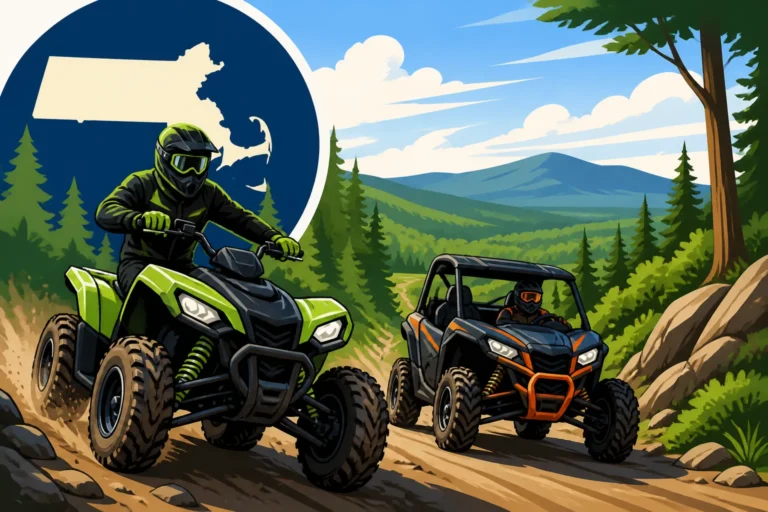
Massachusetts Trails With Camping
Planning an ATV or UTV weekend in Massachusetts can get confusing fast: a forest may allow off-highway riding in one area but prohibit it elsewhere, and a campground nearby does not automatically give you a legal route between camp and trail. This guide explains how to pair camping with authorized riding, what to check before towing, and how to avoid arriving at a closed or unsuitable trailhead.
Where to Pair Massachusetts OHV Trails With Camping
Start with the authorized Berkshire riding areas
Massachusetts has relatively few places where recreational ATV and UTV riding is authorized on designated trails. The best-known public riding opportunities are in the Berkshires, including Beartown State Forest, October Mountain State Forest, and Pittsfield State Forest. These areas are often discussed together, but each has its own trail layout, access points, and rules. Start with [Massachusetts ATV Trails: Three Berkshire Forests] to understand the broader riding options before choosing a place to stay.
Camping and riding are not automatically bundled together. A state forest may have designated OHV routes without a campground, or it may offer camping facilities that are not directly connected to an OHV trail. Even when your campsite is within the same forest, do not assume you can ride from your site to the trailhead. A legal route has to be specifically allowed; riding on an unapproved forest road, campground road, or connector can create a problem even if the trail itself is open.
October Mountain State Forest is one place riders commonly investigate for a trip that combines forest recreation and camping. Treat it as a possibility to research rather than a guaranteed ride-from-camp setup. Confirm whether camping is available for your dates, which sites or facilities can accommodate your group, and how far the campground is from the authorized OHV access point. If you are considering Beartown or Pittsfield, check the same details rather than assuming the camping arrangements match October Mountain’s.
Look beyond the trail boundary for a place to stay
If camping is unavailable at your chosen riding forest, broaden the search to established campgrounds and lodging around Lee, Becket, Great Barrington, and Pittsfield. These towns can serve as practical bases for a Berkshire trip, but proximity on a map does not make a route rideable. Plan to transport your machine by trailer from your campsite to the approved staging area unless the land manager confirms a legal connection.
A nearby campground may be a better fit for families or mixed groups. Some people can enjoy hiking, swimming, or time in town while the riders spend a day on the designated trail system. Before booking, ask whether the campground permits off-highway vehicles on the property, where trailers may be parked, and whether there are restrictions on washing or servicing machines. A quiet campground may have rules about engine noise, loading hours, or where a trailer can sit.
For a useful comparison, think of camping and riding as two separate reservations that need to work together:
| Trip setup | What may work well | What to verify before booking |
|---|---|---|
| Campground in or near a riding forest | Convenient access to forest recreation | Whether camping is offered, whether OHV riding is authorized nearby, and whether a legal connection exists |
| Private campground in a nearby town | More lodging choices and potentially better group amenities | Trailer parking, machine rules, noise expectations, and driving distance to the trailhead |
| Cabin or other forest lodging | A comfortable base for a multi-day visit | Availability, access rules, parking arrangements, and whether the cabin is near an authorized riding area |
| Day-use ride with off-site camping | Flexible option when trail-side camping is unavailable | Trailhead parking, opening dates, travel time, and transportation for the machine |
For more ideas about overnight options, see [Massachusetts Trails With Cabins Nearby] and [Camping Overnight Next to a Berkshire OHV Trail]. Use those as starting points, then confirm the specific facility and current access rules directly before you commit to a reservation.
How to Choose a Campsite That Works for Your Ride
Match the campsite to your trailer and group
A campsite that looks roomy in a listing can feel very different when you arrive with a truck, a trailer, and one or more machines. Ask about the actual parking setup, not just whether the campground allows trailers. Find out whether the trailer can remain attached to the tow vehicle, whether there is a designated overflow lot, and whether the approach includes a narrow lane, steep grade, or tight turn. If you are hauling a side-by-side, verify the dimensions and site access before leaving home.
Think through the entire arrival routine. You may need space to unload without blocking traffic, a safe place to secure helmets and gear, and enough room to turn around if the site is not a pull-through. If you are traveling with children or another driver, decide who will guide the trailer while backing and where everyone should stand. These details sound small until you are trying to maneuver at dusk with tired riders waiting behind you.
It also helps to ask what the campground expects after a day on dusty or muddy trails. Some places may restrict washing machines at the site, while others may have a designated area or no machine-cleaning facilities at all. Bring a plan for handling muddy boots and gear without washing sediment into a campsite or nearby waterway. Keep fuel containers, tools, and riding equipment secured in a way that follows the campground’s rules.
Check camping and riding dates as separate calendars
The riding season and the camping season may not line up perfectly. Massachusetts DCR riding access is seasonal, and individual trails or facilities can close because of weather, maintenance, or other management decisions. A campground may also have its own operating dates and reservation rules. Review [Massachusetts DCR Riding Season] and [Massachusetts Trail Planning and Closures] before selecting dates, then confirm both the riding access and overnight arrangements.
Spring and fall can be especially appealing in the Berkshires, but conditions can change quickly. A wet stretch may leave trails muddy or lead to temporary closures, while a cool night can make a campsite less comfortable than expected. Before towing, check [Massachusetts Trail Conditions Before You Tow] and call the relevant forest or campground office if the information is unclear. A short confirmation call is much easier than discovering at the gate that a route is closed or the campground is not operating.
Use a mapping app such as onX Offroad to help plan the drive, identify nearby roads, and organize potential routes before the trip. It can be useful for getting oriented, but a digital map should not replace posted rules, official trail information, or directions from the land manager. Check the map before departure, save information you may need offline, and be prepared for limited cell service in parts of the Berkshire hills. If an app suggests a route that conflicts with signs or official guidance, follow the official guidance.
Plan the Ride Legally and Avoid Common Camping Mistakes
Confirm the route, rules, and access point
Before you load the machine, verify that your intended trail is open to your specific type of vehicle. A trail that accommodates motorcycles may not be suitable for a wider UTV, and a road that appears on a map may not be open to recreational OHV use. Pay attention to vehicle restrictions, seasonal dates, registration requirements, and any trailhead instructions. [Massachusetts Trails That Allow Side-by-Sides] can help you focus your research if you are bringing a UTV.
Plan to unload and begin riding only at an approved access point. Do not ride from the campground to the trailhead along a public road, through a neighborhood, or over a forest road unless that route is expressly allowed. Massachusetts does not offer a general street-legal route for turning an off-highway machine into a road-going vehicle, so a short connector that looks harmless can still be off limits. Review [Massachusetts Bans Riding on Public Ways] and [Massachusetts Registration and Trail Access] as part of your pre-trip checklist.
If you use onX Offroad to trace a possible route, treat that route as a planning aid rather than permission to ride. Check for signs at the trailhead, follow closures, and stay within designated riding areas. Boundaries can be easy to misread when a trail crosses near private property, a hiking route, or a forest road. When you are uncertain, stop and confirm rather than continuing on the assumption that the route is open.
Respect the campground and the people sharing the forest
A camping-and-riding weekend often means sharing space with hikers, campers, wildlife, and other trail users. Keep speeds low around the campground and staging area, follow posted noise rules, and avoid revving engines early or late. At the trailhead, secure loose gear and leave enough room for other vehicles to unload. Good planning makes the experience less stressful for your group and less disruptive for everyone else.
On the trail, ride within your ability and leave enough distance between machines to manage dust and sudden stops. Yield appropriately when meeting other users, and avoid creating new routes around mud or obstacles. Cutting a fresh line may damage vegetation or widen the trail, which can contribute to closures. [Massachusetts Trail Etiquette Locals Expect] offers useful guidance for sharing the riding areas responsibly.
Build a simple pre-departure checklist and keep it with your trip notes:
- Confirm the authorized trail is open and suitable for your ATV or UTV.
- Verify the campground’s dates, trailer rules, and machine policies.
- Confirm the legal trailhead and arrange to transport the machine there.
- Check registration, safety requirements, and any access instructions that apply.
- Review weather and trail conditions shortly before leaving.
- Save directions and important contact information in case cell service is weak.
- Pack basic tools, water, first-aid supplies, and appropriate layers for changing Berkshire weather.
The most reliable camping trip is the one that treats the campsite, trail access, and vehicle rules as separate things to confirm. Use onX Offroad to help organize your route planning, but let official information and posted signs determine where you can ride. That extra preparation can save you a long tow, a difficult campground arrival, or an avoidable rules problem.
Disclaimer
This article is for general informational purposes only and does not constitute professional advice. Laws, prices and regulations vary by location and change over time. Consult a qualified professional for guidance on your specific situation.