Massachusetts Cabins Near a Forest
Finding a cabin near a Massachusetts forest does not automatically mean you can ride an ATV or UTV from the porch to a trail. Lodging, legal OHV access, seasonal openings, and parking are separate pieces of the plan. This guide explains how to choose a cabin base near Berkshire riding areas, avoid common access mistakes, and prepare for a smoother weekend.
Where to Look for a Cabin Near Massachusetts ATV Trails
Massachusetts has relatively limited public OHV trail access, so start with the riding area rather than choosing a cabin first. The principal state forest OHV areas are in the Berkshires, including Beartown, October Mountain, and Pittsfield State Forests. A place that looks close on a road map may still require a substantial drive or a trailer trip to reach a legal trailhead.
Use the riding area as your starting point
First decide which designated riding area you want to visit, then look for lodging in the surrounding towns. For Beartown State Forest, Monterey, Great Barrington, and parts of Lee can be useful places to investigate. For October Mountain, consider areas around Lee, Lenox, and Pittsfield. For Pittsfield State Forest, look around Pittsfield and the communities toward North Adams.
These are starting points, not promises of a cabin right beside a trail. The Berkshires are full of winding roads, hills, private land, and forest boundaries, so a short distance on a map can translate into a longer drive. Check the route from the cabin to the actual trailhead, including whether your tow vehicle and trailer can use the roads comfortably.
If you are comparing the three areas, read about their trail character before booking. [Massachusetts ATV Trails: Three Berkshire Forests] offers a useful starting point, while [Beartown State Forest Riding in Massachusetts], [October Mountain State Forest Riding in Massachusetts], and [Pittsfield State Forest Riding in Massachusetts] can help you match the area to your group and riding plans.
Treat “near a forest” as a lodging description, not an access permit
A cabin may sit beside state land, a private woodlot, or a scenic road without having any legal connection to an OHV trail. Even when you can see forest from the property, riding across the land may be prohibited unless it is an authorized trail or you have the required permission. A private driveway, logging road, or snowmobile route is not automatically open to ATVs.
This distinction is especially important when a listing says “trail access,” “woods access,” or “close to trails.” Ask the host exactly what those phrases mean. They may refer to hiking, mountain biking, or walking paths rather than motorized riding. Ask for the nearest authorized OHV trailhead by name, and confirm that the route between the cabin and trailhead is a public road where your machine can legally be hauled—not ridden.
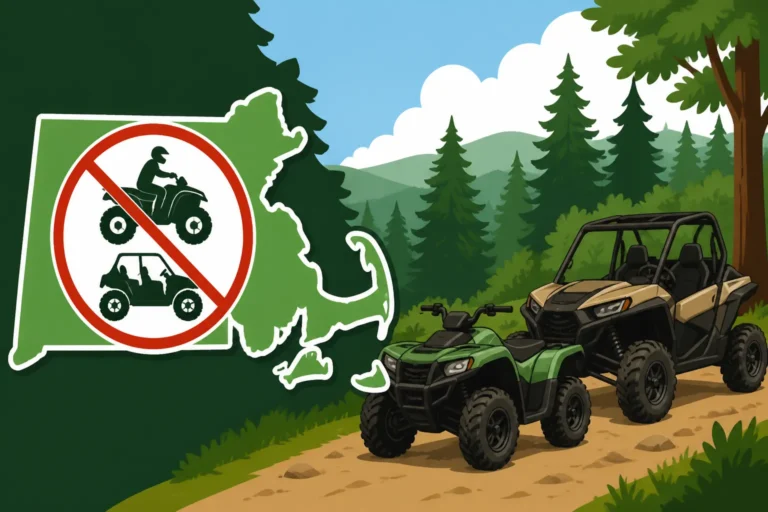
Massachusetts has no general street-legal route that lets an ATV or UTV travel from lodging to a trail on public roads. Plan to transport the machine on a trailer unless you have verified a specific lawful connection. The restrictions are explained in [Massachusetts Has No Street Legal Path] and [Massachusetts Bans Riding on Public Ways].
How to Choose the Right Cabin Base
A cabin can make a riding weekend feel relaxed, but only if the property works for your machines, trailer, and group. Before booking, check practical details that can be easy to overlook in attractive photos: parking dimensions, turning space, storage rules, quiet hours, and the actual drive to the trailhead.
Confirm machine and trailer logistics before paying
Ask whether the property has enough room for your tow vehicle, trailer, and every machine in your group. A narrow gravel driveway, steep entrance, low branches, or a tight turnaround can become a real problem after a long drive. If the cabin is on a hillside or down a private lane, ask whether a loaded trailer can reach it in wet weather.
Clarify where the machines may be parked and whether they can be stored outside overnight. Some hosts may not allow vehicles or equipment on lawns, decks, or septic areas. If you need to unload before reaching the cabin, check whether there is a safe, legal place to do so. Do not assume a nearby roadside pull-off is suitable for unloading or overnight parking.
It also helps to ask about noise expectations. A cabin in a quiet residential area may have strict quiet hours, and starting a machine early or washing mud late in the evening can bother neighbors. Keep machines secured, avoid revving them near homes, and follow the host’s instructions about fuel, cleaning, and indoor storage.
Compare the real travel time, not just the map distance
A cabin that is a few miles from a forest boundary may still be far from the legal OHV entrance. Forest roads can be slow, winding, or unsuitable for towing. Use a route planner to estimate the drive to the correct trailhead, then check whether the route involves narrow roads, seasonal restrictions, or a gate.
Mapping tools can help you understand the landscape. For example, onX Offroad can be useful for reviewing route context and nearby terrain while you plan. Still, an app map should not be treated as permission to ride, proof that a route is open, or a substitute for current land-manager rules. Confirm the trail’s status and access directly before setting out. This matters most when a suggested route appears to cross private property or connect two public areas.
Build a little flexibility into the schedule. If a trailhead is busy, a road is closed, or weather changes the plan, a cabin with easy vehicle access and a reasonable drive to more than one area can be helpful. For broader planning, [Massachusetts Trail Planning and Closures] and [Massachusetts Trailhead Parking] are useful topics to check before you commit to a weekend.
What to Verify Before Booking and Riding
The safest way to avoid a disappointing arrival is to verify the cabin, the trail, and the machine requirements separately. A confirmed lodging reservation does not confirm riding access, and a registered machine does not mean every nearby forest road is open to it.
Ask the host specific questions
Rather than asking only, “Are you near ATV trails?” use questions that invite a clear answer:
- Which named OHV trailhead is closest to the property?
- How long does it take to drive there with a trailer?
- Is there room to park the tow vehicle and trailer overnight?
- Are ATVs or UTVs allowed on the property, and where may they be parked?
- Are there rules about unloading, washing, fuel, or machine noise?
- Does “trail access” mean a designated motorized trail, or a walking or biking path?
- Are there seasonal road closures or gate restrictions that affect the drive?
If you receive a vague answer, verify the details with the relevant land manager before booking. A host may know the local area well but may not track OHV-specific closures or registration requirements. Make sure the trail you plan to use is open to your type of machine; a route suitable for motorcycles or hikers may not allow a side-by-side.
OnX Offroad may help you compare the cabin’s location with roads and mapped routes, but it cannot resolve unclear property permission. If a route crosses private land, obtain permission from the owner rather than relying on a map line. Massachusetts guidance on [Massachusetts Landowner Permission in Writing] explains why clear permission matters.
Check seasonal access, registration, and trail rules
Massachusetts OHV riding is seasonal, and the opening period can vary with conditions and management decisions. Do not assume a trail is open simply because a cabin is available or a route appears online. Check for current forest notices before towing; heavy rain, maintenance, damage, or other operational needs can affect access. [Massachusetts DCR Riding Season] provides background on the general season, and [Massachusetts Trail Conditions Before You Tow] is a useful reminder to check close to departure.
Registration is another separate requirement. Massachusetts requires its own OHV registration for machines used in the state; an out-of-state sticker alone does not replace it. Review [Massachusetts Requires Its Own Registration] and [Massachusetts Visitors Buy a One-Year Sticker] if you are bringing a machine from outside Massachusetts. Keep the registration card with the machine and make sure the decals are displayed as required.
| Before you leave | What to confirm | Why it matters |
|---|---|---|
| Cabin booking | Trailer parking, machine storage, driveway access, and host rules | Prevents arrival-day parking or property-use surprises |
| Trail choice | Named trailhead, permitted machine types, and current opening status | Nearby forest roads may not be legal OHV routes |
| Registration | Required Massachusetts registration and documents | A home-state sticker may not meet Massachusetts requirements |
| Weather | Rain, mud, and trail notices | Conditions can change access and make trails vulnerable to damage |
| Route planning | Tow-vehicle route and legal trail connection | A mapped line does not guarantee a public or authorized route |
A Practical Plan for a Berkshire Cabin Weekend
A simple plan keeps the weekend from turning into a scramble for parking, paperwork, or a legal trail entrance. Decide which area you want to ride, choose lodging based on the trailhead drive and trailer setup, then verify rules shortly before departure.
Build an itinerary that leaves room for changes
Before the trip, save the cabin address, trailhead location, and a second possible riding destination. Check the drive between them rather than assuming the forests connect. A route that looks continuous on a map may pass through land where motorized riding is not allowed.
Use onX Offroad as one planning aid if it helps you visualize the area, but compare what you see with official access information. Download or save the details you need before you leave home, especially if cell reception may be limited in the hills. A paper map or offline directions can be useful when service drops.
Keep the riding day realistic. Allow time to unload, inspect the machines, review the rules, and reach the designated trail. If your group includes new riders, younger riders, or machines with different capabilities, choose an outing that fits the least experienced person rather than pushing to cover as much ground as possible.
Pack for the cabin and the trail separately
For the cabin, confirm linens, cooking equipment, drinking water, trash rules, and any check-in instructions. For the trail, prepare registration documents, helmets, protective gear, tools, water, and basic first-aid supplies. Keep machine keys and documents secure, and do not leave fuel containers inside living spaces unless the host explicitly permits an appropriate storage arrangement.
Before leaving the trailhead, check that everyone understands the route, meeting point, and what to do if a machine develops a problem. Ride only on authorized trails, yield appropriately, and avoid creating new tracks around muddy sections. A cabin weekend should not leave the property or forest with cleanup, noise, or trail damage to deal with afterward.
The biggest planning mistake is treating “cabin near a forest” as shorthand for “ride from the cabin.” Choose lodging for comfort and practical access, transport your machines to the legal trailhead, and verify every part of the trip independently. That small amount of checking can save a long tow to the wrong entrance and help keep the weekend enjoyable for your group and the people who live nearby.
Disclaimer
This article is for general informational purposes only and does not constitute professional advice. Laws, prices and regulations vary by location and change over time. Consult a qualified professional for guidance on your specific situation.