Massachusetts Certificates Carried on Public Land
Massachusetts riders can reach a trailhead with a valid machine registration and still be missing a required document: a youth operator’s OHV safety certificate. Knowing who needs one, when it must be carried and what it does not authorize helps prevent a paperwork problem from ending a ride. Here’s how to think about the certificate before you head onto public land.
What the Massachusetts OHV safety certificate is
An OHV safety certificate is proof that a rider has completed the required off-highway vehicle safety education. It is not a driver’s license, a registration card or a trail pass. Each document serves a different purpose, and having one does not make the others unnecessary.
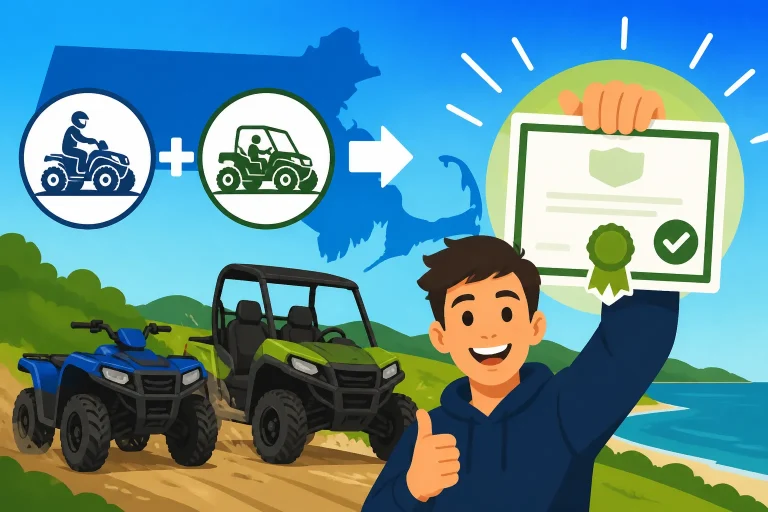
For Massachusetts riders, the certificate requirement matters particularly to operators under 18. A young rider who needs a certificate should complete the required safety education and carry the resulting proof while riding where the rules apply. The course has two parts; finishing only one part does not mean the rider has completed the full requirement. See Two Parts to the OHV Safety Certificate for an overview of how the course is structured.
It is useful to keep these documents separate in your mind:
| Document | What it shows | What it does not show |
|---|---|---|
| OHV safety certificate | The rider completed required safety education | That the machine is registered or that the rider may use a particular trail |
| Registration card | The machine is registered as required | That the operator has completed safety education |
| Registration decal | The machine has a registration decal | That the rider has permission to use all public or private land |
| Land access permission | The rider may use the relevant property or route, subject to its rules | That the machine is registered or the rider has a required certificate |
A certificate also does not give a rider permission to use any trail simply because the trail is on public land. Riding access depends on the land manager’s rules, the route’s current status and the machine type allowed there. Registration and safety education are important, but neither replaces checking whether that particular area is open to your vehicle.
That distinction matters when families prepare for a ride. A parent might have the registration card and a trail map in the tow vehicle while a teen rides the machine. If the teen is required to carry a safety certificate, documents stored back at the parking area may not solve the problem during a trail check. Plan for the rider to have the required proof with them.
Who needs to carry a certificate
Massachusetts requires safety education for certain young OHV operators, and riders under 18 should treat the certificate as a document to carry when operating on public land. The details can depend on the rider’s age and the type of riding. The certificate requirement is only one part of the rules that may apply to a young operator.
Age-based riding limits can affect whether a young person may operate a particular machine, whether adult supervision is required and what conditions apply. Having a certificate does not override those limits. A certificate holder still needs to follow the rules for the rider’s age, engine size, supervision and riding location. For more detail, see Massachusetts Safety Certificates Under 18 and Massachusetts Rules for Young Riders on Public Land.
A practical way to decide what to check is to start with the rider, not the machine:
- Confirm the rider’s age. Youth rules can change as a rider moves into a different age group. Do not assume a rule that applied last season still fits.
- Check whether the rider must complete safety education. Review the current Massachusetts requirements and any age-specific conditions.
- Confirm that both course parts are complete. If the course requires an online component and an in-person component, completing only one is not enough.
- Make sure the certificate has been issued. A course registration, a class booking or a completion screen for only one part may not be the same as the official certificate.
- Carry the required proof while riding. Do not leave it in a parent’s wallet, the truck or a trailer at the trailhead.
- Check the other age rules independently. Certificate possession does not make an otherwise restricted ride lawful.
Rules for riders under 16 are not necessarily the same as rules for 16- and 17-year-olds. A younger operator may have additional requirements involving supervision or parent participation in the safety course. Check [Massachusetts Certificate Rules Under 16] and Massachusetts Certificate Rules at 16 and 17 rather than relying on a general statement that “the kid has a certificate.” The course and riding rules are related, but they are not interchangeable.
For families, it helps to check the rule for the specific rider before choosing the machine. A safety certificate does not authorize a young person to ride a machine that exceeds an applicable engine-size limit, nor does it remove a supervision requirement. If the adult accompanying the rider is expected to supervise, that adult needs to understand what supervision means under the applicable rule. A parent riding somewhere else on the same trail may not automatically meet the requirement.
Where a parent must attend a course session with a younger student, that is a separate course condition, not a substitute for the student’s own completion. The parent’s attendance does not turn into a certificate for the child. Families can review Parents Must Attend With Students Under 16 before booking or attending a course.
If a rider is close to an age cutoff, avoid guessing based on the age they will turn later in the season. Confirm which rule applies on the day of the ride and whether any additional requirements are triggered by the machine or location. When there is uncertainty, ask the relevant state office before the trip rather than trying to resolve it at a trailhead.
What carrying the certificate means in practice
“Carry the certificate” should be treated as an on-the-ride requirement, not a task to remember after arrival. Keep the proof with the rider or in a secure place on the machine where it can be produced if requested. Leaving it in a parked vehicle may mean the rider cannot show it during a check away from the trailhead.
Before a ride, confirm the certificate is legible and belongs to the operator who is carrying it. If a family has several youth riders, do not assume one child’s certificate covers a sibling. Each rider subject to the requirement needs their own valid proof.
A sensible document routine is:
- Check the certificate before loading the machine.
- Put it in a protective sleeve or other secure, weather-resistant place.
- Make sure the rider knows where it is and how to retrieve it.
- Keep it separate from any paperwork that belongs only to a parent or another rider.
- Check that it has not been damaged, misplaced or separated from the rider’s gear.
Paper can become wet, torn or difficult to read, especially if it is carried in a pocket through mud or rain. A small waterproof document sleeve can help keep the proof in usable condition. If buying a sleeve through Amazon or another retailer, choose one that closes securely and fits the certificate without folding or obscuring identifying information. The carrier is just a storage aid; it does not replace the official certificate.
Some riders may prefer to keep a digital image as a backup. A phone photo can help if a paper copy is lost, but do not assume a photo or screenshot is accepted in place of the required certificate. Confirm what format the responsible authority accepts before relying on a digital copy. A charged phone is also not a dependable replacement for carrying required documentation: batteries fail, devices get wet, and coverage may be limited in remote areas.
The rider should know how to show the certificate calmly if an officer or land manager asks. It can help to keep the document accessible without placing it where it may fall out or interfere with riding. Avoid attaching loose papers to handlebars or leaving them exposed to weather. A secure pocket or closed pouch is more practical.
Parents can build the check into the same routine they use for helmets, registration and machine condition. Ask the rider to show the certificate before departure rather than simply asking whether they packed it. That small step can catch a missing or unreadable document before the group is far from home.
If the certificate is lost, damaged or never arrived after course completion, do not assume that a course receipt will be accepted. Contact the appropriate safety education office or course provider and ask how to confirm completion and obtain replacement proof. For contacts and next steps, see Massachusetts Safety Bureau Contacts. If the rider’s certificate status is unclear, postpone riding on public land until the requirement is resolved.
What the certificate does not replace
A safety certificate is only one item in a rider’s compliance checklist. It does not substitute for the machine’s registration card or decal, and it does not establish that the operator has permission to ride a route. Carry the documents that apply to the rider and machine, and check the access rules for the riding area.
Massachusetts registration is separate from safety education. A machine may need Massachusetts registration even if it has an out-of-state sticker, and a certificate from a safety course does not register the vehicle. Review Massachusetts Requires Its Own Registration for the state registration issue, and The Registration Card You Must Carry in Massachusetts for the machine paperwork that must travel with it.
The registration card and the safety certificate are easy to confuse because both may be described as documents riders need to carry. They belong to different people or things: the certificate is evidence about the operator’s safety education, while the registration card concerns the machine. For a group ride, check that each rider has their own required proof and that the correct registration paperwork is available for each machine.
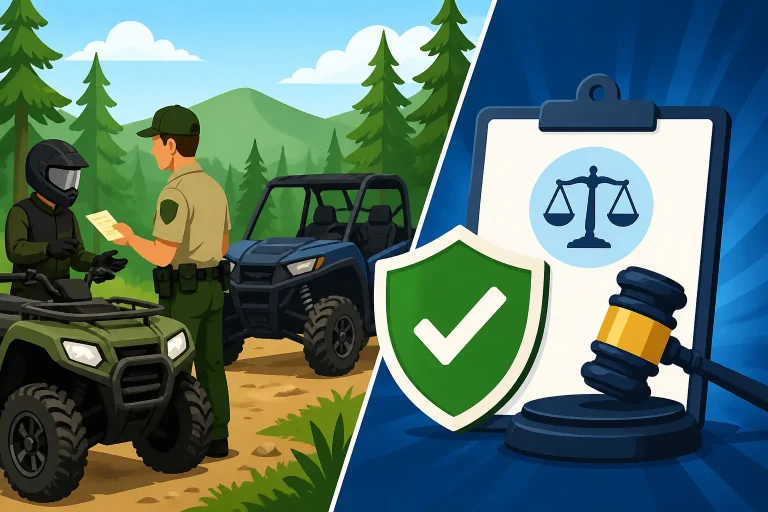
Neither document by itself grants access to a state forest, town property, conservation land or private trail. Publicly owned land is not automatically open to OHV use. Some routes may be closed to motorized riding, restricted to certain vehicle types or temporarily unavailable because of conditions or management decisions. Private land requires the owner’s permission where applicable. Before towing a machine a long distance, check the land manager’s current access information and any local conditions.
A certificate also does not waive other operating rules. Depending on the rider and location, requirements may involve supervision, protective equipment, machine equipment, route restrictions or other conditions. If riding with a young operator, use the certificate as one item on the checklist rather than as a general “all clear.”
A complete pre-ride check can include:
- The rider’s age-specific eligibility and supervision requirements.
- A valid certificate for each rider who is required to have one.
- The machine’s registration documents and properly displayed decal.
- The land manager’s rules for the specific area and vehicle type.
- Any required safety equipment and functioning machine equipment.
- Permission for any private land included in the planned route.
- Current closures, seasonal restrictions and trail conditions.
Visitors from another state should also avoid assuming that a home-state document automatically settles every Massachusetts requirement. Registration and safety education are different questions, and each may have its own rules. Massachusetts does not treat a visiting rider’s paperwork as a universal substitute for state requirements. Confirm what applies to the machine and operator before entering a Massachusetts riding area. The distinction between stickers and access is covered in Out-of-State OHV Stickers Are Not Valid in Massachusetts.
A simple pre-ride document check
A short check at home or before unloading is easier than sorting out paperwork after a ride has begun. Use this sequence for each youth rider:
- Identify the operator. Make sure the paperwork is for the person who will actually ride, not just the parent or owner of the machine.
- Verify the age-specific requirement. Check the current rules for that rider’s age and riding situation.
- Confirm course completion. If the required course has multiple parts, verify that all required parts are done and the certificate has been issued.
- Put the certificate where the rider can access it. Do not store the only copy in a separate vehicle or with another group member.
- Check the machine paperwork. Carry the registration card and make sure the decal is present as required.
- Confirm the route is open and appropriate. A valid certificate and registration do not establish permission to ride there.
- Have a backup plan for missing or damaged documents. Contact the issuing office or responsible authority before riding if the rider cannot produce acceptable proof.
For a family group, create a separate document check for every machine and operator. One adult may be managing multiple helmets, keys and registration cards, but each rider’s individual requirements still apply. A simple paper checklist or a note on a phone can help, but the checklist itself is not proof of course completion.
Keep personal details protected. A certificate may contain identifying information, so avoid leaving it visible in an unattended vehicle or posting a clear image online. Store it securely when not riding, and carry it only in a way that makes it available when required.
If an officer asks to see the certificate, cooperate and show the official proof you brought. If you are unsure whether a particular card or digital format is acceptable, ask the relevant authority before riding instead of relying on informal advice from a seller, another rider or a social media post. Questions about certificate acceptance are distinct from questions about registration reciprocity; Which Safety Certificates the Environmental Police Accept is a useful starting point for checking that issue.
For the smoothest trailhead routine, keep the operator’s certificate with the operator, the machine’s registration documents with the machine, and route permission or access information with the adult organizing the ride. That arrangement makes it easier to find the right document quickly without confusing one requirement for another.
Frequently Asked Questions
Do all Massachusetts ATV and UTV riders need an OHV safety certificate?
The certificate requirement is especially relevant to operators under 18. Riders should check the current rules for their age and riding circumstances rather than assume that the same requirement applies to every adult and youth rider.
Can a parent carry the child’s certificate?
The safest approach is for the rider to carry their own required proof while operating. A certificate left with a parent at the trailhead may not be available if the rider is checked elsewhere.
Does a safety certificate replace the registration card?
No. The safety certificate concerns the rider’s education; the registration card concerns the machine. Carry both when they apply.
Does having a certificate mean a rider can use any public trail?
No. The certificate does not grant land access. Check whether the particular route is open to OHVs, whether that machine type is allowed and whether any separate permission or conditions apply.
Disclaimer
This article is for general informational purposes only and does not constitute professional advice. Laws, prices and regulations vary by location and change over time. Consult a qualified professional for guidance on your specific situation.