Riding Quietly Past Forest Campsites
A quiet ride can turn uncomfortable fast when an ATV or side-by-side passes close to a tent, campsite, or occupied cabin. Even a machine that sounds reasonable on the trail can feel startling at close range, especially early in the morning or after dark. This guide explains how to plan and ride through Massachusetts forest areas with consideration for campers, neighbors, and other trail users.
Plan your route before you start the engine
Confirm the route is open to your machine
A line on a map is not proof that a trail is open to ATVs or UTVs. Massachusetts riding access can vary by forest, route, season, and vehicle type. Some roads are closed to off-highway vehicles, some trails are intended for narrower machines, and a route that appears to connect two legal riding areas may cross land where motorized use is not allowed.
Before hauling to a forest, check current official information and follow signs at the entrance and along the route. Pay attention to seasonal closures, temporary restrictions, and directions from forest staff. The guidance in Massachusetts Trail Planning and Closures can help you think through what to check before a trip, while Massachusetts Trails That Allow Side-by-Sides is useful when you are deciding whether a route suits a wider UTV.
A navigation app can help you understand the area and prepare a route. For example, onX Offroad can be one tool for reviewing mapped roads and terrain before you leave home. Treat it as a planning aid, not as permission to ride: posted signs and official land-manager rules take priority. Download or save what you need before reaching a spot where cell service may be unreliable.
Look for campsites and other sensitive spots
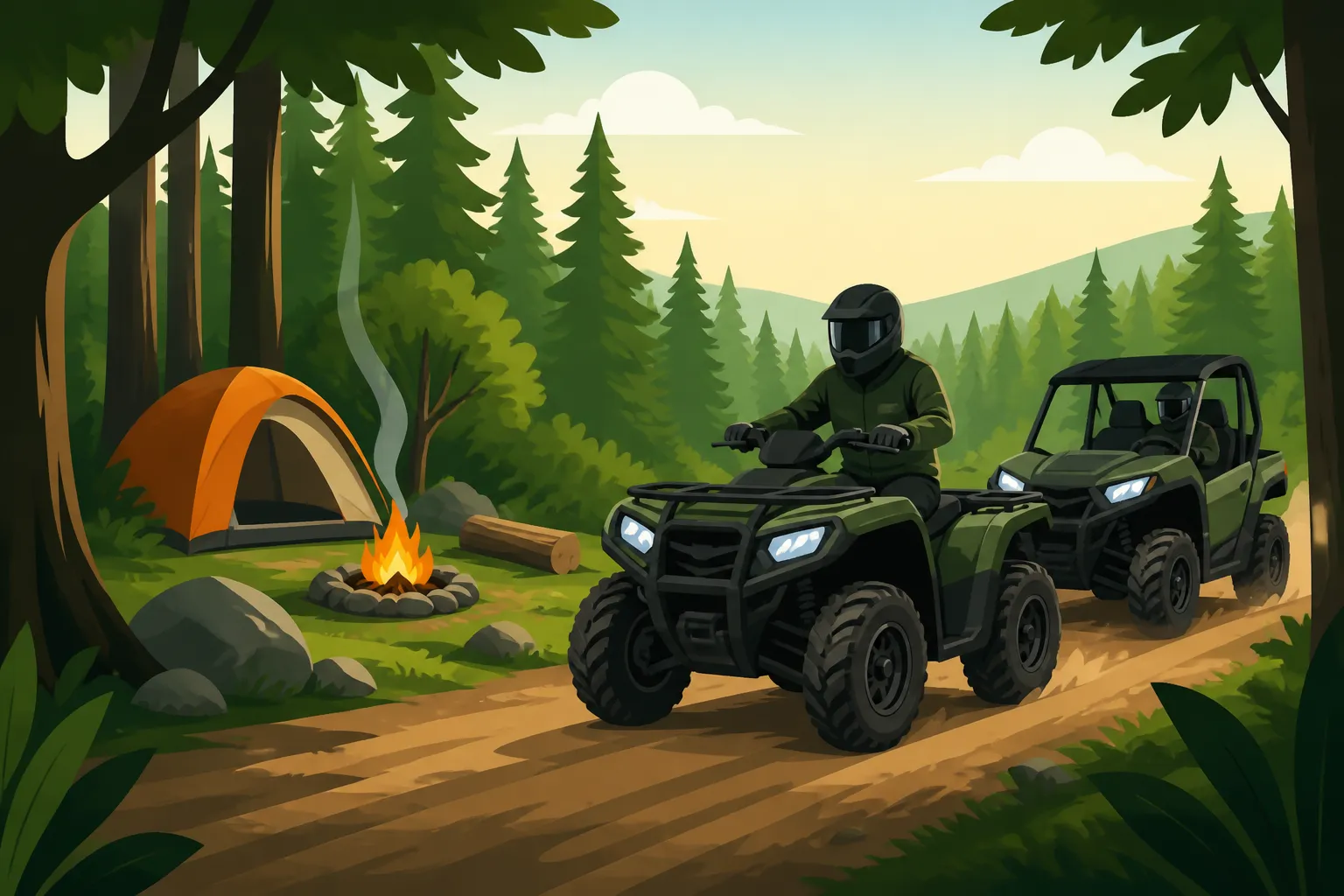
Campsites may sit near forest roads, trail entrances, or other places where riders pass through. The people staying there may be asleep, cooking, tending a fire, or trying to keep children settled. A rider who sees a campsite only at the last moment may have little room to make a considerate adjustment, so look ahead and slow down when the trail approaches a developed recreation area.
If you are planning a weekend ride, check whether camping is available near your intended riding area and where the campground sits in relation to the route. Massachusetts Camping Near Riding Areas is a helpful starting point for that kind of trip planning. Once you arrive, use the posted campground map and local signs rather than assuming a trail continues through or alongside a camping loop.
A map view may not show every occupied site, tent, or temporary restriction. Use onX Offroad or another mapping tool to get a broad sense of the area, then confirm your route at the trailhead. If the route is unclear, ask a forest office or choose a clearly marked alternative instead of improvising past campsites.
Ride quietly when people are nearby
Reduce noise before you reach the campground
The most useful noise-control decision often happens before the ride. Check that your machine’s muffler and exhaust are in good condition, and do not remove or modify equipment intended to control sound. A rattling heat shield, damaged exhaust part, or loose component can make a machine noticeably louder and may signal a maintenance issue as well as a courtesy problem.
Massachusetts has rules addressing off-highway vehicle equipment and sound on state land. Review Massachusetts Sound Limits on State Land and Massachusetts Muffler and Noise Rules for the relevant requirements, and do not assume that an exhaust that seems acceptable in an open field will be welcome beside a campground. Legal compliance is the baseline; riding with extra consideration around people is better.
Avoid revving for no reason, spinning tires, or accelerating hard near occupied sites. If your machine needs attention, stop somewhere appropriate away from campers and troubleshoot without repeatedly blipping the throttle. If it is unusually loud or has an exhaust problem, the considerate choice may be to end the ride and repair it before returning.
Slow down early and keep a steady pace
When you notice tents, vehicles, cabins, or people ahead, ease off the throttle well before you reach them. A gradual reduction in speed is quieter and less startling than charging toward a site and braking sharply at the last moment. Keep a controlled pace through the area, avoid sudden acceleration, and follow any posted speed or access signs.
Dust matters too. A fast pass can send dust toward tents, picnic tables, or food, even if the machine is not especially loud. On dry ground, slowing down well before the campsite helps limit both noise and dust. On a narrow road, leave enough space for people walking, children, or pets to move safely without feeling rushed.
Do not use a campsite loop as a shortcut unless signs clearly allow it. If a route appears to lead between sites, pause at a safe place and check the posted directions. Turning around carefully is preferable to riding through an occupied area because a map seemed to show a connection.
| Situation | Considerate response | Avoid |
|---|---|---|
| You see tents or a campground ahead | Ease off early and ride steadily | Accelerating toward the site, then braking hard |
| People are walking near the route | Slow down and give them room | Revving, crowding, or rushing past |
| Dust is drifting toward a campsite | Reduce speed before reaching it | Spinning tires or passing at high speed |
| A route through the campground is unclear | Stop safely and check signs or choose another route | Guessing that the loop is open to riding |
| Your exhaust sounds unusually loud | Inspect it and consider ending the ride | Continuing past occupied sites and hoping no one minds |
Share forest roads with campers and other trail users
Give people space and time
A campground road is not just a corridor for machines. People may be carrying food, walking with a child, stepping away from a tent, or moving between a vehicle and a site. If you meet someone near the trail, reduce speed and allow them room to choose where to stand. A friendly wave can reassure people that you have seen them, but it does not replace giving them space.
Be especially cautious around children and dogs. They can move unpredictably, and engine noise may make it difficult for a person to hear you approaching. If a child or animal is close to the route, stop at a safe distance and wait until the way is clearly open. Do not assume that a person can quickly pull a dog or stroller out of the trail.
The same courtesy applies to hikers, cyclists, and other riders. Massachusetts Trail Etiquette Locals Expect offers broader guidance for sharing a route. On a narrow trail, follow posted right-of-way rules, avoid blocking the path, and make your intentions clear without using a loud or aggressive horn.
Respect quiet periods and campground rules
Campground quiet periods are set by the facility or land manager, so check the rules where you are staying rather than relying on a general assumption. Even outside a posted quiet period, early mornings and late evenings are sensitive times. If you can adjust your route to avoid passing close to occupied sites during those hours, do so.
Keep your group together without letting it become a noisy convoy. Riders spread far apart may accelerate to catch up, while a tightly packed group can create a prolonged burst of engine noise. Agree on a steady pace and regroup at a designated place away from campsites. Keep conversations and music at a level that does not carry through the forest.
If a camper asks you to slow down or explains that a route is disturbing their site, stay calm and check the signs and rules. Do not argue from the assumption that a public forest is yours to use however you like. If the route is legal, you can still respond courteously by slowing down, choosing another route when practical, and reporting unclear signage to the appropriate office.
Prepare for a quieter, safer ride
Check conditions and machine readiness
A muddy, rutted, or recently damaged route can make it harder to ride smoothly. Before traveling, review Massachusetts Trail Conditions Before You Tow and any official closure notices. After heavy rain, a route may be especially vulnerable to damage; spinning tires or powering through a soft section can harm the trail and create unnecessary noise.
Check your machine before leaving: look for loose body panels, a rattling skid plate, exhaust damage, and other parts that may vibrate or clank. Pack the basic tools you know how to use, but do not perform noisy repairs beside a campsite. If a mechanical problem requires repeated engine starts, move to a suitable area away from occupied sites when it is safe to do so.
Planning with onX Offroad can help you identify a route and possible alternatives before the trip. Still, confirm closures and access rules through official sources, and be prepared to turn around if signs or conditions do not match your plan. A planned alternative is more useful than discovering at the campground entrance that the only apparent route is unsuitable.
Make a simple group plan
Before the ride, tell everyone in your group how you will handle campsites and pedestrians. Agree to slow down early, avoid unnecessary throttle, and regroup away from occupied areas. New riders may not realize how quickly a UTV’s engine noise carries through a quiet forest, so a short conversation beforehand can prevent an awkward encounter later.
For a larger group, designate a lead rider and a sweep rider. The lead can spot signs and hazards, while the sweep can make sure no one is left behind. Ask riders not to race to close gaps between machines. If the group becomes separated, use an agreed meeting point rather than repeatedly revving or calling out near campsites.
Keep the essential details easy to check: the legal route, known closures, campground boundaries, and a safe turnaround point. onX Offroad may help you keep your route organized, but posted directions and land-manager instructions remain the final guide. For additional context on seasonal access, see Massachusetts DCR Riding Season and confirm the rules for the specific forest before you go.
Riding quietly past forest campsites is not complicated, but it does require attention before and during the ride. Choose a legal route, maintain your machine, slow down well before people, and avoid using campground areas as shortcuts. Those small choices help protect the experience of campers while making shared forest access more respectful for everyone.
Disclaimer
This article is for general informational purposes only and does not constitute professional advice. Laws, prices and regulations vary by location and change over time. Consult a qualified professional for guidance on your specific situation.