Tolland’s Street-Legal Trails in Massachusetts
Tolland’s riding area can be confusing if you arrive with an ATV or side-by-side expecting a typical off-road trail network. The key distinction is that the trails are associated with street-legal motorcycles, not a general invitation for every off-highway vehicle. This guide explains what that means, how to prepare, and what to check before towing to Tolland State Forest.
What Tolland’s street-legal trails are for
Street-legal motorcycles are not the same as trail-only machines
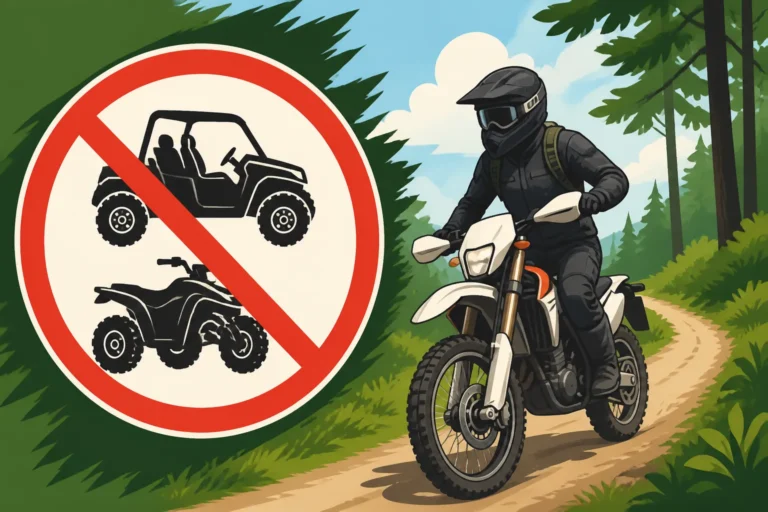
The phrase “street-legal trails” can sound as if any registered off-road vehicle is welcome. In Tolland, the important distinction is the type of machine: the riding opportunity is described for street-legal motorcycles. A dirt bike that is designed for trails but does not meet the applicable requirements for road use is not automatically eligible just because it has an off-road registration sticker.
A street-legal motorcycle is generally equipped and registered for lawful operation on public roads. That distinction matters because Massachusetts treats road use and off-highway riding differently. Do not assume an OHV registration makes an ATV or UTV street-legal, or that it qualifies the machine for a trail intended for street-legal bikes. For more background on the separate registration system, see [Massachusetts Requires Its Own Registration].
If you are considering a dual-sport motorcycle, check both sides of the question before you go: whether the motorcycle is legally equipped and registered for road use, and whether the particular Tolland route is open to that kind of machine. Those are related, but they are not interchangeable permissions. A machine being road-legal does not, by itself, establish that every forest road or trail is open to it.
Tolland is not a substitute for an ATV trail network
A rider searching for “ATV trails near Tolland” may find information about off-road riding and conclude that a quad or side-by-side can use the same routes. That is an easy mistake to make, especially when trail descriptions use broad terms such as “off-road” or “motorcycle.” Read the vehicle designation carefully and confirm it with the managing agency rather than relying on a search result or an informal map label.
For ATV and UTV owners, this means planning around vehicle-specific access. A route suitable for a street-legal motorcycle may be too narrow, restricted to a different class of vehicle, or otherwise unavailable to a quad or side-by-side. The same caution applies to routes that appear connected on a map: a connecting road or trail may have a different rule from the designated riding section.
If your goal is an ATV or UTV ride, compare Tolland with places specifically identified for those machines. The guide to [Massachusetts Trails That Allow Side-by-Sides] can help clarify the distinction, while [Massachusetts Trails That Allow Dirt Bikes Only] is useful for spotting listings that are not a fit for a quad. Before loading the trailer, confirm the permitted vehicle type with the forest office.
Permits, access, and checking the rules
Ask about the permit before you make the drive
Tolland riding information describes a permit obtained through the ranger station. Treat that as a required planning step, not a detail to sort out after you arrive. A permit may be tied to the forest’s access rules, the riding area, or the vehicle being used, so ask what is needed for your specific motorcycle and planned visit.
When you contact the ranger station, be precise. Say whether you have a street-legal dual-sport motorcycle or another type of machine, ask which designated routes are open to it, and confirm how permits are issued. Also ask whether there are any access restrictions, closures, or conditions that could affect the day. If you are traveling with a group, check whether each rider needs to complete a separate step.
The time spent making that call can prevent a frustrating trip. Imagine towing from outside the Berkshires, arriving with a full tank and a ready bike, then discovering that the route is closed or the permit process is different from what you expected. A quick confirmation before departure is much easier than trying to solve an access question at the trailhead. For a broader overview, see [Massachusetts Tolland Ranger Permits].
Verify the trail status rather than trusting an old listing
Trail access can change. Weather damage, maintenance, seasonal restrictions, resource protection, or management decisions can affect where and when riding is allowed. A map downloaded months ago or a forum post from a previous season can still be useful for orientation, but it should not be treated as confirmation that a route is open today.
A practical check includes the official forest or agency information, direct confirmation from the ranger station when necessary, and clear identification of the route you intend to ride. If a gate is closed or a route is marked as restricted, do not go around the barrier based on what a third-party map suggests. Posted signs and on-site directions should guide your choices.
Digital mapping tools, including onX Offroad, can help you organize a route and keep track of your position, but they are planning aids rather than permission to ride. Use a map to understand where you are, then compare it with the official access information. This is especially important in a forest where roads, trails, and connecting tracks may look similar on a screen but have different access rules.
| Question to check | Why it matters | What to confirm |
|---|---|---|
| Is my vehicle type permitted? | Tolland access is associated with street-legal motorcycles, not all OHVs | State the exact machine type when asking |
| Do I need a permit? | Access may depend on a ranger-issued permit | Ask how to obtain it and what information is required |
| Is the route open for my visit? | Closures and conditions can change | Check current official information before leaving |
| Are there restrictions on the route? | A road or trail may have limits that do not appear on a general map | Confirm the designated riding area and posted rules |
| Where can I park or unload? | Parking and trail access are separate practical issues | Ask about the appropriate staging location |
Planning a ride in and around Tolland
Build the day around the route, not just the destination
Tolland State Forest sits in a rural part of western Massachusetts, and a trip there often involves more than reaching a trailhead. Riders may need to account for trailer access, fuel, changing weather, and the time required to check in or obtain a permit. Plan enough margin that you are not trying to rush through the administrative details just to get on the bike.
Before you leave, confirm where you are expected to park, whether trailers can use the access area, and how far you may need to travel between parking and the designated riding route. Do not assume a convenient-looking forest road is a public staging area. If you are arriving with several vehicles, ask whether there is room for a group and whether everyone should meet elsewhere before entering the forest.
For navigation, a paper map or an offline map can be useful where mobile reception is unreliable. onX Offroad may help you review your route and prepare for gaps in coverage, but save the information before leaving home and keep your attention on signs and lawful access once you are on-site. A map that shows a line does not necessarily show whether motorized use is allowed there.
Prepare for changing terrain and limited services
A day in a wooded riding area can feel different from a quick neighborhood ride. Surfaces may be uneven, visibility can be limited around bends, and rain can make a route more challenging. Even if the ride looks short on a map, allow time for slower travel, stops, and unexpected changes in conditions.
Bring the essentials you may need without assuming that services are close by. Think through hydration, basic tools, a charged phone, a first-aid kit, and clothing suited to the weather. If you are riding with others, agree on a regrouping point and a simple plan for what to do if someone has a mechanical problem or gets separated. Riders should stay within their abilities and avoid pressing on when conditions are deteriorating.
It is also worth checking whether the route is appropriate for your experience and equipment. A street-legal motorcycle may be capable of reaching a road, but that does not mean every surface or trail segment will suit every rider. For broader preparation advice, [Massachusetts Trail Conditions Before You Tow] and [Massachusetts Trail Difficulty Ratings] offer useful context for planning a ride without treating a mileage figure as a promise of easy travel.
Why ATVs and UTVs need a different plan
Registration does not make every machine eligible
Massachusetts registration is an important part of riding lawfully, but registration alone does not grant access to every trail or convert a trail-only vehicle into a street-legal one. An ATV owner may have the correct OHV sticker and still be prohibited from using a route reserved for a different machine category. Likewise, a side-by-side may be registered for off-highway use without being allowed on a motorcycle-only route.
This difference is especially important when the trip involves public roads. A road-legal motorcycle and an OHV-registered quad are not treated as interchangeable vehicles. Massachusetts has specific restrictions on where off-highway machines may be operated, and trail permission does not mean that riders can use public ways to connect routes however they choose. Review [Massachusetts Bans Riding on Public Ways] and [Massachusetts Has No Street Legal Path] if you are sorting out what road access means for an off-road machine.
If you own a UTV, also consider physical fit. A route that is open to a motorcycle may be too narrow for a side-by-side even before you reach the question of legal eligibility. Width, turning space, barriers, and trail design can all make an otherwise tempting route unsuitable. Do not use “it fits on the map” as a substitute for explicit authorization.
Choose an area that names your vehicle type
The best way to avoid a wasted trip is to start with the machine rather than the town name. Look for riding information that clearly identifies ATVs, side-by-sides, or dirt bikes, and check the managing agency’s rules for the exact location. Broad regional descriptions may combine several types of riding opportunities, so read the details for each trail rather than assuming one rule applies across an entire area.
For a quad owner, compare the available options using the permitted vehicle category, access process, season, and parking arrangements. For a side-by-side owner, confirm width restrictions and whether the route is explicitly open to that class of vehicle. If nothing clearly says your machine is allowed, ask before going. An unclear listing is a reason to confirm, not a reason to infer permission.
You can also use mapping tools to narrow down possible destinations, but treat them as part of the research process. onX Offroad can help with route planning and orientation; official forest guidance is what you should use to confirm access. For a wider view of options, see [Massachusetts ATV Trails: Three Berkshire Forests] and [Massachusetts Trails Within Two Hours of Boston]. Those resources can help you compare destinations, but still check each location’s current vehicle rules before setting out.
A practical checklist before riding
Confirm the essentials in this order
Start by identifying the exact machine you plan to ride. If it is a street-legal motorcycle, be ready to describe its registration and equipment status when asking about Tolland. If it is an ATV or UTV, do not assume the Tolland route applies; look for a location that explicitly allows your vehicle category.
Next, confirm access directly with the relevant forest or ranger office. Ask about the permit process, designated routes, closures, parking, and any restrictions that could affect your trip. Check again close to departure if conditions or schedules may have changed. Keep any permit or confirmation information accessible, and follow all posted instructions once you arrive.
Finally, make a realistic ride plan. Share your itinerary with someone, carry the basics for navigation and a minor breakdown, and have a backup destination in mind if the route is unavailable. A little preparation can spare you the familiar frustration of a long tow followed by a closed gate or a mismatch between your vehicle and the permitted trail.
Use this quick decision guide
| If you are bringing… | Best next step |
|---|---|
| A street-legal dual-sport motorcycle | Ask the Tolland ranger station about the permit, designated route, and access status |
| A trail-only dirt bike | Confirm whether the specific route allows it; do not assume “motorcycle” includes every dirt bike |
| An ATV | Find a trail listing that explicitly permits ATVs and verify the rules with the managing agency |
| A side-by-side | Confirm both legal eligibility and physical width restrictions before towing |
| A group with mixed machines | Check each vehicle separately; a route open to one machine type may not be open to the others |
The most useful rule of thumb is simple: confirm the machine category first, then the permit and route. Tolland’s street-legal motorcycle access should not be read as general ATV or UTV access. When the official rules are clear and your machine fits them, you can plan with confidence; when they are not, ask before you make the drive.
Disclaimer
This article is for general informational purposes only and does not constitute professional advice. Laws, prices and regulations vary by location and change over time. Consult a qualified professional for guidance on your specific situation.