Beartown’s 25 Miles in Massachusetts
Beartown State Forest offers roughly 25 miles of designated off-highway vehicle trails in the southern Berkshires, but that mileage does not mean every route is easy, open, or suitable for every machine. If you are planning a first visit, this guide explains what the riding is like, how to prepare, what rules to check, and how to avoid a long tow to a closed or unsuitable trail.
What to expect from Beartown’s ATV and UTV trails
The trail network and its setting
Beartown State Forest is in the southern Berkshires, with access points in the Great Barrington and Monterey area. The forest’s designated OHV routes run through a large wooded landscape of hills, forest roads, and narrower trail sections. The advertised mileage is a helpful starting point for trip planning, but it is not a promise that every mile will be open or rideable on the day you arrive.
Expect the character of the terrain to change as you move through the forest. A route that feels manageable on a broad, firm section may become more demanding when it narrows, climbs, or crosses uneven ground. Roots, rocks, loose material, and water can make a trail feel quite different after rain or seasonal wear. Riders who are used to wide, smooth paths should plan for a more varied experience rather than assume the entire network is an easy cruise.
Beartown is often discussed alongside the other Berkshire riding areas, especially October Mountain and Pittsfield State Forest. Each forest has its own trail layout and riding character, so mileage alone is not a reliable way to compare them. For a broader view of the region, start with [Massachusetts ATV Trails: Three Berkshire Forests] and [Beartown State Forest Riding in Massachusetts].
Who may enjoy the riding and who should think twice
Beartown can suit riders who are comfortable adjusting their pace and line to the ground in front of them. An experienced rider on a properly equipped machine may enjoy the mix of forest scenery and changing trail conditions. A newer rider can also have a good day, but should be realistic about experience, machine size, weather, and how quickly conditions can change.
A side-by-side driver should not assume that every trail is wide enough for every UTV. Narrow turns, trees close to the route, and irregular surfaces can make vehicle width and turning room important. Before towing a wide machine to the forest, confirm that the trails and access arrangements are appropriate for that vehicle. The guide [Massachusetts Trails That Allow Side-by-Sides] can help frame what to check across the state, but the forest’s current rules and route information should be your final reference.
Families and mixed-skill groups should talk through expectations before unloading. A rider who wants to explore at a brisk pace may not be a good match for a child or beginner who needs frequent stops. Agree on a conservative pace, decide how the group will handle a separated rider, and be willing to turn around if a section feels beyond someone’s ability. A ride should be challenging in a satisfying way, not a test of who can push past discomfort.
Planning your visit before you tow
Check access, season, and current conditions
A trail listed as part of Beartown’s OHV network is not necessarily open every day of the year. State forest riding is seasonal, and access can be affected by maintenance, weather, damage, or temporary closures. Mud and saturated ground are especially important to respect: riding through soft, wet sections can deepen ruts, damage drainage, and make a route harder for everyone who follows.
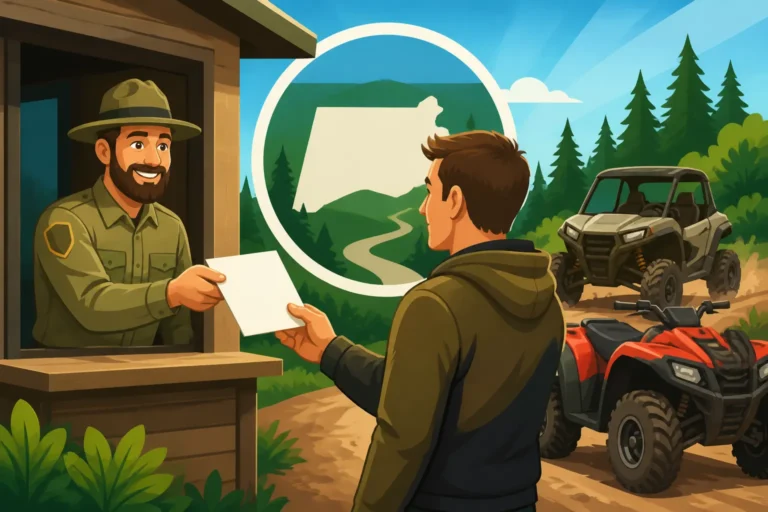
Before leaving home, check current information from the Massachusetts Department of Conservation and Recreation and, when possible, contact the relevant forest office. This matters even if you have visited before. A familiar entrance may be affected by a closure, a route may have changed, or parking arrangements may differ from what you remember. The practical checklist in [Massachusetts Trail Conditions Before You Tow] is useful when you are deciding whether to make the drive.
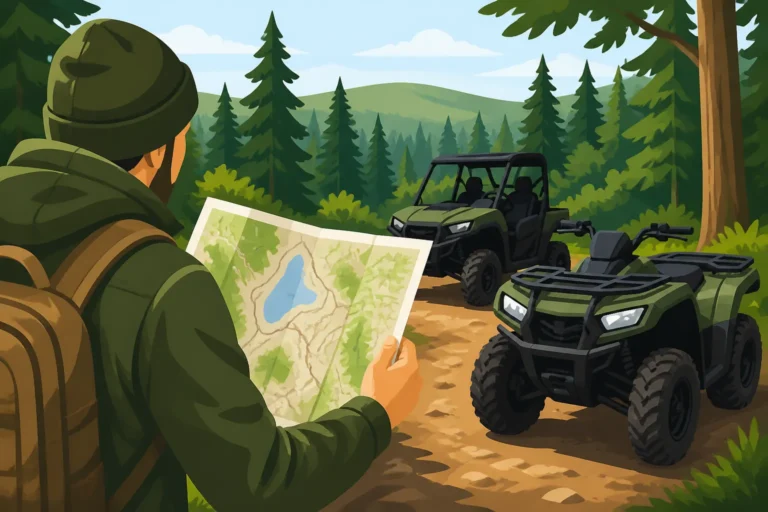
Maps can help you understand the general area, but do not treat a third-party map as proof that a route is authorized or open. onX Offroad can be useful as a supplementary navigation tool for reviewing your planned area and keeping track of where you are. Compare what you see there with official forest information, and do not use a mapped line by itself as permission to ride. Carry a paper map or another backup if you expect limited cell service.
Choose a machine and route that match the day
A machine that is mechanically sound and suited to the trail is more useful than one with every optional accessory. Before loading up, inspect tires, brakes, steering, lights, fuel, and any protective equipment that is appropriate for your machine. Check that tie-downs are secure and that the trailer is roadworthy. A small mechanical problem can become a much bigger one when you are far from a service shop or phone signal.
Consider the least experienced rider and the least capable machine in your group when setting the day’s plan. A strong rider on a large machine may be able to handle a rough section comfortably, while a beginner on a smaller quad may need more time or a route adjustment. If there is uncertainty, start conservatively. You can reassess after a short ride instead of committing the group to a long loop that becomes difficult to reverse.
| Planning question | Why it matters | A sensible next step |
|---|---|---|
| Are the OHV routes open? | Seasonal access and temporary closures can change the plan. | Check official DCR information before towing. |
| Is the route suitable for your machine? | Width, turning space, and terrain vary. | Confirm vehicle access and choose a cautious route. |
| What will conditions be like? | Rain can make climbs, rocks, and soft ground more demanding. | Recheck weather and trail notices close to departure. |
| Will your group stay together? | Mixed skill levels and different riding speeds can split a group. | Set a pace, regroup points, and a turnaround plan. |
| Is navigation available without cell service? | Signal may not be dependable in wooded or hilly areas. | Bring a paper map and use digital mapping as a backup. |
Registration, safety, and riding rules
Make sure the machine and riders are ready legally
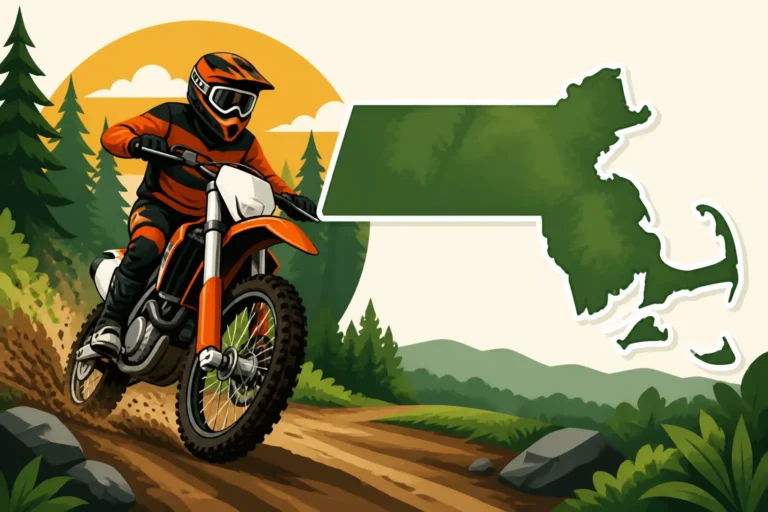
Massachusetts has its own OHV registration requirements. Do not assume that a registration sticker from another state automatically authorizes riding in Massachusetts. Riders should confirm the registration rules that apply to their residency and machine before travelling. The overview [Massachusetts Registration and Trail Access] explains why registration and permission to use a particular trail are separate questions.
Riders under 18 should pay particular attention to safety-certificate requirements and age-based rules. A parent or other responsible adult should check the requirements for the rider’s age and the type of riding planned, rather than relying on what a friend did at another location. The state’s course and certificate information is a useful starting point: see [Massachusetts Safety Certificates Under 18]. Keep required documents accessible, and make sure young riders understand the rules before they start the machine.
Registration is not the same thing as a trail pass that opens every property. A registered machine may still be prohibited from an area, and an open trail does not cancel equipment, age, supervision, or conduct requirements. Review [Massachusetts Requires Its Own Registration] and [Massachusetts Certificates Carried on Public Land] as part of your preparation, then confirm the requirements that apply to your exact situation.
Stay on authorized routes and ride with care
Ride only on routes that are designated and open for OHV use. A visible path, old woods road, or trail shown on an app is not necessarily a legal route. Do not go around a gate or closure sign, and do not assume that an unmarked spur is available simply because another vehicle has used it. When in doubt, stop and verify rather than risk trespass or damage.
Keep your speed appropriate for visibility and surface conditions. On a narrow trail, you may meet another rider, a hiker, or someone managing the forest. Slow down well before passing, leave space, and avoid throwing dust or debris. If you meet a person on foot, give them time and room; a calm, predictable approach is more considerate than forcing a quick pass.
Be especially careful near homes, private property, and public ways. Massachusetts has specific restrictions on where OHVs may be operated, including rules about permission and proximity to dwellings. Do not treat a state forest boundary as a blanket right to ride on neighboring land. For related guidance, review [Massachusetts Written Permission From a Bay State Owner] and [Massachusetts ATV Laws Under Chapter 90B].
How to have a safer, more enjoyable riding day
Pack for changing weather and limited services
The Berkshire hills can feel different from the parking area once you are riding among trees and elevation changes. A cool morning, wind, rain, or a long stop can make the day less comfortable than expected. Wear appropriate protective gear, bring water, and carry a layer that is easy to add if the weather turns. It is much easier to manage a damp, chilly ride when you planned for it than to cut the day short because everyone is uncomfortable.
Bring basic supplies for a minor delay, including a charged phone, first-aid items, and any machine-specific tools or repair items you know how to use. Do not count on continuous cell service or assume that help will arrive immediately. Tell someone where you plan to ride and when you expect to be back. If plans change, update them when you can.
Navigation should have a backup. onX Offroad may help you orient yourself, but battery life, signal, and map interpretation all have limits. Download or prepare the information you need before leaving reliable coverage, and carry a paper map when practical. A phone mount is not a substitute for stopping in a safe place to check your location, especially on a narrow trail or near a junction.
Ride as a group without letting the group become a problem
Groups work best when riders agree on a simple system before starting. Decide who leads, who rides at the back, and where everyone will wait at confusing junctions. If one person stops, the rider behind them should know whether to stop the whole group or notify the leader at the next regroup point. These small decisions prevent the common problem of people continuing in different directions because they assumed someone else was watching.
A large group should also consider its effect on other forest users. Leave room for people to pass when possible, avoid blocking trail junctions, and keep noise and speed under control near parking and camping areas. If the group is too spread out to communicate safely, slow down or divide into smaller groups only if everyone understands the plan. The advice in [Massachusetts Trail Etiquette Locals Expect] is worth reviewing before a busy weekend.
After the ride, take a moment to check the machine and the area around your vehicle. Look for loose tie-downs, trail debris caught around the machine, and anything left behind at the staging area. Pack out your trash and avoid leaving damaged equipment or supplies in the forest. Treating the access area with care helps keep the experience pleasant for the next group.
Make Beartown part of a realistic Berkshire trip
Build in time for the drive and the unexpected
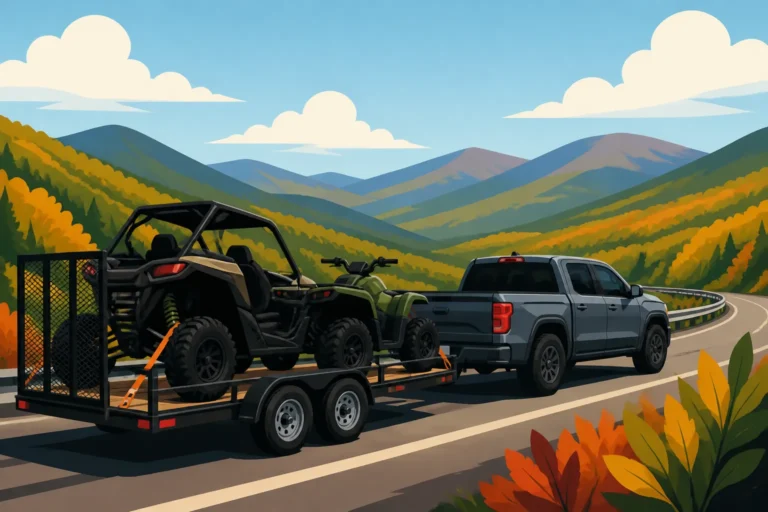
A Beartown ride can take more planning than simply choosing a trail and turning up. The drive to the Berkshires, trailer parking, unloading, registration checks, and changing weather all affect how much riding time you will actually have. If you are travelling from farther east or from outside Massachusetts, leave room for a delayed departure or a change of plan rather than trying to fit a full day into a tight schedule.
Do not assume that a navigation app’s estimated travel time accounts for towing or the roads you prefer to use. Check your route, fuel needs, trailer condition, and where you can safely stop. If your group includes children or newer riders, allow for extra breaks. A relaxed schedule makes it easier to turn around when conditions are poor instead of pressing on because everyone feels committed to the drive.
If you are comparing local options, read about [Massachusetts Riding Near Great Barrington] and [Massachusetts ATV Trail Map Downloads]. Those resources can help you think about the region, but verify each location’s current access rules independently. A map can show where places are; it cannot guarantee that they are open to your particular machine or available on the day you arrive.
Know when to change the plan
Sometimes the best decision is to shorten the ride. Heavy rain, a mechanical concern, a rider who is tired, or a trail section that feels beyond the group’s ability are all good reasons to turn back. That is not a failed outing. It is a sensible way to avoid an injury, damaged equipment, or a rescue situation in a place where assistance may take time.
Use the same caution if you arrive and find unclear access information, a closure, or conditions that look more fragile than expected. Do not cross a barrier or create a new route to salvage the day. Confirm the rules with the appropriate forest contact, and choose another legal activity if riding is not available. [Calling Beartown State Forest Before You Tow] is a useful reminder to check the details before committing to a long trip.
A successful day at Beartown is not measured only by miles covered. It is the day when the machine, route, weather, and riders all match well enough for everyone to get home safely. Plan for the terrain to be variable, check official access information, ride only where permitted, and leave the forest as you found it.
Disclaimer
This article is for general informational purposes only and does not constitute professional advice. Laws, prices and regulations vary by location and change over time. Consult a qualified professional for guidance on your specific situation.