Trailering Over the Berkshires
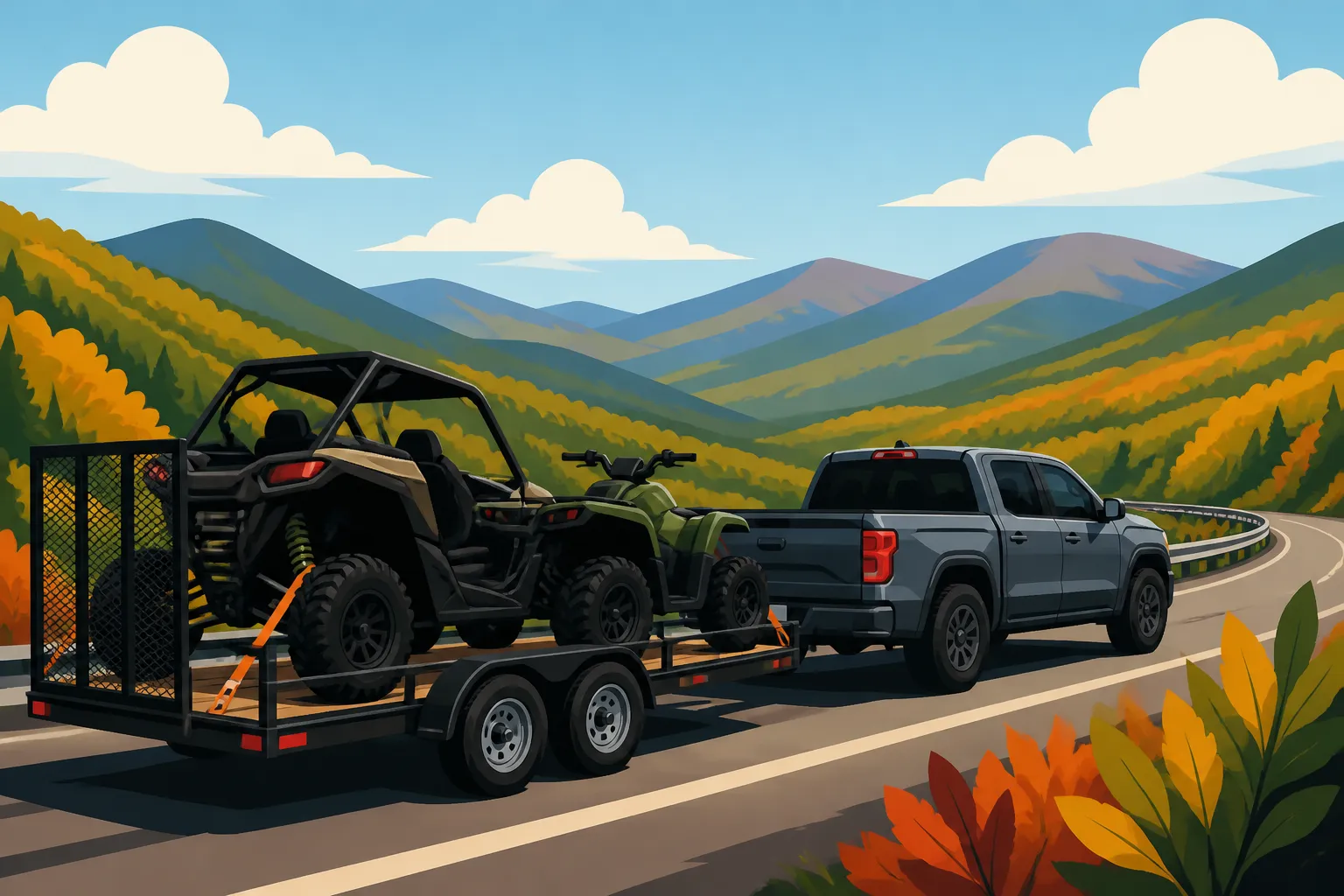
Hauling an ATV or UTV across the Berkshires can turn a promising ride into a stressful one if the trailer is poorly matched to the machine, the load shifts, or the destination has no room to park. This guide covers trip planning, secure loading, mountain-road driving, and what to check before you tow to a Massachusetts riding area.
Plan the route and destination before you hitch up
Check the trailhead, not just the riding area
A forest may allow off-highway riding without having a convenient place for every truck-and-trailer combination to park. Before leaving, confirm that your intended trailhead is open to the type of machine you’re bringing and that its lot can accommodate your tow vehicle and trailer. A narrow entrance, a tight turnaround, or a full parking area can create a real problem when you arrive with a loaded rig.
This matters particularly in the Berkshires, where a day’s route may include rural roads, steep approaches, and trailheads with limited space. Beartown, October Mountain, and Pittsfield State Forest are well-known riding destinations, but access conditions and parking arrangements can vary. Check the specific forest and trailhead rather than assuming that a nearby public lot is suitable for an ATV trailer. For an overview of the region’s riding options, see Massachusetts ATV Trails: Three Berkshire Forests.
Think through the last few miles of the drive as carefully as the highway portion. If your GPS sends you down a narrow road or to a small entrance, look for another route before setting out. A map app may help with navigation, but it does not necessarily show whether a turn is comfortable with a long trailer or whether the destination has space to maneuver.
Build in time for closures and changing conditions
Trail access can change with the season, weather, maintenance, and local management decisions. A route that worked on a previous visit may not be appropriate today, and a trailhead can be affected by a gate closure or a crowded lot. Check for relevant notices close to your departure, and have a backup plan that does not depend on finding a place to leave a trailer on the roadside.
If you use a digital mapping tool such as onX Offroad, treat it as one planning aid rather than permission to ride. Compare the route with official access information and posted signs. A line on a map does not establish that a road, trail, or parcel is open to OHVs. Save useful map details before leaving areas where cell service may be unreliable, and bring a paper backup for remote sections.
A good pre-trip check can prevent the frustrating scenario of arriving in the Berkshires only to discover that you cannot safely park or unload. Review Massachusetts Trail Conditions Before You Tow and Calling Beartown State Forest Before You Tow when those destinations are part of your plan. If your chosen area does not offer a suitable trailer space, change the plan before you start driving.
Match the trailer to the machine and secure the load
Choose a trailer with enough capacity and usable space
Start with the ATV or UTV’s actual weight and dimensions, then account for anything else traveling on the trailer. Accessories, fuel, tools, spare tires, and gear add weight. Check the trailer’s load rating and the tow vehicle’s limits, including the hitch rating. The safest setup is not simply one where the machine fits; it is one where the entire loaded combination remains within the ratings of every component.
Measure the machine’s width and length, especially if it has aftermarket tires, a plow, a winch, or a roof. A UTV may be wider or longer than expected, and a machine that barely fits can leave too little room to position tie-downs correctly. If you’re comparing setups for different trail types, Massachusetts Trails That Allow Side-by-Sides can help you consider whether the machine itself is suitable for the destination.
A single-axle trailer may be easier to maneuver in tight areas, while a larger trailer may offer more room and a different carrying capacity. Neither is automatically right for every tow vehicle or machine. Consider the combined weight, the trailer’s condition, tire ratings, brakes if fitted, and how comfortably you can load and unload. If you’re unsure about the capacity of a trailer or hitch, have the ratings checked before the trip instead of relying on a visual guess.
| What to check | Why it matters | Before departure |
|---|---|---|
| Trailer and hitch ratings | The loaded combination must stay within component limits | Compare each rating with the machine, trailer, and gear |
| Machine dimensions | A tight fit can interfere with tie-down placement | Measure width and length, including accessories |
| Trailer tires and wheels | Damage or poor inflation can become dangerous on a long drive | Inspect tread, sidewalls, lug nuts, and pressure |
| Tie-down points | Secure attachment reduces movement during travel | Check anchors, straps, hooks, and ratchets |
| Ramp fit and condition | A loose or damaged ramp can shift while loading | Confirm it is rated for the machine and locks in place |
| Lights and safety equipment | Poor visibility makes towing less predictable | Test lights and check the hitch connection and safety chains |
Load carefully and secure more than the tires
Park on firm, level ground whenever possible. Set the parking brake on the tow vehicle, connect and secure the ramp, and make sure there is a clear path for loading. If the machine has a winch, it can help control movement, but it should not be treated as a substitute for a sound ramp or careful loading technique. Avoid rushing, especially when loading a heavy UTV or working alone.
Position the machine so the load is balanced for the trailer and tow vehicle. The correct placement depends on the trailer and its design, so follow the trailer manufacturer’s guidance rather than improvising. Too little or too much weight at the hitch can affect handling. If the trailer begins to sway, feels unusually light at the hitch, or causes the tow vehicle to squat excessively, stop somewhere safe and reassess the load.
Use suitable, undamaged tie-downs attached to appropriate points on the machine and trailer. Secure the vehicle against forward, backward, and side-to-side movement. Do not assume that a transmission setting or parking brake alone will keep it in place. Once strapped, push firmly against the machine from several directions and look for movement. Recheck the straps after driving a short distance and again during the trip, especially after rough pavement or a steep climb.
Drive the Berkshires with the trailer in mind
Allow for hills, curves, and narrow roads
Mountain and hill roads require more patience when towing. Leave extra following distance, reduce speed before curves, and avoid abrupt steering or braking. On a descent, choose a controlled speed before the slope begins instead of waiting until the trailer is pushing against the tow vehicle. If the combination feels unstable, stop at a safe location and check the hitch, load, and straps.
Plan fuel and rest stops with the trailer’s length in mind. A station that is easy to enter in a car may be awkward with a loaded trailer, and a tight lot can leave you needing to back out into traffic. If you’re unfamiliar with an area around Lee, Pittsfield, Great Barrington, or Becket, review the route and likely stopping places before you go. Avoid making a last-second turn into a small lot simply because it appears on your navigation screen.
Navigation tools can help you understand the general route, but they may not account for trailer restrictions, narrow entrances, or comfortable turning space. onX Offroad may be useful for checking the riding-area context and saving map information, but use road signs and local access guidance to make actual driving decisions. If an approach looks questionable, choose a safer route rather than following a shortcut that could leave you stuck on a narrow road.
Check the rig at stops and after rough stretches
A quick walk-around can catch problems before they become roadside emergencies. Look at the hitch connection, safety chains, trailer tires, lights, ramp storage, and visible strap tension. Check for a machine that has shifted or straps that have loosened. If you hear new rattling, notice unusual trailer sway, or feel a change in braking, pull over when it is safe to do so and investigate.
Keep loose equipment from bouncing or sliding. Secure ramps, helmets, tools, and fuel containers according to applicable safety guidance, and keep the load arranged so you can reach what you need without climbing over unstable gear. A spare tire, jack, and basic repair supplies may be useful, but make sure the tow vehicle and trailer are equipped for the specific combination you’re taking.
Before pulling away from a stop, do one final check that the ramp is secured and nothing has been left on the ground. At the end of the day, repeat the loading routine rather than assuming the return trip will be easier. Tired riders may be tempted to rush; a methodical check is especially worthwhile after a full day on the trails.
Prepare for trailhead rules and the return trip
Confirm access, registration, and parking details
A trailer gets your machine to the area; it does not by itself establish that you can ride there. Confirm the machine’s registration status, the rider’s eligibility, and the trail’s current access rules before leaving home. Massachusetts registration requirements can apply even when a rider is visiting from another state, so review Massachusetts Requires Its Own Registration and Out-of-State OHV Stickers Are Not Valid in Massachusetts if you are bringing a non-Massachusetts machine.
Parking is a separate consideration from riding access. Check whether the location has a parking fee, whether the fee depends on residency or vehicle type, and whether a trailer takes up space that must be accounted for. Details can vary by location, so verify them with the relevant forest office or official access information. Massachusetts Parking Fees at State Forests is a useful starting point for planning that part of the day.
Keep the registration card and any required documents accessible, and make sure the machine is ready to ride before unloading. That means checking basic equipment and following posted instructions at the trailhead. If you have questions about what must be carried on the machine or what applies to your particular registration, review The Registration Card You Must Carry in Massachusetts before the trip.
Make unloading and repacking part of the plan
Choose a place to unload that does not block traffic, other visitors, or access to the lot. Keep the ramp stable and allow enough room for the machine to come off safely. If the site is crowded, wait for a safer opening rather than trying to unload in a tight space beside another vehicle. Secure your tow vehicle and trailer in the designated parking area, and do not leave the trailer where it obstructs an entrance or route.
Before loading for the return drive, inspect the machine for damage, loose parts, or debris that could fall off in transit. Clean off mud where practical, and check for branches or other material caught around wheels or underbody areas. Follow the site’s rules for cleaning and waste; do not wash mud into a storm drain or leave debris behind. A tidy, secure load is considerate to other trail users and less likely to cause trouble on the road.
Use the same loading sequence each time: park securely, set the ramp, load deliberately, position the machine, attach the tie-downs, test for movement, and complete a walk-around. Check that lights work and the hitch remains secure before pulling out. If you have changed the load arrangement or added gear during the day, verify the balance again rather than assuming it is unchanged.
Trailering over the Berkshires goes more smoothly when the whole outing is planned as one trip: road route, trail access, parking, loading, and the return drive. A few careful checks before leaving can spare you a difficult turnaround, an unstable load, or an avoidable delay at the trailhead.
Disclaimer
This article is for general informational purposes only and does not constitute professional advice. Laws, prices and regulations vary by location and change over time. Consult a qualified professional for guidance on your specific situation.