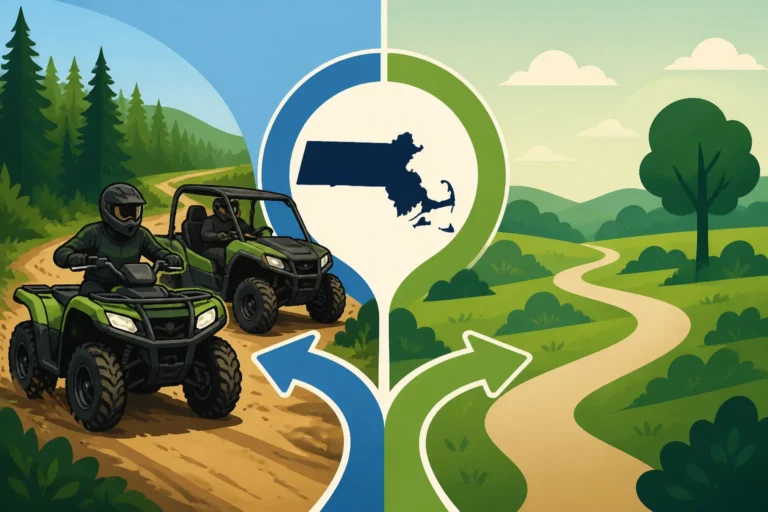
October Mountain State Forest Riding in Massachusetts
October Mountain State Forest can make for a memorable Berkshire ride, but planning is not as simple as unloading a machine and following any visible track. Riders need to confirm which routes are open to their vehicle, understand seasonal access and prepare for rocky, sometimes demanding terrain. This guide covers the practical checks that help you plan a safer, less frustrating visit.
What to know before riding October Mountain
Where the forest is and what to expect
October Mountain State Forest sits in the Berkshires, near Lee, Lenox and Washington. It is a large, wooded public landscape with a mix of forest roads, recreation areas and trails. That variety makes it appealing for a day outside, but it also means that seeing a road or trail on a map does not automatically mean it is open to ATVs or UTVs.
The forest is known as a Massachusetts OHV destination, and its riding network is often described as roughly 30 miles. Treat that figure as a broad sense of scale, not a promise that every mile will be open on the day you visit or suitable for every machine. Trail access can change with conditions, maintenance and land-management decisions.
If you are new to the area, start with [October Mountain's 30 Miles in a Day] and [Massachusetts ATV Trails: Three Berkshire Forests]. Those guides can help put October Mountain in context with other Berkshire riding options. Then confirm the current rules and access details with the responsible forest office before you tow.
A good fit for prepared riders
October Mountain is not necessarily the best first outing for someone who has never ridden off-road. Berkshire terrain can be uneven and rocky, with changing grades, roots, ruts and tight sections. Even an experienced rider may find that a trail takes longer than expected when the surface is rough or the group includes riders with different skill levels.
The terrain can also make machine choice important. A compact trail quad may feel easier to manage in narrow sections than a wide side-by-side. A UTV’s width, turning radius and clearance can affect whether a route is practical, even when the vehicle is legally allowed in the forest. Do not assume that a route suitable for one kind of machine will work for another.
Think about the ride you actually want. If your group is looking for a relaxed scenic drive, a demanding trail network may not match expectations. If you want a technical day, plan conservatively anyway: agree on a turnaround point, ride within your ability and leave enough time to get back before dark.
| Planning question | Why it matters | Practical next step |
|---|---|---|
| Is the route open to OHVs? | A visible road is not necessarily an authorized riding route. | Confirm designated access with the forest office or relevant land manager. |
| Is the trail suitable for your machine? | Width, clearance and turning space vary by vehicle. | Check route restrictions and avoid forcing a machine through a tight section. |
| Is the forest in its riding season? | Seasonal access and weather can affect trail availability. | Verify opening and closure details before loading up. |
| Is your paperwork ready? | Registration and other requirements can apply on public land. | Review documents before leaving home and carry what is required. |
| Is the group prepared for a delay? | Rough terrain, navigation errors or a breakdown can extend the day. | Bring water, basic tools, first aid and a reliable way to navigate. |
Trail conditions and route planning
Don’t rely on an old map alone
A map is useful for orientation, but it can’t tell you everything about a trail’s current condition. A route shown on a downloaded map may be closed, restricted or unsuitable for your machine. Likewise, a track that appears to connect two roads may cross land where riding is not allowed.
Use official information to establish what riding is authorized, then use a mapping tool to support navigation. Some riders use onX Offroad to review mapped routes and organize a plan before setting out. Treat any app as a planning aid rather than permission to ride a particular track. Confirm access rules separately, and be ready to turn around if signs or current instructions conflict with your map.
Before your visit, identify your starting point, intended loop and backup route. Save maps for offline use if you expect weak reception. In the hills, mobile service may be unreliable, so don’t make your whole plan depend on being able to load a route or call for directions once you are deep in the forest.
Build a realistic day around trail difficulty
Trail mileage can be misleading. Thirty miles of rough, winding riding is not the same as thirty miles on a smooth road. A group may cover less ground than expected because of stops, challenging terrain, navigation checks or a rider who needs a break.
Plan a shorter first outing if you have not ridden October Mountain before. That gives you a chance to learn the surface and trail layout without turning the day into a race against sunset. If conditions are wet or the group includes newer riders, reduce the planned distance further. Mud and standing water can slow travel and increase the chance of damage to both the trail and your machine.
For a group ride, agree on simple rules before starting: who leads, who sweeps, where you regroup and what happens if someone gets separated. Keep the group together at intersections. A rider who takes the wrong turn can quickly become hard to locate when branches, terrain and limited reception interrupt communication.
Check conditions after weather changes
A route that was manageable in dry weather can become a different ride after heavy rain. Water can expose loose stones, deepen ruts and make slopes slippery. A low section that looked harmless on a sunny afternoon may hold water after a storm.
Avoid treating wet trails as an invitation to test your machine’s limits. Spinning tires can widen ruts and damage the trail surface, while aggressive riding can make a marginal crossing more difficult for the next rider. If a section looks unsafe or is visibly deteriorating, turn around rather than trying to power through it.
Before driving a long distance, check for seasonal notices, closures and recent conditions. [Massachusetts Trail Conditions Before You Tow] and [Massachusetts Trail Closures After a Storm] are useful starting points for thinking through those checks. You can also ask the forest office what it is seeing locally and whether there are restrictions that affect OHV access.
Choosing the right machine and preparing it
ATV or UTV for Berkshire terrain
An ATV is generally narrower and more maneuverable than a side-by-side, which can be helpful on confined trails. That does not mean every ATV is automatically a good match: tire condition, ground clearance, braking, steering and rider experience matter. A machine that is too large or heavy for the rider can be tiring to manage on a demanding route.
A UTV can offer seating, storage and stability advantages, especially for a group that needs to carry supplies. But those benefits come with trade-offs. A wider vehicle may not fit comfortably through a narrow route, and a longer wheelbase can make tight turns awkward. If you ride a side-by-side, check route suitability before you travel instead of discovering a width problem on the trail.
For more on vehicle access, see [Massachusetts Trails That Allow Side-by-Sides] and [Massachusetts Registration for a Side-by-Side]. The important point is to check both legal access and practical fit. A machine can be registered and mechanically sound yet still be a poor match for a particular route.
Do a pre-ride mechanical check
A small problem at home is easier to fix than the same problem miles into a forest. Before leaving, inspect tires for damage and suitable pressure, test the brakes and check that steering feels normal. Look for fluid leaks, loose fasteners and damaged lights. If your machine has a chain or belt, follow the manufacturer’s maintenance guidance and make sure it is in appropriate condition for the ride.
Carry a compact repair kit matched to your machine. That might include basic hand tools, tire repair supplies where appropriate, a flashlight and a way to secure loose gear. Avoid bringing tools you do not know how to use; the goal is to handle minor issues safely, not to attempt a complicated repair on uneven ground.
A recovery plan matters too. Let someone at home know where you are going and when you expect to return. If you are riding with others, discuss what the group will do if a machine becomes disabled. A tow strap or winch may help in some situations, but recovery equipment can create additional hazards. Use it only when you understand the safe method and the terrain allows it.
Pack for a long day, not just a short loop
Bring more water than you think you will need, especially on a warm day or when the route is demanding. Add food, a first-aid kit and layers that suit changing Berkshire weather. A morning can feel cool in the woods even when the afternoon forecast is mild, and rain can make a long ride uncomfortable quickly.
Carry registration and other required documents in a protected place. Keep them accessible rather than buried beneath cargo. Before your visit, review [Massachusetts Registration Paperwork Checklist] and [The Registration Card You Must Carry in Massachusetts] so you know what applies to your machine and situation.
Navigation tools deserve a backup. A phone with an offline map can be helpful, but battery life and reception are not guaranteed. A paper map or another independent navigation option can give you a way to orient yourself if electronics fail. If you use onX Offroad, download the information you need before leaving service and keep your device charged and protected.
Registration, safety and access rules
Confirm Massachusetts registration requirements
Do not assume that a registration from another state is enough for riding in Massachusetts. The state has its own OHV registration rules, and visiting riders may need to take additional steps before using a machine on public land. Requirements can differ by residency and machine type, so check the details that apply to you rather than relying on what worked on a previous trip.
Start with [Massachusetts Requires Its Own Registration] and [Massachusetts Visitors Buy a One-Year Sticker]. For an ATV, the registration process may require proof of ownership and other paperwork. If you recently bought a machine, confirm that the documents are complete before you travel; a missing bill of sale or other ownership record can turn a planned ride into an administrative detour.
Keep the registration card with the machine as required, and make sure any required decals are attached in the correct place. A decal that is hidden, damaged or mounted incorrectly may create an avoidable problem during an inspection. Review [Massachusetts Decal Placement Rules] before your first ride if you are unsure about placement.
Know the rules for young riders
If children or teenagers are riding, do not rely on general ideas about what seems safe or customary. Massachusetts has specific youth-rider rules, and requirements can depend on age, machine size, location and whether the activity is a sanctioned event. The rules for a public riding area may not be the same as those for a private property or organized race.
Check the relevant requirements before the outing, including any safety-certificate and supervision rules. [Massachusetts Rules for Young Riders on Public Land] and [Massachusetts Safety Certificates Under 18] offer useful starting points. Make sure the child understands the route, stopping signals and what to do if separated from the group.
Adult supervision is not a substitute for choosing an appropriate machine or route. A young rider can be overwhelmed by steep terrain, loose rocks or an unexpected obstacle even when an adult is nearby. Keep the pace comfortable, take breaks and turn back if the conditions are beyond the rider’s ability.
Respect designated riding areas
Registration does not grant permission to ride anywhere in a state forest. Stick to routes specifically open to the relevant type of OHV, follow posted signs and obey closures. A fire road, logging road or worn track is not automatically an approved OHV trail.
Stay off unauthorized paths, fragile ground and areas marked closed. Do not make a new route around a gate, a muddy section or a blocked trail. Detouring around an obstacle can widen the trail and may take riders onto land where motorized use is prohibited.
Rules can also differ between public forests and private riding parks. Before heading to another location, review [Massachusetts Rules for Riding a Conservation Area] and [Massachusetts Private Park Waivers and Rules]. For October Mountain specifically, ask the forest office or land manager to clarify any route or access question you cannot resolve from posted information.
Trail etiquette and sharing the forest
Give other forest users space
OHV riders may share a forest landscape with hikers, campers and other visitors. Slow down well before passing, give people room and avoid throwing dust or gravel toward them. If the trail is narrow, stop in a safe place and let others pass rather than squeezing by at speed.
Be especially considerate around hikers who may not hear an approaching machine until it is close. A friendly greeting and a controlled pace can prevent a tense encounter. If you meet a horse, stop well back, switch off the engine if appropriate and follow the rider’s instructions. Sudden movement or loud revving can frighten an animal.
On a group ride, the lead rider should set a pace that leaves room for other users and keeps the group orderly. Avoid crowding someone who is moving slowly. [Massachusetts Trail Etiquette Locals Expect] and [Riding Etiquette When You Meet Hikers] offer more guidance on sharing trail space.
Keep noise and trail impact down
Noise carries farther than many riders expect in a quiet forest. A machine that sounds ordinary at home may be disruptive near campsites, trailheads or nearby homes. Keep the muffler in good condition, avoid unnecessary revving and move away from busy areas before stopping for an extended break.
Ride steadily over rough ground rather than spinning the tires. Do not cut corners, widen the trail or create bypasses around puddles and rocks. Those habits can turn a narrow route into a broader, more eroded scar and can create new hazards for riders and other forest visitors.
Take all trash with you, including food wrappers, broken straps and small parts. Check your staging area before leaving. A tidy trailhead helps preserve good relationships with other visitors and supports continued responsible access.
Be courteous at trailheads and crossings
At the trailhead, unload in a way that leaves room for other vehicles and emergency access. Keep trailers, gear and machines organized. If the parking area is crowded, do not block a gate, roadway or marked space while the group gets ready.
When a trail reaches a road or other crossing, follow posted rules and stop where required. Do not assume that a forest road is closed to other traffic or that other drivers expect an OHV to appear. Look carefully in both directions and cross only where permitted.
Keep conversations and equipment noise reasonable when people are arriving or packing up. A calm departure matters too: secure cargo, check that the trailer is ready and avoid rushing out of the parking area. Good trail manners begin at the trailhead, not just once the group reaches the woods.
A practical plan for your first visit
Before you leave home
Start by confirming the forest’s OHV access information and any seasonal restrictions. Check whether your machine type is permitted on the routes you intend to ride, and ask about closures or conditions if anything is unclear. Do this before loading the trailer, not after arriving in Lee or another nearby town.
Next, check your paperwork, machine and gear. Confirm that registration is valid, required documents are on board and decals are visible. Inspect the tires, brakes and steering, and make sure helmets and protective gear fit properly. Pack water, food, layers, a first-aid kit and navigation backups.
Finally, tell someone your plan. Share the trailhead, expected return time and who is riding with you. If your plans change, update that person when you can. This simple habit is especially useful when cell service is inconsistent or the day runs longer than expected.
At the forest
Read signs at the entrance and trailhead before unloading or riding. If a sign conflicts with your plan, follow the sign and ask the forest office for clarification rather than guessing. Check for posted route restrictions, seasonal notices and instructions for parking.
Keep your first loop modest. Learn how the surface feels, how quickly your group moves and how easy it is to navigate between trail junctions. If the route is rougher than expected, adjust the plan while you still have time to return comfortably.
Use an app such as onX Offroad as a supporting tool, not a substitute for local rules or posted signs. A digital route can help you understand where you are, but it cannot guarantee that a segment is open or suitable for your vehicle. If you encounter a closure, turn around and choose an authorized alternative.
After the ride
Before loading, look over the machine for fresh damage, leaks or loose parts. Remove mud and debris where practical, especially around areas that need to stay clear for safe operation. Note anything that needs attention before the next outing instead of assuming you will remember it later.
Check the staging area for trash, forgotten gear and small pieces that may have fallen off. Secure the machine and cargo before driving away. If you found a closure, confusing sign or damaged section, contact the appropriate forest office with a clear description of the location rather than trying to fix or reroute it yourself.
A good first visit should leave you with a better understanding of the forest, not just a mileage total. Make a note of which route sections suited your group, what gear you used and what you would change. That record makes future trips easier to plan and helps you avoid repeating the same last-minute surprises.
When to choose another riding area
Consider machine fit and rider experience
October Mountain may not be the right choice for every vehicle or group. A wide UTV, a machine with limited ground clearance or a rider who is uncomfortable on rocky terrain may be better served by a route that more closely matches their needs. Choosing another area is not a failure; it is a sensible way to keep the ride enjoyable.
If your group has beginners, look for a location with clearly described difficulty and routes that allow riders to build confidence gradually. Avoid assuming that a trail labeled for OHV use is easy. “Open to riding” describes access, not necessarily the level of challenge.
The same goes for families. A route that feels manageable to an adult may be tiring or intimidating for a younger rider. Check age rules, supervision requirements and machine suitability, then make the day short enough that everyone can finish safely.
Have a backup plan for closures
A seasonal closure, storm damage or access restriction can change a trip at the last minute. Keep a second destination in mind, but verify its rules rather than simply driving to the nearest forest. Different areas can have different vehicle restrictions, permits, parking arrangements and riding seasons.
If you compare options, look beyond mileage. Consider whether the area allows your type of machine, whether the trails match your skill level, how parking works and whether you can obtain reliable access information before setting out. [Best Massachusetts ATV Trails for Beginners] and [Massachusetts Trail Planning and Closures] can help you think through alternatives.
Do not try to salvage a canceled ride by using unapproved roads or private land. If a location is closed or your machine is not permitted, postpone the ride or choose a lawful alternative. Protecting access is part of being a responsible visitor.
Disclaimer
This article is for general informational purposes only and does not constitute professional advice. Laws, prices and regulations vary by location and change over time. Consult a qualified professional for guidance on your specific situation.