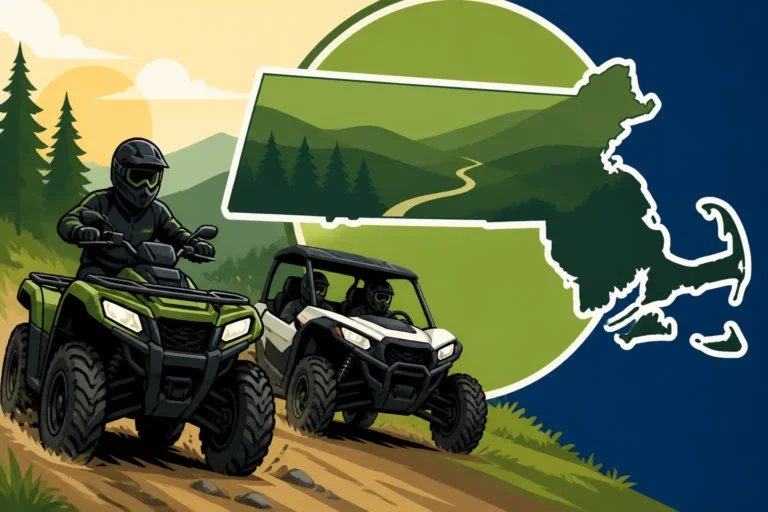
Pittsfield State Forest Riding in Massachusetts
Pittsfield State Forest can be a rewarding Berkshire ride, but it is not a place to assume every visible woods road is open to ATVs or UTVs. This guide explains what to expect from the designated riding area, how to prepare your machine and paperwork, where to check before towing, and how to ride responsibly when conditions, closures, or trail rules are unclear.
What to Know About Riding at Pittsfield State Forest
The riding area is a designated network, not an open forest
Pittsfield State Forest is one of the Berkshire-area state forests associated with authorized off-highway vehicle riding. The designated network is commonly described as having about 14 miles of ATV trails. That number is useful for setting expectations, but it does not mean every road, path, or cut-through within the forest is open to motorized riding.
That distinction matters when a trail seems to continue beyond a marked section. A wide, packed road can look like an obvious route, yet it may be closed to OHVs, reserved for another use, or outside the authorized riding area. Stay on trails identified for your machine, and do not treat an old tire track, a map line, or another rider’s route as permission.
The forest also serves hikers and other visitors. Even on a legal OHV route, riders should expect to share the broader landscape and use care around people, wildlife, and maintenance activity. Slow down when visibility is limited, give other trail users room, and be ready to stop.
If you are planning a ride based on a mileage figure, remember that trail distance is not the same as a guaranteed full-day route. A short network can still feel demanding if it has rough surfaces, steep sections, tight turns, or slow-moving traffic. For more context about the forest’s OHV network, see [Pittsfield State Forest's 14 Miles in Massachusetts] and [What to Expect on Pittsfield State Forest Trails].
Expect a more technical ride than a casual dirt-road cruise
Berkshire terrain can make a modest number of trail miles feel substantial. Rocky ground, uneven surfaces, slopes, roots, ruts, and changing sightlines can all affect pace. Conditions may also shift after rain, wind, seasonal maintenance, or heavy use. Plan around the kind of terrain you and your least experienced rider can handle comfortably, not the speed you hope to average.
A rider coming from a smooth private track may find a forest route tiring because the challenge is continuous rather than concentrated in one obstacle. You may need to choose lines carefully, keep a steady throttle over rough patches, and leave enough space to brake before a blind corner. A UTV driver also needs to pay close attention to trail width and turning room; do not assume every segment that accommodates a quad will comfortably accommodate a wider machine.
Trail descriptions such as “intermediate” can be helpful, but they are not a guarantee that every rider will find a route manageable. Skill, machine setup, weather, fatigue, and passenger experience all matter. If you are new to off-road riding, take a conservative approach and be willing to turn around when a section feels beyond your ability.
For a wider look at how local routes compare, read [Massachusetts Trails Rated Intermediate and Up]. It is also worth reviewing [Massachusetts ATV Trails: Three Berkshire Forests] if you are deciding whether Pittsfield is the right fit for your group or whether another Berkshire riding area better matches your experience.
Check Access, Closures, and Conditions Before You Tow
Confirm that riding is open before leaving home
One of the most frustrating parts of a planned ride is arriving with a trailer only to discover that access has changed. Forest access can be affected by seasonal schedules, weather-related damage, maintenance, environmental concerns, or temporary closures. A trail that was open on a previous trip should not be treated as guaranteed open for the next one.
Before you load up, check the current information from the responsible state forest or land-management office. If a phone number is available, calling can be useful when a written notice is unclear or you need to confirm whether a particular trail or facility is available. Ask specifically about OHV riding, parking, vehicle access, and any temporary restrictions—not just whether the forest itself is open to visitors.
Make the call early enough to change plans. If you are driving from outside the Berkshires, it is much easier to adjust the destination at home than after you have reached the trailhead with a loaded trailer. Checking ahead is especially worthwhile after severe storms, during periods of trail work, and when the season is beginning or ending.
A current trail notice should take priority over an old map, a social post, or an account of someone’s ride from a different weekend. For a practical pre-trip routine, see [Massachusetts Trail Conditions Before You Tow] and [Calling Beartown State Forest Before You Tow]. The latter focuses on another Berkshire forest, but the habit of confirming access before hauling applies just as well here.
Use maps as planning aids, not permission
Maps can help you understand the general layout of a forest, estimate drive times, locate nearby services, and avoid getting turned around. However, a line on a map does not establish that a route is open to an ATV or UTV. Even a map layer designed for off-road travel may not reflect every temporary closure, current rule, or machine-specific restriction.
This is where careful map use helps. Before the ride, compare your planned route with official forest information. At the trailhead, look for signs and posted notices. On the trail, obey the signs you encounter, even if a phone map appears to show a route continuing. If the information conflicts, do not use the most permissive interpretation as your default.
Some riders use an app such as onX Offroad to plan routes and keep track of their position, particularly where phone service is unreliable or forest roads look similar. A digital map can help with orientation, but it cannot authorize access or replace official notices. Download or save the information you need before heading into an area where cell reception may be weak, and consider carrying a paper map as a backup.
A simple preparation routine can prevent a lot of uncertainty: identify the permitted riding area, note your parking location, save an offline map, and agree on a turnaround point with your group. For more on preparing for limited reception, see [Cell Dead Zones in the Berkshire Hills] and [Carrying a Paper Map in a State Forest].
| Before you go | What to confirm | Why it matters |
|---|---|---|
| Riding access | Whether the designated OHV area is open | Seasonal or temporary closures can change plans |
| Trail suitability | Whether your ATV or UTV is allowed on the planned route | A route suitable for one machine may not suit another |
| Parking | Where trailers may be parked and whether fees or restrictions apply | Parking arrangements can affect the whole trip |
| Paperwork | Massachusetts registration and rider safety requirements | Registration in another state may not meet Massachusetts rules |
| Conditions | Recent rain, storm damage, or maintenance notices | Mud, washouts, and debris can make a route unsafe or damaging |
| Group plan | Meeting point, turnaround time, and emergency contact plan | Groups can separate where visibility or cell service is limited |
Get Registration and Rider Requirements Straight
Massachusetts registration is part of the preparation
Visitors should not assume that an out-of-state sticker automatically allows them to ride in Massachusetts. The state has its own OHV registration rules, and riders need to understand which registration applies to their residency and machine. Take care of the paperwork before the trip rather than hoping to solve it at the forest entrance.
The registration card and decals are not just administrative details to leave at home. Riders should know what they must carry and where decals belong on the machine. A card stored in a truck several miles away may not help when an officer asks to see it on the trail. Keep documents protected from water and dirt, but accessible to the operator.
Registration is also separate from permission to ride a particular trail. Having a registered ATV or UTV does not mean every state forest road is open to it, and it does not override posted restrictions. Think of registration as one requirement in a larger checklist that also includes authorized access, machine compliance, and rider eligibility.
For a step-by-step overview, read [How to Register an ATV in Massachusetts]. If you live outside the state, review [Massachusetts Non-Resident OHV Registration] and [Out-of-State OHV Stickers Are Not Valid in Massachusetts]. For details about the card you may need with you while riding, see [The Registration Card You Must Carry in Massachusetts].
Young riders need special planning
A family ride requires more than choosing a machine that looks small enough for a child. Massachusetts has age-related ATV and OHV rules, along with safety certificate requirements that may apply to younger riders. Those rules can affect whether a child may operate a machine, what engine size is allowed, and whether adult supervision is required.
Do not use a child’s height, confidence, or experience as a substitute for checking the legal requirements. A young rider who handles a quad well in a backyard may face very different conditions on uneven public-land trails. The adult supervising should be close enough to respond, able to communicate, and prepared to end the ride if the child is tired or uncomfortable.
Before the trip, verify the current requirements for each rider’s age and machine. Make sure required certificates are completed and carried when applicable. If a child will ride as a passenger in a UTV, check the rules and the machine’s passenger seating and restraint requirements rather than assuming that a seat belt alone settles the question.
Helpful starting points include [Massachusetts ATV Age Requirements], [Massachusetts Safety Certificates Under 18], and [Parents Must Attend With Students Under 16]. The rules can be detailed, so it is worth checking the specific age category instead of relying on a general statement such as “kids can ride with an adult.”
Choose and Prepare the Right Machine
Match the machine to the trail and the group
An ATV and a UTV are not interchangeable simply because both are off-road machines. A quad is narrower and can be easier to maneuver through tight turns, while a side-by-side offers seating and restraints for passengers but may need more width and turning space. The right choice depends on the authorized route, machine dimensions, rider skill, and the group’s needs.
Before bringing a UTV, confirm that the route you plan to use permits that type and size of machine. A trail that accommodates a compact ATV may be too narrow or difficult for a wider side-by-side. Even when the forest has riding opportunities for more than one vehicle type, not every segment necessarily works equally well for every machine.
Inspect the machine before the trip. Check the tires, brakes, steering, throttle, lights, fluid levels, and any guards or protective equipment appropriate to your model. For a UTV, check seat belts and the condition of the seating area. For an ATV, confirm that the controls work smoothly and that the rider has properly fitted protective gear.
Plan for a breakdown without assuming another rider will be able to tow you out. Bring basic tools and supplies suited to your machine, and tell someone at home where you are going and when you expect to return. The equipment list should be realistic: a long ride into unfamiliar terrain deserves more preparation than a quick loop near a parking area.
Protect the machine without adding unnecessary bulk
Rocks, roots, and rough trail surfaces can expose vulnerable parts of a machine. Appropriate protection may help prevent damage, but accessories should be selected for the actual terrain and installed in a way that does not create new problems. A poorly fitted accessory can rattle loose, catch on obstacles, or interfere with maintenance.
Tire choice also affects how a machine behaves. A tread pattern suited to mud may not feel ideal on hard, rocky surfaces, while a tire that performs well on firm ground may provide less confidence in soft conditions. Avoid making last-minute changes before an unfamiliar ride unless you have had time to test them safely.
Mud is another reason to prepare thoughtfully. Deep ruts and wet sections are not an invitation to spin the tires until the machine gets through. Spinning can damage the trail, increase the chance of getting stuck, and create extra work for everyone behind you. If a section is wet or visibly eroding, slow down and assess whether continuing is appropriate.
For Berkshire-specific gear considerations, see [Tires for Berkshire Rock], [Skid Plates for Ledge], and [Why Berkshire Leaf Litter Clogs a Radiator]. Use those topics as a starting point, then follow your machine’s manufacturer guidance and the conditions you expect to encounter.
Ride Safely and Respect Other Forest Users
Keep control on narrow, uneven trails
A safe pace is one that leaves you enough time to respond to a person, obstacle, or sharp turn. On a trail with limited sightlines, that may mean moving much more slowly than you would on an open private track. Keep enough distance between machines to avoid dust, thrown debris, and sudden braking problems.
When the surface changes, adjust your riding rather than trying to force a steady speed. Loose stones, wet leaves, ruts, and steep pitches can all affect traction. Use smooth inputs and avoid abrupt turns or hard acceleration where a tire could lose grip. If you are unsure how to approach a section, stop in a safe place and look it over before proceeding.
For a group ride, choose a leader and a sweep rider, and agree on what to do if someone stops or gets separated. A rider should not speed ahead just because the trail appears obvious. Groups move at different paces, and the person at the back may need extra time to handle an obstacle or help with a minor mechanical problem.
Give yourself permission to call it early. Fatigue affects judgment, especially after a bumpy ride or a long drive to the Berkshires. A shorter, controlled outing is better than pushing on when someone is tired, cold, overheated, or no longer riding confidently.
Share the forest with care
Riders may encounter hikers, maintenance staff, wildlife, or other forest visitors. Slow down and give them room. Avoid sudden approaches, loud acceleration, or passing so closely that someone has to step off the trail. If visibility is poor, assume someone may be just beyond the next bend.
Noise and dust can be a source of tension, particularly near campsites or places where people expect a quieter forest experience. Keep the machine properly maintained, use required exhaust equipment, and avoid unnecessary revving. When passing people or a campsite, a slower pace is a practical courtesy—not just a matter of appearance.
Stay on authorized routes and avoid widening a trail to get around a puddle or obstacle. Going around the edge can damage plants and create a second track that encourages others to do the same. If a section looks badly damaged, do not make it worse by powering through without considering the consequences.
The same care applies to crossings, gates, and posted land boundaries. A gate or sign is not something to bypass because the route appears convenient. For additional local etiquette, see [Massachusetts Trail Etiquette Locals Expect] and [Sharing a State Forest Trail With Hikers]. For situations where horses may be present, [Meeting Horses on an October Mountain Fire Road] offers useful guidance that also translates to other shared forest routes.
Plan Parking, Fuel, and a Full Day Out
Work out the logistics before you arrive
Trailhead logistics can shape the whole ride. Confirm where trailers may be parked, whether a lot has space for your group, and whether parking rules or fees apply. Forest access charges and arrangements can vary, so do not rely on an old receipt or a friend’s memory from a previous visit.
Arrive with enough fuel for the route and the possibility of a delay. The forest itself may not offer fuel at the trailhead, and you should not count on finding a nearby station at the moment you need one. Check the map before departure, identify likely fuel stops along your drive, and start the ride with a sensible reserve.
Bring water, food, basic first aid supplies, weather-appropriate layers, and a charged phone. Cell service can be unreliable in hilly areas, so do not make a working phone connection the only part of your emergency plan. Let someone outside the group know your destination and approximate return time.
If several vehicles are meeting up, agree on a specific parking location and backup plan. “We’ll meet somewhere in the forest” is too vague if one group is delayed or a lot is full. Sharing an offline map pin or written directions can help, but confirm that the location is an appropriate place to park a trailer.
Be realistic about distance and timing
A 14-mile trail network does not necessarily mean 14 miles of easy riding, nor does it promise that every rider can cover all of it in one outing. Difficult footing, stops, route decisions, and group pace all affect how long a ride takes. If you are bringing children or inexperienced riders, build in extra time and plan a shorter outing.
Set a turnaround time before the group starts. This is especially useful if the ride is scheduled around daylight, a campground check-in, or a long drive home. A group that agrees in advance to turn back at a certain point is less likely to pressure a tired rider into continuing.
Leave a buffer for loading and unloading. A late start can turn an easy day into a rushed one, especially if you need to check parking information, unload multiple machines, fit protective gear, or review the route with riders who have not been there before. Give yourself room to handle small delays without skipping safety checks.
If you are combining riding with camping, check the camping arrangements separately from trail access. A campsite reservation does not automatically guarantee that riding trails are open, and a trail registration does not include a campsite. Review [Massachusetts Camping Near Riding Areas] and [Reserving a State Forest Campsite for a Ride Weekend] when building a longer trip.
A Practical Pittsfield State Forest Ride Checklist
Before loading the trailer
Start with the essentials: confirm the OHV area is open, verify the route is appropriate for your ATV or UTV, and make sure every rider meets the applicable age and safety requirements. Check registration documents and decals, and keep required paperwork where it can be accessed during the ride.
Inspect the machine while it is still easy to work on at home. Look for tire damage, loose fasteners, worn brakes, leaks, and problems with steering or controls. Make sure helmets and other protective gear fit correctly. If you are bringing a passenger, verify the machine is designed and equipped for that passenger.
Check the weather and recent conditions, but do not treat a forecast as a guarantee about the trail surface. A dry morning can follow heavy rain, and a forest road can remain muddy after nearby pavement dries. If you use onX Offroad or another mapping app, save the map ahead of time and compare the planned route with official notices.
Finally, tell someone your plan. Share where you expect to park, who is riding, and when you expect to be back. If your group has a new rider, agree on a pace and a way to stop the group safely before you leave the trailhead.
At the trailhead and on the ride
Read the posted signs before unloading or starting the engine. Confirm that you are in the correct parking area and that your route begins on a designated riding trail. If there is a question about access, ask the responsible office rather than assuming that a nearby road is part of the OHV network.
Keep paperwork, water, a basic first aid kit, and any essential tools with the group. Know who is carrying what so that the group does not discover halfway through the ride that everyone left the map or repair supplies in a truck. If you divide into smaller groups, set a meeting location and a time to regroup.
On the trail, follow posted directions and remain within the authorized area. Reduce speed when sightlines narrow, make room for other trail users, and stop if conditions become unsafe. Do not bypass a closure or create a new route around mud, debris, or a gate.
When you finish, check the machine for damage or debris before loading it. Leave the parking area tidy, secure your equipment, and report an obvious hazard or trail problem through the appropriate forest contact. A little care at the end of the day helps protect access for the next group of riders.
Common mistakes that can spoil the day
A frequent mistake is relying on a route description written for a different season. Trail surfaces change, and temporary restrictions may not appear in an older post or map. Check before traveling and treat current signs as the deciding information on site.
Another mistake is assuming that registration alone makes a route legal. Massachusetts registration, a valid safety certificate where required, and permission to ride the designated route are separate issues. Handle each one instead of treating the sticker as a universal pass.
Riders also sometimes underestimate the time needed to load, reach the forest, and complete a ride. A tight schedule encourages speeding, skipping checks, or continuing after a rider is tired. Build a plan with enough flexibility to turn back early without feeling that the trip has failed.
Finally, avoid using another person’s comfort level as your own benchmark. A skilled rider may move quickly through terrain that feels intimidating to a beginner. Choose a pace that works for the least experienced person in the group, and remember that a good ride is one where everyone gets back safely.
Disclaimer
This article is for general informational purposes only and does not constitute professional advice. Laws, prices and regulations vary by location and change over time. Consult a qualified professional for guidance on your specific situation.