Towing a Trailer Behind a Quad on Trails
A small trailer can make an ATV or UTV much more useful on a Massachusetts trail, but it can also turn a manageable ride into a clearance, braking, or access problem. The key is not simply whether your machine can pull the load: you need to confirm the route allows towing, match the trailer to your machine, and prepare for tight turns, hills, and changing trail conditions.
Confirm that the route allows a trailer
Registration does not automatically mean trail permission
A registered ATV or UTV is not automatically allowed on every trail, and registration alone does not establish that towing a trailer is permitted. Access rules can depend on who manages the land, the type of trail, seasonal closures, and restrictions on vehicle width or use. A route that accommodates an ATV may still be a poor fit for a long or wide trailer.
Before leaving home, identify the actual trail system and check its current rules with the land manager. For Massachusetts state forests, that generally means checking the relevant Department of Conservation and Recreation information. Private riding areas and town properties may have separate requirements. Ask specifically whether a trailer may be towed on the trails you intend to ride, not just whether ATVs or side-by-sides are allowed.
This distinction matters in the Berkshires, where a wide forest road, a narrow wooded trail, and a route that crosses a public way can all have different constraints. For broader route planning, see [Massachusetts Trails That Allow Side-by-Sides] and [Massachusetts Trail Conditions Before You Tow]. If the route itself is unclear, do not assume that a visible track or an open gate means towing is allowed.
Plan road crossings and public-way connections carefully
Massachusetts off-highway riding rules do not make an ATV or UTV street legal. A trail route that requires a brief road crossing is different from riding along a public road to connect two trail sections. Do not plan to tow a trailer on a public way just because the trail map appears to show a convenient connection. Confirm that the crossing and the approach to it are lawful for your situation.
Where a crossing is permitted, arrive slowly, stop as required, and make sure the trailer is tracking behind the machine before entering the road. A trailer can cut across the inside of a turn, and its rear wheels may be closer to the road edge than the ATV’s. Take extra care if brush, snowbanks, parked vehicles, or an uneven shoulder restrict your view.
The rules on roads and woods roads deserve their own check before you ride. Review [Massachusetts Bans Riding on Public Ways] and [Massachusetts Rules for Riding a Woods Road]. When a route description is vague, contact the responsible office or property owner rather than trying to work it out at the trail entrance.
Choose a trailer your machine and route can handle
Match capacity to the real load
Start with your ATV or UTV owner’s manual. Check the manufacturer’s towing limit and any conditions attached to it, such as operating on level ground or using a particular hitch arrangement. Then check the trailer’s rated capacity. The lower limit is the one that matters. A trailer’s maximum rating does not mean your machine can safely pull that much on a steep, uneven trail.
Count the weight of the trailer itself, the cargo, and anything mounted to it. A load of firewood, tools, camping gear, or recovery equipment can add up quickly. Keep cargo secured and balanced, and follow the trailer manufacturer’s guidance for loading. A poorly distributed load can make the hitch feel unstable, make steering harder, or cause the trailer to sway on ruts and descents.
Also think about the terrain, not just the load. Pulling a trailer on a broad, dry path is different from maneuvering through soft ground, a rocky climb, or a tight switchback. Even a light trailer can become difficult to control if its wheels drop into a rut or if it pushes the ATV downhill. If the route includes challenging sections, a shorter, lighter setup may be safer than trying to bring everything in one trip.
Check hitch, clearance, and trailer dimensions
Use a hitch that is designed for your particular machine and compatible with the trailer coupler. Before riding, inspect the hitch connection, pin or other retention hardware, and any safety devices recommended by the manufacturers. Make sure the trailer can articulate through the turns and uneven ground you expect without striking the machine, dragging on the trail, or binding against the hitch.
Compare the trailer’s width and length with the narrowest parts of your route. A trailer that fits through a gate may still snag on trees, rocks, or trail-side obstacles. Consider ground clearance too: a low axle or long rear overhang can catch on ledges and dips. A wide trailer can also make passing hikers or other riders more difficult, so ask about trail width restrictions rather than relying on appearance alone.
When comparing hitch accessories or utility trailers, riders may come across options from companies such as SuperATV. Treat any product description as a starting point, not proof that a part fits your exact year, model, and intended load. Confirm compatibility with the manufacturer, and compare the component’s rating with the limits in your machine’s manual. A well-matched hitch cannot increase the ATV’s own towing capacity.
| What to check | Why it matters | What to do before riding |
|---|---|---|
| Trail permission | A route may allow an ATV but restrict trailers | Ask the land manager specifically about towing |
| Machine towing limit | The ATV or UTV may be the limiting component | Check the owner’s manual |
| Trailer rating | The trailer has its own load limit | Include cargo and trailer weight |
| Width and length | A trailer can snag or block narrow routes | Compare dimensions with gates and trail conditions |
| Hitch compatibility | A poor fit can loosen or bind | Verify fit for the exact machine and coupler |
| Braking and handling | A loaded trailer can push the machine downhill | Test the combination at low speed in a safe area |
| Road crossings | A trailer can track differently from the ATV | Confirm the route is lawful and approach slowly |
Prepare the machine and trailer before departure
Inspect the connection and cargo
Park on firm, level ground and connect the trailer according to the instructions for the hitch and coupler. Check that the connection is fully seated and retained, then gently test it before loading. Inspect the trailer tires, wheels, and fasteners, and look for visible damage to the frame or coupler. If the trailer has lights or other equipment required for the use you are planning, check that they work.
Secure cargo so it cannot slide, bounce out, or shift to one side. Loose tools can move during a climb or hard stop, changing the trailer’s balance when you need control most. Keep heavy items low and distribute the load as directed by the trailer manufacturer. Avoid stacking cargo so high that it blocks your view or catches on branches.
Do a short, slow test in a safe, open area before heading onto a trail. Turn both directions, stop gently, and check whether the trailer tracks smoothly. Listen for unusual clunks, scraping, or rattling. Recheck the hitch and cargo afterward. This quick test often reveals a loose pin or a load that needs to be secured better before you are far from the trailhead.
Carry the right tools and plan for a problem
A trailer adds another set of tires, fasteners, and connection points that can fail or need attention. Bring basic tools suited to your setup, along with a way to secure loose cargo. If you have a spare tire or repair supplies, make sure they fit the trailer rather than assuming your ATV’s equipment will work. Tell someone where you plan to ride and when you expect to return, especially if the route has limited cell coverage.
Think through what you would do if the trailer became stuck or damaged. A machine may be able to pull a trailer forward on a firm surface but struggle to reverse it around a bend or up a grade. Avoid choosing a route where you would have no safe place to turn around. If you need to back up, do it slowly in a clear area, with a spotter if available, and stop if the trailer starts to jackknife.
SuperATV and other equipment suppliers may offer different hitch or hauling components, but no accessory removes the need to plan for trail-side repairs. Verify that replacement parts fit your setup, and do not improvise a repair with a strap or connector that is not designed for the load. If a connection is damaged, unload the trailer and arrange a safe way out rather than continuing with a questionable hitch.
Tow with control and respect for other trail users
Adjust speed and braking to the terrain
A trailer changes how an ATV or UTV accelerates, turns, and stops. Begin at a conservative speed and leave more room than usual between you and other riders. Brake gradually where possible. On descents, a loaded trailer may push the machine forward, so approach hills cautiously and use the braking method recommended in your owner’s manual. Avoid sudden steering or braking that could destabilize the trailer.
Take turns wider and slower than you would without a trailer. The trailer’s wheels usually follow a tighter path than the machine, which means they can strike the inside edge of a turn or drop into a ditch. Check for rocks, roots, washouts, and narrow bridge or culvert edges before committing. If a turn is too tight, stop in a safe place and reassess rather than forcing the trailer through.
Be especially cautious in wet leaves, loose gravel, mud, or snow. Traction can change quickly, and the trailer can continue moving even after the ATV slows. If the trail is too steep, narrow, or slippery for controlled towing, turn back if you can do so safely. A day’s plan is not worth risking a rollover, damaged machine, or blocked trail.
Give people and the trail room
A trailer takes up more space and can make it harder to pass hikers, horses, cyclists, or other riders. Slow down well before meeting someone, keep the machine under control, and follow local yielding rules. On a narrow trail, wait at a wider spot if necessary rather than trying to squeeze past. For practical reminders, see [Massachusetts Trail Etiquette Locals Expect] and [Riding Etiquette When You Meet Hikers].
Stay on the authorized route and avoid widening the trail to get around an obstacle. A trailer can scrape vegetation, dig into soft shoulders, or catch on the edge of a narrow path. If conditions are muddy or the trail has been damaged by a storm, towing may increase the impact and make the route harder for everyone to use. Check [Massachusetts Trail Riding After Heavy Rain] when recent weather may have changed the trail surface.
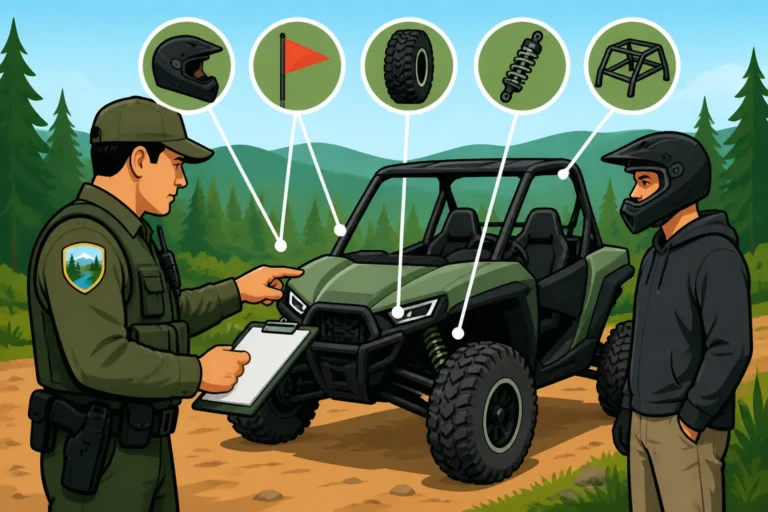
Finally, make sure the required registration documents and safety equipment are handled before you leave. Towing a trailer does not replace the rules that apply to the ATV or UTV itself. Review [Massachusetts Equipment Requirements] and [What an Environmental Police Officer Checks at a Trailhead]. If the land manager says trailers are not permitted, choose a different way to carry your gear or select a route where towing is allowed.
Disclaimer
This article is for general informational purposes only and does not constitute professional advice. Laws, prices and regulations vary by location and change over time. Consult a qualified professional for guidance on your specific situation.