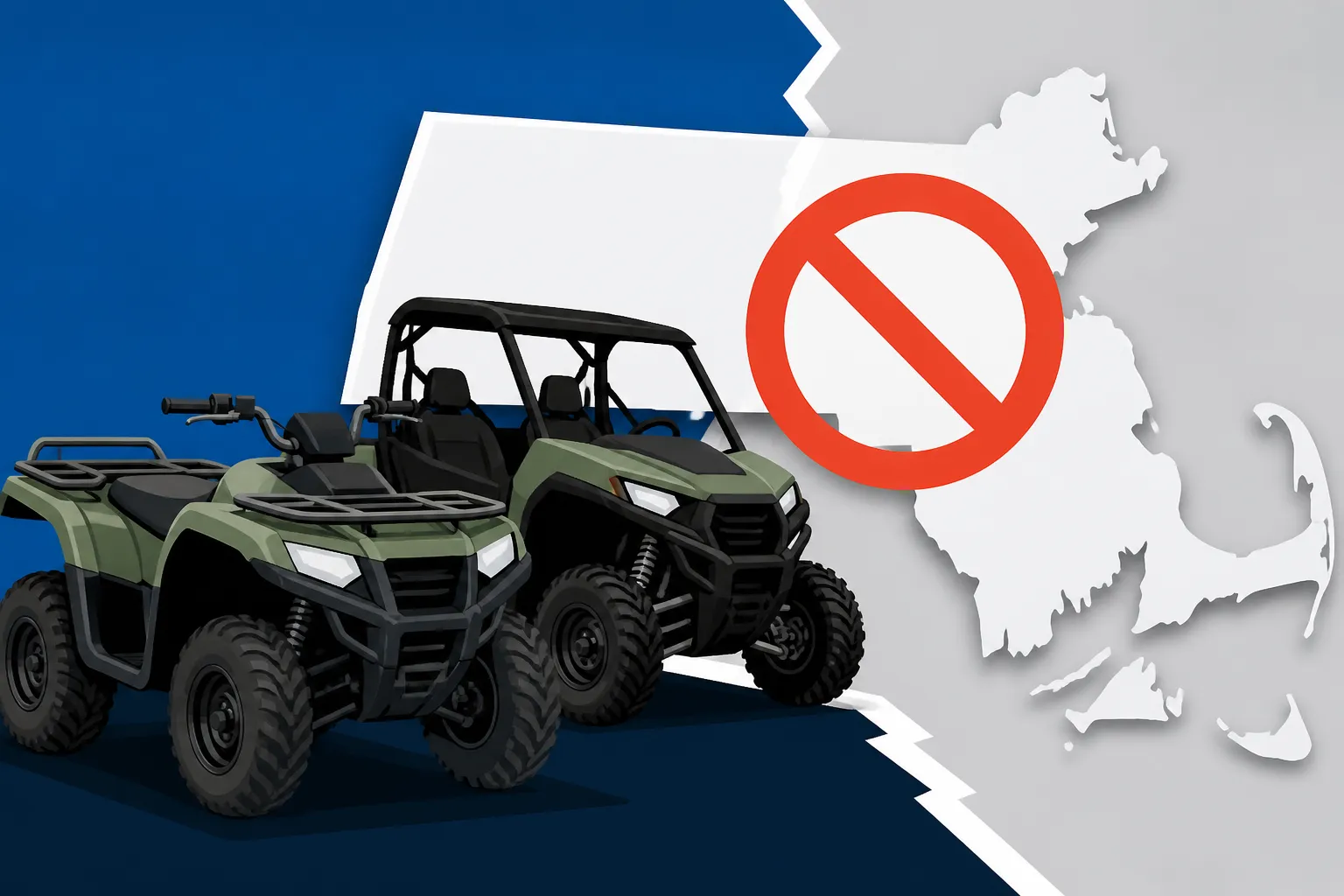
No Conversion Path to a Plate
It's incredibly frustrating, isn't it? You invest in an amazing ATV or side-by-side, envisioning adventures not just on trails, but perhaps even zipping down a quiet country road to get to the next section or simply to grab a forgotten item from the general store. Unfortunately, if you're riding in Massachusetts, that vision hits a wall. This guide is here to help you understand precisely why converting your off-road vehicle for street use simply isn't an option here in the Bay State, and what the strict rules mean for your riding experience.
The Hard Truth: Massachusetts Bans ATVs and UTVs on Public Ways
Let's not sugarcoat it: Massachusetts has some of the strictest laws in the nation when it comes to off-highway vehicles (OHVs) and public roads. Unlike some other states where a "street legal kit" can transform your machine, Massachusetts draws a very clear line in the sand. Your ATV or UTV, by its very definition in this state, is not a street-legal vehicle, and there's no official path to make it one.
Understanding Chapter 90B: The Core Law
The foundational reason for this strict stance lies within Massachusetts General Laws Chapter 90B, which specifically governs recreational vehicles, including ATVs and UTVs. This chapter defines these machines as "off-highway vehicles," meaning they are primarily designed for off-road operation on unpaved surfaces, dirt trails, and private land. Crucially, they are explicitly not considered motor vehicles for use on public ways. This distinction is paramount.
When the law refers to a "public way," it's not just talking about busy highways. It encompasses all public roads, streets, and thoroughfares maintained by the state, counties, or towns. This includes even the quietest dirt roads, paved residential streets, and any other surface accessible to the general public for vehicular travel. The legal framework here is designed to keep the distinct worlds of off-road recreation and public road transportation entirely separate, primarily for safety reasons. The types of tires, suspension, braking systems, and overall design of an ATV or UTV are simply not engineered to safely share pavement with cars, trucks, and motorcycles.
Why No Conversion Kit Works Here
You might see advertisements for "street legal kits" that include turn signals, horns, mirrors, and even license plate brackets. Companies like SuperATV and others offer fantastic products for enhancing your OHV, and in states with more permissive laws, these kits absolutely can help make a machine compliant for limited street use. However, in Massachusetts, adding all the bells and whistles in the world won't change the fundamental classification of your ATV or UTV.
The issue isn't a lack of equipment; it's the vehicle's inherent design and legal definition. The state doesn't look at whether you've bolted on a turn signal; it looks at what the machine is and how it's registered. ATVs and UTVs in Massachusetts are registered with the Environmental Police, not the Registry of Motor Vehicles (RMV). This is a critical point: the RMV handles street-legal vehicle registrations and titles, while the Environmental Police manage off-road registrations, which do not confer any right to operate on public roads. Trying to get an ATV or UTV registered with the RMV would be a non-starter because it simply doesn't meet the safety and design standards for on-road vehicles. This legal separation means that even if your side-by-side looks like a miniature truck with a SuperATV windshield and wipers, it's still legally confined to off-highway use.
Road Crossings: The Exception, Not the Rule
While riding on public roads is strictly prohibited, Massachusetts law does provide a very narrow and specific exception for crossing a public way. This is a privilege, however, not a right to operate on the road. It's meant to facilitate access between legal riding areas, not to allow you to run errands.
The Strict Rules for Crossing a Public Way
If you find yourself needing to get from one legal riding area to another, and a public road is between them, you can perform a crossing – but only under very specific conditions. First and foremost, you must come to a complete and absolute stop before entering the public way. You then must yield to all vehicular and pedestrian traffic. Once the way is clear, you must cross the public way by the most direct and shortest route possible, typically perpendicular to the road, without lingering or traveling along the road itself. As soon as you complete the crossing, you must immediately return to a legal off-road area. Think of it like a pedestrian quickly crossing a busy street, not driving on it.
There are also age restrictions that come into play for these crossings. Riders under a certain age are typically prohibited from crossing public ways unless they have a valid safety certificate and are under the direct supervision of an adult who is themselves at least 18 years old. For anyone under [Road Crossings Change at 16 and a Half], the rules become even more stringent, often requiring a licensed adult to be physically present and in a position to supervise closely. These rules underscore the state's deep concern for safety on public roads, especially where OHVs are involved.
Penalties for Riding Illegally on Roads
Let's be clear: getting caught operating an ATV or UTV on a public way in Massachusetts can lead to significant consequences. An Environmental Police Officer or local police officer can issue citations carrying substantial fines. Beyond the financial hit, your machine could be impounded, leading to further costs for towing and storage. In some cases, repeat offenses or dangerous operation might even involve more serious legal repercussions.
It's not just about the law, though. There's a very real safety aspect. ATVs and UTVs simply aren't designed for the speeds, traction demands, or visibility requirements of road traffic. Their narrower wheelbases, higher centers of gravity, and often knobby tires can make them unstable on pavement, especially at speed or during sudden maneuvers. Mixing these machines with cars and trucks creates a dangerous situation for everyone involved. The [Massachusetts Penalties for Illegal Riding] are not just deterrents; they're in place to protect riders and the general public from preventable accidents.
The Reality of Trail Riding in Massachusetts
So, if public roads are off-limits, where can you ride your ATV or UTV in Massachusetts? The good news is that there are fantastic opportunities for off-road enthusiasts, provided you stick to the designated areas and follow the rules.
Where You Can Ride Your ATV and UTV Legally
Massachusetts offers some excellent state forest trails specifically set aside for OHV use. The primary riding destinations are located in the western part of the state. You've got fantastic places like [Beartown State Forest Riding in Massachusetts], October Mountain State Forest, and [Pittsfield State Forest Riding in Massachusetts], which collectively offer miles of trails suitable for ATVs and UTVs. These trails are managed by the Department of Conservation and Recreation (DCR) and are generally open from May 1st through November 30th, weather permitting. Before you head out, it's always a good idea to check the DCR website for current conditions and any temporary closures.
Beyond state forests, you can also ride on private land, but there's a crucial caveat: you must have the express written permission of the landowner. Simply having an oral agreement isn't enough; the Environmental Police can and do ask for proof. This written permission protects both you and the landowner. You can even create your own trail system on your private property, as long as you're not disturbing neighbors or violating local bylaws. Remember, even on private land, your OHV still needs to be registered with the state, as discussed in [Do You Need to Register an ATV in Massachusetts?]. Always respect private property signs and never trespass – it damages the reputation of all responsible riders.
Why Massachusetts' Approach is So Strict
Massachusetts' stringent approach to OHV use, particularly regarding public roads and youth riders, is rooted in a history of accidents and public safety concerns. A significant turning point was the tragic death of a young rider, which directly led to the enactment of [Sean's Law: The 2010 Ban Named for a Boy]. This law dramatically reshaped the landscape for youth ATV riding, implementing strict age and engine size restrictions, as well as mandatory safety courses.
The state's philosophy is clear: OHVs are powerful machines that require skill, experience, and a controlled environment for safe operation. Public roads, with their unpredictable traffic, diverse vehicle types, and potential for high speeds, are simply not that environment. By keeping OHV use segregated to dedicated trails and private land, the state aims to minimize conflicts with traditional road users and reduce the risk of accidents. This commitment to safety, while sometimes frustrating for riders who wish for more flexibility, is a core tenet of Massachusetts' OHV regulations.
Looking for Street-Legal Alternatives?
If the idea of street legality is truly important to you, and you find the Massachusetts OHV laws too restrictive, it might be worth exploring other types of vehicles that are designed and legal for road use.
Comparing OHVs to Other Vehicle Types
When considering vehicles that offer a blend of utility and road-legality, it's important to understand the fundamental differences. For example, while some UTVs might resemble golf carts, a standard golf cart is classified as a "low-speed vehicle" (LSV) if it meets specific federal safety standards and state registration requirements, which typically allow them on roads with speed limits up to 35 mph. However, very few traditional ATVs or UTVs meet these LSV criteria without being specifically manufactured as such from the ground up. These are purpose-built machines, not converted off-roaders.
Another option might be dual-sport motorcycles or plated dirt bikes. These vehicles are designed to be street-legal from the factory, equipped with all the necessary lights, mirrors, and emissions controls, and are registered through the RMV like any other motorcycle. They offer off-road capability combined with the freedom to ride on public roads. However, they are fundamentally different riding experiences than an ATV or side-by-side and come with their own set of licensing and safety requirements. The key takeaway is that street-legal vehicles are built for the road first, with off-road capabilities as an addition, whereas ATVs and UTVs are built for off-road use, with no legal conversion path for public roads in Massachusetts.
The Future of OHV Laws in Massachusetts
It's natural to wonder if these laws might ever change. While legislative bodies are always reviewing and updating regulations, any significant shift in Massachusetts' stance on ATV and UTV street legality would likely require a substantial legislative effort. Such changes typically involve extensive public hearings, safety studies, and debates, given the state's historical emphasis on recreational vehicle safety and the distinct separation of vehicle classifications.
For now, the best approach is to stay informed through official channels like the DCR and Environmental Police. Engage with local riding clubs and organizations, as these groups often advocate for riders' interests and can provide updates on potential legislative discussions. While the dream of riding your ATV down Main Street might remain out of reach in Massachusetts, focusing on enjoying the fantastic and legal off-road opportunities available in our state forests and on private lands is the most practical and responsible way to embrace your passion for OHV riding.
Here's a quick comparison of key aspects:
| Feature | Off-Highway Vehicle (ATV/UTV) | Street-Legal Vehicle (Car/Motorcycle) |
|---|---|---|
| Primary Use | Off-road trails, private land, work | Public roads, highways, daily transport |
| Road Legality | No, explicitly banned on public ways | Yes, designed and legally permitted |
| Registration | Massachusetts Environmental Police | Massachusetts Registry of Motor Vehicles |
| Title | Certificate of Origin (MCO) / No state title | State-issued Certificate of Title |
| Equipment | Basic lights, spark arrestor, muffler | Headlights, tail lights, turn signals, mirrors, horn, DOT tires, emissions controls |
| Driver's License | Not required for operation off-road, but age restrictions apply. Required for crossing public ways if no supervision/certificate. | Required (driver's license or motorcycle endorsement) |
| Insurance | Optional (but recommended) | Mandatory (liability) |
| Street Legal Conversion | Not possible in Massachusetts | N/A (already street legal) |
Disclaimer
This article is for general informational purposes only and does not constitute professional advice. Laws, prices and regulations vary by location and change over time. Consult a qualified professional for guidance on your specific situation.